
Tea Knowledge
How to Describe Layers in Tea Without Overstatement
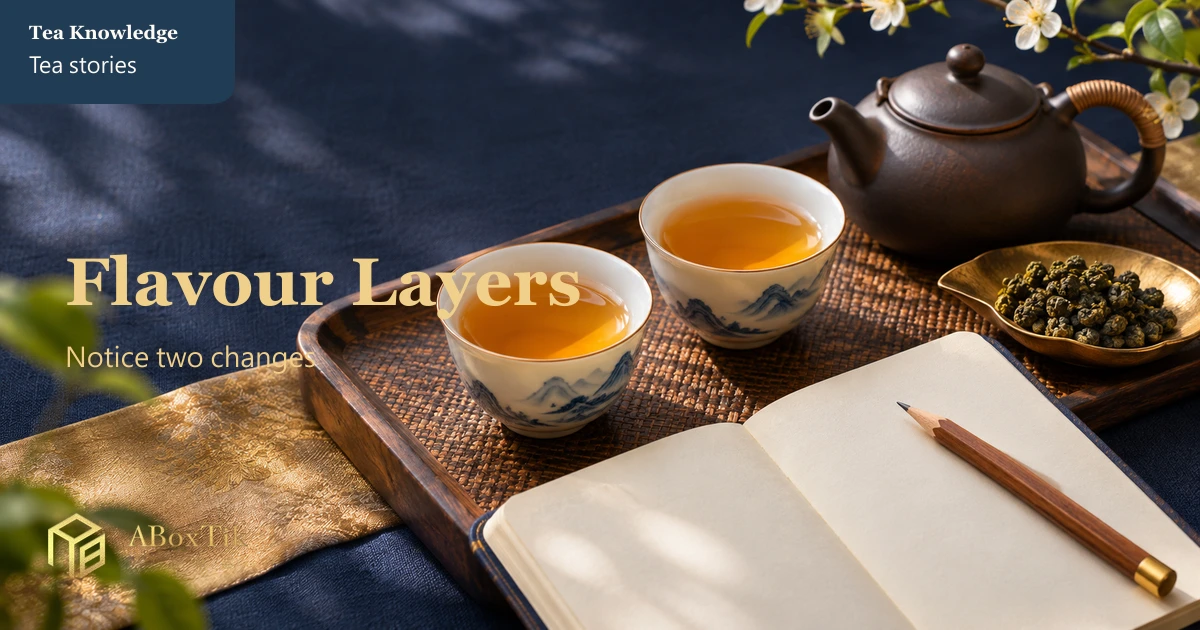
Begin with a change you notice
To describe layers, compare two moments: what appears as the tea enters the mouth, and what remains after swallowing. One change you can actually recognise is more useful than a list of ten invented fruit names.
Give the cup two observation points
Notice aroma and apparent strength on the first sip. After swallowing, pause and record any remaining taste or mouthfeel. If nothing clearly changes, “similar throughout” is a useful note too. Observation is not a compulsory score.
Write a before-and-after sentence
Try “at first ___, then ___” or “warm ___, after cooling a little ___”. Familiar floral or roasted words can help, as can light, rounded or drying. First decide whether the word describes aroma, taste or texture. Taiwan’s tea flavour wheels offer shared vocabulary; there is no need to fill every segment.
Record comparison conditions
For the same tea, keep tea amount, water, temperature, time and vessel as similar as practical, noting tea and batch. If tea and brewing both change, several factors may contribute; change one variable in the next comparison.
Let the note sound like you
Replace “complex” with “light at first, followed by a little roasted aroma,” then add the brewing conditions. If a friend notices something else, keep both descriptions side by side. A tea notebook does not need to convene a court.
To bring these questions back to an actual tea choice, browse ABoxTik Taiwan teas, then check the product label and batch information supplied for that tea.
Turn “layered” into a change someone can recognise
Describing layers does not require turning a cup into a carousel of aromas. Begin with two repeatable observations within the same tea: “light on entry, with a clearer roasted aroma after swallowing,” or “floral while hot, with sweetness easier to notice as it cools.” A sentence that names both the moment and the impression is more useful than “very complex.” It helps another drinker understand what to look for and gives you something specific to check next time.
Broad words are enough at first: light, strong, sweet, dry, soft, brisk, floral, fruity or roasted. Move to a more exact comparison only when it is genuinely recognisable. If “floral” is all you can identify, keep it. A short accurate note is more valuable than a confident guess about a particular blossom in a distant valley. The tea will not take offence at economical prose.
Separate aroma, taste and mouthfeel
Exaggeration often begins not with an ornate word but with several senses being folded into one claim. Aroma is what the nose perceives, including retronasal aroma after swallowing. Taste includes basic sensations such as sweetness, bitterness and acidity. Mouthfeel covers weight, smoothness, dryness and astringency. Keeping three columns prevents “smells sweet” from being mistaken for a claim that sugar is present, and shows where the perceived layer actually occurs.
- Aroma: does the fragrance change between the hot cup, the sip and the moment after swallowing?
- Taste: do sweetness, bitterness or other basic impressions appear in a sequence?
- Mouthfeel: does the liquor move from light to full, smooth to drying, or remain similar?
No change is also a valid result. “Aroma remained similar and the mouthfeel stayed light” is a complete observation, not a missing answer. Tasting notes preserve comparisons; they do not require every cup to perform a three-act play.
Three sentence frames keep the language grounded
Use a time comparison—“at first ___, after swallowing ___”; a temperature comparison—“while hot ___, after cooling slightly ___”; or an infusion comparison—“first infusion ___, second infusion ___.” Fill the spaces only with impressions you can recognise. Words such as “seemed,” “closer to” and “in this brew” are useful when they accurately express uncertainty. They separate a personal observation from factual claims about ingredients, processing or origin.
When introducing a tea to a customer or friend, replace claims such as “explosive aroma” or “endless sweetness” with an observable statement: “In this preparation, the roasted aroma was clearer while hot, and a sweet impression became easier to notice as the cup cooled.” If you have not tasted the current batch, rely on verified product information rather than inventing a batch-specific tasting note. A good description does not need to crown the tea; it simply tells the reader what they may choose to notice.
Keep the brewing conditions beside the sentence
Tea amount, water volume, temperature, time, vessel and infusion number can all change perception. Record at least the date, tea or batch identifier, tea-to-water amounts, water temperature, infusion time and infusion number. To compare temperature, follow one cup from hot to warm. To compare brewing methods, change one variable at a time. If the tea, pot, temperature and time all change together, even beautiful prose cannot explain where the difference came from.
When tasting with another person, write one sentence separately before comparing notes. Circle shared observations and keep differences side by side. Sensitivity, recent food and the place where each person directs attention can affect what is noticed. The notebook keeps clues; it does not need to award a prize for the most authoritative nose.
Use four small cups for an easy repeat check
To see whether a description was more than a passing inspiration, divide one pot among four clean, odour-free cups. Smell the first while hot without rushing to a verdict. Sip the second at a comfortable temperature. Let the third cool further, then compare sweetness, bitterness, astringency and weight. Keep the fourth until the end and check whether the aftertaste or aroma in the empty cup is still recognisable. Four cups are not four examinations; they are simply four pause buttons for the same tea.
At each point, record only the clearest change and use relative wording such as “more,” “slightly” or “in this brew.” A useful sequence might read: “roasted aroma clearer while hot; taste rounder when warm; astringency easier to notice after further cooling.” Repeat the exercise on another day with the same tea amount, water volume, temperature and time. If a similar sequence appears twice, the wording is a stronger candidate for your regular note. If the result changes, keep both entries with their dates and conditions instead of quietly sending yesterday’s notebook to the paper shredder.
Professional sensory evaluation described by Taiwan’s Tea and Beverage Research Station controls the room, equipment, tea amount, temperature and infusion time, then considers appearance, liquor colour, aroma, taste and infused leaves. This home exercise is not competition judging and cannot grade a product; it borrows the simpler principle of controlling conditions and recording senses separately. ISO 5492 likewise provides shared vocabulary for sensory analysis. A home notebook does not need a laboratory coat, but separating aroma, taste, mouthfeel and inference makes its language much easier to trust.
A two-minute layers card
- Record the brewing conditions and identify the tea.
- Choose one broad word for aroma, taste and mouthfeel.
- Look for one before-and-after change; write “similar” if none is clear.
- Add one variable to keep or adjust next time.
The result may be simple: “5 g tea, 100 ml water; roasted aroma clearer while hot, sweetness easier to notice when warm, mouthfeel similar throughout; keep the amount and shorten the second infusion next time.” It is restrained but useful. For a wider vocabulary, continue to the full Taiwan tea flavour wheel and tasting-note guide. This article keeps the smaller promise: making one change clear without making the cup sound theatrical.