
Tea Knowledge
Why Tea-Making Records Matter
Halfway through tea making, someone says, “Yesterday’s batch rested a little longer,” and everyone nods. Ask three months later what “a little” meant, and the tea leaves may be the only ones staying calm. Tea batch records turn those in-the-moment decisions into a trail that can be reviewed, handed over and linked to the finished tea.
A record is not a magic form that proves quality, origin, safety or certification simply because every box is filled. Its practical job is narrower: identify the incoming lot, show what actually happened during processing, capture exceptions and decisions, and connect the result to a finished-tea batch.
Define what counts as one batch
The first field should be a stable batch identifier, not a poetic aroma note. At intake, record the receiving date and time, supplier or declared source, cultivar when known, weight, visible leaf condition and any relevant intake observation. Keep that identifier with the container, work area, intermediate tea and final product so the name does not change whenever the leaves change rooms.
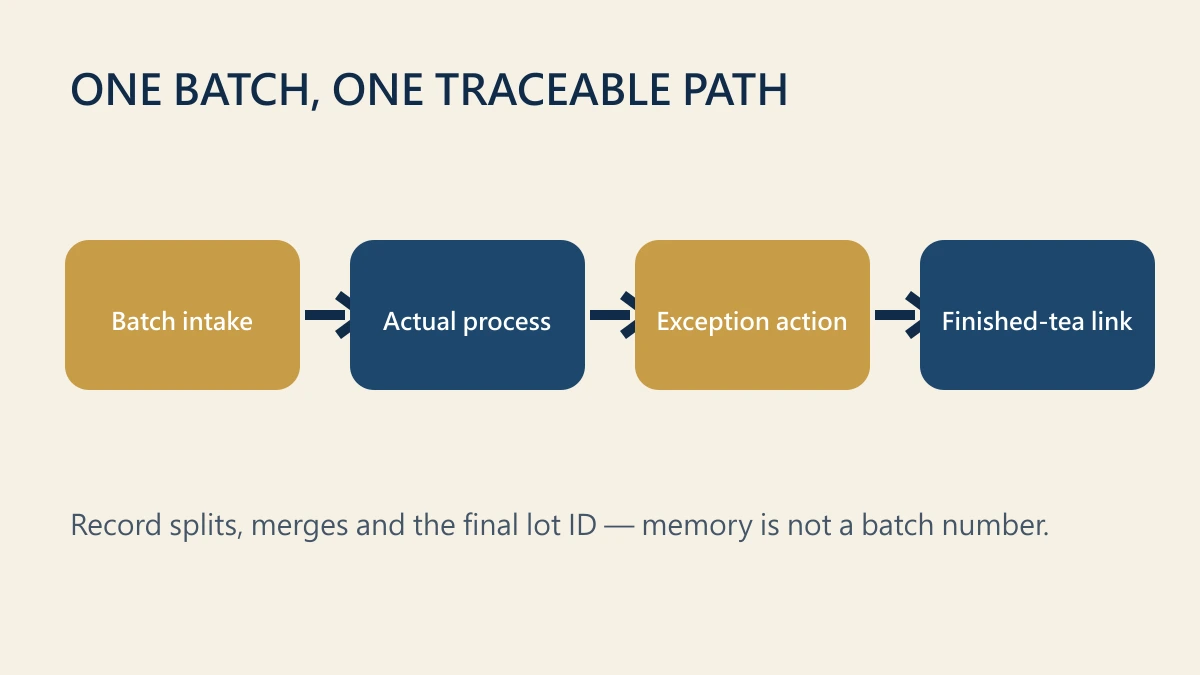
If one incoming lot is split into two processing paths, create child-batch identifiers. If two intermediate lots are deliberately combined, record the parent lots and the new combined identity. These split-and-merge links may feel fussy on a quiet day; during a review, they are the bridges on the map.
Record what happened, not the ideal recipe
A standard procedure describes what is expected. A batch record describes what happened this time. For each meaningful stage, capture the start and end time, equipment or work area, measurable settings, operator, and relevant observations such as leaf condition, aroma or feel. Tea type, weather, equipment and leaf condition vary, so do not insert a universal temperature or duration merely because it looks impressively precise.
Withering, turning, fixation, rolling, drying and roasting fields should match the producer’s actual workflow. No one needs a novel for every minute. However, any point that changes a quality decision, batch identity or product destination should be understandable to the next person reading the record.
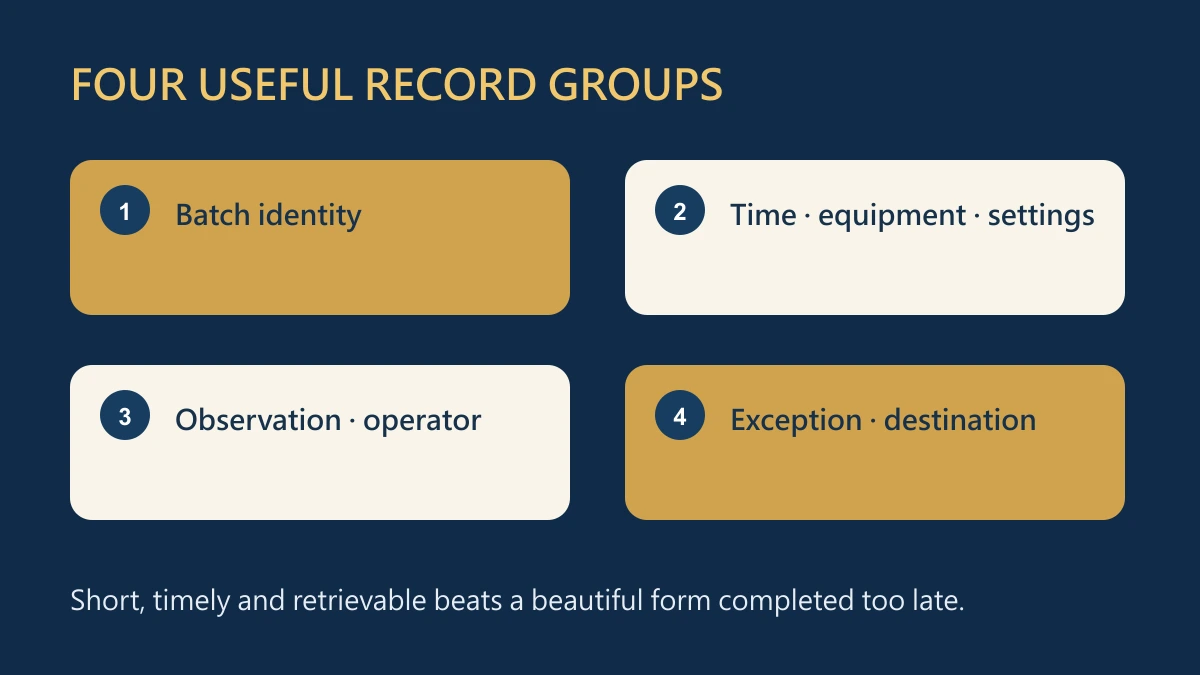
A useful form contains four information groups
| Group | Useful fields | Purpose |
|---|---|---|
| Batch identity | Lot ID, receiving time, source, weight, leaf condition | Shows which material the record covers |
| Actual process | Stage, time, equipment, setting, operator | Reconstructs the path taken |
| Observation and exception | Difference, decision, response, decision owner | Explains deviations and actions |
| Finished-tea link | Split/merge, final lot, quantity, storage location | Connects intake to the resulting tea |
Do not add so many fields that staff suddenly discover an urgent desire to reorganize the warehouse. Start with information required to identify, decide or trace. A good form is one the team will complete at the right time and can later use to answer a real question.
Exception notes protect the next decision
Weather changes, equipment pauses, uneven leaves, extended timing or a risk of lot mixing can all alter the planned route. An exception entry should state when the issue was found, what was observed, the affected quantity or area, the immediate response, the follow-up decision and who confirmed it. If the tea was held, reworked, downgraded, split or discarded, link that destination to the batch.
Writing only “handled” is like marking “arrived” on a map without naming the place. A short factual sentence is more useful than polished prose. Records should support learning and control, not become a scoreboard that makes people afraid to report a problem.
When you record matters more than beautiful typography
Complete an entry when the step or decision occurs, and identify the person who performed or confirmed it. If an entry must be reconstructed later, mark the later entry time and explain why. Tea may develop a lovely aftertaste; memory does not come with the same warranty.
Paper forms, spreadsheets and manufacturing systems can all work. The essentials are a controlled version, appropriate access, visible amendments and availability where the work happens. A weak connection may call for an offline form with controlled transfer. A shared digital form needs a clear owner so the team does not produce “final_v7_really_final” in three folders.
Turn separate entries into a traceable chain
After processing, link the finished-tea lot, actual yield, storage or packing unit, storage location and subsequent checks back to the incoming identifier. During an internal check, test both directions: can a finished lot be traced back to its incoming material and processing record, and can one incoming lot be traced forward to every resulting finished lot?
Taiwan’s official food-hygiene and traceability materials emphasize relevant records, batch identity and product-flow links. A record still does not prove quality, origin, safety, certification or legal compliance by itself. It supplies an evidence trail; conclusions require the relevant tests, documents and applicable requirements.
Use a five-minute batch closeout
- Does the identifier connect intake, processing and finished tea?
- Are times and conditions actual values rather than defaults?
- Can another person understand every split, merge, stop or rework?
- Do exception notes show the affected scope and final destination?
- Can a colleague retrieve the record without an oral treasure map?
If the same field causes trouble every time, do not immediately add ten new forms. Improve its label, timing or ownership first. Mature records evolve with the work; they are not ceremonial objects waiting for a binder inspection.
Start with a minimum workable record
Pilot the form with one tea, one process line and one week of batches. Ask tea makers, storage staff and quality personnel to retrieve a batch independently. Remove fields nobody uses, add the decision points people repeatedly ask about, and then define the identifier rule, storage location, amendment method and review frequency before expanding.
For related reading, see ABoxTik’s guides to fresh-leaf transport and handover, tea packaging traceability and tea storage records. Clear batch stories do not make tea bureaucratic; they keep good decisions from depending on one person’s memory being on duty.

A good production record makes the batch easier to trace; consider the links below its friendlier next line: premium tea gifts, more tea articles, and the latest boutique selections—all without adding another spreadsheet column.
Sources
Laws & Regulations Database of Taiwan — Regulations on Good Hygiene Practice for Food · Taiwan Food and Drug Administration — food traceability and batch information · Tea and Beverage Research Station — fresh-leaf grading and intake information