
Tea Knowledge
How to smell tea consistently
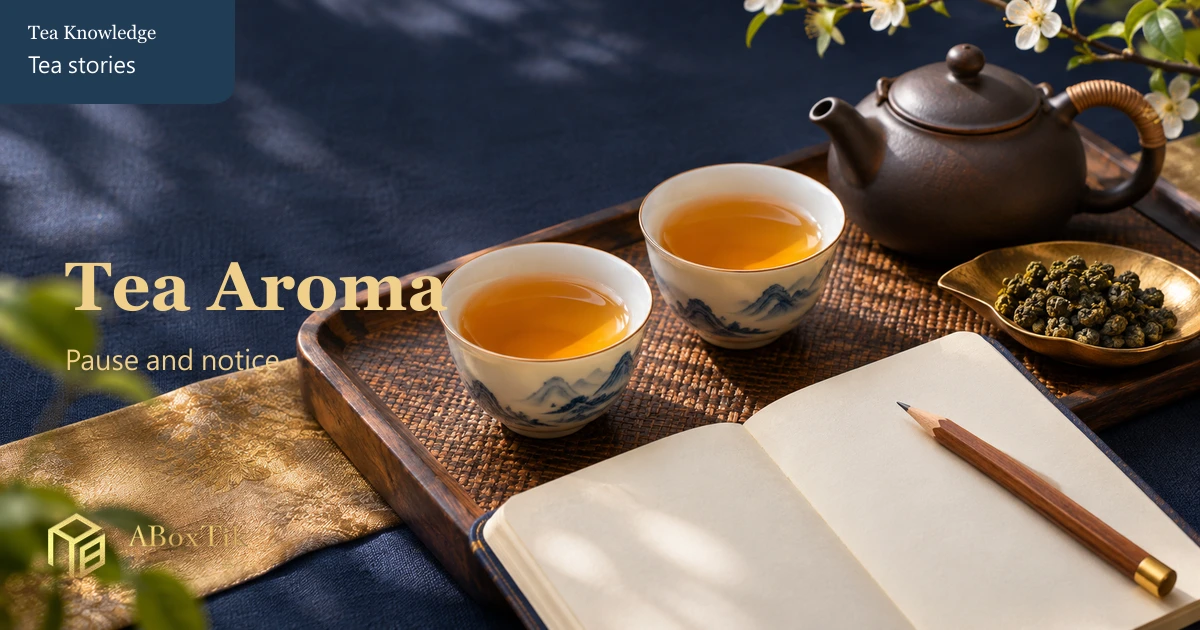
Begin with gentle, short sniffs
Use natural, brief breaths and pause before comparing. Start with dry leaves, then notice the aroma of the cup and brewed tea. Record the conditions so another session can be compared fairly.
Keep the setup consistent
Use the same cup, amount and brewing method, and compare at similar temperatures. Keep the cup at a comfortable distance; allow very hot tea to cool rather than leaning into steam.
Name one impression
Begin with a familiar direction such as floral, fruity or roasted, then note whether it feels subtle or pronounced and how it changes. “Like toast” is a perfectly useful beginning.
Give your nose a rest
After a long session, aromas may become harder to distinguish. Pause and return later. Associations are personal; the aim is to notice and record, not guess a single correct answer.
Direct answer: use brief natural sniffs, pause, then repeat
Smelling tea need not become a lung-capacity test. Hold the sample at a comfortable distance, take one or two brief natural sniffs for a first impression, move it away and breathe normally, then decide whether to return. “One or two” is a practical consistency setting, not a medical standard or a claim about the ideal physiological duration for every person.
Immediately after pouring, keep away from very hot steam. Do not press the nose to a pot, cup or wet leaves. When the steam is comfortable, smell the lid, wet leaves or air above the liquor briefly. The Taiwan Tea and Beverage Research Station’s professional description says judges inhale the infused-leaf aroma several times; it does not prescribe a universal number of seconds. For home practice, record distance, sample and timing.
A three-approach method: first impression, confirmation and change
- First approach: make a brief sniff and write one broad family—floral, fruit, plant, roast, sweet or an off-odour—without forcing a particular flower.
- Move away: breathe normally and see whether the impression remains clear. Wait longer if the cup is still too hot.
- Second approach: use the same distance and confirm the family, then add strength and clarity.
- Third approach later: return as the tea cools and record persistence, change or fading rather than declaring the first observation wrong.
This method does not prove that brief sniffing always detects “more” than one long inhalation. It reduces variation in exposure and movement. Olfaction research shows that people rapidly adjust sniff behaviour to odour intensity, and that repeated or continuous exposure can produce habituation and adaptation. Extending one inhalation indefinitely therefore does not guarantee a more reliable comparison.
“Warm,” “like toast” and “faint” are valid first notes. A second line can add clear or blurred, brief or persistent, comfortable or off. A flavour wheel can suggest vocabulary but is not a bingo card. When tasting with a friend, write separately before comparing notes; “you should smell orchid” can place an answer in the other person’s cup before their nose has arrived.
When comparing two teas, reverse the order
Use two clean, odour-free cups of similar shape and record tea, water, temperature, time and the moment of pouring. Smell A then B in the first round. With newly prepared equal portions, reverse the next round to B then A. If B is always second, fatigue, cooling and changing attention can be mistaken for permanent features of B.
When two teas genuinely require different brewing methods, do not impose one recipe merely to look fair. Follow each package and record the difference. To compare only the smelling action, divide the same batch into two cups, use brief sniff-and-pause on one and the usual method on the other, then reverse the order in a new round. The result describes that session; it does not establish one breathing rhythm for everyone.
| Hold or record | Why | Short note |
|---|---|---|
| Cup, tea, water and brewing | Reduce differences unrelated to smelling | Same cup shape; both recipes recorded |
| Sample location | Lid, wet leaf, liquor and empty cup are different samples | Wet leaf, about ___ after pouring |
| Distance and order | Proximity and sequence affect comparison | Comfortable distance; B→A this round |
| First and second words | Separate initial impression from confirmation | First floral; then sweet and clear |
When every cup starts to smell alike, rest instead of inhaling harder
After several samples, stop if the aroma profiles flatten or each cup resembles the previous one. Leave the table, breathe normally in a place without a strong odour, and return only when ordinary environmental smells and attention feel available again. This page gives no universal rest time. Perfume, hand cream, coffee, food and cleaning products can interfere; when the room itself is strongly scented, another session is more sensible than a stronger sniff.
A human-olfaction review indexed by PubMed describes reduced response after repeated exposure through processes including habituation and adaptation. That supports the boundary that continued exposure can change perception; it does not supply one compulsory tea-table break formula. Stop when steam is uncomfortable, when you have a cold or blocked nose, or when smell has changed noticeably. This article is not a diagnosis of an olfactory disorder.
A five-minute two-cup drill: compare the smelling method, not two teas
Gently combine one freshly brewed batch, then divide it equally between two similar odour-free cups. Use “brief sniff—move away—return” for cup A and your ordinary method for cup B. Record the first word, clarity and whether the profile becomes tiring. Brew again and reverse the A/B order so the first method is not always hotter and the second always later.
If the cups differ, write “A was clearer in this session” or “B lost its outline sooner,” not “brief sniffing works for everyone.” Cup temperature, pouring time, distance and attention may still contribute. Keep cup, tea, water and time similar and change only the smelling action. One variable at a time keeps the answer from being surrounded by a noisy table of explanations.
Do not mistake faint dry leaf, lifted hot wet leaf and sweet cool cup-bottom aroma for three effects of breathing. Hold the sample location constant: lid against lid, wet leaf against wet leaf, or empty cup against empty cup. The complete aroma guide handles stages; this page tests approaching, pausing and returning within one stage.
With a friend, write separately before swapping notes. Ask “Which method preserved your first impression more easily?” rather than “Who smelled it correctly?” The first produces a practical next step. The second can make afternoon tea grow an examination bell.
A repeatable brief-sniff record
- Tea, batch and brewing method: ______.
- Sample: dry leaf / lid / wet leaf / liquor / empty cup.
- Timing and temperature impression: ______.
- First word: ______.
- After returning: strength ___, clarity ___, persistence ___.
- Order: A→B or B→A; rest taken: ______.
- One variable for the next round: ______.
For the full sequence through dry leaf, hot aroma, cool aroma, retronasal aroma and flavour vocabulary, use the complete tea-aroma guide. This page keeps the narrower experiment of how to sniff, pause and reverse order. To practise with two teas, see the current Taiwanese tea selection and follow each package.
Sources
- Taiwan Tea and Beverage Research Station: introduction to tea sensory evaluation
- Pellegrino et al.: Habituation and adaptation to odors in humans
- Ferdenzi et al.: Viewing Olfactory Affective Responses Through the Sniff Prism
Sources checked 11 November 2026. The suggested number of brief sniffs is a consistency exercise, not a medical or competition standard.