
Tea Knowledge
Fresh Leaf to Dry Tea: Why One Fixed Conversion Ratio Fails

“How much fresh leaf makes one kilogram of finished tea?” sounds like a quick arithmetic question. In practice, it is a journey question: what entered the batch, what left at each step, and what actually reached finished-tea storage. A conversion ratio may support a very rough capacity estimate, but it cannot tell the true story of a specific batch.
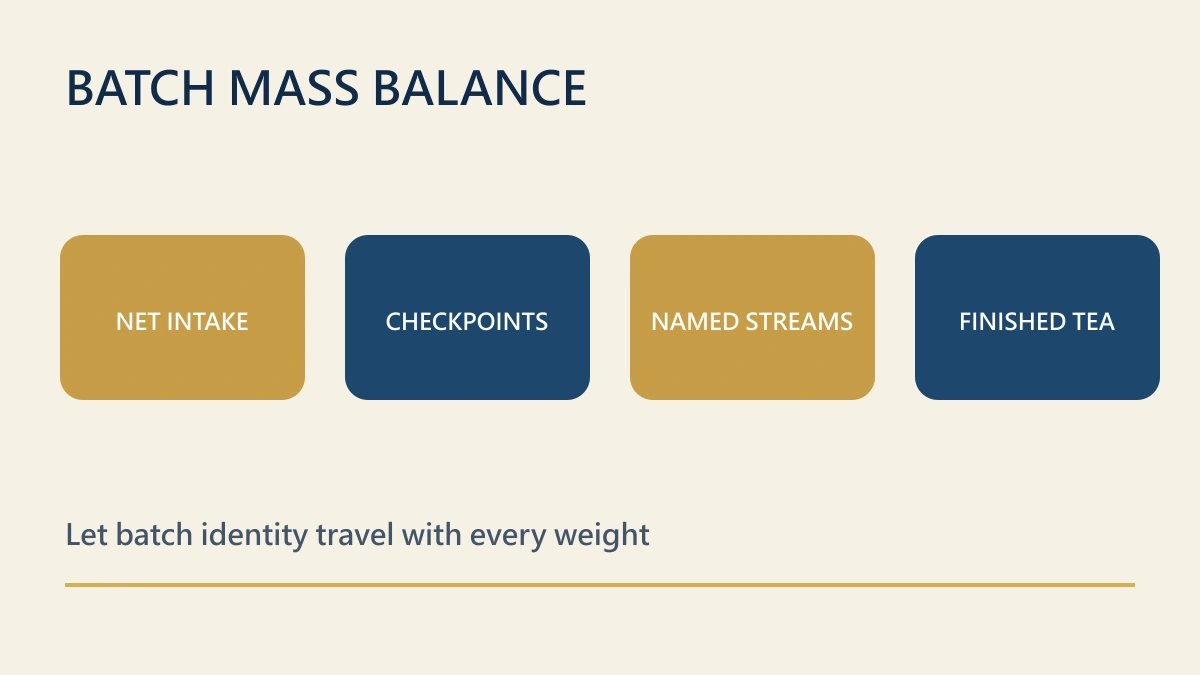
A more useful approach is a batch mass balance. Start with net incoming fresh-leaf weight, record selected process checkpoints, then separate samples, sorting fractions, stems, fines, rework, rejects and saleable finished tea. When the numbers differ, nobody needs to accuse the calculator of having a difficult day; the team can return to the record.
Define the starting weight before calculating anything
Record weighing time, unit, scale, container tare and batch identifier. If leaves arrived wet with rain or dew, came in separate deliveries or changed containers, note that condition and handover. Surface moisture is an intake condition, not permission to apply an automatic deduction.
If one lot splits into two process paths, create child lot IDs. If semi-finished lots later merge, preserve the before-and-after relationship. Precision at intake does little good if every tray becomes “the same family” halfway through the workshop.
Much of the weight change is water, but not all of it
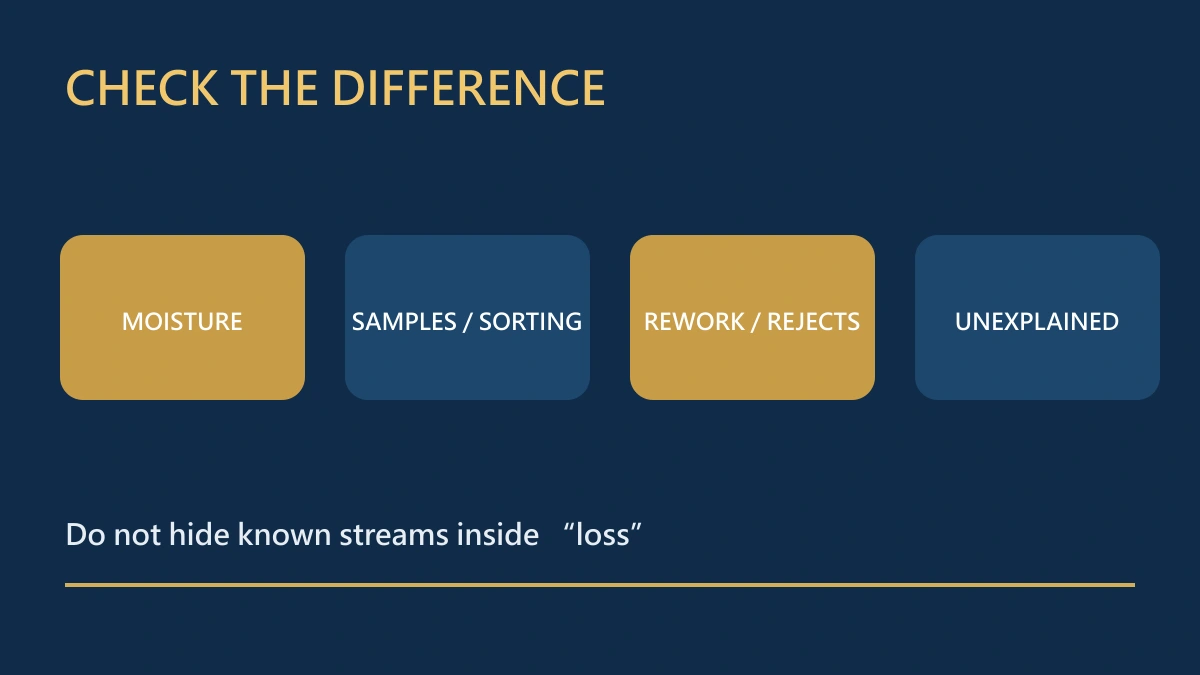
Water leaves during withering, turning, fixation, rolling, drying or roasting, depending on the tea and method. The path differs with leaf condition, equipment and the producer’s target. Weight may also leave as laboratory or tasting samples, dropped leaf, stems, fines, sorting fractions, handling residue, rework or rejected material. The total difference should not simply be renamed “evaporated water.”
Comparing dry matter requires moisture measurements on a consistent basis. Wet weights alone are like comparing someone in a raincoat with the same person after changing clothes: the difference is obvious, but its components still need evidence.
Four checkpoints are often more useful than constant weighing
| Checkpoint | Record | Question answered |
|---|---|---|
| Receiving | Net weight, leaf condition, time, lot ID | What identifiable amount entered? |
| Key process stage | Semi-finished weight, time, equipment, condition | Where did weight change materially? |
| Refining and sorting | Main tea, stems, fines, samples, rework, rejects | Where did each removed stream go? |
| Finished storage | Saleable net weight, lot ID, package or location | What finished tea remains traceable? |
The exact checkpoints should follow the real process. The aim is not to carry a scale into every corner; it is to preserve one basis, one unit and one batch identity at the points needed for review.
Build a batch balance before applying a ratio
A simple structure is: incoming net weight equals material still in process, plus recorded outgoing streams, plus finished tea stored, plus an amount still under investigation. Name outgoing streams instead of hiding them in one “loss” bucket. Do not force the final difference to zero; first check tare, units, lot splits and merges, samples and unrecorded movements.
A planning ratio must remain a planning ratio
Purchasing, staffing and packaging decisions sometimes need an early estimate. Build a range from the producer’s own comparable batches—similar tea style, season, leaf condition and equipment—and label the data period and assumptions. Any numerical example should be clearly hypothetical, not presented as an industry rule. This guide deliberately avoids a neat multiplier that makes every batch wear the same-sized coat.
After production, replace the estimate with actual stored weight and review the difference. A ratio plans; a batch record explains. They can share the same table, but they should not swap name tags.
When the difference looks unusual, check five things
- Are scale, unit, decimal convention and container tare consistent?
- Was the batch split, merged or carried across days, leaving material at another checkpoint?
- Were samples, trials, rework, stems, fines and rejects recorded separately?
- Are intake condition and moisture measurements comparable?
- Could handling residue, dropped leaf or a transcription error explain part of the gap?
A difference is not an instant quality score, and it does not prove origin, certification or safety. It is a small lamp showing where the process deserves a closer look.
Test the sheet on three batches
Begin with one familiar tea and record three consecutive batches. Ask production, storage and quality staff to trace one finished lot back to intake. Remove fields nobody uses and add checkpoints that repeatedly disappear. If the form always inspires “I will fill it in later,” the form may be too far from the work.
Continue with ABoxTik’s guides to tea batch records, drying and moisture, and packaging traceability. Clear weights do not turn tea into accounting; they simply stop one batch from becoming a memory puzzle.
Practise with one hypothetical batch, not a universal answer
Imagine a batch whose net incoming weight has been recorded. A tasting sample leaves during production, stems and fines are separated, and a small semi-finished portion waits for rework. Saleable finished tea is only one line in the balance. Instead of beginning with “the answer should be one quarter” or another assumed fraction, check that every outgoing stream has a lot ID, weight, time and destination—and that material still in process has not been prematurely renamed as loss.
This example deliberately avoids kilogram figures. The useful skill is the checking order, not memorising an answer. A workshop that needs a numerical exercise can anonymise one of its own closed, well-recorded batches and ask a second colleague to trace the finished tea back to intake. When the record works in both directions, the sheet is doing real work.
Keep the measurement basis beside every weight
Add gross or net, wet basis or dry basis where moisture conversion is used, scale identifier and measurement time. Do not subtract figures taken on different bases. Preserve the original reading as well as any calculated value. If the method changes, record why and show the conversion so another person can reproduce it rather than trusting a mysteriously confident spreadsheet cell.
Scale checks belong in the routine too. A tidy form cannot repair a drifting scale, a missed tare or a handwritten unit that changes from kilograms to grams halfway down the page. A short pre-use check and a consistent unit convention remove many apparent process mysteries before they become meetings.

Fresh leaf and dry tea refuse to fit one universal ratio; fortunately, the next choice can stay simple. Below are premium tea gifts, related reading, and the latest boutique selections—no conversion formula required.