Tea Knowledge
How to Review a Corporate Tea Gift Sample
A little preparation leaves more room to enjoy the tea.
A corporate tea-gift sample is excellent for confirming the particular item in front of the team. It is not a certificate for an entire production run. The calmest way to review one is to separate four tracks: packaging and print, contents and specification, brewing and sensory notes, and delivery acceptance. Give every track a version number, photos, measurable conditions, and an owner. That small discipline keeps “it looks about right” from becoming an expensive riddle later.
If the gift list is still moving, begin with one master list using the corporate gift quantity planning guide. If the per-gift allowance is still open, the corporate tea-gift budget guide is a useful companion. For the larger approval chain around customization, see the corporate gift-box timeline. This article stays with one practical question: when a physical sample reaches the meeting table, what should the team examine, record, and approve?
Start by defining what the sample is allowed to confirm
A sample can help a team assess box dimensions, visual direction, opening experience, contents arrangement, and one real brewing experience. It can put design, purchasing, and receiving colleagues in front of the same object. A sample does not automatically settle every production condition, however. The final batch, print run, shipping stack, quantities, and outer cartons may differ.
At the opening of the review, ask one useful question: “Which decisions does this sample approve?” Write the answer at the top of the record. It might approve the visual direction and tea combination, approve card copy subject to one edit, and leave outer-carton protection for confirmation before shipment. Anything not listed should not quietly become approved. This is not fussiness; it is a considerate note to the future team.
Give every sample a small identity card
Make one non-duplicated record for every received sample. A filename may be simple, but “final-final-really-final” is rarely a reliable archive. Include the following fields:
| Field | What to record | Suggested owner |
|---|---|---|
| Sample ID and date | Project code, sample sequence, received date | Project coordinator |
| Version links | Design, copy, and contents-list version numbers | Brand/design contact |
| Included scope | Box, insert, tea, card, bag, outer carton: which are present? | Supplier and purchasing |
| Photo index | Unopened, all sides, interior, labels, and defects | Recorder |
| Measurement conditions | Dimensions, count, or weight; tool and unit | Receiving or quality contact |
| Decision | Pass, conditional pass, revise, or information needed | Named approver |
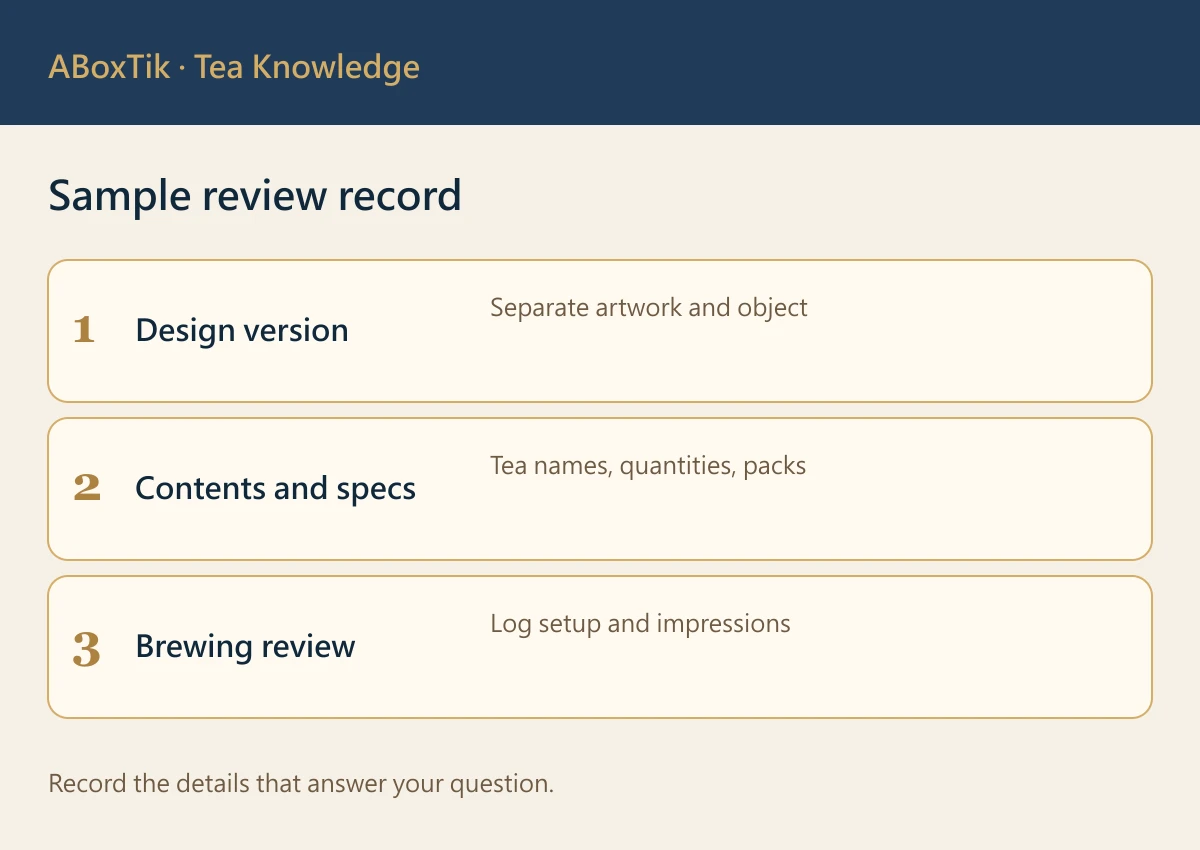
Photographs do not need to be styled like a campaign. They need to be usable later: consistent background, adequate light, file names tied to the sample ID, and a ruler or scale in frame when it explains a measurement. For a defect, take a wide image and a close one. A mysterious close-up of a corner is hard to interpret three days later—and may turn out to be a lunch biscuit rather than the box lid.
Track one: packaging and print—compare to the approved artwork first
Review packaging against the approved artwork and copy list, not against memory. Create checkboxes for the logo version, product names, languages, dates, punctuation, QR code or URL, placement of required product or storage information, seal direction, and the front and back of cards or sleeves. If color is specified, record the swatch, file version, and viewing light. “It seems a little darker under this office lamp” can be a useful observation, but should not alone become a rejection criterion.
Separate the layers of physical review. The presentation box should be flat, open and close appropriately, and hold its contents as intended. The shipping carton should provide the agreed protection, show useful handling information, and protect vulnerable corners. Both matter, but one photo should not stand in for both. Tea can be affected by moisture, light, oxygen, temperature, and odors; internal packaging and sealing therefore deserve their own line in the review rather than being inferred from a handsome outer box.
Write acceptance language that is specific without pretending to be universal: “Product names, language, and QR destination match the approved files”; “the lid closes fully”; “visible scuffs or dents are assessed against criteria agreed by both parties.” If a project needs numeric color difference, dimensional tolerance, or print-defect limits, take those figures from the project specification or conditions the supplier can actually inspect. A number copied from the internet may look confident and be impossible to measure at receipt.
Track two: contents and specification—check each item, not a hopeful “it should all be there”
Open the sample with the contents list beside it: tea names, pack format, units per box, gift inserts or cards, information material, bag, and seals. Check each item for presence, identity, and placement. Where a specification includes weight, dimensions, or count, record the actual reading, instrument, and unit. If the sample is visual only, state “not measured” or “outside this review scope.”
| Review item | Useful observations | Decision basis |
|---|---|---|
| Tea bags or tea tins | Name, count, appearance, closure, readable label | Matches the contents list |
| Insert and restraint | Loose movement, collision, awkward removal | Holds items in approved layout |
| Card and information | Copy version, language, fold, position | Matches approved artwork |
| Bag and seal | Size, print side, handle or adhesive position | Reviewed for agreed use case |
The point is not to turn a meeting room into a laboratory. It is to stop different people from comparing different versions from memory. If there is no agreed basis for a claim—bag load capacity or insert drop resistance, for example—mark it as “verification pending,” assign an owner and date, and do not let “feels fine” impersonate a test result.
Track three: brewing and sensory notes—keep preferences beside conditions
The tea will eventually be brewed. A sensory review need not imitate a competition panel, and one experienced tea drinker should not speak for every recipient. Record the brewing conditions first: tea, pack unit, water, vessel, leaf amount, water volume, temperature, steep time, infusion number, and assessors. Without consistent conditions, two cups may only be answering the question, “Who steeped theirs longer?”
Invite assessors to write private observations before the group discussion. Fields such as aroma clarity, expected strength, mouthfeel, ease of brewing, usefulness of instructions, and suitability for sharing are often more helpful than an impressive-sounding score. For tea bags, note whether a typical office user can understand the directions and whether a suitable vessel is easy to find. For loose leaf tea, note any additional equipment needed. Those details are more useful to a gift decision than simply calling a tea “premium.”
Label the scope of every sensory note: this sample, these conditions, these assessors, this date. It can guide selection and improve instructions; it cannot replace testing for every production batch or promise that every recipient will experience the tea in the same way. Tea has a personality. Fortunately, the meeting record does not need to pretend otherwise.
Track four: receipt acceptance—turn sample direction into usable delivery conditions
At delivery, the receiver needs a short usable checklist, not a bouquet of adjectives. Translate sample approvals into inspectable conditions and divide responsibilities:
- Receiving contact: reconcile the delivery note, carton count, labels, and obvious shipping damage; photograph unusual cartons before moving them.
- Contents contact: follow the planned sample or full-check approach to compare gift-box type, contents, product names, and readable labels against the approved list.
- Brand contact: verify that logo, copy, and layout use approved versions. The receiver should not have to become a version-detective.
- Project approver: using pre-agreed acceptance conditions, decide whether to accept, hold for clarification, request correction, or begin the agreed supplier process.
Define measurable conditions before delivery. Examples include: “The carton count on the delivery note equals the received carton count”; “The reviewed units match the approved contents-list version”; “Outer-carton damage is photographed and logged.” The sampling approach, acceptable range, escalation deadline, and remedy responsibility belong to the particular purchase or supplier agreement. Different volumes, packaging, and delivery models do not justify one borrowed rule.
When a difference appears: record, isolate, then decide
The first response to a difference is not a message saying “What do we do?” Pause the release of the potentially nonconforming cartons or gifts into usable stock. Record the sample or batch information, time, quantity, photographs, exact difference, and current holding location. Then compare it with the approved materials and acceptance conditions: is it copy, specification, shipping damage, or simply missing information?
The designated contact can then ask the supplier a precise question: which item, which version, how many instances, and what response or timing is needed? Instead of “the color is odd,” write: “The box uses a logo version different from approved file X; the front photograph and file version are attached.” Once the difference can be located, resolution tends to need less emotion and less time.
A 12-question close for the sample meeting
- Is the sample ID, date, and included scope complete?
- Are design, copy, and contents-list versions traceable?
- Are exterior, interior, label, and defect photographs named and saved?
- Were presentation box, internal packaging, and shipping carton considered separately?
- Do product names, languages, labels, and links match approved materials?
- Were contents, counts, and placement checked item by item?
- Do measured items show their tool, unit, and reading?
- Are brewing conditions separate from sensory preferences?
- Which items passed, passed conditionally, or require revision?
- Does each open item have an owner and due date?
- Are delivery acceptance conditions and the escalation path written down?
- Does everyone agree that approving a sample does not verify the entire production run?
A good sample review does not keep people in a meeting longer. It saves them from repeating the same guessing later. When appearance, contents, brewing, and receipt each have a record and an owner, a corporate tea gift can feel composed when opened and remain traceable when questions arise. For a corporate-gifting discussion, prepare the quantity range, desired delivery date, customization scope, and this review sheet before contacting ABoxTik.