
Tea Knowledge
Mingjian and Songboling Tea: Place, Cultivar and Process
A little preparation leaves more room to enjoy the tea.
“Mingjian Songboling tea” is not one fixed tea name, and a cultivar label such as Jinxuan is not a complete flavour answer. A more useful approach is to separate place, cultivar, processing, and the particular tea in hand. The Tri-Mountain National Scenic Area Administration describes Songboling in Mingjian, Nantou, at the southern end of Bagua Mountain, and lists Jinxuan No. 12, Cuiyu No. 13, Qingxin, and Sijichun among common cultivars. That is a starting point for reading a region, not a guarantee for every product.
Put four kinds of information in separate boxes
People often let a place name become a cultivar, a cultivar become a process, and a process become a quality promise. Mingjian is a geographic and agricultural-context clue. Songboling is a local place name within that context. Jinxuan, Cuiyu, Qingxin, and Sijichun are cultivar clues. Terms such as lightly scented, roasted, ball-shaped, or strip-shaped point toward processing and finished-tea description. They may appear together on one package, but they are not interchangeable.
| Information on a label | What it can tell you | What it cannot prove alone | A useful next question |
|---|---|---|---|
| Mingjian or Songboling | A stated geographic connection | Exact origin and quality of every batch | Is there batch, farm, or producer information? |
| Jinxuan No. 12 or Cuiyu No. 13 | A cultivar clue | A guaranteed aroma or body | How is this actual tea described and made? |
| Qingxin or Sijichun | A planting-material clue | Altitude, grade, or “high mountain” status | Is cultivation information available? |
| Roasted or lightly scented | A processing/flavour direction | One particular place of origin | What processing details are stated? |
| A product name | A purchasing identifier | Full geographic evidence | Which specifications can be checked? |
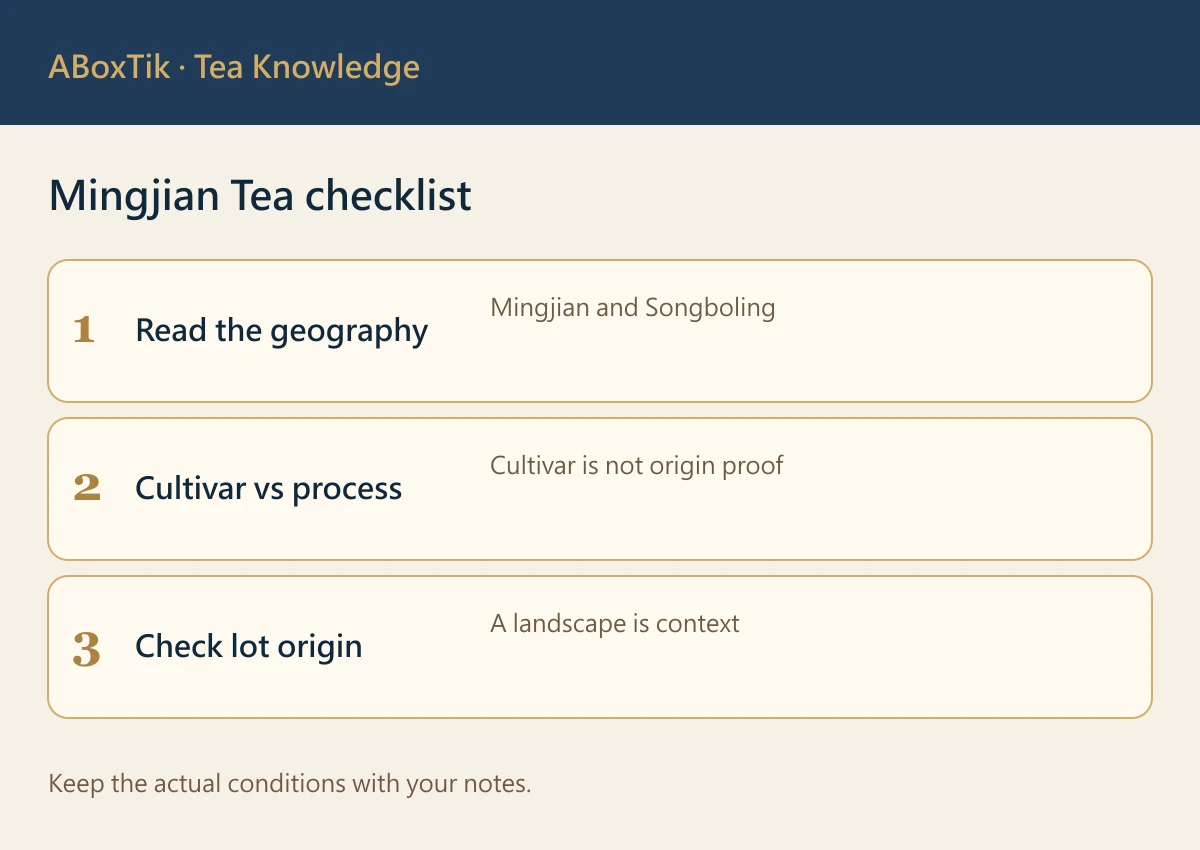
The card is not a vocabulary quiz. It helps you notice which label statement still needs another kind of evidence. “Songboling Jinxuan,” for example, offers two useful clues; it does not by itself reveal every detail about farming, processing, or cup character.
A geographic card, not a quality ranking
The official description placing Songboling at the southern end of Bagua Mountain gives a clear way to locate it within Mingjian, Nantou. This article does not call it the largest, the best, or make any similar ranking. Nor does it treat regional identity as a uniform promise. Seasonal conditions, cultivation, plucking, manufacture, roasting, packing, storage, and brewing can all shape a finished tea.
Place matters because it creates better questions, not because it removes the need for questions. Try marking a package in four colours: place, cultivar, process, and verifiable batch or storage details. Leave an unknown box blank. It is more reliable than filling in a familiar place name with an invented story, and it prevents a broad Taiwan tea-region guide from becoming a claim that every tea from a region tastes alike.
Cultivar is a clue, not a sensory verdict
The official list of Jinxuan No. 12, Cuiyu No. 13, Qingxin, and Sijichun shows that a place can include several cultivation choices. A cultivar name invites useful questions: Which cultivar is this batch? What tea style was made from it? How does the producer describe the actual aroma? It should not be translated automatically into a promise of milky, floral, strong, or gentle flavour.
Fictional example: Yun buys tea labelled “Songboling Cuiyu.” Instead of writing that Cuiyu must be floral, she records place, cultivar, and roast level separately. She follows the package directions for the first infusion, notes aroma, strength, and finish, and changes only steeping time in the second round. Her notes describe her own packet of tea, not the entire region.Read processing separately from place
Tea-processing references describe how stages such as withering, agitation, oxidation control, fixation, rolling, and drying influence a finished tea. Those stages are not synonyms for a place name. Similar cultivars can be treated differently; a roasted or fragrant label cannot be used to reverse-engineer one origin.
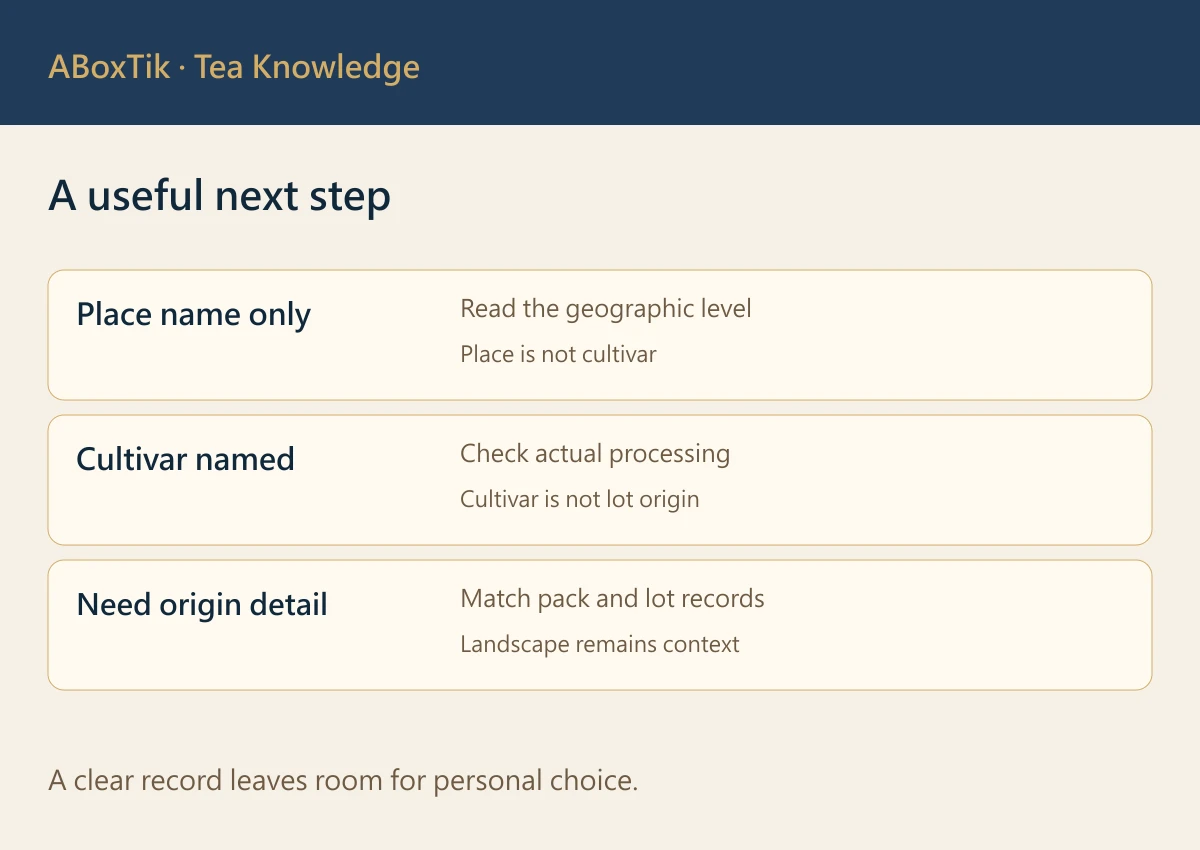
When choosing tea, ask three modest questions: How specific is the stated origin? Is the cultivar identified? Is processing or flavour described concretely? If a seller gives only one answer, it can still be a useful clue, but it does not fill the other two boxes. That restraint does not make tea less enjoyable. It gives comparison a fairer starting line.
Turn the card into a cup-side observation
Brew according to the package directions and record only three things at first: what the dry-tea information says, what you notice in hot aroma and on the palate, and what remains unknown. When comparing two teas, keep water amount, leaf amount, and time stable; change one condition at a time. This is not professional sensory evaluation. It is a small way to connect a geographic reading card with the tea in front of you.
To begin learning Mingjian and Songboling, ask simply: what place is named, which cultivars are common there, and what processing and labelling information is still needed for this tea? Leave room for the next question. A place name does not have to explain everything, and one cup does not have to carry every expectation about a place.
Use the card to ask a seller better questions
When a tea is labelled Songboling or Mingjian, try three calm questions: “How specifically is origin stated for this batch?” “What cultivar or raw-material description is available?” and “What processing and storage guidance is provided?” These questions are more likely to produce checkable information than “Is this authentic?” They also avoid asking a seller to replace evidence with attractive language.
If the answer is simply that the tea tastes good, return to the cup and treat that as a tasting invitation rather than a geographic conclusion. If batch, maker, harvest, or processing information is available, write it alongside your own notes. The point is not to collect ever more terms. It is to know which statement belongs to a place, which belongs to a cultivar, which belongs to a process, and which belongs only to this brewed cup.
The same card can travel with you through many local teas. There is no need to rank place names quickly. A place offers direction, a cultivar offers a clue, processing describes change, and a cup records one moment of preparation. Keeping those four layers separate makes the next label easier to read, while leaving enough openness for real tea to surprise you.
Take the card into storage as well. Note the opening date, package guidance, and what happens in the first few brews. Those are use notes for this packet, not proof that every tea from a locality behaves the same way, but they make your next comparison more honest. When sharing tasting notes, separate “I noticed” from “the label states.” The first is an experience; the second is information that can be checked.
This small division has a practical benefit. It lets a producer’s stated origin remain visible without turning it into an all-purpose story. It lets a cultivar name start a conversation without becoming a compulsory flavour. It lets processing information explain an observed change without making the origin disappear. That is enough structure for a beginner and enough humility for a careful drinker.
It also makes a considerate gift note. State the origin information you actually have, add brief brewing guidance, and leave the recipient free to use their own cup and pace. Do not turn a regional name into a test of knowledge. When information is missing, an honest blank is more useful than an invented farm, altitude, or flavour promise. A good regional reading changes when better information arrives; it does not carve its first answer into the package.
Curiosity is a better companion than certainty here.
Related reading and tea choices
Sources
- Tri-Mountain National Scenic Area Administration, Songboling
- Tea and Beverage Crop Research Station, English information page
- Ministry of Agriculture Knowledge Web, Tea processing reference