
Tea Knowledge
Are Expanded Tea Leaves Filling Your Teapot Too Tightly?
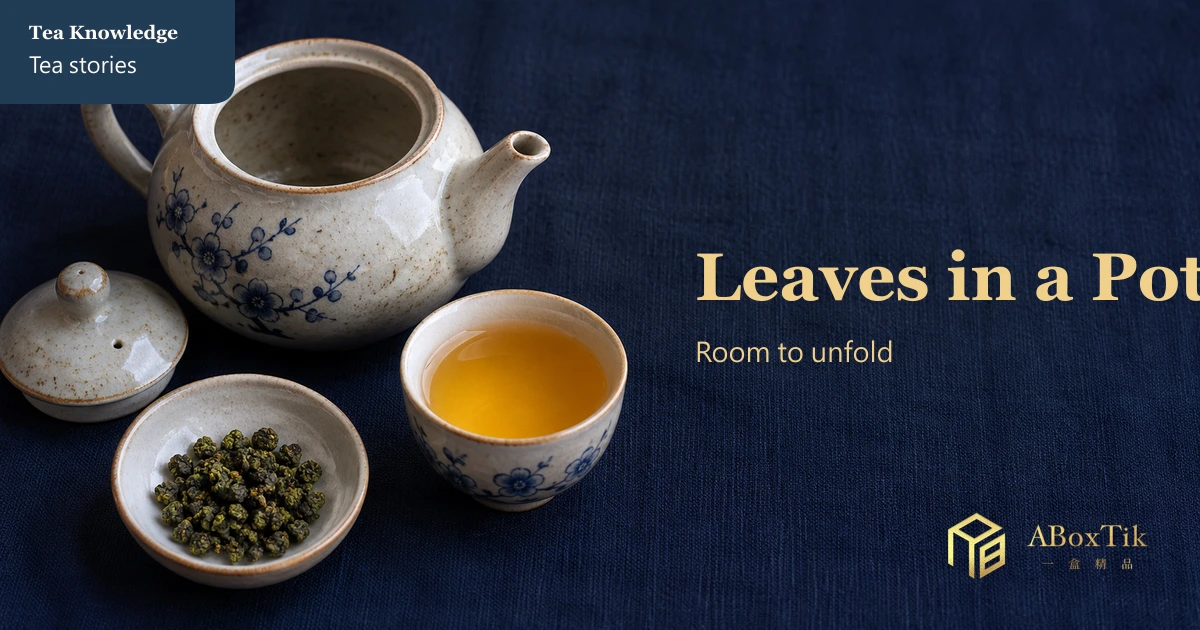
Look at the cup as well as the pot
Leaves reaching much of the pot after brewing do not automatically mean too much dry tea was used. Leaf shape, rolling and the vessel all affect the visible space. Check whether water enters, the tea pours and the cup tastes right before deciding to reduce the next dose.
Watch three practical clues
Can water move between the leaves? Does the spout become noticeably blocked when pouring? Is the tea stronger than you enjoy under the same conditions? A leaf touching the lid alone is not proof that the amount is wrong.
Keep the other variables steady
Record the tea, pot capacity, leaf amount, water temperature, time and pouring method. On the next brew, change only the tea amount while keeping the rest as similar as practical. Try a small reduction and adjust again according to the cup; package directions can provide a first starting point.
If space causes a problem
If leaves repeatedly block the spout, try less tea, a larger vessel or a suitable strainer designed for the pot. Do not force or compress the leaves. Place hot vessels securely and pour with care; give the tea room and the table fewer surprise performances.
Keep a short brew card
Write down dry leaf, pot capacity, time, ease of pouring and preferred strength. After two trials of the same tea, keep the preferred combination as a starting point. Observe again when changing tea or vessel: similarly shaped leaves can open differently.
Find a comfortable brew
A useful result is an easy pour and a cup you enjoy, with a note that helps repeat it. Treat the next infusion as a small experiment rather than an examination.
To bring these questions back to an actual tea choice, browse ABoxTik Taiwan teas, then check the product label and batch information supplied for that tea.
A teapot full of opened leaves is not automatically overloaded
Some tightly rolled oolongs look modest when dry and expand dramatically after absorbing water. Long twisted leaves may spread across the visible space even sooner. Leaves reaching the lid prove that they have opened; the sight alone does not prove that too much tea was used. A better judgment combines leaf movement, the way water enters the pot, the speed of the pour and whether the liquor becomes difficult to control within a sensible brewing time.
Teapot shape changes the picture. A broad pot lets leaves spread sideways, while a tall narrow pot encourages them to stack upward. Filter-hole size, spout construction and the proportion of small particles can slow the pour even when the total tea amount is reasonable. The leaves may look busy without causing a problem. A teapot is not a lift: it does not need to sound an alarm simply because it appears full.
Four signals that are more useful than appearance
- Water entry: can water move between the leaves, or does it sit above a compact layer and rise immediately to the rim?
- Pouring: has the pour become distinctly slower, and are leaves repeatedly sealing the filter holes?
- Strength: does a reasonable infusion produce liquor that remains excessively strong or astringent even after timing is shortened?
- Opened leaf: when removed, are the leaves tightly compressed into a mass, or can they separate and show normal expansion?
One signal is not enough for a verdict. A slow pour may come from the spout or fine particles. An overly strong first infusion may simply have run too long. When two or three signs appear together, tea amount becomes a more convincing variable to adjust first.
Change one variable at a time
Record the current tea amount, water volume, temperature, infusion time and vessel. The notes do not need laboratory precision at the beginning. On the next session, reduce the tea by a small, repeatable amount while keeping the other conditions close. If water movement and pouring improve and the liquor becomes easier to control, the original amount may have exceeded the comfortable working space of that pot.
If the problem remains, inspect fine particles, filter holes and the position of the leaves. Avoid changing the pot, temperature, tea amount and timing all at once; otherwise a table full of variables will politely blame one another and teach you very little. When the liquor is merely strong but the leaves and pour are normal, shorten the infusion first. When strength is acceptable but pouring is slow, investigate the filter and leaf position before reducing tea.
A small scale and a measured check of the pot’s real water capacity can make comparisons easier. Their purpose is not to turn tea into an examination. They simply allow the next brew to begin with less guesswork and make a successful adjustment easier to repeat.
Build a two-brew comparison before changing the vessel. For the first session, note the dry-leaf weight, actual water filled, infusion time and how long the pot takes to empty. After pouring, look at the leaf bed without pressing it down. For the second session, use the same tea and pot but reduce the leaf by a small amount. Keep the water temperature and timing close enough that the result answers one question: did the smaller dose improve water movement, pouring and control of strength?
Official sensory evaluation uses fixed tea weight, water volume and time so different samples can be compared on common terms. Home brewing does not need to copy a competition recipe, but the principle is useful: stable conditions make a change easier to interpret. Taiwan’s agricultural tea guidance also treats tea amount, water temperature and time as interacting brewing factors. If the second cup is still too strong while the pour is clear, shorten the time next. If the strength is pleasant but the spout blocks, inspect leaf fragments and the filter before cutting the dose again.
Finish the comparison by writing one repeatable starting point: for example, “this pot, this tea, this leaf weight, pour at this time.” The note belongs to that tea-and-vessel combination, not to every rolled oolong in the cupboard. New tea, a different harvest, a smaller pot or a finer broken grade can all change the behaviour. The goal is a calm baseline that can bend when the cup asks for it—not a household constitution engraved beside the kettle.
Allow for leaf shape and serving context
Tightly rolled oolong needs room to unfold. Tea with more broken particles needs attention around the filter. Bulky twisted leaves should not be judged only by how large the dry handful appears. During continuous service for several people, a clear and reliable pour may matter more than achieving maximum concentration. For a quiet solo session, a smaller amount and a little more time may produce a gentler rhythm.
Use the product’s guidance as a starting point, then adapt it to your vessel, water and preference. If the package is damaged, the leaves have an unexplained unusual odour, or their condition clearly conflicts with the label, pause the brewing experiment and ask the supplier while keeping the packaging. Ordinary leaf expansion usually calls for observation and a small adjustment—not a dramatic rescue operation.