
Tea Knowledge
Tea Off Notes: Check Green, Stuffy, Burnt and Stale Impressions
A little preparation leaves more room to enjoy the tea.
When tea seems vegetal, roasted, stuffy, or aged, do not rush to call it bad tea or to diagnose a factory process from one cup. A more useful order is simple: first check that cup, water, and surroundings are clean; then record the sensation as an observation under particular conditions; finally, change only one controllable condition. If there is obvious dampness, mould, damaged packaging, or anything concerning, do not re-taste to decide. Stop using the tea and contact the supplier.
What this checklist does—and does not—do
This is a home tasting card for four common descriptions: green/vegetal, roast, stuffy, and aged. A 1989 Tea Research and Extension Station document preserved by the National Culture Memory Bank lists related terms in a historical professional context. It does not give a modern home drinker a formula for tracing a flavour back to production settings. This guide is not a defect diagnosis, a re-roasting instruction, or a health smell test.
Existing aroma guidance already explains dry, hot, warm, and cool aroma. Existing storage guidance helps separate changes in dry tea from changes during brewing. This article adds only a practical question: before calling something an off-flavour, what ordinary condition can be checked first?
Make three answer-free checks first
Smell a clean empty cup and a small amount of suitable-temperature water. This helps reveal whether the cup, pot, detergent, a previous flavoured drink, or kitchen air is taking the lead. Brew a small portion according to package guidance and record leaf amount, water amount, time, and water used. Then write dry leaf, hot aroma, taste, and cooler-cup aroma separately. This is a comparison starting point, not a safety test.
Write down relevant background noise too: a new cup, different water, recent spicy food, perfume, smoke, or cooking aromas. Everyday senses are real but contextual. Quieting the background lets the tea speak without being asked to take responsibility for dish soap.
A conditional four-note checklist
| What you notice | Do not automatically call it | Check first | Change only one thing next time |
|---|---|---|---|
| Green or vegetal | A flaw or unfinished tea | Tea style, dry-versus-hot aroma, very short steeping | Repeat with the same cup and water, following package guidance |
| Roast | Burnt tea or automatic quality | Roasting description, coffee/caramel residue in the vessel | Use a clean vessel and compare aroma with taste |
| Stuffy | A factory problem | Damp cup or pot, seal, room, delayed pouring | Dry equipment fully and keep the time fixed |
| Aged | Always safe or always unsafe | Opening date, package, light/heat, storage odours | Check storage; stop use if condition is concerning |
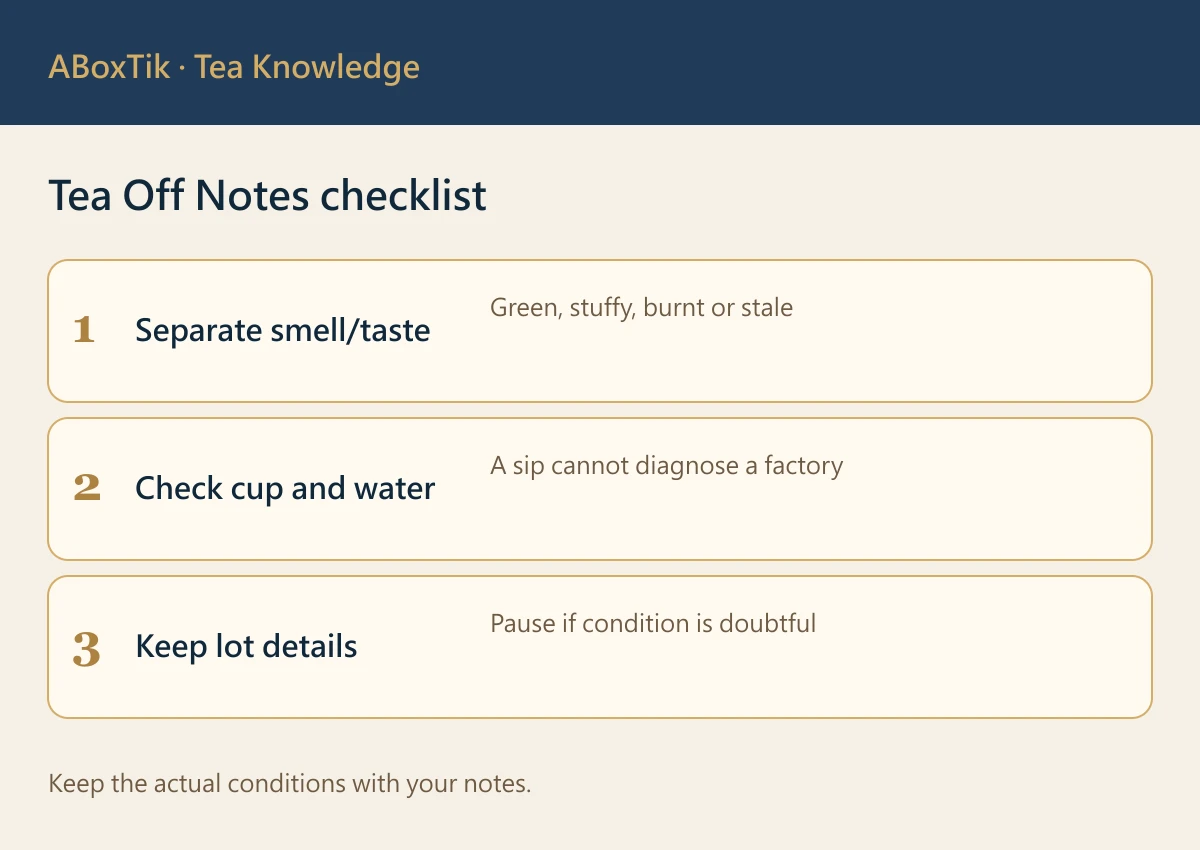
Vegetal character is not automatically “green off-flavour,” and roasted character is not automatically “fire off-flavour.” Note when it appears, whether it is clear, whether it agrees with the liquor, and whether it remains when conditions are held steady.
Green: locate the plant-like note before naming it
Some teas can suggest grass, beans, fresh leaves, or other plant-like impressions in dry aroma or immediately after water is added. That may be part of a tea’s character, or simply especially noticeable in this brew. Instead of using one word for every plant impression, record a time point: “strong vegetal note in hot aroma, softer after sipping,” or “quiet dry leaf, leaf-like note remains in the cooled cup.”
On the next brew, keep vessel, water, leaf amount, and water amount consistent and follow the product’s directions. If you compare, compare the same tea twice rather than changing tea, pot, water, and time together. Otherwise the result is a chorus of changing conditions, while the tea never gets a solo.
Roast: record direction separately from discomfort
Roast, caramel sweetness, wood, and warm baked impressions can be legitimate flavour directions. Check whether the product actually describes roasting, and whether the empty cup or pot holds a trace of coffee, caramel drink, or strongly scented cleaner. Then record hot aroma, taste, and cup-bottom aroma separately: does the roast feel warm and clear, or sharp, scattered, and overwhelming?
This is still not home certification. If a note makes the tea unpleasant to you, “not for my preference” is a complete conclusion. You do not need to write a production-failure report. No cup has to pass a board meeting of your taste buds before it is allowed to go home.
Stuffy and aged: check storage, equipment, and stopping points
TBRS storage information explains that tea readily absorbs moisture and odours, while light, oxygen, temperature, and time can contribute to quality change. Check the seal, storage location, and proximity to strong smells. Use dry hands and utensils; allow washed cups and pots to dry fully. These checks reduce ordinary variables; they do not certify a packet of tea.
Fictional example: Cen notices a stuffy impression in a packet during its second week. Rather than declaring it spoiled, she smells an empty cup and water, checks the seal and storage place, and brews a small portion as before. The cup has a detergent odour. After washing and drying it, she repeats the brew the next day and writes, “The previous stuffy note did not return.” If she had seen obvious dampness, mould, or unusual package condition, her next step would have been to stop using the tea and ask the supplier—not to brew another test cup.An aged note also needs separation between ordinary change and a concerning condition. There is no need to hide it with longer brewing or added fragrance. When the condition is questionable, safety outranks tasting notes. Tea is not a courage game with a prize for finishing the cup.
Turn one observation into a question a supplier can use
If the same packet keeps giving an unwelcome note after the ordinary conditions have been held steady, a short record makes “this tea seems odd” genuinely useful. Capture six fields: product name and lot or best-before information, date opened, storage location, leaf and water amounts, water temperature and steeping time, and the stage when the note appeared. Add whether it happened in every infusion, only in the first, or only after the cup cooled. This is not an invitation to turn the kitchen into a laboratory. It simply gives the supplier a sensible starting point.
For example, a calm, complete note could read: “Mountain oolong, lot L24-071, opened 10 October and stored in a closed cupboard. I used 5 g tea with 150 ml filtered water at 95°C for 45 seconds. The hot aroma was neutral, but a stuffy note remained at the bottom of the cooled cup in the second infusion. I repeated this once with a fully dried porcelain cup and the same water, and noticed it again.” That example separates the packet, storage, brew conditions, timing, and observation. It does not claim to identify a production cause.
When contacting the supplier, include clear photos of both sides of the packet and the lot information, then ask one focused question: “Could you help me understand whether this note is expected for this lot, and whether there is any storage guidance I should check?” Avoid guessing at the cause or demanding a verdict before they have the details. If the packet is visibly damp, shows mould, is damaged, or otherwise feels concerning, retain the packaging and purchase information, stop using the tea, and contact the supplier rather than continuing comparisons. If the package and tea appear normal but the flavour is simply unwelcome, one small comparison under fixed conditions can be reasonable—or you can ask the supplier directly and leave the tasting there. A clear stop point is part of good tea care, not a failed tasting exercise. If the supplier offers guidance, add it beside the original note; a dated record keeps any later comparison useful without pretending that one cup can settle every question.
A small record that can be repeated
Keep five fields: date and opened status, whether cup/water seemed neutral, when the note appeared, the fixed brewing conditions, and one thing to alter next time. This card can reveal a pattern, but it cannot replace testing, supplier batch information, or professional sensory assessment. Keep packaging and purchase details when there is a product or storage concern; those are more useful than an elaborate guess.
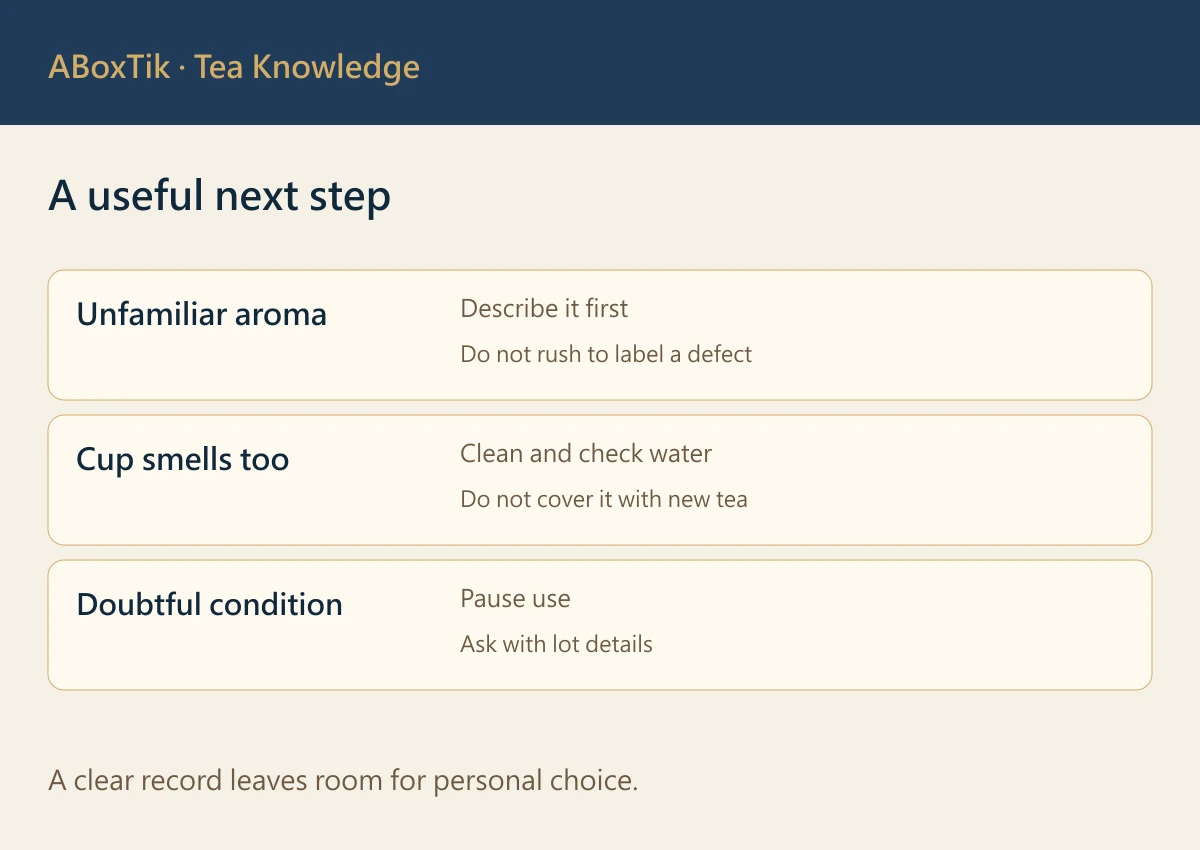
To turn “off-flavour” into clearer language, start with one cup: make the cup and water neutral, note the moment of appearance, then alter one thing only. You do not need a perfect answer. Knowing how to make the next comparison is already good care for tea.

Related reading and tea choices
Sources
- National Culture Memory Bank, 1989 TBRS tea document
- Tea and Beverage Crop Research Station, Tea Packaging and Storage
- Ministry of Agriculture Academy, Tea sensory-evaluation material