
Tea Knowledge
Corporate Tea Gift Decisions: Set Clear Priorities

A little preparation leaves more room to enjoy the tea.
A manager may be protecting the way a gift represents the company. A purchasing colleague may be protecting the ability to deliver the right thing, in the right form, with a usable record. Both concerns belong in the room. The trouble starts when they are expressed as competing tastes rather than decision conditions. Before choosing a tea, box, or customization option, translate each opinion into something the team can check. Then separate non-negotiable constraints, useful preferences, and questions that still need evidence. Name the person who can resolve the trade-off, and record the version that won. It is a modest system, but it keeps “looks about right” from becoming an expensive group project.
This article offers a requirements-priority table for the stage before a corporate tea gift is specified. It does not set a budget, delivery promise, minimum quantity, or acceptance standard for any organisation. Those belong to the current product information, supplier response, internal process, and written agreement. If the recipient count is still open, start with the corporate gift quantity planning guide. Here, the task is earlier and quieter: decide what rules will be used to compare options.
First, separate a constraint from a preference—and a preference from a veto
Teams often place “it should feel considered” beside “the recipient list must support separate delivery groups” and hope a spreadsheet will settle the difference. The first statement needs unpacking: does “considered” mean the tea story, the box material, the card, the opening experience, or the degree of company branding? The second statement may directly affect data collection, packing, and handoff. Both may be important. They simply need different treatment.
Use three categories. A constraint is a condition that must be met before an option can move forward: a required language, a confirmed budget ceiling, a delivery window, an agreed data format, or an internal approval step. A preference is used to choose among options that already meet the constraints: a more shareable tea format, a quieter brand presence, or a more ceremonial unboxing moment. An information gap is not ready to rank at all: perhaps the recipient context is unknown, the logo question has not been decided, or a proposed delivery arrangement has not been confirmed.
Collect four pieces of input before the meeting
A priority table does not need lengthy position papers. Ask each key contact for a short answer to four questions: Who will receive the gift? How are they likely to use it? What must not go wrong? Who has authority to make the final trade-off? Recipient groups can be factual and broad—visiting guests, staff across offices, business partners, or event attendees—without inventing personas. “Use” should also be concrete. Will people brew the tea individually, share it in an office, carry it after a meeting, receive it through central distribution, or receive it at separate addresses?
The requirements-priority table
| Condition | Type | Why it matters / user | How the team will assess it | Priority | Owner and version |
|---|---|---|---|---|---|
| Recipients can understand the tea and brewing guidance | Constraint or high preference | The person who will actually use the gift | Check language, legibility, and fit between directions and tea format with the named content contact | P1 | Content owner / copy v__ |
| Degree of company branding | Preference | Relationship tone and brand expression | State the intended location, scale, and card-signature approach; compare with approved artwork | P2 | Brand owner / design v__ |
| Recipient and delivery data is usable | Constraint | Purchasing, administration, and recipients | Confirm list fields, grouping rules, and the internal cut-off for the project | P1 | Administration owner / list v__ |
| Tea style supports the intended sharing situation | Preference | The recipient’s practical experience | Compare tea information, brewing needs, and context; do not treat one person’s taste as a universal verdict | P2 | Selection owner / assortment v__ |
| Additional customization | Classify after facts are known | May affect cost, proofing, and timing | Obtain an executable description and confirmation chain before ranking it | Open | Project owner / requirement v__ |
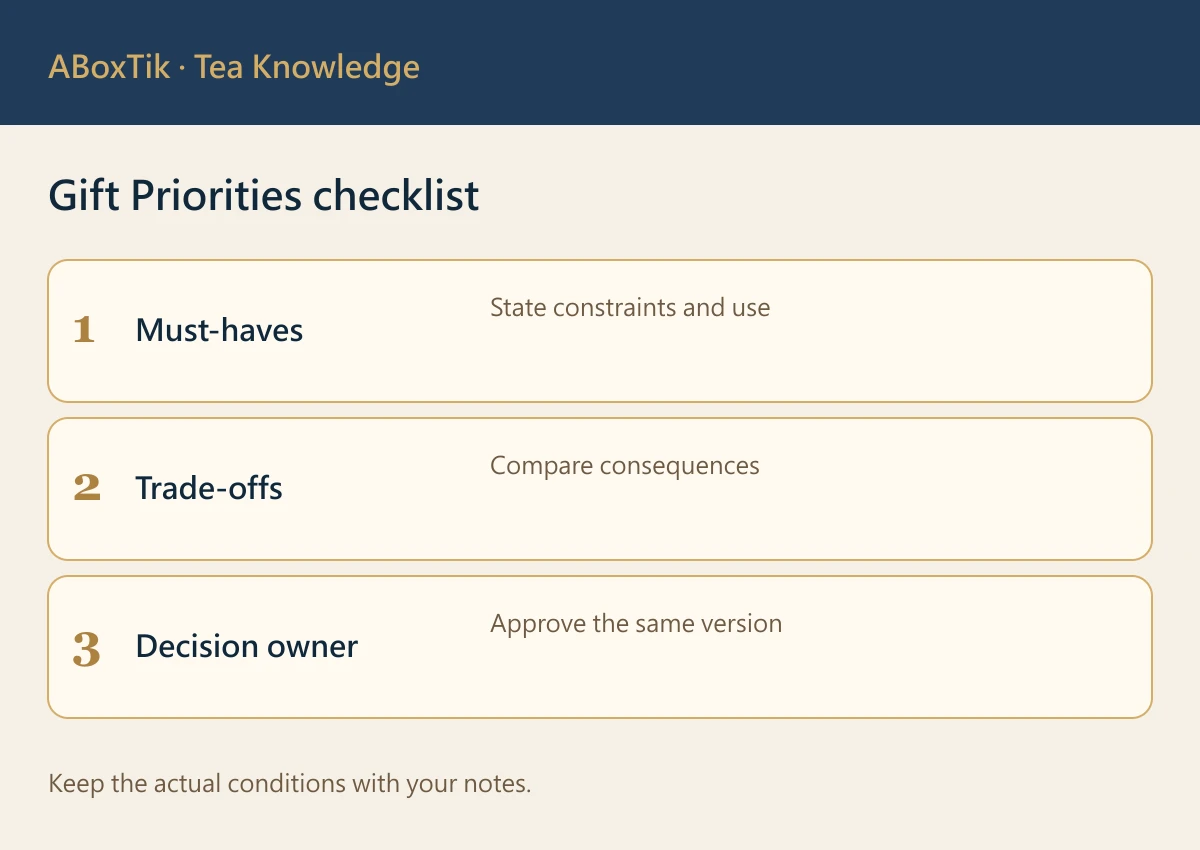
P1 means an option does not continue if it fails that condition. P2 means the condition helps choose after P1 is met. A team may add P3 for “worth having, not blocking.” The labels matter less than the consequence of each label. Do not make every line P1. If everything is non-negotiable, the useful discovery is not that the options are weak; it is that the team has not yet made a trade-off.
Translate vague praise into a condition people can act on
“It needs to feel premium,” “not too commercial,” and “generous but restrained” are real reactions, but a supplier, purchaser, and designer cannot execute a reaction alone. Ask a few practical follow-ups. Who sees the gift first? Where and when will it be opened? Should the first impression be care, ease of use, recognition, or something else? What would feel excessive? The answer does not have to become a false numerical certainty. It only needs to become a choice that can be compared.
For example, “quiet but recognizably ours” may become: “Tea information remains the primary visual; the company name appears in the agreed card signature or sleeve position; location and scale are confirmed against the approved artwork.” “Recipients should want to use it” may become: “Choose format and instruction level after considering equipment, sharing, and brewing guidance in the recipient context.” Neither sentence guarantees an outcome. Both tell the team what to review.
Purchasing language deserves a translation, too. “Freeze the version” is not a request to send creativity home early; it is a request to know which file may be executed. “Complete the data” is not affection for another table; it prevents printing, packing, and distribution from receiving three different answers. When a constraint is explained as protecting the recipient’s experience, it is usually easier for everyone to support.
Use recipient experience to weigh the trade-off, not job title against job title
When a manager and purchaser disagree, the strongest referee is often the documented use context rather than a louder title. If gifts will be distributed centrally by an administrative team, clear grouping, simple instructions, and a workable recipient list may outrank elaborate construction. If they will be handed over during visits, the first opening moment, card signature, and ease of carrying may deserve more weight. If most recipients will brew tea at a desk, tea information and usable directions should be confirmed before a decorative line that exists only for display.
This does not demote design or brand. It puts them back inside the purpose of the gift. Ask the same three questions of each option: Does it help the recipient understand and use the gift? Does it express the intended company relationship with the right degree of care? Can it be carried out within the constraints that are actually confirmed? If two answers are missing, gather information before selecting a polished image as a substitute for a decision.
When views differ, use four moves: locate, compare, decide, record
- Locate the disagreement. Write one condition, such as “Should the logo appear on the box face?” rather than “Brand likes it and purchasing does not.”
- Compare workable options. List two or three approaches and assess each against constraints, recipient use, and any cost or timing information that still needs confirmation. A blank cell is allowed when information is missing; label it rather than inventing an answer.
- Make the decision. The pre-named decision owner chooses, postpones, or asks for a specific missing item. If the choice is conditional—“proceed after card copy is confirmed”—record the condition as part of the decision.
- Leave a trace. Record the date, basis, decision owner, scope, and next version. This is not a vote of no confidence. It lets a colleague who missed the meeting take over correctly.
A team does not need to pretend that everyone has come to love the same box. When preferences remain genuinely opposed, record the feasible options and their effects, then let the authorized person make the trade-off. If a critical specification or supplier response is absent, mark the decision as pending information. An honest uncertainty is usually faster than a fictional consensus.
Give “final version” a real name and an owner
A useful decision record has at least six fields: project name, decision date, version, scope, decision owner, and open items. Add an owner and next date for every unresolved condition, and “please take another look” becomes work that can be followed. A version does not need theatrical naming. “2026-10-25 / requirements v1” is enough. What matters is that design, copy, recipient list, and tea selection are not each called “latest” in separate folders.
One project coordinator can maintain the single priority table without becoming the sole judge. The brand contact confirms message and visibility; purchasing confirms executable constraints; administration confirms lists and distribution approach; the decision owner resolves conflicts. Mark a person as consulted when they are providing input, and as approver only when they may change priority. Clear roles make it safer, not harder, for people to offer a thoughtful objection.
A ten-minute close before asking the next question
Before sending a request to a supplier or moving to the next internal gate, take ten minutes to review the table. Does every P1 line have a way to be assessed? Does each information gap have an owner? Are design, content, recipient data, and delivery using the same version label? Is the recipient’s actual use present in the record, rather than only in someone’s memory? Finally, list what the team did not decide as out of scope. That prevents an unspoken wish from quietly becoming an added promise.
A corporate tea gift does not require every participant to adore the same detail. It needs a shared understanding of what cannot be lost, what is worth pursuing, what still needs evidence, and who decides when a trade-off remains. Start with the priority table, the recipient group, the expected use, the quantity range, and the current version. Then the tea and design conversation has a calm, clear route forward.

Related reading and tea choices
Include storage and packaging in the requirements discussion. TBRS identifies moisture, temperature, oxygen, light and odours as relevant storage conditions; ask how the chosen pack and actual hand-off arrangement will support the product directions.
Sources
- TBRS: tea packaging and storage
- ABoxTik: Corporate Lunar New Year Tea Procurement (checked 2026-10-25; procurement and delivery context)
- ABoxTik: Corporate Tea Gift Logo Guide (checked 2026-10-25; brand-expression and proofing context)
- ABoxTik: Corporate Mid-Autumn Gift-Box Timeline (checked 2026-10-25; confirmation-chain and timeline context)