
Tea Knowledge
Same Tea, Different Lots: A Practical Comparison Guide
Give the next lot a little room to introduce itself.
Your favourite tea has arrived again, but the first cup tastes a little different. Before your taste buds hand in their resignation, check what you are comparing. The same product name does not necessarily mean the same production lot. At the same time, “tea is natural” is not a complete explanation for every change.
A useful approach is to keep the package information, bring the brewing conditions closer together, describe the difference, and decide what to do next. You might keep the new lot, adjust one brewing variable, or ask the supplier a specific question. This is a shopping and tasting record, not an examination you need to pass.
What does “the same tea” mean on these two packages?
A matching name may identify a product line, a style or a specification. It does not by itself establish that the leaves came from the same harvest date or production lot. Equally, a redesigned pouch does not prove that the tea inside has changed. Put the labels side by side before making either assumption.
Compare the product name, format, stated ingredients, pack weight, lot information and labelled dates. Do not work backwards from a best-before date to invent a harvest date. If a code is unclear, ask whether it is a lot code and whether the two packs represent different production lots. A direct question is much easier to answer than a guessing game.
Separate a lot difference from a storage difference
Raw materials and processing are part of tea production, while moisture, temperature, light, oxygen and surrounding odours can affect storage. An old pouch opened several months ago and a pouch opened this morning therefore have more than one possible reason to taste different.
You do not need laboratory equipment to acknowledge this. Write “opening date unknown” or “stored near the cooking area” where appropriate. An honest conclusion can be that a difference is noticeable but its cause is not yet clear. The tea table does not have to identify a single culprit before anyone is allowed another cup.
Use a simple tea-lot comparison card
| Record | Earlier pack or lot A | New pack or lot B | Why it helps |
|---|---|---|---|
| Product and format | Copy the label | Copy the label | Confirm that these are comparable products |
| Lot and labelled dates | Keep a clear photograph | Keep a clear photograph | Keep lot information separate from harvest assumptions |
| Opening and storage | When opened and where kept | When opened and where kept | Mark unknown details instead of filling them in |
| Brewing setup | Leaf, water, temperature and timing definition | Use a comparable setup | Check bag weight where tea bags are involved |
| What you notice | One note each for aroma, taste and mouthfeel | Use the same headings | Specific descriptions make discussion easier |
| Next action | Keep, adjust one variable, ask the supplier, or stop using a questionable product | Choose the action that fits the observation | |
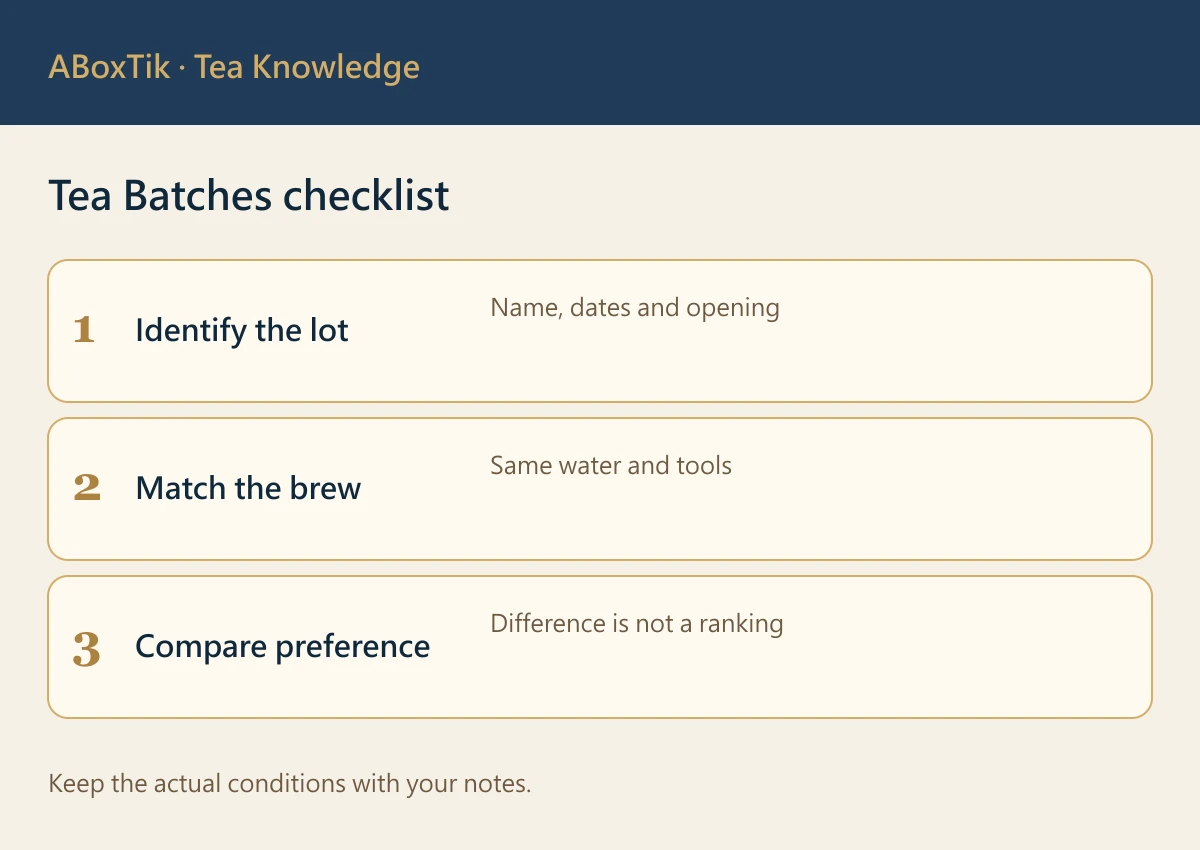
Bring the controllable brewing conditions closer together
Use matching cups, water from the same source and a brewing method appropriate to the product. Keep leaf quantity, water quantity, water temperature and the timing convention as similar as practical. With tea bags, check the actual weight per bag. One bag is a convenient unit, but it is not automatically the same quantity across products.
Try the teas at comparable stages after brewing. A freshly poured cup and a cup left until the end of the afternoon are not a very helpful pair. Temperature and time are now involved as well. Record the conditions you can reasonably control, without pretending that a home comparison isolates every possible variable.
You can first brew each tea according to its own package directions to see how it fits everyday use. If you want a closer comparison, arrange a separate round using matching settings. These answer different questions: which preparation suits your routine, and what differences you notice under a more comparable setup. Keep the two sets of notes separate.
Describe the experience before ranking the lots
Smell the tea, take a comfortable small sip, and write separately about aroma, taste and mouthfeel. “The floral note is easier for me to notice in B” is more useful than “B is strange.” “A leaves my mouth feeling drier” also says more than an unexplained score of seven out of ten.
You do not have to decide which lot is objectively superior. A few home cups are a limited observation, and personal preference remains part of the decision. A tea can be different from the earlier lot and still be enjoyable. It can also be perfectly reasonable tea that does not deliver the particular character you hoped to buy again.
If someone joins you, let each person make a brief note before discussing the cups. Otherwise, the first confident description can become the whole table’s vocabulary. Compare the notes afterwards and keep differences of opinion visible. Your friend’s “pleasantly brisk” and your “a little too drying” can both be useful information.
Change one brewing variable when exploring your preference
If the new lot tastes stronger than you expected, try a separate round changing only the steeping time while keeping the other settings steady. If you want to change leaf quantity, make that another round. Changing the cup, water temperature, leaf and timing together may produce a nicer drink, but it will be harder to know what helped.
This approach helps you explore a preference; it does not promise that brewing can recreate every earlier flavour. If you loved a particular aroma in the previous lot, the new direction may simply be less appealing to you. Understanding variation does not require you to praise a cup you do not enjoy.
Give the supplier details they can actually investigate
Try this message: “The product is ___ and the lot code is ___. The earlier pack was opened around ___, and the new pack was opened today. I used ___ leaf, ___ water and started timing at ___. In the new cup I notice less ___ and more ___. Are these different lots, and do you have preparation advice for this one?”
Attach clear photographs of the product and lot information. Mention the feature you particularly enjoyed before, rather than asking the supplier to interpret “it used to be better.” If the supplier can identify the lot but cannot provide harvest details, keep that distinction in your record. Missing information does not need an imaginative replacement.
Damaged packaging, visible mould, moisture damage or another questionable condition calls for a different response: stop using the product and contact the supplier. Stronger brewing, hotter water or an acceptable smell does not establish safety. A flavour preference and a possible product problem should be handled separately.
Three small questions before your next repeat purchase
Ask whether the current stock is a new lot, whether there is a description or brewing guidance for that lot, and whether a smaller suitable pack is available. None of these questions guarantees an exact replay of your favourite cup. They do make expectations clearer and can help you choose an amount you feel comfortable trying.
For a gift, also consider the recipient’s equipment and preferred strength. Your memory of a previous lot is not a promise about another person’s experience. A short card can say, “This lot is described as ___; start with the package directions and adjust to your preference.” That is a useful invitation, with room for the recipient to make the cup their own.
Do you need to save old tea for a future comparison?
No. There is no need to keep an opened pouch for a long time just to maintain a reference sample. A package photograph and a short note can still help after the tea is finished. When relying on memory, simply recognise that the earlier brewing conditions and setting may have been different.
If you only have the new pouch, start a record for that one and continue at the next purchase. One clear sentence about the most noticeable feature is often easier to maintain than ten ambitious tasting terms. Would you begin with aroma, strength or the feeling after the sip? Pick one. The record is here to help you enjoy buying tea, not to become another unfinished household assignment.

Related reading and tea choices
Sources
Sources checked: 25 October 2026.