
Tea Knowledge
Annual Corporate Gift Calendar

An annual corporate gift calendar works best when it starts with the desired arrival date, not the festival name. Confirm the recipient group and local working calendar, then count backwards through scope approval, sample sign-off, production, packing, documents and delivery buffer. This turns a thoughtful tea gift into a manageable project instead of an emergency relay race with ribbon.
A useful calendar records decisions, not just festivals
A coloured square marked “Mid-Autumn Festival” looks organised, yet it does not tell purchasing, design or logistics what must happen next. Build a separate row for each audience and destination when the arrival window, language, address format, customs documents or delivery method differ. Taiwan employees, Taiwan clients, an overseas office and international customers may share an occasion while requiring four different plans.
For each row, record the country or region, occasion, desired arrival window, quantity range, budget owner, recipient-list owner, product format, customisation level, card language, delivery method and fallback. Add a status—confirmed, pending or not applicable—rather than leaving an empty cell to impersonate approval. A calm little status label can prevent a surprisingly dramatic Friday afternoon.
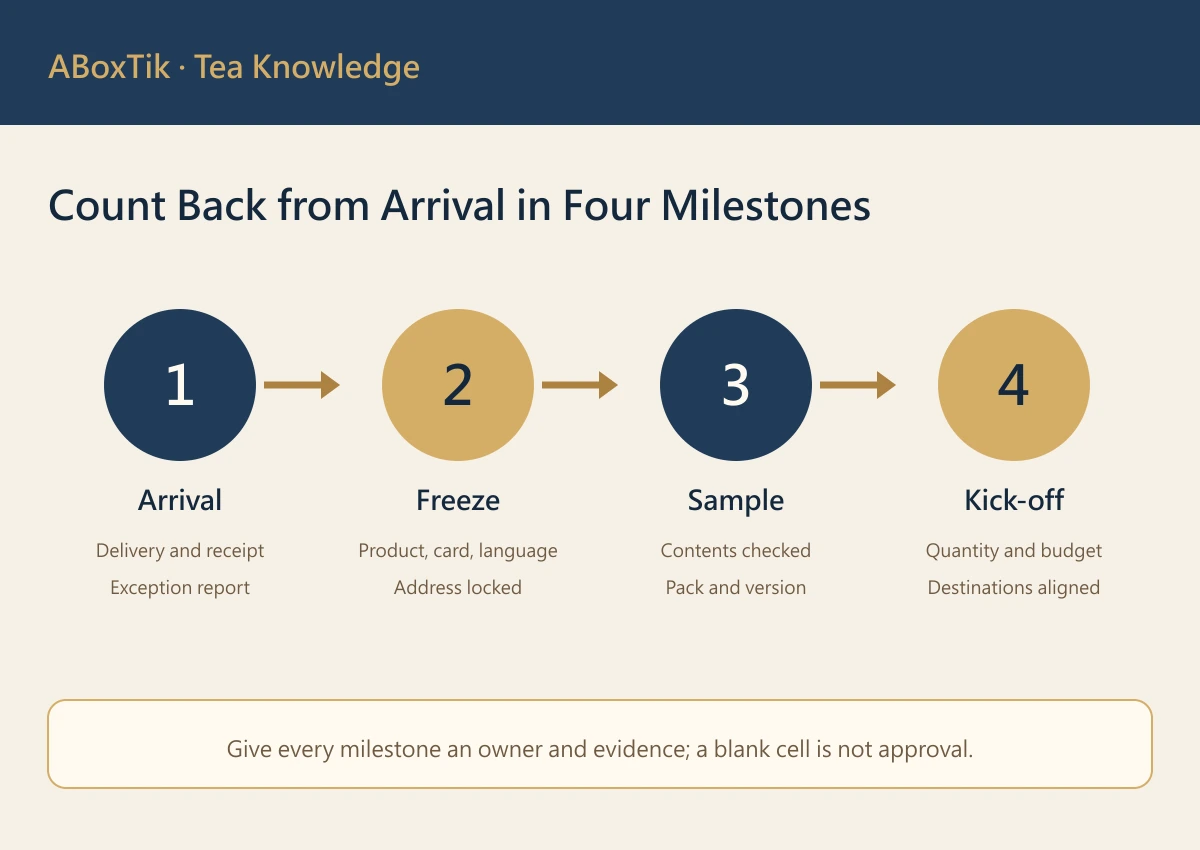
Count backwards through four milestones
Arrival is the window in which the recipient should actually receive the gift, not merely the day a carton leaves the warehouse. Record split deliveries, receipt confirmation and the person handling exceptions. Freeze is the last point at which the product, card copy, language, address format and quantity can change without moving the rest of the plan. Sample is the dated approval of contents, packaging and version. Kick-off aligns quantity, budget, destinations and decision owners before design or production effort expands.
These milestones are checkpoints, not universal lead-time promises. Ask the supplier for the current quotation, sample time, artwork cut-off, production window, packing window and last dispatch date for the exact configuration. A stock gift with a printed card, a semi-custom sleeve and a fully custom box belong in different planning lanes. Copying one lead time across all three makes the spreadsheet neat and the real project rather less neat.
Keep internal approval, supply and delivery separate
One total number such as “allow six weeks” hides the source of delay. Keep three timelines. The internal lane covers recipient-list ownership, budget approval, card copy, translations, legal or brand review and sample sign-off. The supply lane covers stock confirmation, customisation, production, packing and dispatch inspection. The delivery lane covers transport, documents, customs examination where applicable and final-mile handover.
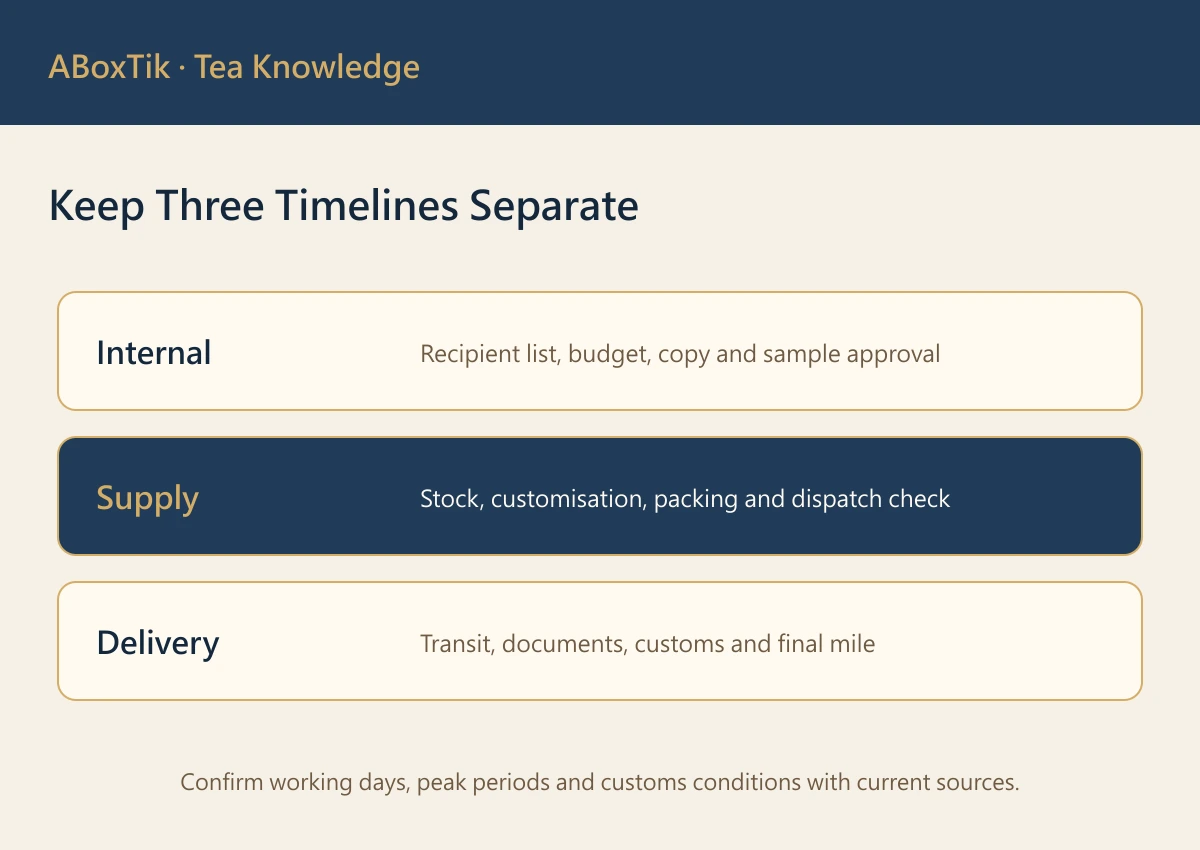
When one lane changes, update the dependent dates rather than silently borrowing time from another lane. If the recipient list is late, decide whether to split the shipment, use individual fulfilment later, or send the first batch to known addresses. If custom artwork misses its freeze date, move to an approved non-custom pack instead of asking production to compress an unverified process. A fallback chosen early still feels intentional; a fallback invented at the loading dock usually feels like a loading dock.
Build one evidence trail for every approval
| Milestone | Decision | Evidence to retain |
|---|---|---|
| Calendar verified | Local date, working days and recipient custom | Current official calendar or local-office confirmation |
| Scope frozen | Quantity range, budget, gift tier and destinations | Approved brief with owner and version |
| Sample approved | Tea, packaging, card, language and address format | Dated sample sign-off and photographs |
| Production released | Final quantity and acceptable variance | Purchase order or production record |
| Dispatch checked | Labels, invoices, tracking and local contact | Shipment list and exception owner |
Evidence does not need to become a paperwork museum. Keep the latest approved brief, the dated sample record and the current shipment list where the next person can find them. Archive superseded files and make the current version obvious. If an approval happens in a meeting or chat, add a short dated note stating what was approved, by whom and which file it referred to.
Verify dates and transit conditions every year
Taiwan’s government office calendar is published by the Directorate-General of Personnel Administration. It is a reference for government agencies, however, and does not automatically define every private company’s operating days. Lunar and regional festivals move, overseas offices observe different holidays, and a recipient may have internal closure dates that are not visible on a public calendar. Confirm the applicable date with the local recipient team at the beginning of planning and again before production.
For international delivery, postal estimates are generally working days to a stated part of the delivery network and may exclude customs examination. Peak periods, weather, incomplete addresses and local holidays can extend the journey. Record transport time, customs or document buffer, and final-mile buffer in separate fields. Never convert an estimate into a guarantee simply because the number fits nicely in a presentation.
Use different lead-time questions for different gift types
Ready-stock gift
Confirm live stock, lot or version where relevant, card insertion, outer packing, recipient-list cut-off and dispatch capacity. Ready stock reduces production uncertainty but does not remove address, translation or delivery work. For a large order, ask whether all units can leave together or need a staged release.
Semi-custom gift
Define exactly which layer is customised: card, sleeve, sticker, ribbon, insert or combination. Ask for artwork specifications, proof format, revision allowance and the point after which a change affects cost or delivery. Approve physical colour and material when those details matter; a screen preview is useful, but it is not a magic portal into every paper and ink combination.
Fully custom gift
Separate structural sample, printed proof, production sample and mass-production release. Record who accepts dimensions, material, print, food-contact separation and packing method. If the schedule cannot support those checks, reduce customisation rather than skipping the check that protects the final result.
Plan for the recipient list as a living document
Keep personal data only where authorised and necessary. The working calendar can show the list owner, count, completion percentage and freeze date without exposing every name and address to the whole project team. Before dispatch, validate required address fields, phone format where the carrier requires it, language, duplicate recipients and the treatment of returned or refused parcels.
For international groups, ask the local office whether individual shipment, consolidated delivery or local fulfilment is more appropriate. Product availability, import conditions and tax handling may vary by destination; confirm them with the responsible carrier, broker or local team for the actual shipment. A global gift programme should feel consistent to recipients without pretending every border works the same way.
A quarterly review keeps the calendar alive
- Q4 for the next year: list occasions, markets, intended arrival windows and owners.
- At the start of each quarter: refresh quantity assumptions, addresses, product availability and supplier capacity.
- Before each sample: confirm the current specification, language files and approval route.
- Before production: replace planning estimates with the latest supplier and carrier information.
- After delivery: record actual approval, production, transit and exception time for the next cycle.
The post-campaign note matters. Record what arrived on time, what changed, how many spare units were useful, which question came too late and which fallback worked. Next year’s planner should inherit evidence, not folklore.
Questions to settle before the calendar is approved
How early should we begin? There is no single number for every product and destination. Begin early enough to obtain current supplier, approval and delivery intervals, then count backwards with explicit buffers. Can last year’s calendar be copied? Use it as a record of actual timing, not as proof that dates or capacity remain unchanged. What if the arrival date cannot move? Decide the fallback at kick-off: approved stock packaging, local fulfilment, split shipment or a digital message followed by the physical gift.
Must every detail be public? No. Public-facing information and recipient communications should be accurate, while personal data, quotations and internal approvals stay in controlled systems. Who owns the calendar? Name one coordinator, but assign each decision to the person with authority and information. A calendar owned by everyone often becomes a calendar owned by the person who notices the problem last.
Finish with a handover that another person can use
Ask a colleague who was not in the planning meetings to find the current version, next deadline, pending decision, responsible person and fallback. If that takes three follow-up questions, simplify the sheet. Keep limitations beside the related dates, not in a distant note. Then link the calendar to the approved brief, sample record and shipment list.
For related planning, continue with ABoxTik’s year-end corporate gift checklist, overseas corporate tea gift guide and corporate tea gift budget guide. The best calendar is not the one with the most coloured cells. It is the one that tells the team what must be true next—and still leaves enough time to enjoy the tea.

With the gift dates on the calendar, leave one calm line for inspiration: premium tea gifts, more planning articles, and the latest boutique selections are waiting below—consider them the part of the schedule that does not need a meeting invite.
Sources
Taiwan DGPA — official office calendar list · Chunghwa Post — international EMS estimated delivery days · Chunghwa Post — international parcel time and customs notes