
Tea Knowledge
Year-end corporate gifts: a final dispatch checklist

A final gift check is a small act of care: every name, card and parcel has somewhere clear to go.
A year-end corporate gift checklist is ready when the recipient list, delivery address, card proof and documented spare count agree in one controlled file. This is a final handover checklist, not a procurement plan or a promise about stock, price or delivery time.
A calm final check prevents a parcel from becoming a scavenger hunt. Assign one list owner, freeze a review time, and show unresolved fields openly. The tea can remain the pleasant part; the spreadsheet can do the remembering.
Year-end corporate gift checklist: one controlled list
Create a dispatch sheet with a version date, owner and cut-off time. Only that file may feed labels, card printing and courier instructions. Keep prior versions read-only rather than asking colleagues which attachment was probably the latest.
Use columns for recipient name, organisation, contact method, delivery type, complete address, postal code, card version, relationship owner, dispatch status and an exception note. A blank field should remain blank until confirmed; invented data is never a useful contingency.
Before freezing the list, compare it with the agreed scope in the corporate gift timeline. Earlier ideas do not automatically become final dispatch instructions. The list owner should explicitly confirm whether a late request replaces a row or adds a recipient; otherwise two apparently helpful edits can create one very confusing parcel.
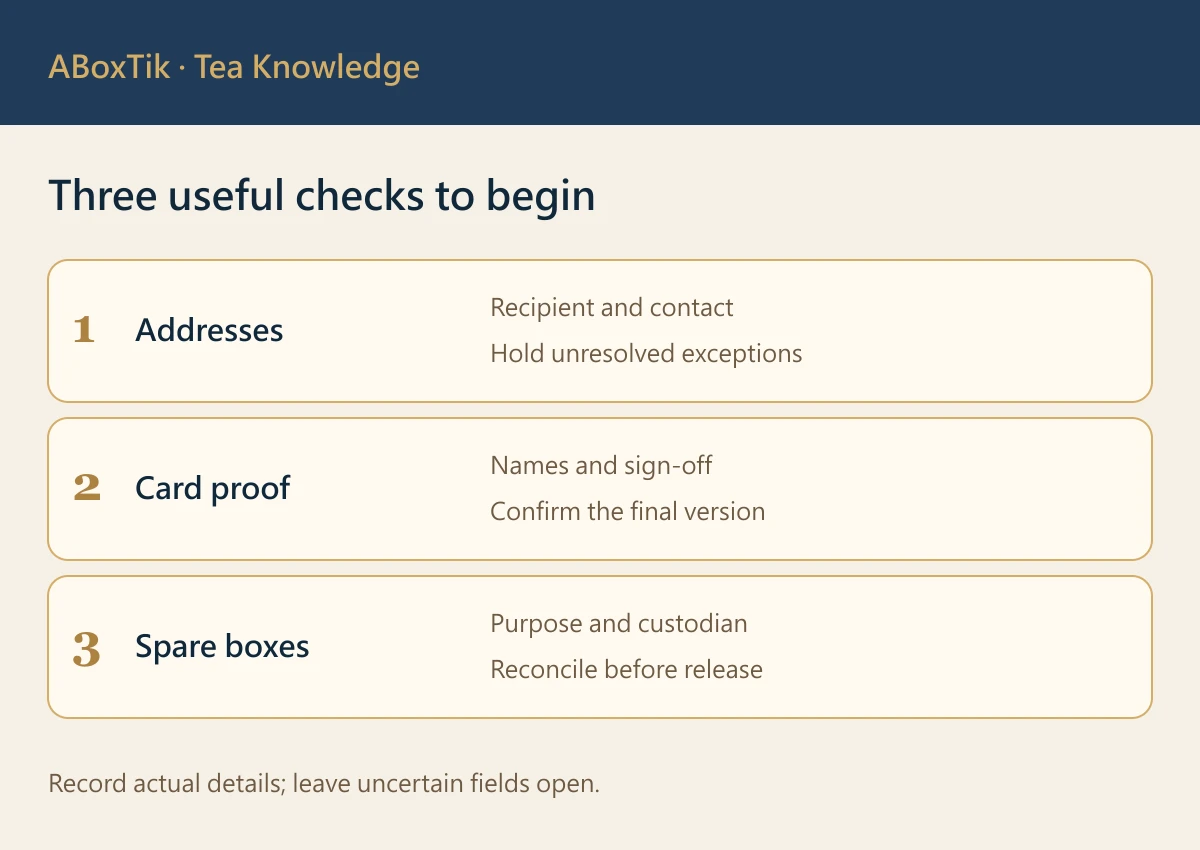
Check names and addresses in the order a label needs
Read each address aloud against the confirmed source, then check the recipient name, organisation or department, telephone contact where appropriate, postal code and special delivery instruction. Confirm whether a shared office address needs a named recipient or reception contact.
Chunghwa Posts current postal service pages provide address and postal-code lookup tools, envelope-writing examples, domestic and international services, and delivery enquiries. Use the carrier selected for the actual shipment to confirm its current label requirements; this article does not set a delivery promise.
Check postal information using the actual destination, not the sender’s memory. For a shipment outside the usual region, keep overseas gift preparation separate from the domestic checklist. The person who confirms the address should also identify any receiving window, reception name or instruction that the chosen carrier actually accepts.
Proof the card as a separate item
Treat the gift card as a small publication. Compare the greeting, recipient spelling, sender name, signature, job title, date, language and punctuation with the approved brief. Check a printed-size proof as well as an enlarged screen proof.
A card should identify the sender and express the intended thanks without carrying shipping, product or compliance duties. If wording changes after sign-off, create a new named proof. Use the earlier version is not a version-control system, however charming it may sound in a meeting.
For a branded card, use the logo and gift-card planning guide to check the sender’s presentation. Inspect the printed-size proof without enlarging it: a title can be spelled correctly yet be difficult to read. If two languages are included, compare names and the intended message rather than assuming a translation inherits approval automatically.
Make spare count a documented decision
A spare is a labelled response to a known dispatch risk: a late confirmed recipient, an address correction, a damaged outer carton or a failed handover. Record the reason, count, storage location and person permitted to release it.
Do not turn the spare count into a universal percentage. A locked list delivered to one office has different exposure from a changing list sent to many addresses. The quantity-planning guide covers recipient and delivery-unit logic; this final checklist only makes the chosen buffer traceable.
Keep the reasoning connected with quantity planning, while recording the final spare decision here. If one spare is used, update the reserve balance and the recipient row together. A spare box sitting beside the packing table is inventory, not permission for anyone nearby to send an extra gift.
Run the label-to-box reconciliation
Before packing, reconcile each label to one row in the dispatch sheet and one physical box. Use a two-person check where the project warrants it: one person reads the row, the other verifies label, card version and destination. Mark the row only after the parcel is closed.
Keep exceptions separate from completed rows. If a recipient changes office or a card is reprinted, return that row to the exception list and record what changed. This avoids a late edit being hidden inside a completed count.
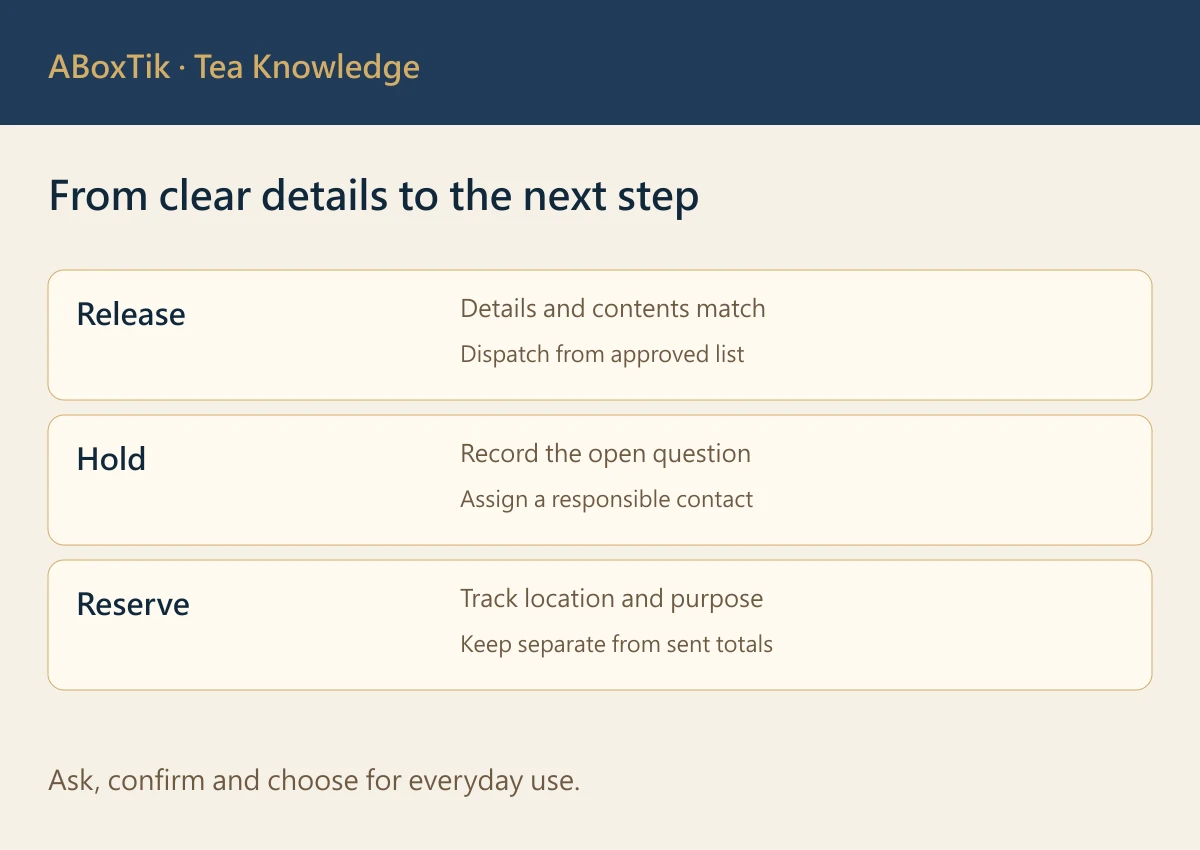
Use a hold-and-release worksheet for any parcel that cannot close cleanly: row number; recipient; reason for hold; missing confirmation; owner; next contact date; card status; box status; replacement or spare decision; and release approval. A hold is not a failure. It is the visible place where a team keeps an unresolved detail from travelling by accident.
| Row | Open issue | Owner | Release evidence |
|---|---|---|---|
| __ | Address / card / contents __ | __ | Confirmed version and date __ |
Confirm the actual contents before sealing: the current four-box tea selection and two-box tea-bag gift have different product specifications. A label that matches the correct person can still sit on the wrong assortment. Read the confirmed order, not a previous campaign’s photograph, and keep any gift-box selection change visible.
Use a final ten-minute desk check
Ask: Is there one current list? Are all addresses confirmed or visibly pending? Does every card proof match its row? Is every spare counted and controlled? Are labels, boxes and dispatch status reconciled? Does the delivery service and date still match the actual booking?
This checklist is deliberately narrow. Budget approvals, tea selection, custom packaging and lead-time estimates belong earlier in the project. Keeping the final desk check small lets the team notice what must be fixed today.
Example: a partner changes offices after labels are printed. Keep the original row as a record, mark the old label void, add the verified replacement address as a new controlled version, confirm the card still belongs to that recipient, and record whether a documented spare is released. Do not quietly overwrite the old address and lose the reason for the second parcel.
Use a short release line for every held parcel: what changed, who confirmed it, and which version may now be sent. A checkbox alone cannot explain the missing detail. Keep the current order or individual tea specification available when contents change, then repeat the relevant label, card and box checks instead of restarting unrelated procurement work.

Follow ABoxTik | Let the final details make the thanks easy to receive.
A clear final check leaves room for the gift itself
When the list and parcels agree, save the final version, store the exception log and share the dispatch owners contact internally. That record is useful if a colleague later asks what was sent, to whom, and which card text was used.
For broader planning, read corporate gift quantity planning and company logo tea gifts. A thoughtful gift is easier to receive when the practical details have already been handled quietly.
At handover, separate three outcomes: dispatched, held, and not proceeding. Each outcome needs a date and owner. A clean count of dispatched boxes is useful, but an honest held list is what keeps a late confirmation from becoming a duplicate shipment. Store the final file according to the organisation’s own data-retention practice, especially where contact details are involved.
Before the workday closes, give the list owner one short reconciliation: count sealed parcels, held rows, released spares and cancelled rows separately; then confirm that their total equals the controlled list. This takes only a few minutes and creates a useful answer when the next colleague asks for dispatch status.
Save one final file, keep exceptions visible and release documented spares only for their stated purpose. Those small habits make a year-end handover easier for sender and recipient alike.
Explore corporate gift quantity planning for the earlier counting decision, then return to the current product page before confirming any tea format or availability.
Related reading
- Corporate gift quantity planning: separate recipients from delivery units.
- Company logo tea gifts: proof a clear sender message.
- Overseas corporate tea gifts: use a separate handover checklist when destination requirements apply.
Sources
Sources checked 16 October 2026.