
Tea Knowledge
Handmade tea and quality control
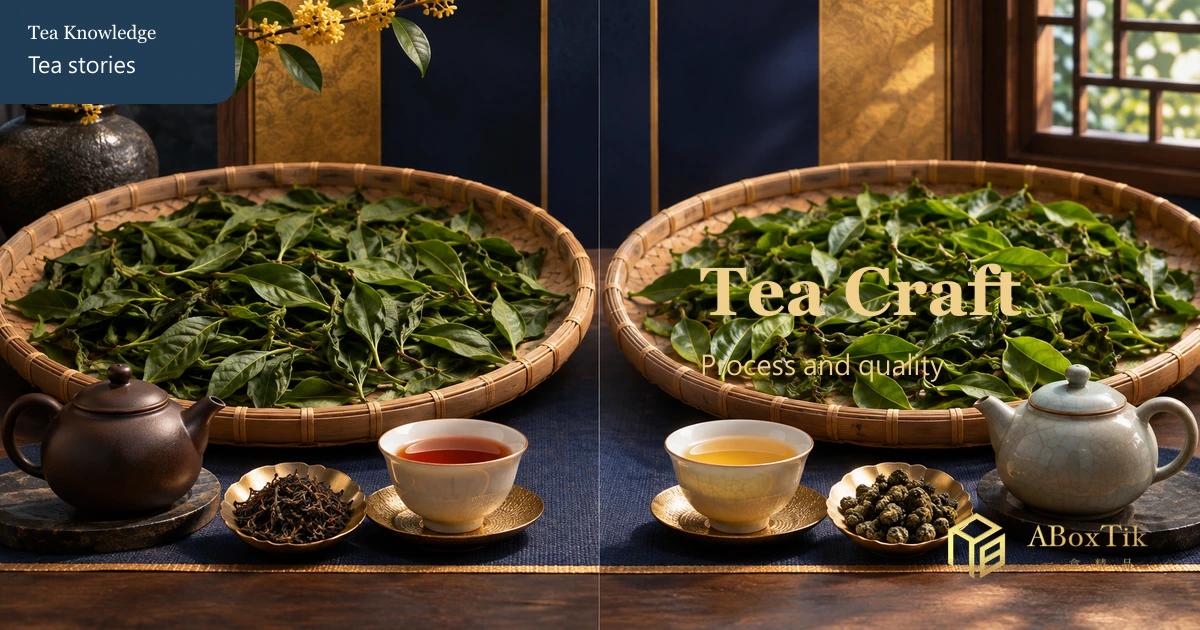
Look at the process and the cup
Handmade does not automatically mean better, and machinery does not eliminate skill. Leaf quality, process control, the maker’s decisions and storage all matter. Ask which step was handled in which way.
Compare three areas
Ask about the raw leaf and lot; identify which stages involve human judgement or equipment; then compare aroma, taste and consistency according to your preferences. Equipment also needs settings, monitoring and cleaning.
Read claims carefully
“Handmade” can describe different stages. Ask the producer what the term means for this tea and what information they can share. A single phrase does not establish every step or guarantee quality.
Choose for your routine
If the craft story matters, ask the maker. For everyday brewing, consider consistency and instructions too. Let your own cup have a vote.
Ask “which step is handmade?” before trusting the large type
“Handmade tea” may refer to hand picking, turning leaves during withering, manual agitation, hand rolling, stem removal, close manual supervision of roasting, or only final packing. Tea styles use different processes, and one lot can alternate between people and equipment. The useful questions are: which step, who performs it, where is machinery used, and what quality risk is that choice meant to control?
Machinery does not remove the maker. Equipment requires decisions about batch size, speed, time, temperature, pressure and stopping point, as well as cleaning, inspection and maintenance. Manual work is not a guarantee either. Unsuitable leaf, poor judgement, weak hygiene or inadequate drying can produce a poor result. Compare how this lot was managed and whether the cup is clean, coherent and consistent with its description.
Turn the process into control points for people and equipment
| Stage | What equipment may assist | Controls that still need explanation |
|---|---|---|
| Leaf and withering | Racks, warm air or environmental control for even moisture loss | Leaf condition, loading depth, turning, temperature, humidity and completion |
| Agitation or bruising | Drums move and rub leaves and redistribute moisture | Frequency, force, intervals, aroma and leaf condition |
| Fixation | Heated machinery supplies heat and movement to suppress enzyme action | Leaf state, temperature, time and discharge point |
| Rolling and shaping | Rollers and ball-rolling equipment supply force and repetition | Pressure, cycles, breaking clumps, damage and intended form |
| Drying or roasting | Dryers and roasters control heat and throughput | Layer depth, temperature curve, moisture, aroma and lot uniformity |
| Refining and packing | Sieving, optical sorting, destemming and weighing improve consistency | Foreign matter, fragments, lot identity, cleaning, labelling and barrier storage |
The Tea and Beverage Research Station explains that rolling machinery uses mechanical force to rub and shape leaves, dryers remove remaining moisture, and agitation machinery supports moisture redistribution and oxidation conditions. These are process functions, not evidence that machinery must produce ordinary tea. Its factory hygiene guidance also calls for equipment checks, control of foreign matter, clean spaces and process records.
Four kinds of evidence are more useful than “purely handmade”
Scope: can the seller say exactly where manual work occurs? Lot records: can date, raw material, settings or exception handling be traced? A producer need not disclose every proprietary parameter, but should be able to explain how the process remains controlled.
Hygiene and equipment: are contact surfaces clean, machinery checked and finished tea protected from moisture and odour? More hand contact is not automatically more prestigious; it also makes a clear hygiene procedure important. Finished tea: do name, origin, cultivar, process and lot information make sense, and are aroma, taste, liquor and leaf clean and broadly repeatable under similar brewing?
For the separate question of cost, use the premium tea price and value guide. This page does not decide how much “handmade” should cost. Labour may affect cost, while raw material, yield, refining, grading, packaging and service also contribute.
Use two tasting rounds to observe consistency without false attribution
Choose the same tea and lot, keep leaf, water, temperature, vessel and time similar, and repeat on another day. Record dry-leaf integrity, aroma cleanliness, strength, abrupt bitterness or astringency, finish and infused leaf. Differences can come from brewing, storage, sampling or attention. A handmade label does not prove that enjoyment came from hand rolling, and uniform appearance does not prove that quality came solely from machinery.
When comparing two different products, list raw material, tea type, season, origin, oxidation, roast and storage. If every condition differs, the bounded conclusion is “I preferred A under this preparation,” not “hand work beats machines.” Testing one processing step requires comparable raw material and processes—usually not a causal experiment a shopper can construct from two product pages.
Packaging language deserves the same calm check. “Small batch,” “artisan,” “traditional” and “master made” can be meaningful descriptions, but they are not interchangeable with a named processing step. Look for a nearby explanation rather than assuming that decorative wording describes the entire production line. A specific statement—such as manual sorting after machine rolling, or a maker adjusting agitation by leaf condition—gives you something that can be discussed and compared. A broad claim with no scope may still introduce a pleasant tea; it simply carries less information.
For an everyday purchase, start with the outcome you need. If several people will brew the tea at work, repeatable instructions and lot consistency may matter more than a romantic process story. If you are exploring craft decisions, buy a modest amount, brew it twice, and ask how the maker handled the stages that most shape that style. Neither choice is less sophisticated. The better choice is the one whose evidence, cup and practical use agree.
Also separate natural variation from preventable inconsistency. Seasonal leaf and attentive adjustment can create small changes in aroma or body without making a batch defective. By contrast, stale odour, foreign taint, uneven drying, unexplained scorching or a label that cannot identify the product are reasons to pause. This distinction keeps the review fair: craft is allowed to be responsive, while basic hygiene, traceability and truthful description should not depend on whether hands or machines performed the movement.
If the explanation remains vague, keep the purchase small and let a second brew answer more than the label. Curiosity is welcome; certainty does not need to be hurried.
Eight questions for the maker
- Which step does “handmade” describe?
- Which stages use equipment, and what does it control?
- Which leaf, aroma or moisture cues guide adjustments?
- What most often varies between lots?
- How are time, temperature, lots and exceptions recorded?
- How are equipment and contact surfaces cleaned and checked?
- How is finished tea refined, graded and stored?
- Which statements are traceable facts, and which are sensory impressions?
A good answer need not be crowded with jargon. “A person judges the leaf here, equipment keeps this stage even, and time changed for this lot” explains craft better than “century-old secret method.” To review current teas, visit the ABoxTik Taiwanese tea selection and check each product’s actual process and lot information. Do not add a handmade halo where the page is silent.
Sources
- Taiwan Tea and Beverage Research Station: tea-processing machinery
- Taiwan Tea and Beverage Research Station: hygiene and safety rules for tea factories
- Taiwan Tea and Beverage Research Station: common tea-processing equipment in Taiwan
Sources checked 11 November 2026. This page makes no all-handmade or quality-grade claim for a named product.