
Tea Bag
Why Does Premium Tea Cost More? A Value Guide
The price of tea holds days spent waiting for the right weather and the maker’s repeated decisions by touch, scent and time. When those details are visible, your budget can follow what you genuinely value.
A premium tea price usually reflects more than a famous name or high elevation. It may include the leaf and growing conditions, harvest and craft labour, sorting losses, traceability and grading, protective packaging, and the service that helps the tea reach you in good condition. A higher price does not automatically mean a better cup. Value becomes meaningful when you can verify it, notice it in the tea, and use it in the way you intended.
If two similar-looking tins carry very different prices, you do not need expert vocabulary before asking why. This guide separates the price into six practical areas. For the wider story of terroir, cultivars and craft, start with why Taiwanese tea is distinctive. For record prices and competition-tea stories, see the separate guide to Taiwan’s most expensive teas. Here, the question is simpler and more useful: is the tea in front of you worth its price for your purpose?
What makes up a premium tea price? Start with three layers
First separate the price into three layers: the tea itself, trustworthy information, and packaging or service. The first shapes what goes into the cup. The second reduces uncertainty about origin and quality claims. The third protects, portions, presents and delivers the tea. All three can have legitimate costs, but one should not pretend to be another.
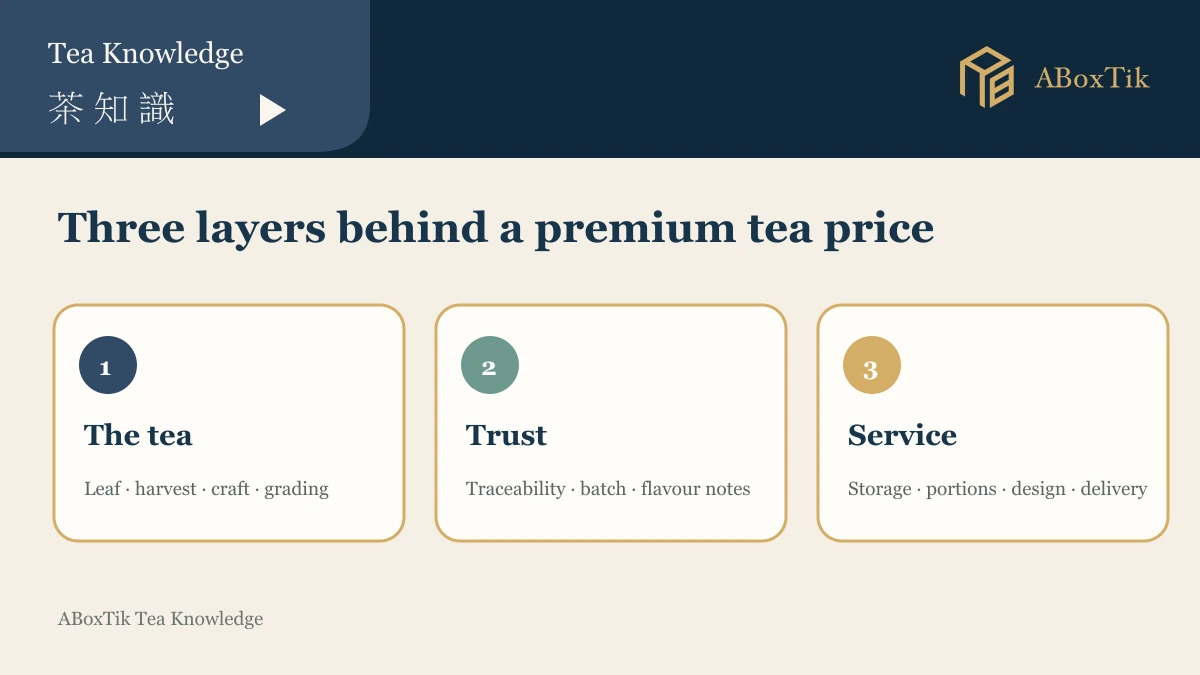
| Value layer | What you may be paying for | What to check |
|---|---|---|
| The tea | Raw leaf, harvest, processing, refinement, grading and batch losses | Origin, cultivar, season, method, leaf style and flavour description |
| Trustworthy information | Traceability, testing, certification, judging and batch records | A searchable code, the scope of a claim, a report or clear label |
| Packaging and service | Moisture and light protection, portioning, design, packing, delivery and guidance | Net tea weight, inner pack, storage advice and the service included |
A beautiful box can protect tea and make a gift feel complete, but it cannot replace origin, net weight or brewing information. Plain packaging does not prove that nearly all of the price went into the leaf, either. Once the three layers are visible, you no longer have to choose between “packaging has no value” and “the most elaborate box must contain the best tea.”
Six factors that can increase the price of premium tea
1. Origin and batch: scarcity is more than a place name
Climate, terrain, access and transport affect the way a garden is managed and how much it can produce. Different seasons, sites and batches within one region can still taste different. Taiwan’s Tea and Beverage Research Station explains that geographical certification marks help identify origin, and eligible teas also undergo sensory review. That information can strengthen trust, but it does not mean every tea from a named place will suit you, or that greater elevation guarantees greater quality. Explore the Taiwan tea regions guide and the Alishan regions comparison for more context.
2. Harvest and raw leaf: timing and selection matter more than a slogan
Harvest timing, tenderness, leaf integrity and later sorting all affect cost. Taiwan’s agricultural knowledge portal notes that mechanical harvesting can raise efficiency and reduce costs. This does not make machine-harvested tea inherently poor, and “hand-picked” does not make a tea inherently excellent. A better question is why a particular harvest method was chosen, what raw-leaf standard was used, and whether the finished tea is clean and balanced.
3. Making and refinement: much of the work is hidden
Withering, leaf agitation, heat-fixing, rolling, drying and roasting are not simply boxes to tick. A maker responds to the condition of the fresh leaf, temperature, humidity and aroma as the batch changes. Tea may then be destemmed, screened, refined, re-roasted or blended within a clearly defined lot. These steps add labour, energy and yield loss. At their best, they also bring cleaner aroma, better balance and greater consistency. Read more about tea withering and oolong oxidation and leaf agitation.
4. Grading and yield loss: not everything becomes the final lot
After refinement, tea can be evaluated by appearance, liquor colour, aroma, taste and infused leaf. The official TAGs framework combines traceability, safety, quality grading and flavour language, allowing buyers to choose by preference and budget. A grade is not a universal retail price. Its value is that a defined standard and result are made visible. If a label says only “supreme” without a batch, flavour description or judging basis, it is reasonable to ask for more detail.
5. Packaging and storage: protect the tea before decorating it
The Tea and Beverage Research Station identifies moisture, oxygen, light, temperature, time and surrounding odours as factors that can affect stored tea. A sealed, moisture-resistant and light-protective inner pack can therefore preserve what the maker achieved. An outer box, printing, bag and message card mainly serve presentation and gifting. Both may be useful, but they belong to different parts of the price. See the practical tea storage guide for the next step.
6. Brand and service: reducing uncertainty has value too
Clear product information, readable brewing instructions, batch support, small portions, gift assembly, delivery and after-sales help all require time. These services cannot turn ordinary leaf into fine tea, but they can help you choose the right format, store it well and brew it consistently. For a gift, the service layer matters more; use the separate tea gift box guide. Corporate customisation and multi-address delivery belong in the corporate tea gift budget guide.
A reassuring premium does not need mystery. It can explain the origin, work, quantity and storage, one detail at a time.
Does a high price mean better tea? Separate four common signals
- High elevation: it is an environmental clue, not a quality guarantee. Garden care, harvest, processing and storage still matter.
- Hand-picked: it may add labour and selective-harvest costs, but the raw-leaf standard and cup quality remain essential.
- A competition award: check the organiser, year, category, grade and whether the tea sold is the actual winning batch.
- Elaborate packaging: it may provide protection and gifting value, but it is not a substitute for evidence about the tea.
A cultivar name cannot be converted directly into a price, either. TTES No. 12 Jinxuan, for example, can express different styles according to origin, season, processing and roast. To compare what reaches your cup, follow the dry, hot and cool aroma sequence and keep repeatable notes instead of relying on “very fragrant” alone.
How can you compare two teas on the same budget?
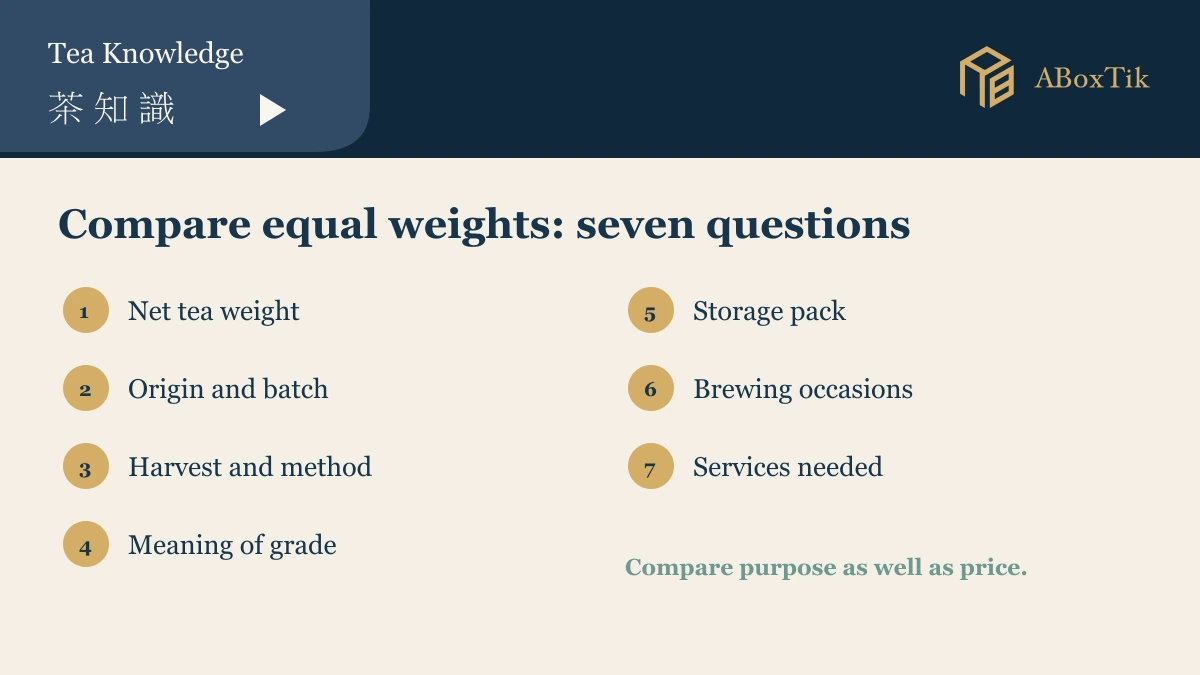
- Compare net tea weight: separate leaf weight, teabag count and total boxed weight.
- Confirm origin and batch: is it grown and made in Taiwan, Taiwanese-style tea, or merely packed in Taiwan? Can the claim be traced?
- Read the harvest and method: are season, harvest style, oxidation, roast and refinement explained clearly?
- Ask what the grade means: if it says selected, award-winning or limited, what are the standard, year, category and quantity?
- Inspect storage packaging: is the inner pack sealed and light-protective? Can you open it in portions that match your drinking pace?
- Estimate brewing occasions: use the recommended leaf amount or portion size to estimate how many sessions the tea provides.
- Count services last: do you need the box, bag, card, assembly, delivery or consultation included?
Two teas designed for different occasions do not need one universal winner. An office tea may need consistency, convenience and easy storage. A slow weekend session may place more value on batch character and repeated infusions. A gift also needs suitable presentation, information and delivery. The kindest choice is often the one that fits, not the one with the highest number on its label.
Premium tea price questions
What price per kilogram makes a tea premium?
There is no threshold that applies to every tea type, region, year and market. Teas of the same weight may differ because of season, batch, refinement, verification, packaging and retail service. Define the use and budget first, then compare the seven points above rather than searching for one universal price line.
Is competition tea always worth buying?
A competition result can provide information about a particular organiser, category, year and batch. It does not mean every awarded tea matches your taste. Confirm the seal or mark, winning lot, net weight and storage condition, then decide whether your purpose is drinking, gifting or collecting.
Does simple packaging mean more of the price went into the leaf?
Not necessarily. A simple exterior may still contain high-barrier inner packs, small portions or substantial service costs. An elaborate box may perform a genuine gifting function. Unless a seller publishes a supported cost breakdown, compare the actual contents instead of guessing a percentage.
Does traceability or an origin mark guarantee better flavour?
Traceability and origin marks primarily help confirm source, scope and responsibility; some grading systems also include sensory evaluation. They reduce information uncertainty, but your preferred flavour still depends on useful tasting notes, a small sample when available, and your own brewing.

Follow ABoxTik | Spend on an origin you can understand, craft you can taste, and the care that keeps tea well until it reaches the cup.
Understand the price, then leave room for the tea that fits
You do not need to become an expert before choosing premium tea. Ask about origin and batch, raw leaf and harvest, making and refinement, grading, storage packaging and service. Then return to your own cup, time and flavour preferences. ABoxTik hopes a premium tea price can feel less like a gate and more like a clear explanation you can compare with confidence.
To compare Taiwanese whole-leaf teas, browse the ABoxTik tea collection. If you would rather build a flavour map across several teas, consider the four-tea Taiwanese collection. Product names, specifications, prices and availability remain subject to the current product page. You can also read about ABoxTik and our way of bringing Taiwanese terroir, craft and design into one box.
Sources
- Taiwan Tea and Beverage Research Station: TAGs traceable-tea classification and grading (accessed 2026-09-10)
- Taiwan Tea and Beverage Research Station: tea geographical certification marks (accessed 2026-09-10)
- Taiwan Agriculture and Food Agency: domestic-tea traceability policy (accessed 2026-09-10)
- Taiwan Agricultural Knowledge Portal: mechanical and hand harvesting (accessed 2026-09-10)
- Taiwan Tea and Beverage Research Station: tea packaging and storage (accessed 2026-09-10)