
Tea Knowledge
Tea Texture: Roundness and Body
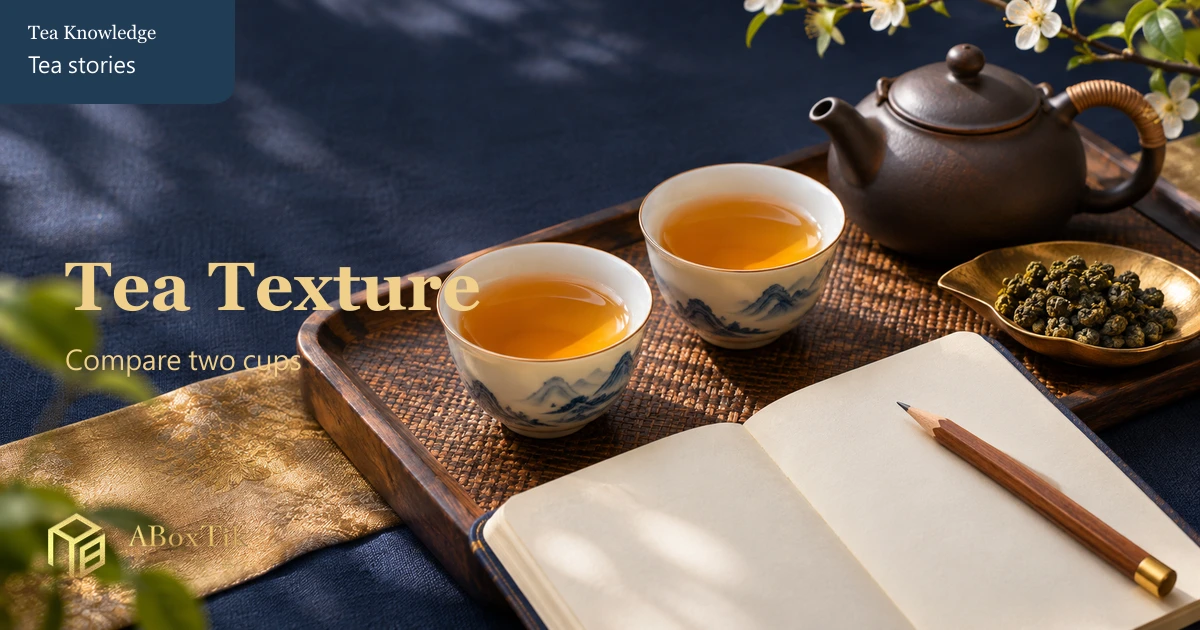
Two useful observations
Roundness can describe a smooth, integrated impression; body can describe the weight or persistence felt in the mouth. Neither term has a universal score, and a tea may feel round without feeling heavy.
Set up two cups
Use matching cups and record tea, quantity, water, temperature and time. Compare the same tea at two strengths, starting with the lighter cup and drinking water between tastes. Take small sips and notice texture before reaching for a label.
Make a comparison card
Give cups A and B their own columns. Note smoothness, perceived weight, astringency and finish. Begin with relative terms such as lighter or more noticeable; compare at similar temperatures.
Connect words to brewing
Check which preparation variables differ. Next time change only one, such as steeping time, and record the result. An enjoyable cup does not need a long vocabulary to justify it.
Questions
Does body mean bitterness? They are separate observations. Does roundness mean no astringency? Record both if both are present.
Try again later
Keep the card and repeat under similar conditions. Your own vocabulary can evolve.
Separate roundness, body and astringency before choosing a favourite
“Round” and “full-bodied” can describe the same cup, but they answer different questions. Roundness is a personal way to note whether the transition from entry to finish feels smooth, integrated and free of abrupt edges. Body describes the perceived weight or presence of the liquor in the mouth. Astringency is the drying or contracting sensation that may appear on the tongue, gums or cheeks. Intensity and preference belong in separate columns: a tea can feel full yet gentle, light yet angular, or rounded with a noticeable drying finish.
| Observation | Question to ask | Do not assume |
|---|---|---|
| Roundness | Do the sensations connect smoothly from entry to finish? | Round automatically means thick or sweet |
| Body | How much weight or presence does the liquor seem to have? | More body automatically means higher quality |
| Astringency | Does the mouth feel drier, tighter or more frictional? | Astringency is identical to bitterness |
| Finish | What remains, where and for how long? | A long finish must be pleasant |
The Taiwan Tea and Beverage Research Station’s sensory materials treat aroma, taste and mouthfeel as related but separable observations. Use the vocabulary as a communication aid, not as a laboratory measurement or a grade. If a sensation is unclear, “not identified this round” is more useful than choosing the fanciest word on the page.
Build a two-cup comparison with one controlled change
Use two clean, odour-free cups of the same shape. The clearest beginner exercise uses the same tea, water, vessel and dose, changing only one brewing factor—often infusion time. Follow the tea’s current guidance for Cup A; make a modest, recorded change for Cup B. Pour equal tasting portions and wait until both cups are at a similarly comfortable temperature. This does not predict that the longer brew will always be fuller or more astringent; it simply gives the comparison an address.
- Write tea, lot or package, date, dose, water, temperature, vessel and time.
- Taste Cup A first, then Cup B; use water and a short pause between them.
- On a second pass, reverse the order if enough tea remains.
- Describe entry, mid-palate, drying sensation and finish before writing preference.
- Choose one setting to repeat on another day.
If comparing two different teas, brew each according to its own useful starting guidance and admit that cultivar, processing, age and storage differ. That exercise answers “which cup feels more rounded or fuller to me today,” not “which single variable caused the difference.” Controlled practice and product comparison are both valuable; they simply should not borrow each other’s certainty.
To reduce expectation, ask a friend to label the cups A and B without telling you which setting is which, then reveal them after the first notes. This is still a home exercise, not a formal blinded study, but it can show when “the longer brew must be heavier” arrived before the tea did. If practising alone, cover the written settings and alternate which cup is tasted first on another day.
Use an anchored card instead of a floating score
| Field | Cup A | Cup B |
|---|---|---|
| Entry: smooth / edged / unclear | ___ | ___ |
| Body: light / medium / full, for this pair | ___ | ___ |
| Astringency: location and duration | ___ | ___ |
| Finish: what remains after swallowing | ___ | ___ |
| Preference and one reason | ___ | ___ |
A 1–5 scale can help only when it is anchored to the current pair: 1 means the lighter or less evident end of today’s comparison, and 5 means the more evident end. It is not an instrument reading and should not be used to rank another person’s palate. Add one sentence—“B feels heavier, while A connects more smoothly”—so the number retains meaning after the cups are gone.
Temperature deserves its own note. Very hot tea may be uncomfortable to assess, while cooling changes aroma and tactile perception. Compare at a comfortable, similar temperature and record if the impression changes later. Do not repeatedly sip a cup that feels unpleasant merely to finish the card; a sensory exercise is allowed to stop.
Diagnose the next brew, not the entire tea
If Cup B feels heavier but also rougher, the next question is not “Is this a bad tea?” Repeat with fresh tea and alter one factor. Shorten time while keeping dose and water fixed, or reduce dose while keeping time fixed. Reused leaves already carry the history of the previous infusion, so they cannot serve as a clean one-variable control.
If both cups feel similar, that is a valid result. The chosen change may be too small for this tea or for today’s attention, or body may not be the most noticeable contrast. Keep the record and try another day. If an unfamiliar odour or persistent discomfort appears across careful fresh brews, preserve the package and brewing notes and ask the seller rather than diagnosing processing from mouthfeel alone.
Keep this guide distinct from the wider flavour notebook
The Taiwan tea flavour-wheel notebook helps separate aroma, taste and mouthfeel and find broader vocabulary. The bitterness and astringency guide isolates those two sensations and troubleshooting. The three-stage aroma guide follows dry, hot and cooling aroma. This page owns a narrower task: compare roundness and body through a two-cup texture card with one controlled change.
Browse the ABoxTik Taiwanese tea selection and use current package guidance when choosing a practice tea. The aim is not to collect impressive adjectives. If one note helps the next cup become easier to understand, the vocabulary has already earned its seat at the table.
Sources
- Taiwan Tea and Beverage Research Station: introduction to tea sensory evaluation
- Taiwan Tea and Beverage Research Station: Taiwan specialty tea flavour wheel
- Taiwan Tea and Beverage Research Station: astringency in tea
Sources checked 11 November 2026. The card records personal relative perception; it is not a chemical measurement, competition score or product grade.