
Tea Knowledge
Taiwan Ceramic Art: From Everyday Ware to Contemporary Practice
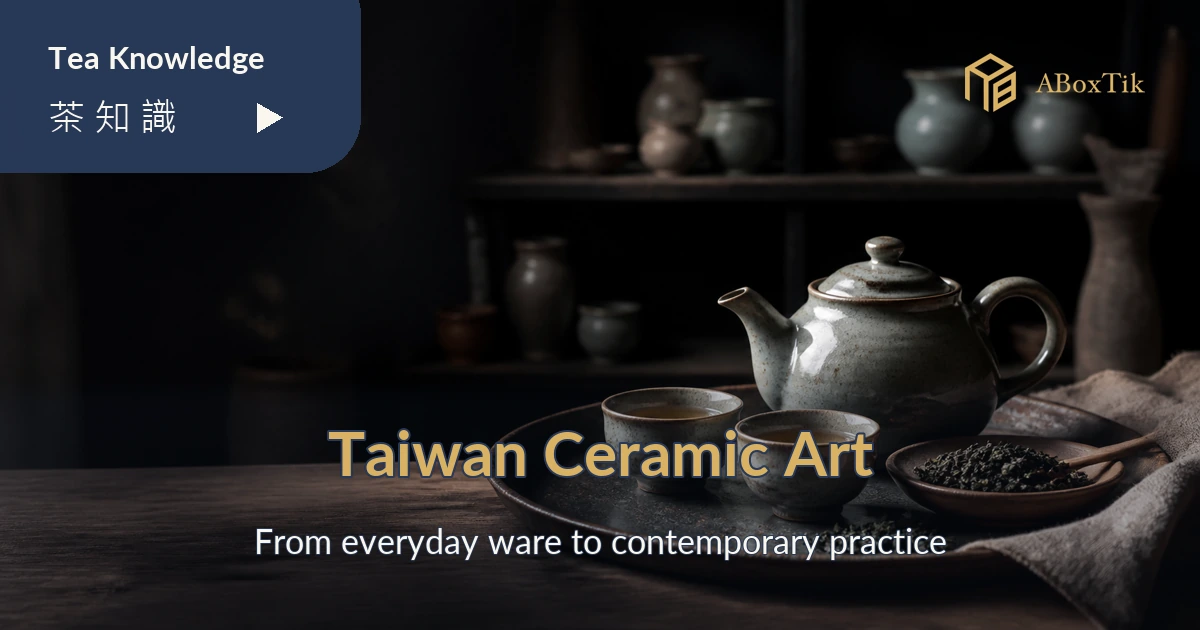
Clay becomes a vessel through hand, wheel and fire. It holds more than warmth: it holds the time in which an island made daily use into culture.
Taiwan ceramic art is not one style or one straight line of progress. Official museum and craft-research accounts connect prehistoric pottery, Indigenous ceramic traditions, migrant technologies, regional kilns, modern factories, studio practice and contemporary art. A tea cup can therefore be read as more than a material choice: clay, glaze, forming, firing, use and the maker’s decisions all meet in the hand.
This is a cultural-history route, not an appraisal of any individual object. For vessel handling, read our gaiwan versus teapot guide; for practical material comparison, see how to choose a teapot material.
The same distinction helps when learning tea. A vessel never replaces the leaf, water or method: our introduction to what makes Taiwanese tea distinctive supplies the broader tea context, while the tea brewing guide keeps attention on repeatable preparation.
Where does Taiwan ceramic art begin?
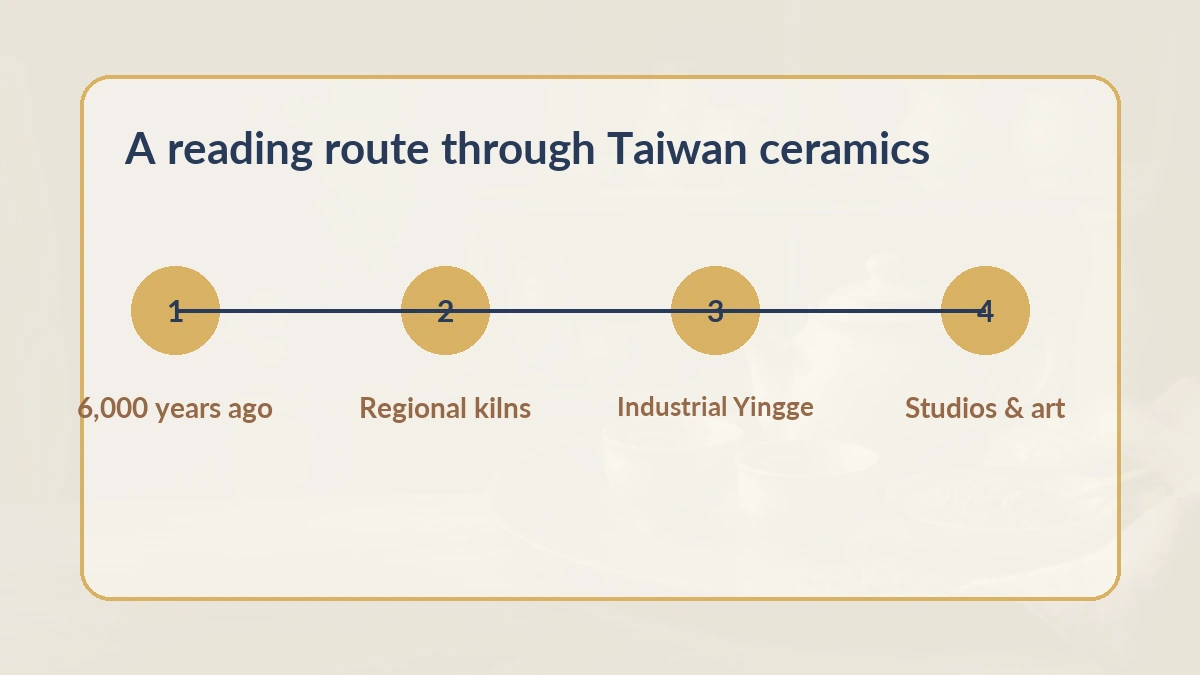
Yingge Ceramics Museum notes that pottery-making in Taiwan may begin with the Dapenkeng culture around 6,000 years ago. Prehistoric forms, decorations and uses point to needs such as holding water, cooking and ritual. The museum also places Indigenous ceramic cultures within this broad history. That framing should not flatten distinct communities into a single “Taiwanese style”: a museum overview is a map, while a specific community or object deserves its own sources and voices.
Regional kilns made objects for living
The National Taiwan Craft Research and Development Institute links ceramics with settlement, construction and daily life. Building demand supported brick and tile production; sugar processing also needed ceramic containers. By the nineteenth century, kiln industries in Nantou, Puli and Zhushan made jars, vats, basins and bowls, while northern Yingge developed traditional ceramic-container production through Fujian-linked techniques.
This matters because craft did not begin as decoration. Capacity, durability, stacking, repair and local use were often the first questions. When looking at a modest vessel today, ask what task it was designed to repeat and whose life it entered.
That question is useful at a tea table too. A compact pot and a small cup can support close tasting, whereas a larger serving vessel can make sharing easier. Neither arrangement is more authentic. Let the tea and the occasion lead; ABoxTik’s tea aroma guide is one way to notice change without treating equipment as a shortcut to expertise.
Technology and industry changed the kiln
Institutional histories describe Japanese-period raw-material surveys, technical change and new kiln technologies. After the war, Beitou, Yingge and Miaoli continued with inherited facilities and expertise while modernising production. The story is not simply “handmade became better”: labour, fuel, supply chains, markets and technology were continually reorganised.
In Yingge, twentieth-century industrialisation brought a connected chain of materials, equipment, processing, wholesale and retail. The museum records household, architectural, industrial and art ceramics in the same region. A handmade mark is meaningful, but the less visible work of kiln operation, material preparation and distribution is part of craft too.
This fuller view also makes room for tea’s own work. Leaf cultivation and processing shape what arrives in the cup; the oolong oxidation and leaf-handling process explains why fragrance and texture should not automatically be credited to the pot. A cup frames attention, but it does not erase origin or craft in the tea itself.
Why Yingge is a ceramic centre
Yingge’s more than two centuries of ceramic history reflect suitable clay, geography and industrial clustering. As market competition intensified late in the twentieth century, traditional production changed. Studios, education, cultural spaces and exhibitions offered other ways to continue ceramic knowledge. Industry and art are not opposites here; manufacturing memory and individual practice can meet under new conditions.
For a visitor, the useful habit is to move slowly between display and use. Read a label, notice whether an object is intended for handling, and ask before photographing or touching. At home, a simple tea setting can be enough: a familiar loose-leaf tea from the Taiwan tea collection, matched cups, and time to rinse and dry the vessel properly.
From useful ware to contemporary art
Everyday ware asks whether it can be used dependably. Contemporary ceramic art may also ask questions about body, memory, land, space or material experiment. Neither is automatically higher. A cup can have a strong artistic voice through proportion, glaze and touch; a ceramic artwork that cannot brew tea may still change how we see form.
Yingge Ceramics Museum opened in 2000, and its Taiwan International Ceramics Biennale began in 2004. Such platforms connect makers and audiences internationally without requiring every ceramic work to become a museum object.
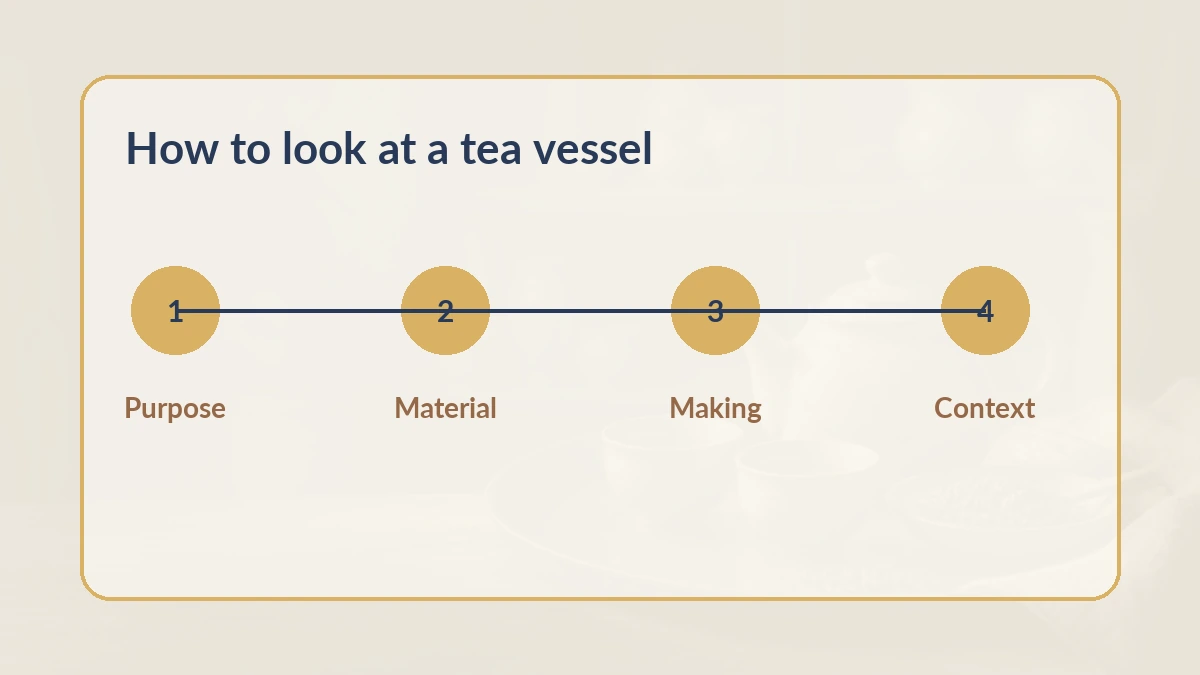
Four questions for looking at a tea vessel
- What is it for? A pot, cup, vase, sculpture and display object have different conditions of use.
- What do material and surface tell you? Notice clay colour, glaze and touch; do not infer everything from a photo.
- How was it made? Wheel throwing, hand building, moulding and firing leave different clues. Ask the maker when uncertain.
- What context holds it? Place, studio, exhibition and a user’s daily practice all shape meaning.
This is ABoxTik editorial guidance, not an authentication formula. When an object contacts food or hot water, follow the maker’s or seller’s stated material, care and use information.
If the vessel is a gift, the same restraint matters. It is kinder to consider whether the recipient has a way to brew, clean and store it than to assume that a handmade object fits every routine. Pairing an object with a clearly explained tea gift can offer a gentle entry point; our tea gift guide begins with the recipient’s habits rather than price alone.
Let Taiwanese tea meet craft without making craft a myth
Tea offers a slow way to look: notice weight and rim, the pace of pouring and the surface after washing. These are personal observations, not proof that one clay always makes tea taste better. Use a familiar tea and a repeatable method if you want to compare experience; our tea aroma guide can help build that attention.
A useful record can stay modest: note the tea, water temperature, vessel and one observation after the first and third infusion. Over time, the notes distinguish a repeatable change from a one-off impression. They also keep the conversation with a maker open, because care advice and intended use remain more reliable than a material myth.

Follow a Box of Tea|A vessel gives tea a texture in the hand; learning where it comes from adds another layer of time to daily life.
Keep exploring Taiwan through one vessel
Taiwan’s ceramic story moves through prehistoric and diverse community traditions, regional kiln industries, industrial transformation, studios and contemporary practice. Start with appreciation, then ask about intended use, material and care. Explore ABoxTik’s Taiwanese teaware and craft; live product details always belong to the current product page.
ABoxTik’s purpose is to make these conversations hospitable rather than exclusive: tea, craft and gift-giving can begin with a question, not a test of connoisseurship. Read our story for the brand context, then return to the maker’s own information whenever a specific ceramic work asks for closer attention.
Nor does a carefully made vessel require a rare tea to deserve attention. Our guide to what makes a tea genuinely rare separates limited supply from ordinary quality signals; that same care with language helps keep craft appreciation grounded.
Sources
- NTCRI: Ceramics (checked 2026-09-01)
- Yingge Ceramics Museum: A pottery town (checked 2026-09-01)
- Yingge Ceramics Museum: A journey through time (checked 2026-09-01)
- Yingge Ceramics Museum: Museum history (checked 2026-09-01)
- Taiwan International Ceramics Biennale (checked 2026-09-01)