
Tea Knowledge
What Is the Best Teapot Material? Clay, Porcelain, Glass and Metal Compared
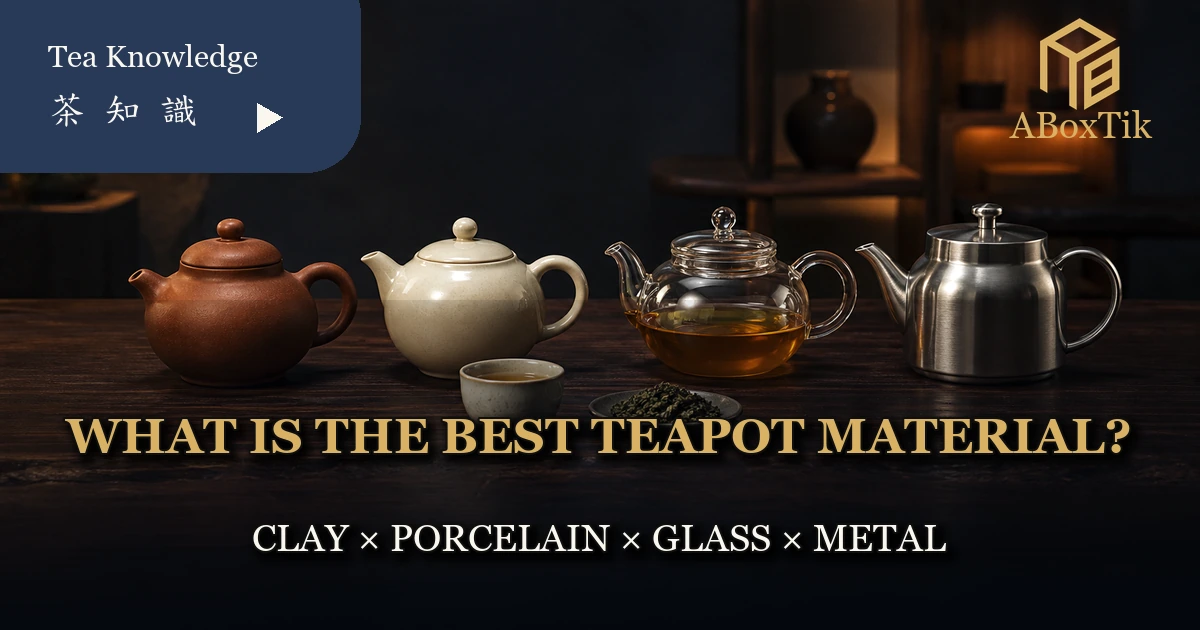
A vessel does not choose the tea for you. It changes what you can see, how quickly the liquor cools and whether brewing feels easy enough to repeat tomorrow.
The best teapot material is not a universal winner. Clay varies by glaze, body and firing. Glazed porcelain provides a practical neutral baseline. Glass keeps the leaves and liquor visible. Food-grade metal is often chosen for durability and travel. Wall thickness, volume, shape, lid fit, pour speed, preheating and infusion time can matter as much as the material label.
Begin with your routine. Do you rotate several Taiwanese teas, study leaf expansion, dedicate one pot to a familiar roasted oolong or brew at the office? If you are still choosing between vessel shapes, read our gaiwan vs teapot guide. This article keeps the teapot shape constant and asks a narrower question: which material and construction suit the way you brew?
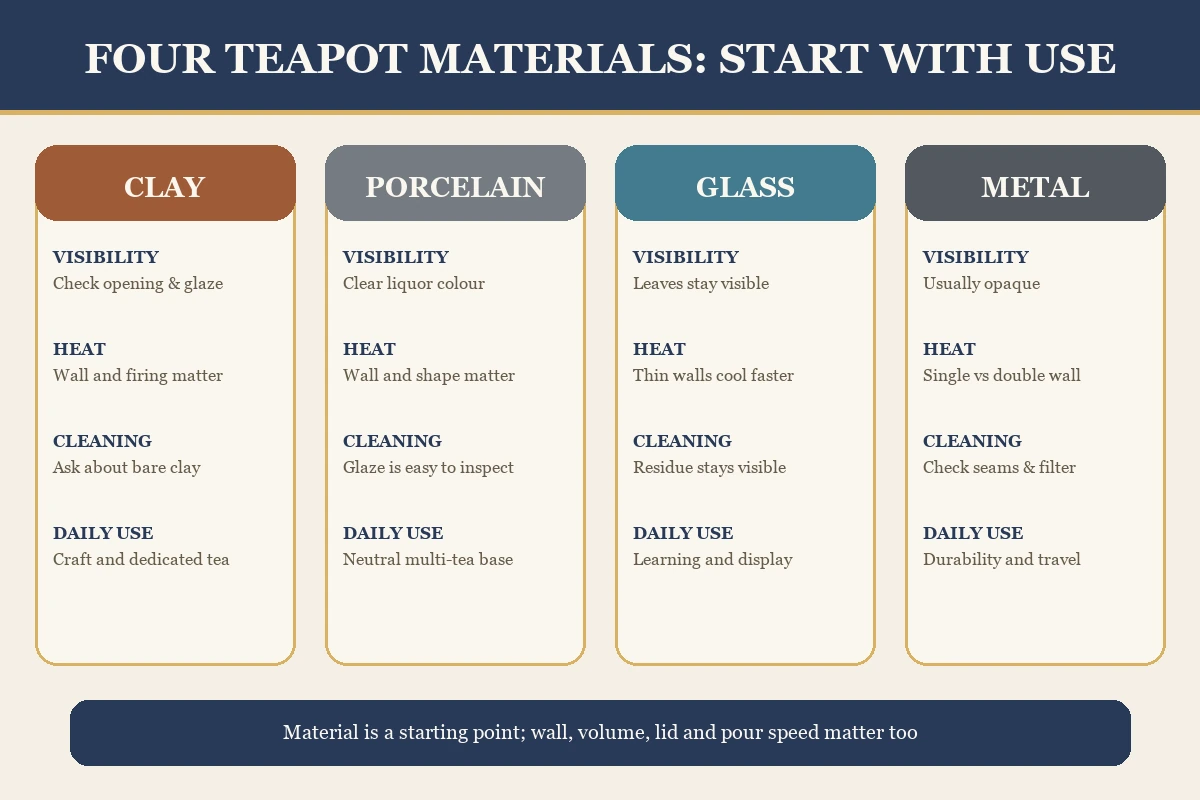
Best teapot material: compare four practical starting points
| Material | Useful strength | Ask before buying | Good starting use |
|---|---|---|---|
| Clay | Wide range of tactile craft surfaces | Glaze, food-contact use, firing, cleaning and thermal limits | A known tea and an interest in the individual maker’s work |
| Porcelain | Pale glazed interiors show liquor colour | Wall, volume, lid fit, pour and handle temperature | Rotating teas and building a repeatable baseline |
| Glass | Leaves, colour and residue remain visible | Glass type, heat guidance, handle and thermal-shock care | Learning, display brewing, botanicals and cold brew |
| Metal | Impact resistance and portability | Food-grade material, single or double wall, seams and filter | Office, travel, outdoor or larger-volume service |
This is a screening table, not a flavour verdict. Thick glass can retain heat differently from thin porcelain; a vacuum-insulated metal pot cannot be compared with a single-wall version by material name alone. Keep construction and pouring in the picture.
Clay vs porcelain teapots: glaze and construction come first
“Ceramic” is an umbrella term. An unglazed clay body may retain odour or residue differently depending on porosity, firing and use. A glazed surface separates the liquor from the body. Porcelain is generally dense and glazed, which makes a pale interior easy to inspect, but a porcelain pot can still have a slow filter, awkward handle or damaged glaze.
Taiwan’s food-container guidance advises consumers to choose ceramic ware from a clear source and to replace items with damaged food-contact surfaces. That does not make handmade clay something to fear. It means craft questions and food-use questions belong together: ask the maker whether the piece is intended for hot beverages, how it was finished, what temperature change it can tolerate and how it should be cleaned.
If one pot must rotate through floral pouchong, high-mountain oolong and black tea, pale glazed porcelain is an understandable baseline. If you already know a particular Dong Ding oolong and want to explore Taiwanese craft, browse ABoxTik’s teaware collection, then judge the specific work rather than relying on a clay legend.
Glass teapots: visibility without a simple heat rule
Glass offers information. You can watch rolled oolong open, see fine fragments approach a filter and notice scale or tea film before it becomes a cleaning problem. That makes glass useful for teaching, comparing leaf shape and connecting visual changes with the dry, hot and spent-leaf aroma sequence.
“Glass always cools fastest” is still too broad. Wall thickness, volume, lid, room temperature, preheating and double-wall construction all change heat behaviour. Follow the product’s heat and temperature-difference guidance; do not assume every transparent pot tolerates boiling water straight from a cold surface. Retire a pot with cracks, chips or a loose handle.
Glass can be especially satisfying for flowering botanicals, cold brew and open-leaf tea. For broken leaves or a pyramid tea bag, check whether the filter and opening let you remove the tea on time instead of extending the infusion for appearance.
Metal teapots: look beyond durability
Food-grade stainless steel is common at work and on the road because it resists impact and can be made in many volumes. Construction changes the experience. A single wall can transfer heat quickly to the exterior; a double wall or vacuum layer may hold temperature for much longer. Check the handle, lid retention, interior seams and whether the filter can be removed and cleaned.
Some drinkers report a metallic note while others do not. New-product residue, a filter, a seam, cleaning, long heat retention or an over-concentrated infusion can all influence that perception. Clean the pot as directed, test it with hot water, then compare the same tea in another vessel. Persistent odour, rust, coating loss or damaged joints are reasons to stop using the item rather than mask it with tea.
Run a 90-second empty-pot check before buying
- Read the label: confirm food-contact use, material, volume, heat guidance, cleaning and exclusions.
- Add water and grip: an empty pot can feel fine but strain the wrist when full. Check handle and lid stability.
- Watch the stream: use room-temperature water to test start, flow, stop and full decanting.
- Check drips: observe the spout, lid and seams after the stream stops.
- Plan cleaning: can a hand, brush or water jet reach the wall, spout and filter?
- Inspect damage: cracks, chips, glaze loss, rust, loose handles or persistent odour are not cosmetic details.
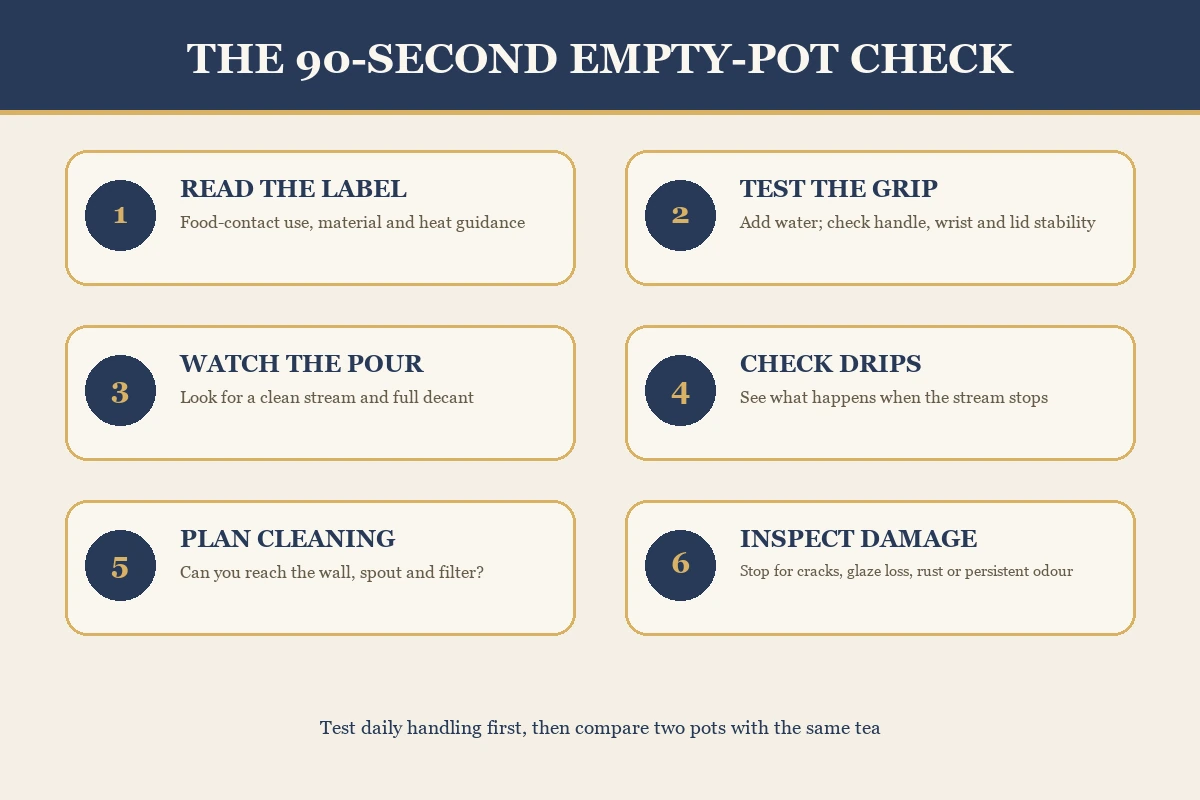
These checks are more useful than tapping a pot, judging price alone or asking how long it must be “seasoned.” For one to three people, 100–150 ml is a common starting range, but your cups, leaf expansion and whether one round divides evenly are better guides.
How to compare two teapots fairly with one tea
Taiwan’s Tea and Beverage Research Station uses white porcelain, fixed leaf weight, water volume and time to make professional sensory comparisons more consistent. A home test is not an ISO evaluation, but it can borrow the principle:
- Mix one packet gently and weigh two equal leaf portions.
- Measure each pot’s effective volume and keep the tea-to-water ratio equal.
- Use one kettle and the same starting temperature; preheat both or neither.
- Time from the same point and decant both pots completely.
- Taste from matching cups before seeing the vessel. Note aroma clarity, strength, texture, finish and desire for another cup.
- On the next round, change one variable only—perhaps begin pouring earlier from the slower pot.
A peer-reviewed study compared the chemical composition of oolong liquor held in six teapot materials. It found some differences, but not every comparison was statistically significant, and the authors called for more long-term work. That supports testing materials; it does not support “this pot is always more fragrant or healthier.” Read our guide to oolong oxidation and leaf handling so that a production difference is not automatically credited to the pot.
Four drinkers, four sensible starting materials
- First main pot, many teas: begin with pale glazed porcelain for visibility and easy cleaning.
- Leaf study and visual brewing: choose glass with clear heat guidance and a secure handle.
- Daily commute or office: choose food-grade metal after checking wall construction, filter and grip.
- Known tea and Taiwanese craft interest: choose a traceable clay piece and ask the maker about glaze, firing, use and care.
If the pot is a gift, consider whether the recipient already owns cups, a sharing pitcher and suitable cleaning space. Pair the decision with our premium tea gift guide and ABoxTik story, while checking current product material, stock, price and delivery details on the live page.
Teapot material FAQ
Which teapot material is easiest for a beginner?
Pale glazed porcelain is a practical baseline when you rotate teas because the interior is easy to inspect and clean. It is not the right choice if the handle, volume or pour does not fit your hand.
Must an unglazed clay pot be dedicated to one tea?
Not as a universal rule. The answer depends on body, firing, porosity, existing odour, cleaning and your flavour goal. Follow the maker’s care advice and verify with your own controlled tasting.
Can every glass teapot take boiling water?
No assumption should replace the manufacturer’s heat and thermal-shock guidance. Avoid sudden temperature change unless the product explicitly supports it, and stop using cracked or chipped glass.
Does metal always make tea taste metallic?
No. Experiences vary, and residue, filters, seams, cleaning, heat retention or brew concentration may contribute. Start with a hot-water test and a same-tea comparison.

Follow a Box of Tea|A good pot need not win a legend. It should make pouring, sharing and cleaning dependable enough to become part of daily life.
Bring material back to the hand
Teapot material is the first layer, not the final answer. Confirm food-contact use, intact surfaces and cleanability; then judge volume, wall, lid, pour and routine. Finally, compare with one familiar tea. Explore ABoxTik’s Taiwanese teaware and craft or begin with a familiar Taiwanese loose-leaf tea. The right pot does not have to win an argument—it has to work reliably in your day.
Sources
- Tea and Beverage Research Station: Introduction to tea sensory evaluation (checked 2026-09-01)
- Liao et al.: Effect of teapot materials on the chemical composition of oolong tea infusions (checked 2026-09-01)
- Taiwan FDA: Food-container materials guide (checked 2026-09-01)
- National Taiwan Craft Research and Development Institute: Selecting Vessels project (checked 2026-09-01)