
ABoxTik Tea, Tea, Tea Knowledge
How to Choose a Tea Gift Box: 7 Questions Before You Buy
A tea gift should not prescribe a new life. It should notice the cup, the hour, and the rituals already there—then place a Taiwanese landscape inside a box that belongs.
How to choose a tea gift box: begin with the recipient, not the price tag. Ask when and how they drink tea, whether they use bags or loose leaf, which aromas feel familiar, whether caffeine or ingredients matter, how many people will share the gift, what the occasion needs to communicate, and how the tea will be delivered and stored. Those seven answers will tell you whether to choose two contrasting teas, a four-profile assortment, one familiar loose-leaf tea, or a tea-and-craft presentation.
This is ABoxTik’s general tea-gift pillar guide. Our article on why tea carries meaning as a gift explores cultural context; separate guides address birthdays, Mid-Autumn gatherings, and corporate procurement. Here, the aim is practical: make a thoughtful choice even when you do not know every preference.
How to choose a tea gift box: ask these seven questions
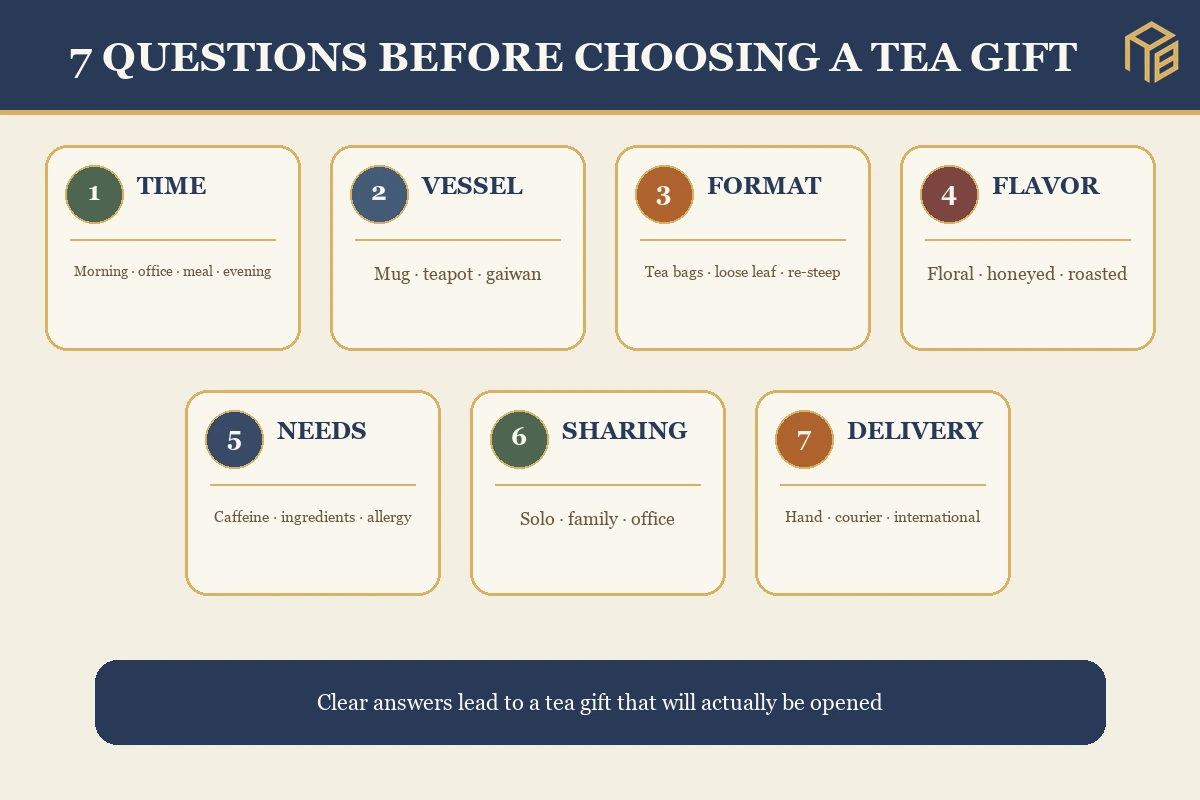
| Question | What it reveals | Safer direction |
|---|---|---|
| 1. When do they drink tea? | Morning, office, meals, evening, or a weekend tea table | Match convenience and flavor intensity without promising effects |
| 2. What do they brew with? | Mug, flask, teapot, gaiwan, or a full tea setup | Choose individual bags when equipment is limited |
| 3. Bags or loose leaf? | Speed, portability, leaf-opening, or repeated infusions | Choose for routine; do not equate format with quality |
| 4. Which aromas do they enjoy? | Floral, creamy-sweet, honeyed fruit, or roasted warmth | Start with familiarity and add one contrasting profile |
| 5. Do caffeine or ingredients matter? | Avoidances, allergies, medication, or personal limits | Read ingredients; never infer from color or marketing names |
| 6. Who will share it? | One person, a couple, family, team, or international guests | Match the number of profiles and portions to real users |
| 7. How will it travel and keep? | Hand delivery, multiple addresses, overseas shipping, storage time | Check dimensions, timing, documents, sealing, and light protection |
The order can change, but do not skip brewing method and audience. A large gift may look complete yet remain unopened if it requires equipment the recipient does not own or contains more tea than they can reasonably use.
Question one: when and with what do they brew?
Daily observation is often more useful than asking for a favorite tea name. Someone with only a mug and kettle will usually benefit from clear portions and few steps. A person who already uses a teapot, fairness pitcher, or gaiwan may care about leaf opening, infusion changes, and water control. If the equipment question is new to you, compare a gaiwan and teapot for everyday brewing.
Individually wrapped tea travels well between home, office, and hotel rooms. Loose leaf can be a more engaging choice for someone who deliberately makes time to brew. Neither routine is more sophisticated; a useful present respects the routine that already exists.
Question two: should the gift contain tea bags or loose leaf?
Tea bags offer portioning, portability, and easy sharing. Loose leaf allows the drinker to adjust leaf quantity and observe how a tea changes over several infusions. Format alone does not establish quality: examine origin, cultivar, leaf material, processing, packaging, and the resulting cup. Our guide to pyramid tea bags and traditional flat bags explains why space and leaf size matter without treating the bag shape as a guarantee.
When equipment is unknown, individually packed whole-leaf bags are a low-barrier starting point. When you have seen the recipient brew in a pot, ask about region, cultivar, oxidation, and roast before choosing loose leaf. “Easy to begin” is not the same as “right for everyone.”
Fine tea is not only waiting to be collected. It is waiting to meet a familiar cup and be brewed.
Question three: use aroma to find an approachable flavor
The recipient may not know cultivar names, but their everyday preferences still offer clues. For floral freshness, begin with lightly aromatic Taiwanese oolongs such as Yingxiang or Green Jade. For ripe fruit and honeyed depth, consider Honey Red Oolong. For a warmer roasted line, Dong Ding Oolong offers a clearer bridge. These are flavor directions, not rules that make coffee and tea equivalent.
Use the dry, hot, and cooling aroma sequence and our guide to where tea flavor comes from to describe the options without vague luxury language. An adventurous drinker may enjoy two strongly contrasting profiles. Someone loyal to one style may prefer a better-documented example of what they already drink.
Question four: how should caffeine and ingredients shape the choice?
Traditional tea comes from the tea plant and contains caffeine. The amount transferred to the cup varies with leaf quantity, water temperature, time, and brewing method, so liquor color, oxidation level, or words such as “light” and “strong” cannot answer the question alone. Taiwan’s Food and Drug Administration also identifies tea as a common caffeine source. Use product information where available and never claim that one tea is guaranteed not to affect sleep.
If the recipient deliberately avoids caffeine, consider an infusion that contains no tea leaf—but still read every botanical ingredient and account for allergies, medication, pregnancy, or other personal restrictions. Words such as “wellness” or “relaxation” are not medical evidence. Our overview of tea, decaffeinated tea, and caffeine-free infusions provides a useful distinction.
Question five: is the tea for one person or a shared table?
More tea does not automatically express more care. For one or two people, two distinct profiles create choice without overload. For a household, office, or gathering, four profiles can cover floral, roasted, honeyed, and botanical directions. If the recipient already drinks one tea consistently, a focused single-style gift may be more thoughtful than an assortment.
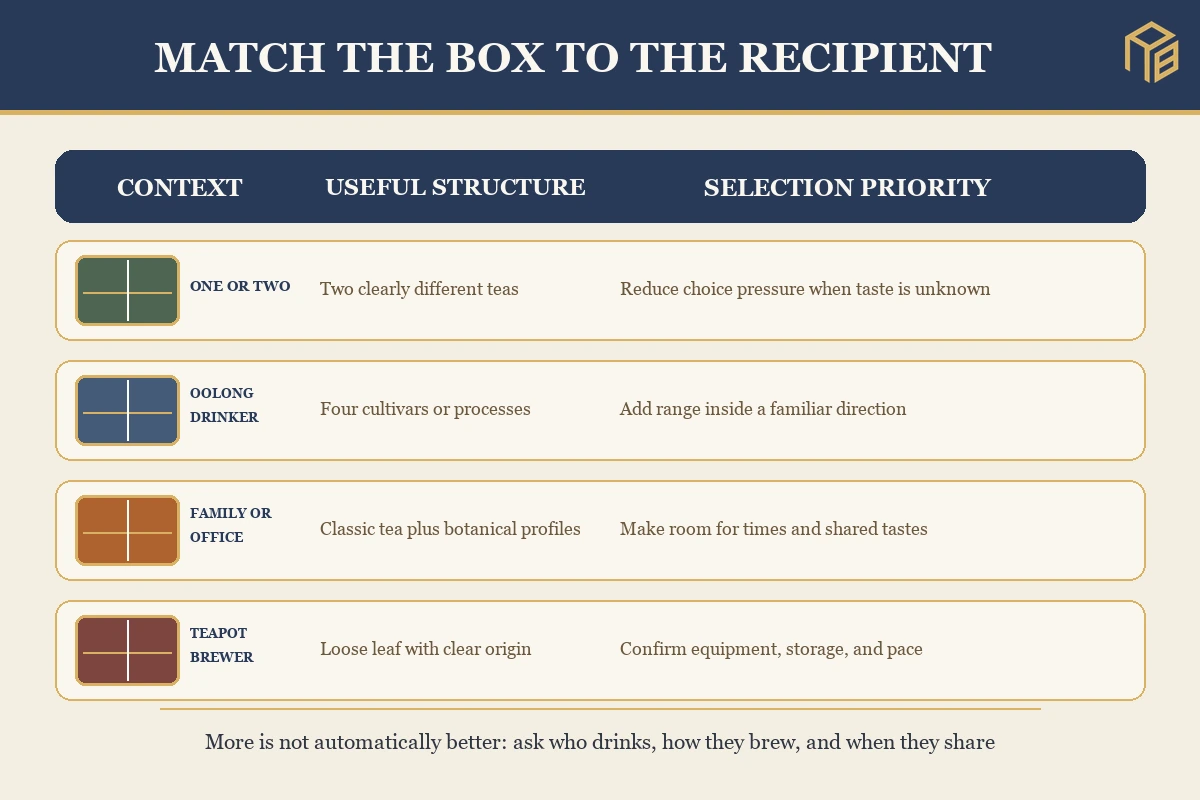
| Recipient context | Useful structure | ABoxTik direction |
|---|---|---|
| One or two people; preferences unknown | Two clearly different, individually packed teas | Two-selection Taiwanese tea gift |
| Known Taiwanese oolong drinker | Four cultivars or processing styles | Classic Taiwanese Tea four-box set |
| Family, office, or group sharing | Classic teas beside botanical infusions | Four-selection premium Taiwanese tea gift |
| Experienced teapot brewer | Loose tea with clear origin and storage information | ABoxTik loose-leaf tea collection |
Question six: what relationship should the box speak for?
A tea box has a different job in each setting. A birthday gift should fit the recipient’s ordinary routine; see our guide to choosing birthday tea by habits rather than stereotypes. A Mid-Autumn gift joins mooncakes, barbecue, and family sharing; use the three Mid-Autumn pairing contexts. A corporate project also requires lists, approval, customization, and delivery, which belong in the corporate tea-gift budget guide.
For an anniversary, collection, or international exchange, a set can explain Taiwanese origin and craft more deliberately. The limited-edition tea-and-craft guide shows how design can extend a story. Presentation should clarify the contents, never replace origin, ingredients, or usefulness.
Question seven: can the tea be delivered and stored well?
Taiwan’s Tea and Beverage Research Station identifies moisture, light, heat, oxygen, time, and surrounding odors as major risks to stored tea. A gift should therefore provide sealed inner packaging, protection from light, storage guidance, and a clear date. A very large quantity is not an advantage if it will sit open for too long.
For hand delivery, check the carrying bag and weight. For domestic shipping, check the outer carton and arrival date. For international delivery, confirm destination rules, ingredient documents, actual and volumetric weight, and possible charges. For a multi-address project, contact ABoxTik with quantity, budget, destinations, and the required arrival date before selecting customization.
What if you know almost nothing about the recipient?
- Lower the brewing barrier: choose individually packed tea when equipment is unknown.
- Create contrast: one floral tea and one warmer or honeyed tea are more informative than four near-identical profiles.
- Prioritize legibility: origin, cultivar, ingredients, storage, and brewing instructions should be easy to find.
- Do not promise outcomes: write flavor, provenance, and good wishes on the card—not treatment, sleep, or anxiety claims.
- Offer a next step: include ABoxTik’s guide to what makes Taiwanese tea distinctive for a first-time drinker.
ABoxTik begins with 100% Taiwanese tea as a statement of origin, then asks whether the flavor is understandable, the format is usable, the packaging protects the tea, and the recipient has room to choose. Taiwan’s TAGs system similarly brings traceability, safety, quality grading, and flavor description together. “Premium” should communicate more than price or elevation.
Tea gift box questions people often ask
Are there taboos around giving tea?
There is no universal rule for every recipient. Check whether the person drinks tea, avoids caffeine or ingredients, works under a gift-acceptance policy, or observes cultural expectations that affect the occasion.
Should I choose two teas or four?
Two distinct teas suit one or two people and keep the decision simple. Four profiles add exploration for a family, office, or gathering. A known single-tea preference can justify a focused gift instead.
Are tea bags always lower quality than loose leaf?
No. Format describes convenience and brewing behavior. Quality still depends on leaf material, origin, processing, packaging, freshness, and the cup. Match the format to the recipient’s equipment and routine.
Can oxidation level tell me whether a tea is suitable at night?
Not by itself. Caffeine extraction also changes with leaf quantity, water temperature, time, and repeated infusions. A caffeine-sensitive recipient should use product information, control timing and portion, or select a confirmed tea-leaf-free infusion.

Follow ABoxTik|The right tea gift stays in daily life long after the box is opened.
Let a tea gift carry Taiwan into the recipient’s real life
How to choose a tea gift box is not answered by a product grid alone. Understand the recipient’s cup, time, flavor, and sharing habits; then use Taiwanese origin, cultivar, craftsmanship, and presentation to build a fitting gift. Read About ABoxTik to see how the brand connects Taiwanese products with local value. Contents, inventory, delivery, and customization must still be confirmed on the current product page or in a formal quotation.
Sources
- Taiwan Tea and Beverage Research Station: Taiwan tea traceability, grading, and flavor information (TAGs) (checked 30 August 2026)
- Taiwan Tea and Beverage Research Station: Tea packaging and storage (checked 30 August 2026)
- Taiwan Food and Drug Administration: Caffeine labeling for packaged beverages (checked 30 August 2026)