
Tea, Tea Knowledge
How Is Oolong Tea Oxidation Controlled? From Withering and Tossing to Fixation
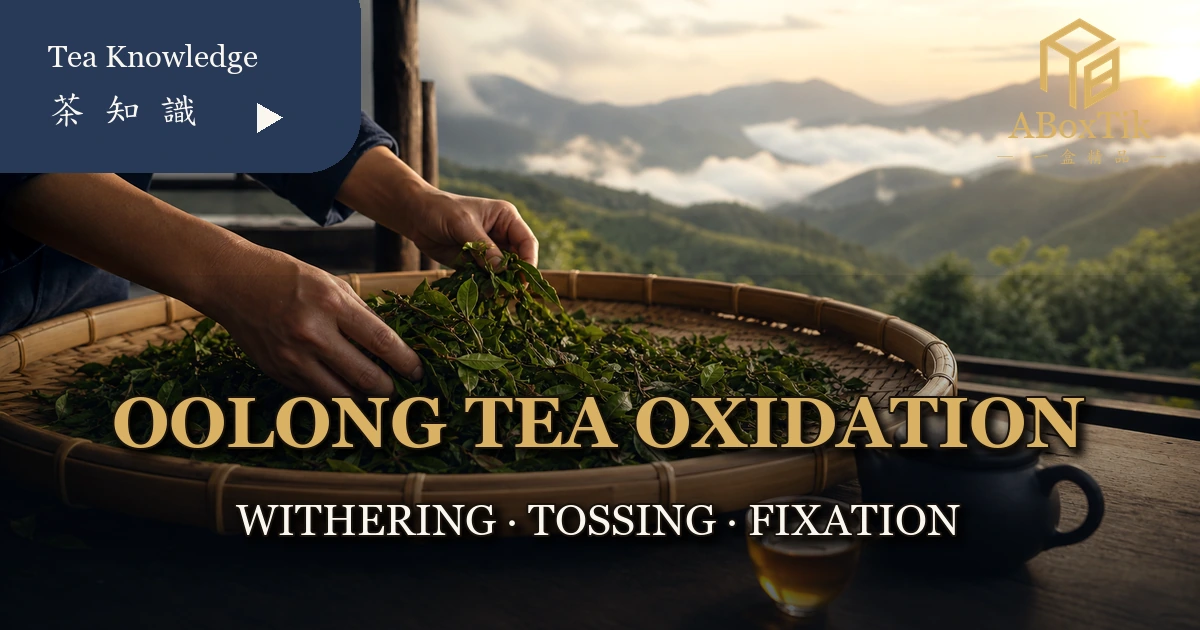
As leaf edges brush against one another, mountain air and time begin to take shape; aroma is not added, but slowly awakened.
Oolong tea oxidation is driven mainly by leaf enzymes, not microorganisms. Withering, resting, tossing and fixation guide moisture and oxidation, helping form floral or ripe-fruit aromas, liquor weight and reddish leaf margins.
Two teas labelled “oolong” may still taste strikingly different. A single oxidation percentage cannot explain the whole cup. This guide stays close to oolong craft rather than repeating the six tea categories; for that framework, read tea oxidation and the six tea categories, then explore how oolong tea is made.
What is oolong tea oxidation?
A plucked leaf remains active for a time. Contact among polyphenols, oxygen and enzymes—especially polyphenol oxidase—changes its colour, aroma and taste. Tea makers have long called this “fermentation,” but enzymatic oxidation is more precise. It is not the microbial process behind yoghurt, wine or kimchi.
Green tea is heated early to suppress enzyme activity; black tea generally oxidizes much further. Oolong occupies a broad range between them. Its character comes partly from resting and gently moving the leaf before applying heat at the intended moment. Compare the six types of tea, or begin with how tea flavour develops.
More time does not automatically make a finer aroma. Craft lies in knowing whether the leaf needs air, stillness, movement—or a timely stop.
From plucking to drying: the oolong process timeline
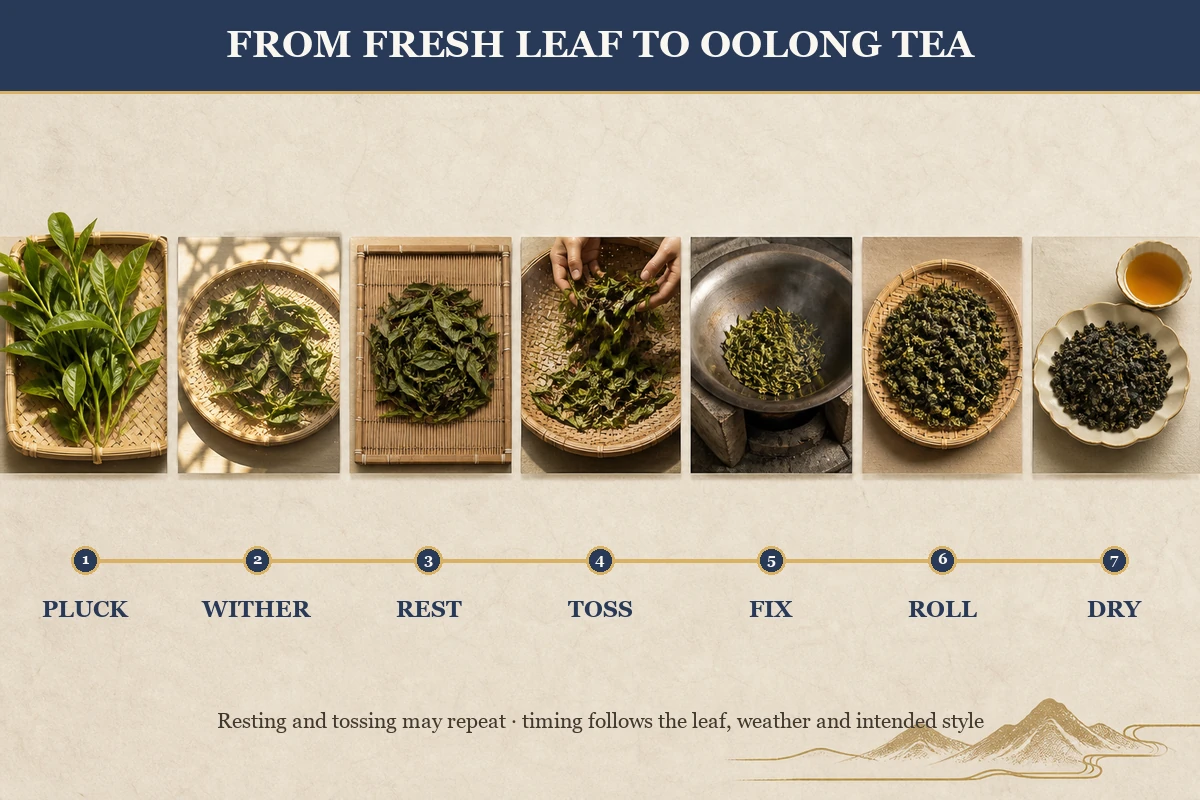
- Plucking: leaf maturity, moisture and condition set the working range.
- Solar withering: leaves lose water, soften and begin aromatic change.
- Indoor resting: moisture moves out from stems and veins—often called zou shui, or “water travelling.”
- Tossing: light rubbing redistributes moisture and encourages localized oxidation.
- Fixation: high heat suppresses enzyme activity and stops the intended oxidation phase.
- Rolling: the maker forms strips or pearls, influencing how the tea opens in water.
- Drying and optional roasting: drying stabilizes the tea; further roast depends on style.
This is not a universal recipe. Resting and tossing may repeat, but frequency, duration and force depend on weather, cultivar, maturity, equipment and style. High-mountain oolong, Sijichun and traditional Dong Ding oolong cannot share one rigid formula.
What do withering, tossing and fixation actually change?
Withering and resting: move moisture before simply drying the surface
If a leaf’s surface dries while moisture remains in its stem and veins, later change can become uneven. Withering softens the leaf; resting lets water and soluble compounds redistribute. “Water travelling” therefore means managing moisture loss, not merely air-drying leaves.
Tossing: disturb the edge and awaken aroma
Tossing lets leaves brush against one another, encouraging oxygen, enzymes and polyphenols to interact around the edges. It helps create the traditional “green leaf with a red edge.” Stronger is not better: excessive bruising or rapid oxidation may amplify bitterness, astringency or muddled aromas.
Fixation: apply the brake at the chosen moment
When aroma, colour and moisture approach the intended state, heat suppresses enzyme activity. Too early may leave aroma underdeveloped; too late may pass the target. Oolong tea oxidation is a sequence of judgements, not a number read from a clock.
Are oxidation and roasting the same thing?
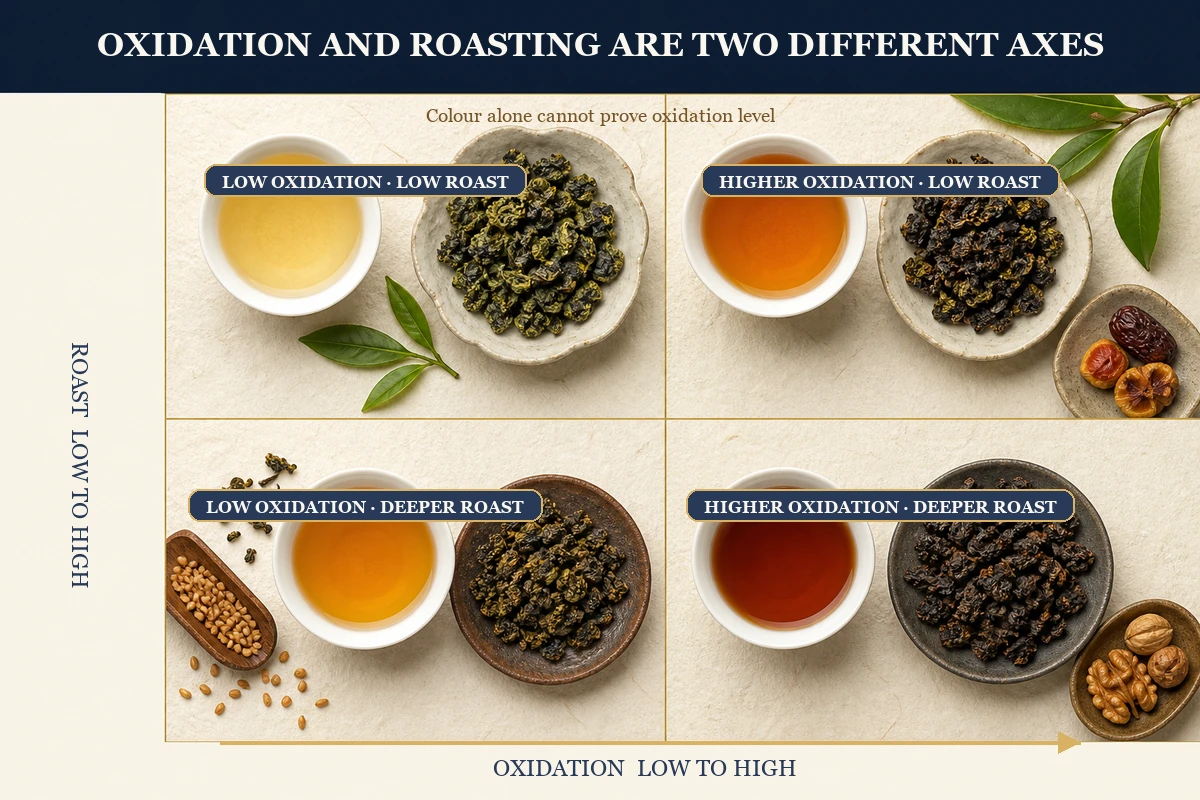
No. Oxidation occurs mainly before fixation. Roasting is a later heat treatment after fixation, rolling and initial drying. Both can change colour, aroma and mouthfeel, but they are separate dimensions.
| Point of comparison | Oxidation | Roasting |
|---|---|---|
| Main stage | From fresh leaf until fixation | After fixation, rolling and initial drying |
| Primary mechanism | Enzyme-assisted oxidation | Heat-driven aroma and moisture changes |
| Common sensory direction | From green freshness and flowers towards ripe fruit, honey and fuller liquor | From fresh fragrance towards toast, nuts, cooked sweetness or fire notes |
| Common mistake | A darker infusion is not proof of higher oxidation by itself | A deeply roasted tea is not necessarily highly oxidized |
Traditional Dong Ding tea is often discussed in terms of both oxidation and roasting, yet “more deeply roasted” should never be rewritten automatically as “more heavily oxidized.” To see how Taiwan developed such varied styles, continue with seven characteristics of Taiwanese tea and our guide to Taiwan’s tea regions.
Do light, medium and heavier oxidation predict flavour?
“Light,” “medium” and “heavy” oxidation are usually relative descriptions. Producers do not all use one percentage scale, so these terms are useful beginnings—not predictions of the entire cup.
| Common label | Possible flavour direction | What else to check |
|---|---|---|
| Light oxidation | Fresh flowers, brightness, greener infused leaves | Cultivar, elevation, season and light roasting |
| Medium oxidation | A balance of floral and fruity notes with a rounder body | Maturity of the tossing stage, roast and storage |
| Heavier oxidation | Ripe fruit, honeyed sweetness and fuller liquor | Insect-bitten leaves, red-oolong methods and roast level |
Within ABoxTik’s selection, Green Jade Oolong, Jinxuan Oolong, Dong Ding Oolong and Honey Red Oolong can serve as entry points into different flavour directions. They are not a scientific controlled set: cultivar, origin, season and roasting may all vary at once. Refer to each current product page for its actual specifications and availability.
How to read oxidation information when buying oolong
- Ask whether the description concerns oxidation or roast. Toasted, nutty and fire notes do not necessarily mean heavier oxidation.
- Treat percentages as producer-specific information. Unless a maker defines its scale, a 20% tea from one seller should not be compared mathematically with another seller’s 30% tea.
- Read the cultivar and origin too. Jinxuan, Green Jade, Qingxin Oolong and Sijichun begin with different raw-material tendencies.
- Check harvest and storage. Season, packaging and time since opening all affect aroma.
- Read the full sensory description. Floral, ripe-fruit, roasted, light-bodied or full-bodied notes are usually more useful to a buyer than one light/medium/heavy label.
For a premium tea, traceability and a meaningful process description matter more than treating oxidation as a quality score. Our guide to rare and premium tea explains what else to examine, while how ABoxTik chooses a box of tea places craft within our wider selection philosophy.
A careful home comparison of two oolongs
This ABoxTik editorial exercise is not an official evaluation protocol. Choose two well-labelled oolongs, preferably with similar origins or cultivars. Fix the vessel, water, ratio, temperature and time. Compare dry and hot aroma, the first sip, aroma after swallowing and the cooled liquor. Note floral versus ripe-fruit or roasted, brisk versus full, and when bitterness appears.
The result describes only those batches; cultivar, year, roast and storage remain alternative explanations. This careful comparison is more honest than a fixed flavour chart and can reveal your preference among Taiwanese tea and craft gift sets.
A blank three-cup comparison sheet
Choose three products with stated oxidation and roast information. Label the cups A, B and C, retain their packets, and record the actual brewing conditions. The table is deliberately blank: the tea has not sent its answers ahead of the session. Use comfortable drinking temperatures and compare observations before exchanging notes.
| Record | A | B | C |
|---|---|---|---|
| Product/batch; cultivar; origin | __ | __ | __ |
| Stated oxidation and roast | __ | __ | __ |
| Tea / water / temperature / time / vessel | __ | __ | __ |
| Hot aroma / first sip / after swallowing / cooled liquor | __ | __ | __ |
| Floral, fruit or roast direction / liquor weight | __ | __ | __ |
| When bitterness or astringency appears | __ | __ | __ |
| Other differences / next-round question | __ | __ | __ |
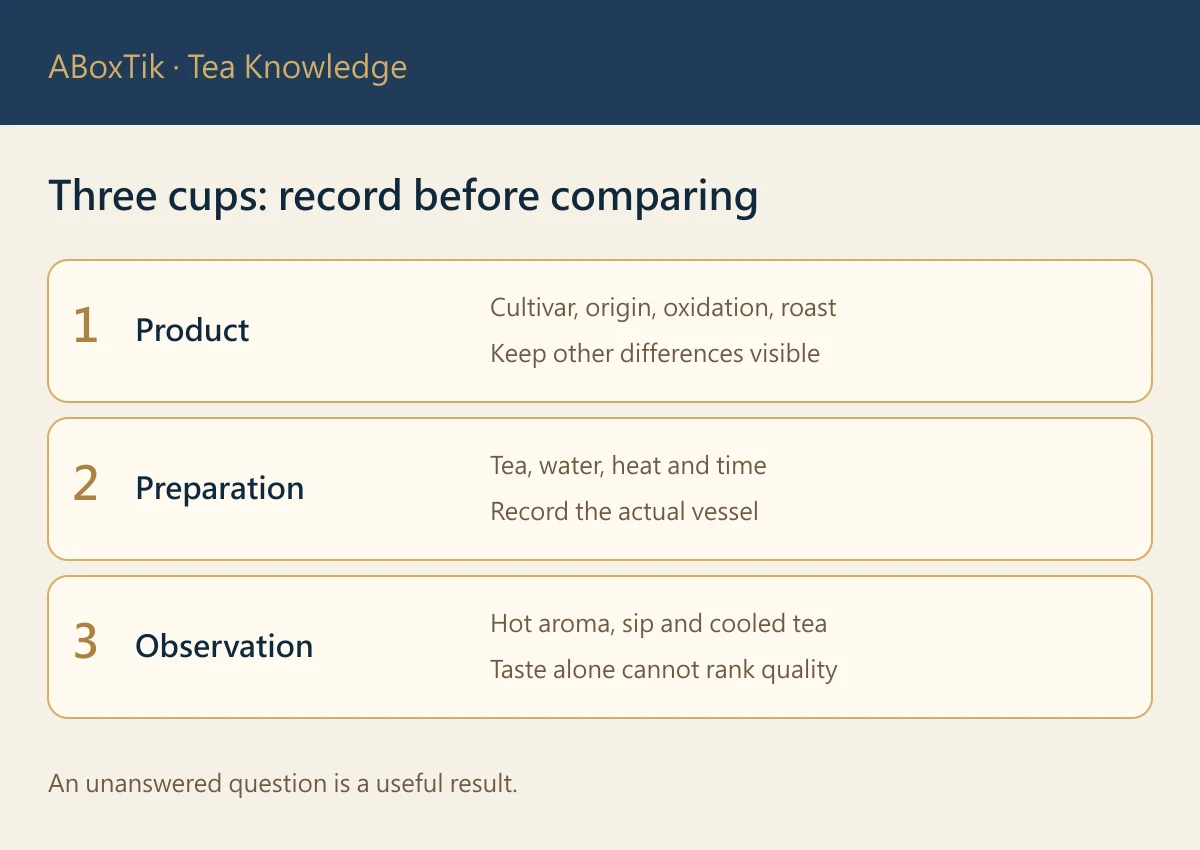
Read the results as a comparison of these three prepared cups. Differences in cultivar, origin, season, storage and roasting remain possible explanations; taste alone cannot identify oxidation level or rank quality. Write one unanswered question instead of forcing a winner. For a separate comparison of roast direction, continue with light and roasted Taiwanese tea.
Oolong tea oxidation: frequently asked questions
Does oolong fermentation require microorganisms?
Ordinary oolong production relies chiefly on enzymatic oxidation within the leaf, not microbial growth. Some post-fermented teas involve different mechanisms and should be discussed separately.
Does darker liquor always mean heavier oxidation?
No. Leaf-to-water ratio, steep time, roasting, age and particle size can all change liquor colour. Process information, the infused leaf, aroma and taste must be considered together.
Is heavy roasting the same as heavy oxidation?
No. Oxidation develops mainly before fixation; roasting is a later heat treatment. A tea may be lightly oxidized and more deeply roasted, or more heavily oxidized with only enough drying to stabilize it.
Why can the same cultivar produce different aromas?
Cultivar is only one condition. Origin, season, leaf maturity, withering, tossing, fixation, roast and storage all influence the finished tea.

Follow ABoxTik into the world of tea
The turn of a leaf reveals the measure of Taiwanese craft
There is no universal timetable for oolong tea oxidation. The maker must judge air, temperature, moisture and the changing leaf: when to rest it, move it gently and finally apply heat. That invisible measure helps make Taiwan’s premium tea worth understanding and sharing.
ABoxTik wants tea selection to go beyond handsome packaging and return to cultivar, terroir and craft. Read the story behind ABoxTik, then build your own sensory map across Taiwanese teas. Once oxidation and roasting become separate ideas, the next cup of oolong offers another layer to notice.
Sources
- National Taiwan Science Education Center: the science of tea oxidation and tossing (checked August 24, 2026)
- Tea and Beverage Research Station: applicability of an automatic tea-leaf stirring machine (checked August 24, 2026)
- Tea and Beverage Research Station: ten undesirable flavours in quality, safe oolong tea (checked August 24, 2026)