
Tea Knowledge
How Many Corporate Gifts Should You Order? A Recipient-Tier Checklist

A gift list earns its value when every addition and every spare box has a reason someone can explain.
Corporate gift quantity planning starts with a deduplicated recipient list—not a guess plus a few extra boxes. Count confirmed delivery targets, segment the relationship purpose, flag shared addresses and delivery exceptions, then add a documented spare quantity. A spare percentage is a planning buffer, not a universal industry rule: one locked list delivered to one office has different exposure from a changing, multi-address campaign.
This article answers how many boxes to order. Read the corporate Taiwanese tea gift budget guide for cost lines and the corporate Mid-Autumn timeline for arrival-date planning. For formats, start with the premium tea gift box guide; current availability, customization and lead time need a quotation confirmation.
How do you estimate corporate gift quantity? Build one master list first
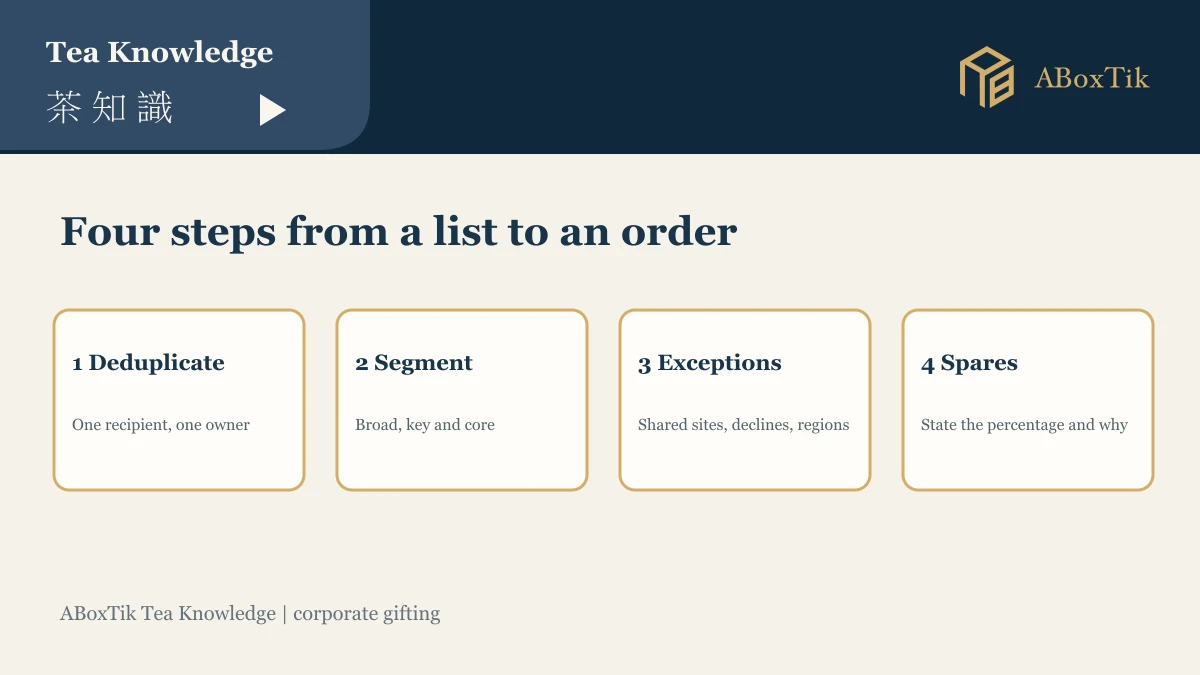
Do not add separate sales, administration and executive spreadsheets together. Use one owner-managed file, one row per recipient or delivery unit, and a visible last-updated time. Keep only the data required to deliver the gift and apply your organization’s established data-handling rules.
| Field | Question it answers | How to count it |
|---|---|---|
| Recipient / delivery unit | Is it duplicate or shared? | One deliverable target per row |
| Relationship tier | Does the format differ? | Broad, key, core |
| Delivery method | One site or many? | Track boxes and addresses separately |
| Status | Confirmed, pending, or exclude? | Only confirmed enters the base |
| Exception reason | Why is a spare needed? | Make it traceable |
A single office contact may receive one shared box, while another account needs one box for each named person. That distinction separates recipient count from delivery-unit count. Tea as a gift offers cultural context, but does not determine how every company distributes gifts.
Segment recipients by purpose, not title alone
Tiers are not a way to price a relationship. They keep the contents, approvals and late-addition rules consistent: a broad list may need standardized distribution; a key-partner group may need clearer flavor range; a core milestone group may need acceptance and handover confirmed first. Recipient organizations’ own gift rules and your compliance contacts decide what is permitted.
- Broad list: standardize the format and prevent duplicates.
- Key partners: document the relationship owner and a shareable tea direction.
- Core relationships: confirm acceptance, handover method and timing before bespoke work.
Use the two-tea gift set, classic Taiwan tea set, and multi-profile tea gift only as discussion starting points—not as a bulk-price or stock promise.
Set spare quantities by writing down the source of change
Connect additions to the master list with a change record
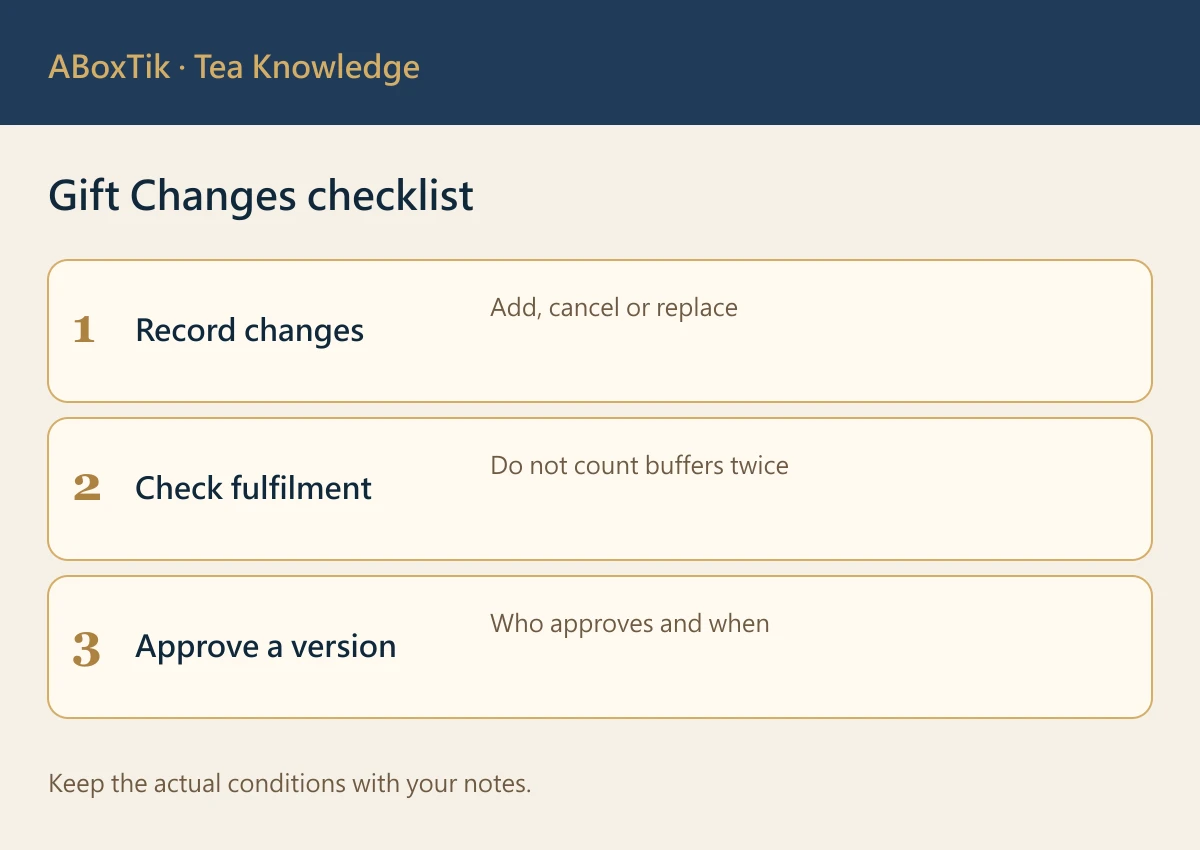
One more name does not always mean one more purchase. It may be a replacement, a corrected address or an approved use of reserve stock. Record the event before changing the total. Let the version number do the running so the purchasing team can retire from chasing three competing spreadsheets.
| Field | Record | Confirm before updating |
|---|---|---|
| Change ID and time | For example C-01, date and requesting contact | Link to the master version, not a second master list |
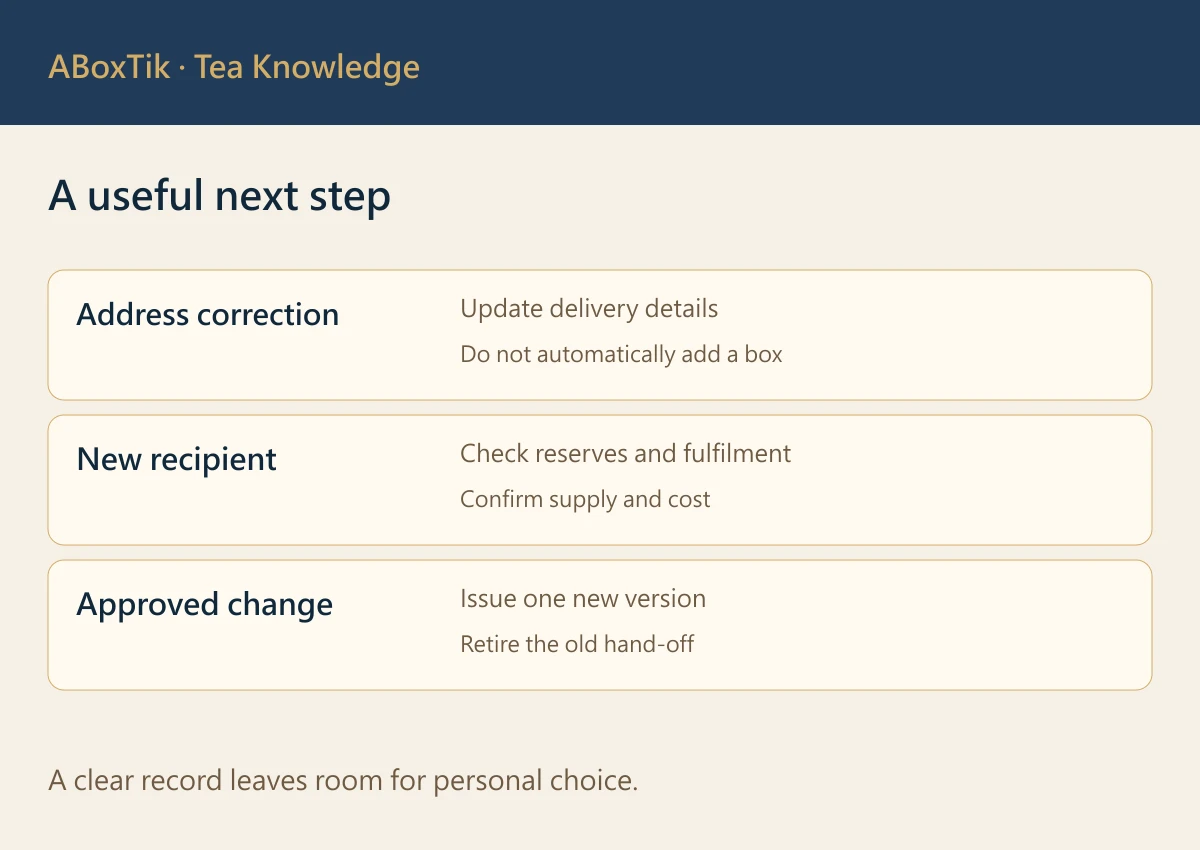
| Change type | Add, cancel, replace or correct address | A replacement or address correction need not add a box |
| Quantity and fulfilment | Approved quantity, change and delivered quantity | Separate unprepared, packed and dispatched stock |
| Supply implications | Product, artwork, cost and delivery changes | Obtain a current supplier response |
| Approval and effective version | Decision owner, date and new version | Have one owner issue the active record |
A purely hypothetical example starts with 80 approved boxes. Five additions and two cancellations bring the requirement to 83. One separate address correction adds no box. If two of the additional boxes can come from existing reserves, the purchase adjustment still depends on remaining undelivered stock and the reserve policy. Increased demand and increased purchasing are different calculations; these figures are not a product minimum order or a supply promise.
Keep the list, labels and delivery hand-off on the same effective version. Preserve the reason for a cancellation or replacement while limiting personal delivery details to the people who need them. If you make only one improvement today, add a field asking whether the change affects box count. Avoiding one duplicate is usually more helpful than adding another handsome spreadsheet heading.
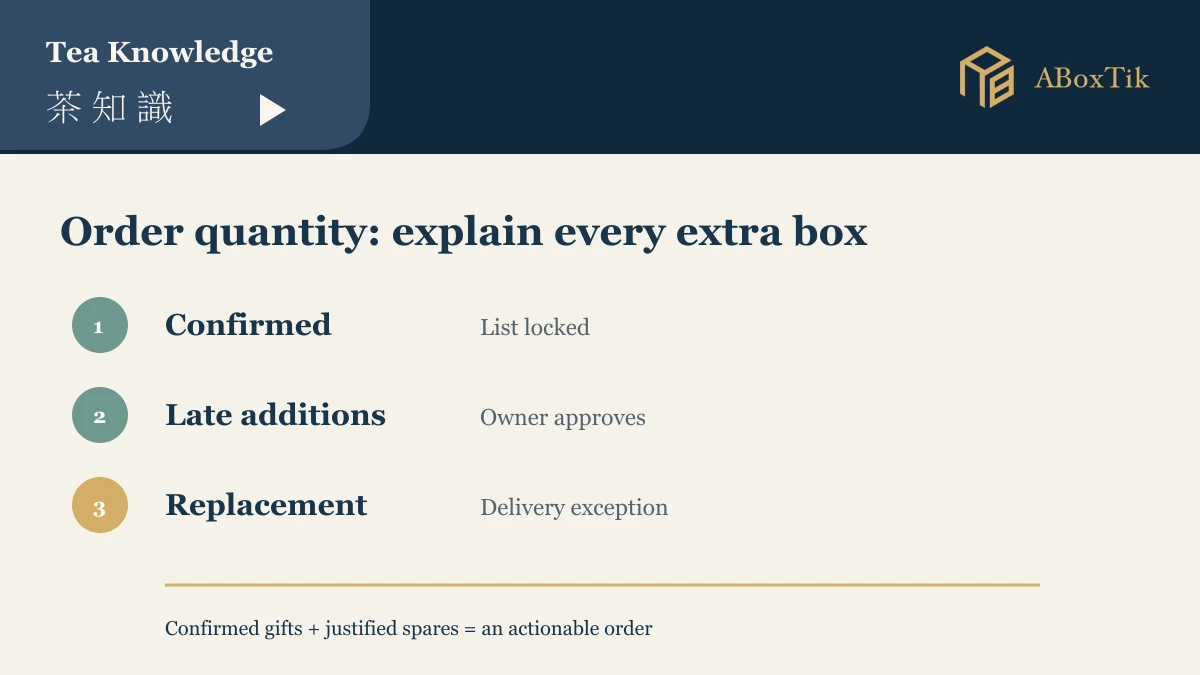
Calculate the confirmed base first. A locked one-site list may need very little buffer. A multi-team list, address-by-address dispatch, variable event attendance, or likely replacement deliveries may justify more. Do not copy a previous project’s 5% or 10% as a rule. Record the percentage, its reason, the approver, and how unused gifts will be handled.
- Base: only confirmed, deliverable targets.
- Additions: a separately stated estimate for incomplete replies or guest lists.
- Replacement: a named process for corrected addresses, failed delivery or damaged cartons.
- Order: confirmed quantity plus approved spares; do not count pending names twice.
Check boxes, addresses and receiving conditions separately
One hundred boxes to one office is not the same project as one hundred individual deliveries. Track address count, recipient contact, receiving window and outer-carton count separately. For offshore, cross-border or multi-point delivery, confirm restrictions and timing before quotation; this article does not promise delivery coverage. Bring the list scope, desired arrival date and method to the ABoxTik contact page when you are ready to discuss an inquiry.
Make the list usable across sales, administration and delivery
A useful list makes handoffs visible. Sales can identify the relationship purpose; administration can check the approval status; the delivery owner can confirm the address and receiving condition. These roles do not need unrestricted copies of every field. A practical workflow is to keep the full working file with the designated owner, then share a task-specific extract only when the next step genuinely requires it. Record the date and source of each change, especially when a name moves from pending to confirmed.
Before the list is locked, decide what counts as a late addition. It may be a newly confirmed executive, an event attendee, a replacement for a returned parcel, or a team that will share one box. It is not simply every name that has not answered yet. That distinction prevents a project from ordering for the pending list and then adding the same people again as “spares.” If a late addition needs a different gift tier, have the approver decide whether it uses a spare, changes the order, or waits for a follow-up delivery.
Also define the decision deadline. A date is meaningful only if it is tied to a next action: content selection, customization proof, packing, address confirmation, or handover. The seasonal delivery timeline shows why those steps cannot be treated as one final task. In an evergreen corporate project, the same principle applies: a list locked after the packing decision no longer produces the same operational certainty.
Corporate gift quantity checklist
- One deduplicated master list and owner?
- Recipients, delivery units and addresses separated?
- Purpose and approver defined per tier?
- Pending names excluded from the confirmed base?
- Every spare percentage explained and approved?
- Contents, availability, customization and arrival date reconfirmed?
A clear list turns quantity from a guess into a decision others can review. ABoxTik brings Taiwanese tea, clear flavor directions and gift-ready presentation to the relationship; transparent planning helps that gesture arrive correctly.
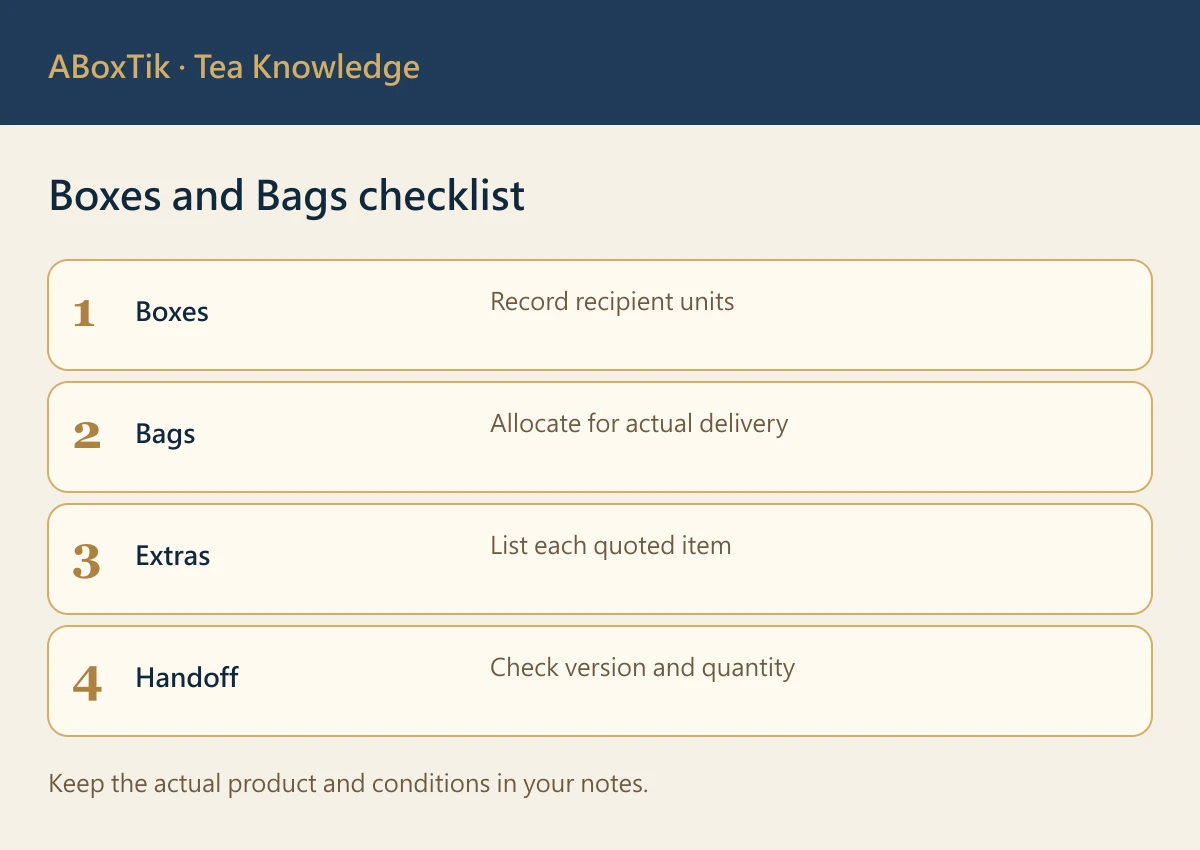
Count boxes and bags separately
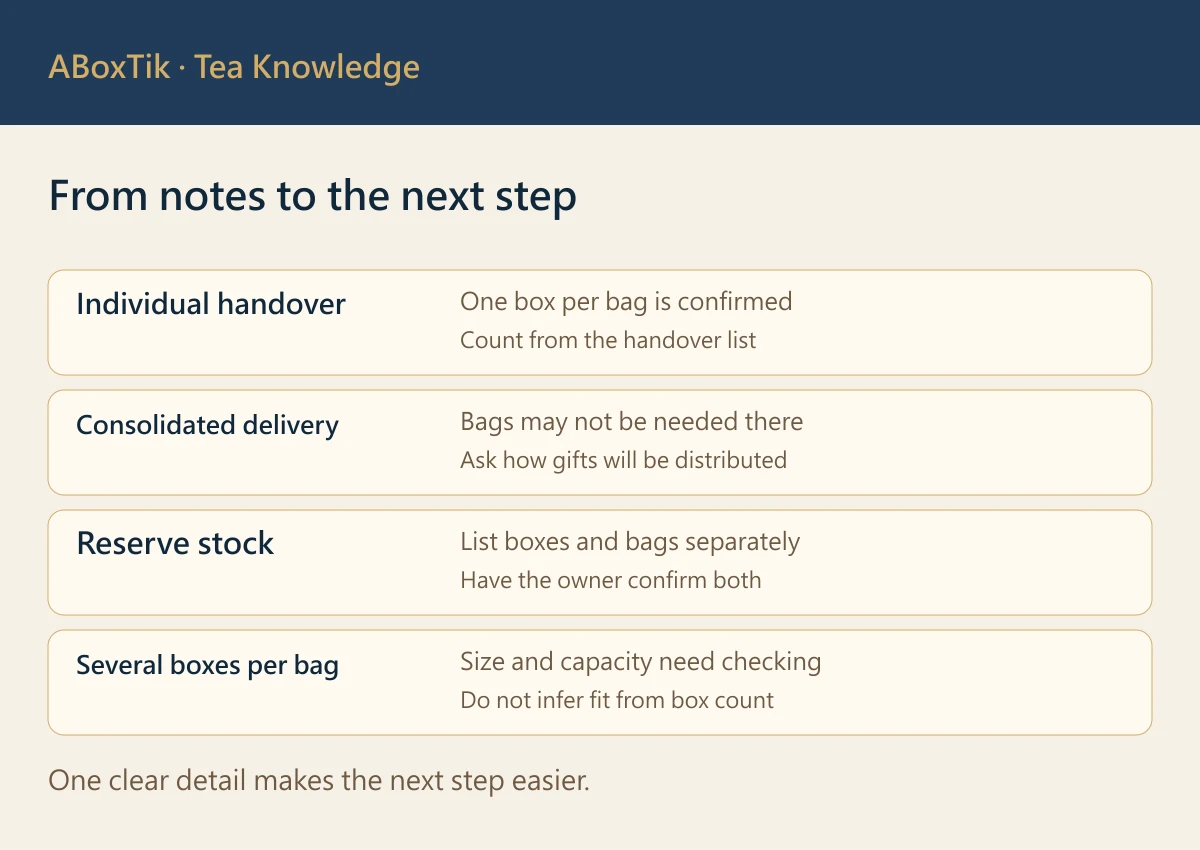
One gift box does not always need one bag. Some gifts travel in shipping cartons, some are handed over individually, and a few boxes may be held in reserve. List each handover situation first, then ask whether bags are included or ordered separately and how many boxes a particular bag is designed to carry.
| Handover | Boxes | Bags | Check |
|---|---|---|---|
| Individual handover | 30 | 30 | This example assumes one box per bag; confirm fit and load capacity |
| Consolidated delivery | 10 | 0 | Confirm whether the recipient needs bags after the carton arrives |
| Reserve | 2 | To confirm | Decide whether spare boxes also need bags and where both will be kept |
The example has 42 boxes and 30 bags confirmed so far. Add any reserve bags only after the handover plan is settled; do not assume the final total is automatically 30 or 42. If a recipient will carry several boxes, check the actual bag dimensions and capacity before choosing individual bags or combining them. Record the supplier’s answer, version date, taxes and any separate accessory charge, then count boxes, bags and cards individually at delivery. An unanswered field is a useful reminder, not a number to guess.
Sources
- ABoxTik contact page (checked 8 September 2026)
- ABoxTik Premium Gift Box category (checked 8 September 2026)
- Tea and Beverage Research Station: Tea packaging and storage (checked 8 September 2026)