
Tea Knowledge
Tea Best-Before and Expiry Dates: Questions to Ask the Seller
A date on a tea package is useful once you know what it refers to. Find the date and storage instructions on the retail package, then check whether the wording refers to manufacture, expiry or another date. Ask the seller when the label is unclear.
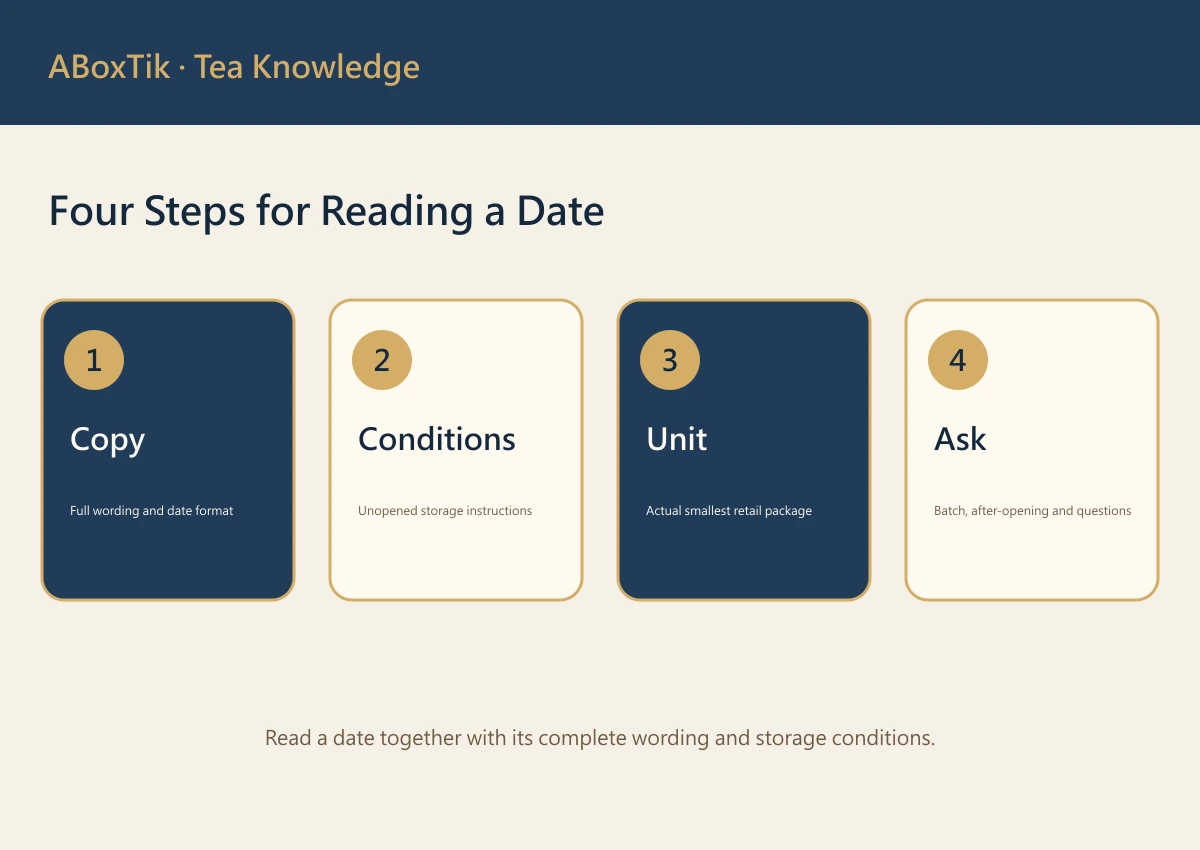
Read the date with its conditions
Record the wording, date format, batch and storage instructions. Taiwan FDA guidance distinguishes an expiry date as a point in time under stated conditions from shelf life as a period. The actual label must be interpreted under the rules applicable to the product and market.
Do not assume date terms are identical
Different markets use different wording. Keep both original and local-language labels when asking the supplier which date applies and under what conditions. A translation alone does not establish that every term has the same regulatory meaning.
Opening changes the context
Read the original date with its stated conditions. After opening, follow the package and supplier’s advice and protect tea from moisture and unwanted odours. A universal number of days is not suitable for every tea. If packaging or condition is abnormal, stop using the product and ask the seller.
A question card
Product and batch: ____; complete date wording: ____; storage conditions: ____; guidance after opening: ____; retail unit: ____; supplier reply and date: ____. A photo of the complete label can help the seller identify the product.
Common questions
Should I change a date myself? No: ask the responsible business. Is storage irrelevant before expiry? The stated conditions still matter. For a gift, check the intended delivery date and package information so there is practical time to enjoy it.
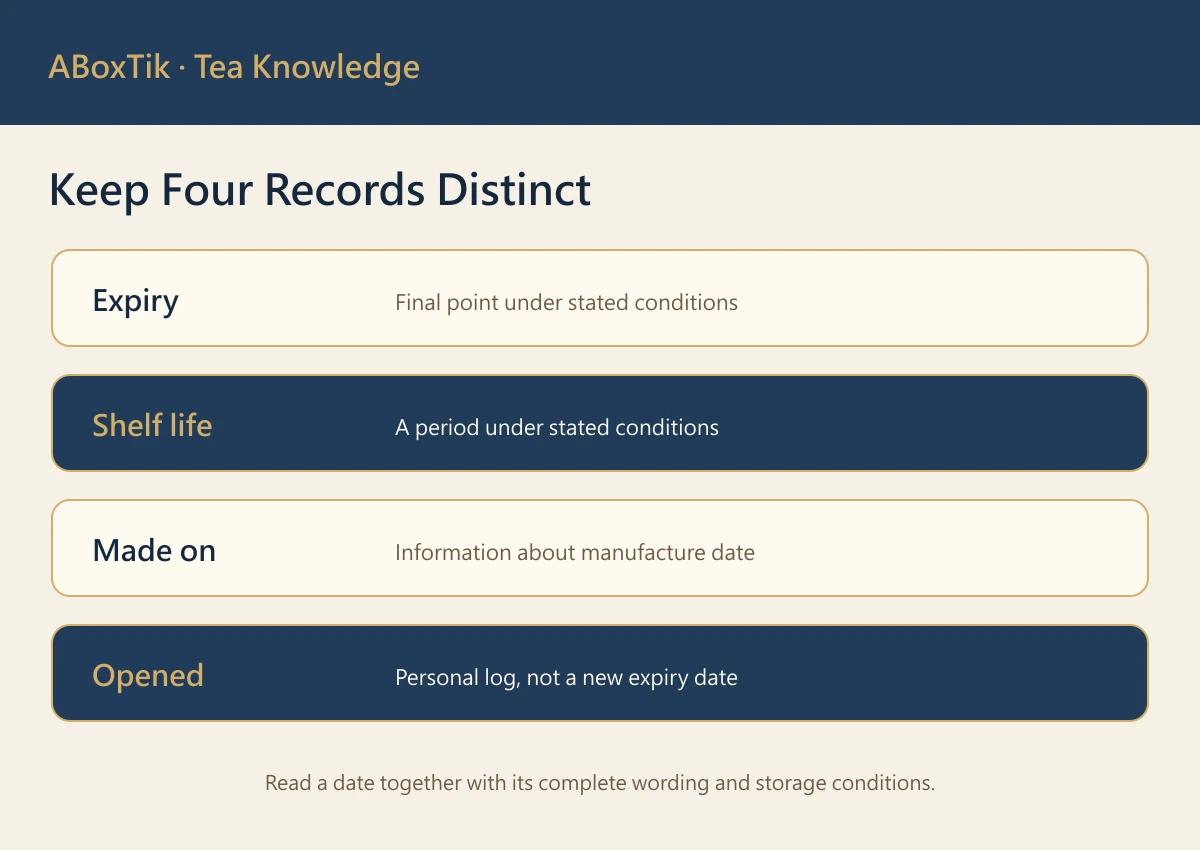
Separate a point in time from a period
Taiwan FDA guidance describes an expiry date as the final point in time at which a product retains its value under specified storage conditions; shelf life is the corresponding period under stated conditions. Record the complete wording beside the date, its format and the storage instructions. If a package shows only a manufacturing date and a period, or the printing is unclear, ask the responsible business about the applicable label. Do not add, reprint or change a product date yourself.
A package can show manufacturing information, a date and storage directions for different purposes. Copy each field as written rather than assuming a date is automatically a harvest date, roasting date or the final day after opening. If the order of day, month and year is unclear, a photograph of the complete label gives the seller a better starting point than guessing the numbers.
What to ask about best before
Date terminology and labelling requirements can differ by market. Taiwan FDA guidance explains best before as wording about the period of best quality and discusses separate conditions and supporting evidence for the Chinese expiry-date label on imported food. When both original and Chinese wording appear, retain the complete labels and ask the responsible domestic business which expiry date and storage conditions apply to that particular product and how they were determined. A translation alone cannot establish the same rule for every imported item.
A labelled date is important, but it does not replace attention to actual storage. Check package integrity before purchase and follow the stated temperature, light or other conditions. Ask the business if the wording is unclear or does not match the product. This guide does not determine whether an individual expired item is safe, and a normal smell is not a sufficient stand-alone test.
Use a small card after opening
Read the original date with its stated storage conditions. After opening, closure, humidity, utensils and location can change the practical situation. Check whether the package gives after-opening advice; ask the supplier if it does not. A personal note can record opening date, product, batch, location and the supplier’s advice. Such a note helps manage use; it does not establish a new product expiry date.
If transferring tea, use a clean, dry container suitable for the purpose and follow the product’s storage instructions. When several packages share one box, retain their individual original labels and identifying information. If a package is damaged, damp or otherwise unusual, stop using it and ask the responsible business with photographs and product details.
Keep batch details with gifts and procurement records
For a multipack, review the dates and batches visible on the outer package and individual packs. If the retail unit or information is unclear, ask the supplier about the actual combination. Taiwan FDA questions and answers address mixed batches and the smallest retail unit in specific circumstances; a purchasing team should verify applicability before repeating a rule. Recording purchase date, quantity, supplier, arrival condition, batch and intended delivery date helps a colleague follow up on the right product.
Before giving a gift, confirm a convenient delivery time and check the package’s use and storage information. If the date is close or difficult to read, discuss the arrangement with the supplier rather than attaching a new date yourself. Clear information can travel with the tea so the recipient can spend less time decoding the wrapper.
A shopper can verify the label, not recalculate it
Taiwan FDA guidance assigns the original manufacturer responsibility for establishing a packaged food’s expiry date from the ingredients, process, product characteristics and supporting storage studies. An importer must not simply invent or change that date. A shopper’s useful role is therefore to retain the complete package, batch details and receipt, photograph all wording beside the date, and ask the responsible local business. An online arithmetic shortcut is not evidence that a product has acquired extra days.
“Best before” and similar terms may describe a best-quality date in another market. How an imported food is labelled with a Taiwan expiry date depends on the business’s supporting information and the applicable rules. This guide offers a reading and question sequence; it does not decide whether a particular item is safe. If a marked date has passed, a package is damaged, or the product appears abnormal, smell and a brave sip are not an adequate investigation.
Keep a photograph that another person can understand
Include the product name, responsible business, date wording, storage conditions, batch and the boundary of the smallest retail package in one set of photographs. Record when the photograph was taken and which part was unclear. When tea is moved into a household container, keep the original labelled package nearby and write only the actual opening date on a personal card. Do not cover, alter or replace the manufacturer’s date.
For a gift or workplace purchase, confirm the intended handover date and leave reasonable time for the recipient to follow the label. If multiple inner packs have different identifiers, ask the supplier how the displayed information applies to the actual sale unit. Good date reading is less dramatic than detective work—and much kinder to the person receiving the tea.
Explore next
Keep the seller questions on your checklist, then give the next choice a little room: premium tea gifts, related articles, and the latest boutique selections are below—fresh ideas, without pretending dates can answer everything.
Sources
Taiwan FDA—Guidance for evaluating expiry dates of packaged foods · Taiwan FDA—Food labelling Q&A · Taiwan FDA—Clarification of online expiry-date claims