
Tea Knowledge
Organic Tea vs TAP Tea in Taiwan: Certification and Buying Guide
Choosing tea should not feel like sitting an exam. Begin with the question that matters to you, then match the label to a current official record—one calm step at a time.
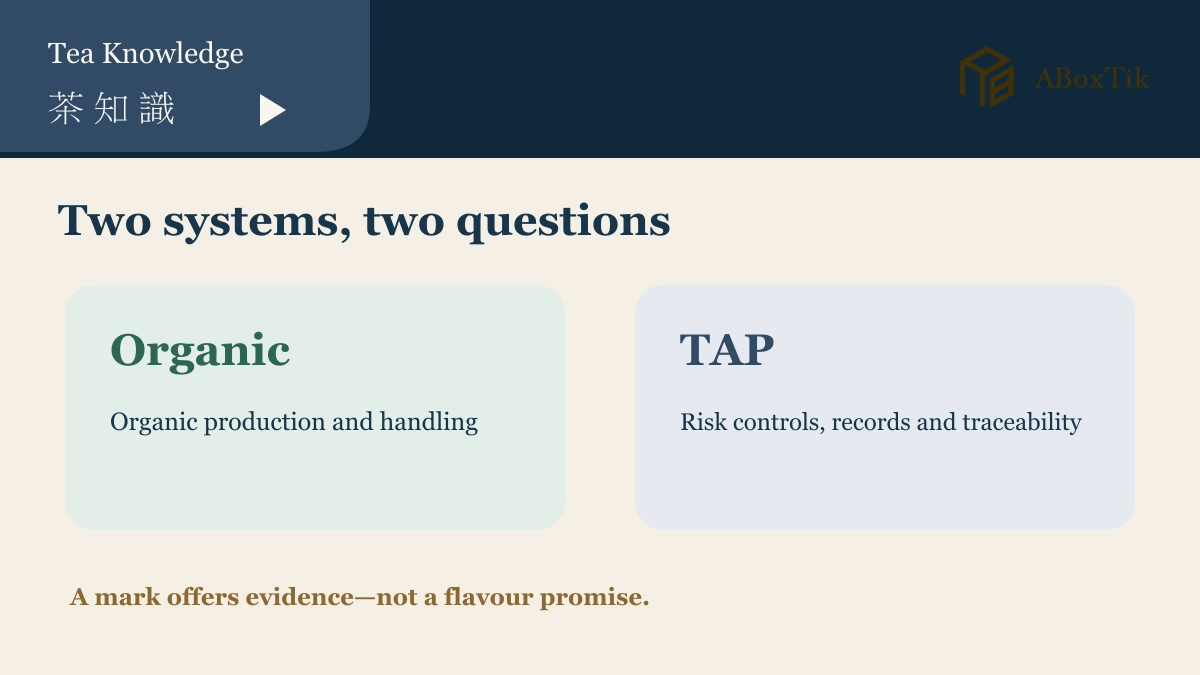
The clearest way to understand organic tea vs TAP tea in Taiwan is to see them as two verifiable systems designed to answer different questions. Organic certification focuses on an organic production and handling system, including rules concerning chemical fertilizers, chemical pesticides and genetically modified organisms. TAP certification focuses on applicable Taiwan Good Agricultural Practice requirements, risk management, operating records, batches and traceability. TAP does not mean organic, while an organic mark does not by itself prove that every retail pack has a zero-residue test result. Neither mark can promise that a tea will suit your palate.
If two beautiful packs carry different marks and you are unsure which to choose, that hesitation is understandable. This guide will not ask you to declare a winner. Instead, it will help you separate three things: what the certification covers, what the exact pack can prove, and what you personally care about. For the broader story of origin, cultivar and craft, begin with why Taiwanese tea is special. Here, we stay close to labels and buying decisions.
Organic tea vs TAP tea: the difference at a glance
| Question | Organic tea | TAP-certified tea |
|---|---|---|
| Primary focus | Whether production, processing, packing and distribution within the certified scope follow organic requirements. | Whether the certified scope follows applicable TGAP, risk controls, records, segregation and traceability requirements. |
| Chemical inputs | Taiwan’s Organic Agriculture Promotion Act defines organic agriculture without chemical fertilizers, chemical pesticides or GMOs and their products, subject to detailed standards. | TAP is not an organic system. Agricultural inputs must follow applicable law and TGAP, with the required controls and records. |
| Package clues | Organic wording, the official Taiwan Organic mark where applicable, certifier and certificate number, plus origin information. | TAP mark, traceability code, certifier and a way to access the public record. |
| Useful when | Your priority is a product certified to the organic production system. | Your priority is a documented and traceable production-management system. |
| Not a promise of | Zero residue in every pack, local origin, small-farm production, better taste or zero risk. | Organic production, no pesticide use, complete testing of every batch, superior taste or zero risk. |
You do not need to memorize this table. Think of the systems as two windows. Organic certification lets you look into a regulated organic production and handling framework. TAP lets you follow records, controls and a traceability code through a certified production chain. The views can overlap, and a business may hold both certifications for an applicable product or scope, but one mark does not silently include the other.
What does Taiwan organic certification cover?
Taiwan’s Ministry of Agriculture defines organic agriculture around ecological balance and nutrient cycling, without chemical fertilizers, chemical pesticides, genetically modified organisms or their products. A product sold as organic must meet the rules that apply to its certified production and handling scope. Packaged products also carry required information such as product identity, origin, cert and certificate details under the applicable rules.
The gentle but important distinction is between a production-system standard and a single laboratory result. Organic verification examines the operation, site, process, inputs and records under the certification standard. It should not be rewritten as a claim that every finished packet has been individually tested and found to contain zero residue. If a particular laboratory result matters to you, ask for a report that clearly matches the product or batch, test date, sample and substances examined.
Green packaging, “natural,” “eco-friendly” or “grown with care” can express a producer’s approach, but those phrases are not substitutes for current organic verification. The Ministry’s official consumer guidance on identifying organic products explains the Taiwan Organic mark and points readers to the official lookup system. Checking a record is not an accusation; it is simply how a certification becomes useful trust rather than decoration.
What does TAP certification cover?
TAP stands for Taiwan Agricultural Product Traceability. The system uses the applicable Taiwan Good Agricultural Practice framework, with process mapping, risk-management and self-check records. Certification involves document review and on-site auditing, and the management rules include product sampling and residue testing before a verification decision according to the applicable audit plan and requirements. That still does not mean every pack on a retail shelf undergoes every possible laboratory test.
For a shopper, the traceability code is especially helpful. On the official TAP information portal, a record may show the product, agricultural operator, production area or origin, principal operations, packing date, certifier and certification validity. The fields vary by record. A successful search is only the beginning: make sure the product name, code and dates correspond to the pack in your hand, rather than another item from the same brand.
If you would like a fuller explanation of TAP, the general domestic tea QR route and geographical-origin marks, continue with our Taiwan tea traceability guide. That guide walks through the lookup sequence. This article stays with the organic-versus-TAP comparison so you can use the right page when the relevant mark appears.
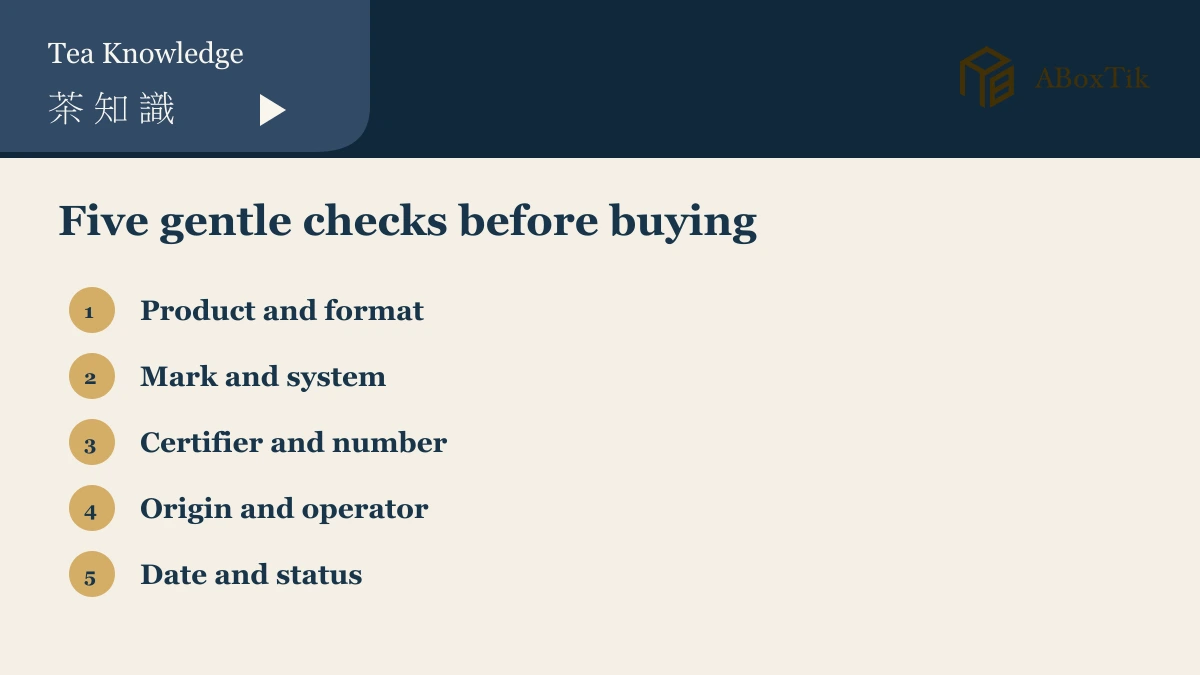
Five things to check on the actual tea pack
- Product name and format: The official result should match the tea and pack you are holding. A shared brand name is not enough.
- Mark and system name: Identify the Taiwan Organic mark, TAP mark, a general domestic traceability QR label or a brand’s own icon.
- Certifier and number: For organic tea, check the applicable certificate details. For TAP, match the traceability code, certifier and public information.
- Origin and responsible operator: “Organic” does not automatically mean Taiwan-grown. A company named in a record may be the certified operator or packer and is not automatically the grower.
- Date and current status: Compare the packing date, certification validity and current database status. If something does not match, keep a photo and ask the seller before drawing a conclusion.
Origin information remains valuable, but it answers a different question. Our Taiwan tea regions guide offers the larger landscape, while the Alishan subregion comparison shows why one famous mountain name may still contain several distinct places. Certification tells you whether a defined system and scope were verified; origin gives you context for environment and identity.
Which tea should you choose?
If organic production is your main priority, look for a currently valid organic certification that can be checked in the official system. Match the product, origin, certifier and certificate information. Do not let an informal “natural” claim do the work of verification.
If documented production and traceability are your priority, TAP provides a clear route through its code and public record. Match the result to the exact product and date. If the pack instead carries the general domestic tea traceability QR, first identify that system rather than assuming it is TAP.
If both matter, verify both separately. A product may have both certifications, but one mark does not prove that the other exists. If the teas in front of you each carry only one, you do not have to turn the decision into a moral contest. Budget, brewing style, gifting needs and flavour preference are valid parts of a thoughtful choice.
If taste is the deciding factor, certification cannot choose oxidation, roast or texture for you. Our guide to oolong oxidation and flavour explains how processing shapes the cup, while the tea aroma guide offers a simple way to notice dry, hot and cooling aromas. Your palate does not need an official score to be real.
Three common misunderstandings worth leaving behind
“Organic” always means local and small-scale
Organic certification describes compliance with organic requirements within a defined scope. It does not automatically identify the country, farm size or relationship between the farmer, processor and brand. Read origin and operator information as separate fields.
TAP means every batch is pesticide-free
TAP includes applicable risk controls, records, audits and sampling requirements, but it is not the organic standard and should not be compressed into a “pesticide-free” promise. A careful description is that TAP provides verified production management and traceability within the certified scope.
More marks always mean more premium tea
Certification marks answer compliance and system questions. Premium value also depends on leaf material, origin, skill, sorting, storage and service. Our premium tea price and value guide can help you keep these considerations in proportion.
Keep the evidence clear—and keep room for delight
You do not have to become a certification specialist before buying tea. Ask what you want to verify, then check the product, mark, number, origin and date. Finally, return to aroma, brewing and the people who will share the cup. That order can make the decision feel steadier without taking away the warmth of discovery.
To compare several Taiwan teas side by side, browse the Classic Taiwan Tea Gift Set. For an easy brewing format, the two-tea-bag gift set offers another starting point, or you can explore the full tea collection. These are flavour and format suggestions, not claims that the products hold either certification discussed here; always rely on the current product label and official database for certification status.

Follow a Box of Tea
At ABoxTik, we prefer clear, checkable information to oversized promises. Read about ABoxTik for our approach to Taiwan tea, or contact us if you would like help understanding a package or choosing a thoughtful gift.
Sources
- Taiwan Ministry of Agriculture: Organic Agriculture Promotion Act (checked 13 September 2026)
- MOA: Organic Agricultural Product Certification Regulations (checked 13 September 2026)
- MOA: TAP Certification Management Regulations (checked 13 September 2026)
- MOA: TAP Certification Criteria (checked 13 September 2026)
- MOA: Taiwan Agricultural Product Traceability portal (checked 13 September 2026)