
Tea Knowledge, Tea
Alishan Tea Regions Compared: Shizhuo, Xiding, and Zhangshuhu
A mountain name is an address written by the land. The cup is completed later—by a season of leaf and a maker’s decisions.
Alishan tea regions should not be compared by asking which place has the highest elevation. Shizhuo lies in the mountain area of Zhuqi Township, Xiding is a tea community along the Alishan Highway in Fanlu Township, and Zhangshuhu is associated with the Taihe area of Meishan Township. All three sit within the wider “Greater Alishan” tea region, but they are not one mountain, one garden, or one method of production. A place name helps establish origin; by itself, it cannot guarantee aroma, texture, or quality.
If Taiwanese geography is new to you, begin with our guide to Taiwan’s tea regions and terroir. This article moves in closer. Its purpose is to help you read labels that say “Alishan High Mountain Tea” and know which questions to ask about Shizhuo, Xiding, and Zhangshuhu before buying.
Alishan tea regions: what does “Greater Alishan” mean?
Taiwan’s Tea and Beverage Research Station describes the Greater Alishan tea area as spanning Meishan, Zhuqi, Fanlu, and Alishan townships in Chiayi County. Chin-shin oolong and Taiwan Tea No. 12, commonly known as Jinxuan, are among the cultivars grown in the region, and semi-ball rolled, partially oxidized tea is a common production style. “Alishan tea,” then, is a regional umbrella—not the name of a single estate.
A useful label has several layers. “Alishan” identifies the broad region; Shizhuo, Xiding, or Zhangshuhu narrows the location; a garden, cultivar, harvest, maker, and lot number add the information needed to understand one actual tea. For more context on why altitude is only one part of the story, see our guide to Taiwanese high mountain tea.
| Tea community | Geographic clue | Public elevation reference | What the name can tell you |
|---|---|---|---|
| Shizhuo | Zhonghe Village, Zhuqi Township; Alishan Highway corridor | An official rural-tourism profile cites gardens around 1,200–1,700 m; the public trail system is around 1,360–1,690 m | A well-established mountain-tea community; the actual garden still needs to be identified |
| Xiding | Fanlu Township; closer to the western approach to Alishan | Scenic-area trail information is around 1,000–1,100 m, but this is not the elevation of every tea garden | A distinct community within Greater Alishan; trail elevation is not a batch specification |
| Zhangshuhu | Taihe area, Meishan Township | A Tea and Beverage Research Station site near Zhangshuhu sits above 1,600 m; individual gardens vary | A high-elevation environment; the place name does not replace estate and lot data |
Note: these figures come from public information about a producer, trail system, or research site. They provide geographic orientation only and should not be presented as the elevation of every garden or package bearing the place name.
The same cloud may cross several ridges. What remains in the liquor also carries the season, cultivar, and choices made at the tea factory.
Shizhuo: an established tea community, not one fixed flavour
Shizhuo is in Zhonghe Village, Zhuqi Township, and is one of the most recognisable tea communities along the Alishan Highway. An official Ministry of Agriculture rural-tourism profile describes one local growing area at approximately 1,200 to 1,700 metres. The public Shizhuo trail system also shows the considerable changes in height across the mountain landscape.
Those figures do not mean that all Shizhuo tea comes from an identical elevation. Gardens differ in slope and exposure; spring and winter leaf will not behave identically; Chin-shin oolong and Jinxuan are different cultivars; and withering, oxidation, rolling, and roasting remain human decisions. A maker quoted on the official rural-tourism page makes the point plainly: even the same cultivar can taste different in different hands. For a wider introduction, read our guide to Alishan tea, production, and brewing.
Xiding: a clear location, but the cup still belongs to the lot
Xiding is in Fanlu Township, on the earlier stretch of the Alishan Highway when travelling uphill from the Chiayi plain. Public scenic-area material places the Xiding trail around 1,000 to 1,100 metres. This helps overseas readers picture the community’s relative position, but the height of a walking trail is neither a certificate of origin nor the specification for every nearby tea garden.
When a package says “Xiding tea,” a better next question is not whether it must be thicker, sweeter, or more floral than tea from another village. Ask where the garden is, which cultivar was plucked, in which season, whether the tea is lightly processed or roasted, and who made and packed the lot. Apply the same discipline when reading any high mountain tea comparison or ranking: a ranking can describe a market category, but it cannot supply missing details about one tea.
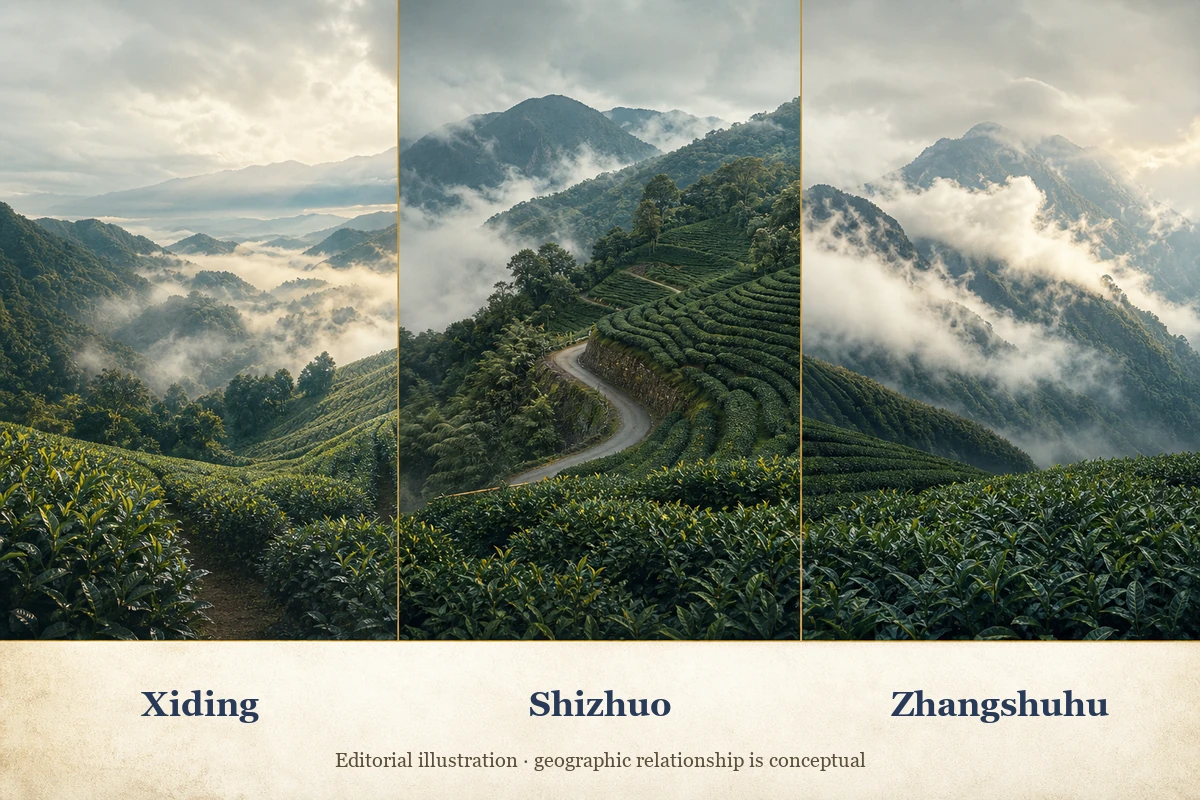
Zhangshuhu: high-elevation conditions still need farming and craft
Zhangshuhu is associated with the Taihe area of Meishan Township. The Tea and Beverage Research Station has established a high-elevation research site near Zhangshuhu at more than 1,600 metres to study tea physiology, environmentally responsible cultivation, and processing in mountain conditions. That official project confirms the relevance of the local environment; it does not mean that every packet labelled Zhangshuhu came from one elevation or will share one sensory profile.
Altitude, day-night temperature range, cloud, and light can affect how a tea plant grows. The raw leaf still has to be cultivated, harvested at an appropriate stage, and transformed with control. This is why ABoxTik does not reduce the comparison to “Zhangshuhu is always better.” If you are interested in scarcity and price, continue with five ways to evaluate rare tea and our explanation of how high-priced Taiwanese tea creates value.
Can Shizhuo, Xiding, and Zhangshuhu be ranked by a fixed taste?
Not responsibly. Online descriptions often assign a permanent set of tasting words to each community. This can turn one merchant’s experience with one lot into a claim about an entire region. A more useful comparison treats origin as one variable and holds as many other conditions as possible constant.
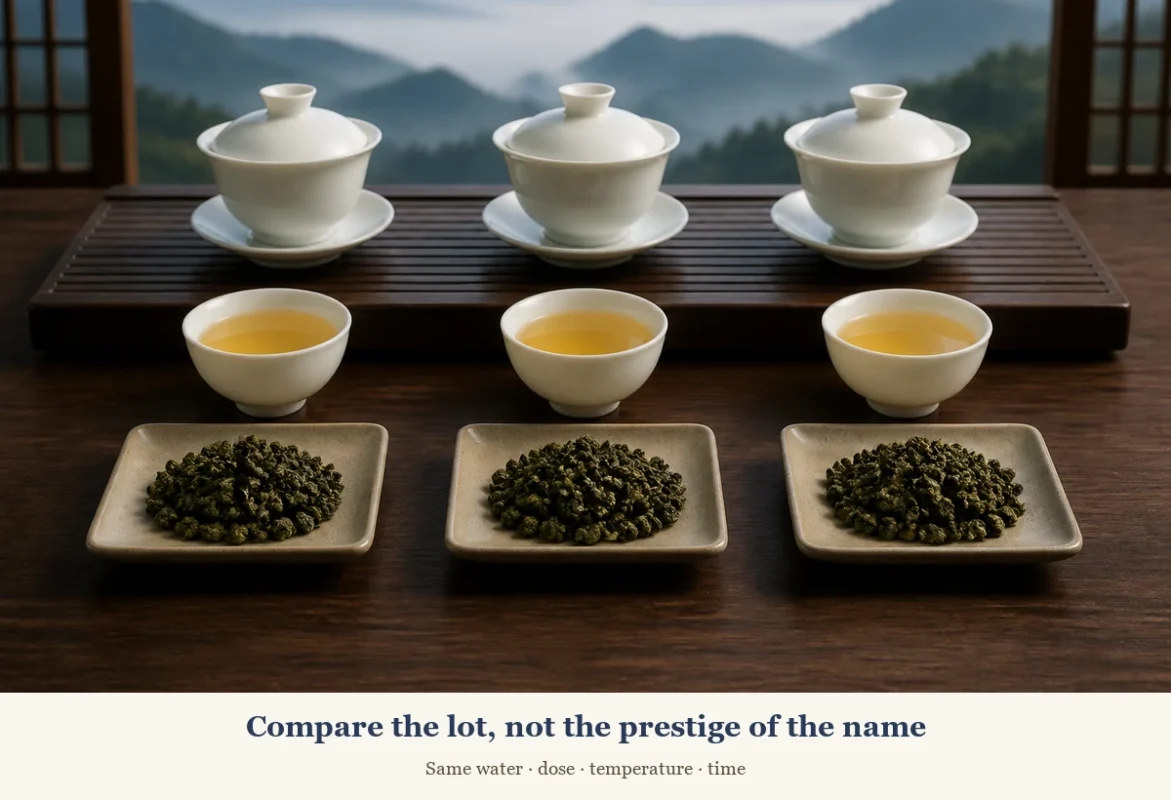
- Standardise water and equipment: use the same water, temperature, leaf-to-water ratio, steeping time, and cup.
- Compare like with like: whenever possible, select the same cultivar, harvest season, and a similar oxidation and roast level.
- Record observations separately: note dry leaf, warmed-leaf aroma, liquor, texture, finish, and spent leaf without looking at the price first.
- Reveal origin last: compare your notes with the production information and build experience rather than memorising regional adjectives.
Before comparing mountain names, it also helps to separate tea type, cultivar, and processing. Our guide to tea types and the six major categories and introduction to representative Taiwanese teas provide a practical foundation.
Six label details that matter more than mountain-name prestige
- A more precise origin: beyond “Alishan,” does the seller identify the township, village, garden, producer, or traceable source?
- Cultivar: Chin-shin oolong, Taiwan Tea No. 12, and other cultivars should not disappear behind the generic words “high mountain tea.”
- Harvest and lot: look for spring, winter, or another harvest period and information that connects the tea to a production lot.
- Processing direction: lightly aromatic, more oxidised, or roasted; the degree of oxidation and roast can be more immediately noticeable than the village name.
- Taiwan-origin traceability: packaged tea made from Taiwan-grown leaf has been subject to origin traceability labelling requirements since 2023, using an approved traceability QR code, Taiwan Agricultural Product Traceability certification, or organic certification route.
- Scope of the geographic certification mark: the Alishan High Mountain Tea origin mark is a voluntary scheme with origin, pesticide-residue, sensory-quality, and serial-control requirements. It does not replace mandatory domestic-tea traceability.
Save these six points as your own buying checklist. If a label offers an impressive mountain name but no cultivar, season, maker, or traceability clue, the Alishan tea regions comparison is incomplete. This supports the same principle discussed in our article on why Taiwanese tea is distinctive: terroir deserves a story, and origin should also be understandable.
Choose for the occasion, not simply for the highest mountain
| Occasion | A practical starting point | What to compare |
|---|---|---|
| First Alishan tea | A well-documented, lightly aromatic single lot | Cultivar, season, maker, and brewing guidance |
| Everyday brewing | Choose the fresh or roasted direction you enjoy | Brewing tolerance, persistence, and storage |
| Three-region tasting | Same cultivar and season with similar processing | Keep water, dose, temperature, and time identical |
| A gift for an international friend | Taiwan tea with clear origin and traceability | Bilingual information, complete packaging, and current availability |
To build a comparative tasting set, explore ABoxTik’s four-tea Taiwanese tasting gift. For individually packed tea, see the two-selection tea bag gift box and four-selection premium Taiwanese tea gift box. Use the set to practise controlled comparison; contents and availability should always be confirmed on the current product page.
Frequently asked questions about Alishan tea regions
Which is highest: Shizhuo, Xiding, or Zhangshuhu?
The public references used here describe different things: a research site near Zhangshuhu above 1,600 metres, a Shizhuo producer profile around 1,200–1,700 metres, and a Xiding trail around 1,000–1,100 metres. They cannot be treated as a ranking of every garden. Ask for the actual origin and production information of the tea in front of you.
Is Zhangshuhu tea automatically better than Shizhuo or Xiding tea?
No. High elevation is one environmental condition, not a guarantee of quality. Cultivar, farm management, harvest, processing, storage, and brewing can all change the result. Compare actual lots under similar conditions.
Is every Alishan tea a high mountain tea?
Alishan is a broad tea region crossing several townships and elevations. “Alishan High Mountain Tea” is a familiar market name, but not every garden has identical conditions. Look for a more precise location and product record.
How can I verify that a tea really comes from Taiwan or Alishan?
Check the domestic-tea traceability QR code, Taiwan Agricultural Product Traceability certification, or organic certification information, then confirm producer, lot, and more precise origin. If the Alishan High Mountain Tea geographic origin mark is used, verify its scope through the relevant official system. The two systems serve different purposes.

Follow ABoxTik into Taiwanese tea
Let a place name begin a more complete understanding of Taiwan
Shizhuo, Xiding, and Zhangshuhu are not three answers to arrange from lowest to highest. They are three geographic entrances to the Greater Alishan tea region. A meaningful comparison places mountain name, cultivar, season, craft, producer, and traceability on the same table—and lets careful tasting make the final distinction.
ABoxTik was created to help Taiwan’s quality products travel with context, dignity, and verifiable value. Read the story and selection philosophy behind ABoxTik, or discover how limited-edition tea gifts bring together Taiwanese tea and local craft.
Sources
- Ministry of Agriculture, Tea and Beverage Research Station: Central and southern tea areas (checked 21 August 2026)
- Tea and Beverage Research Station: Tea geographic origin certification marks (checked 21 August 2026)
- Agriculture and Food Agency: Taiwan-grown tea traceability FAQ (checked 21 August 2026)
- Ministry of Agriculture rural tourism: Shizhuo tea area profile (checked 21 August 2026)
- Tea and Beverage Research Station: High-elevation research near Zhangshuhu (checked 21 August 2026)