
Tea Knowledge
How Did Sanyi Woodcarving Become a Taiwanese Craft Icon? History and Ways to Look

Wood does not tell its whole story at once. Give it a moment: grain, tool marks, and open space begin to speak in their own time.
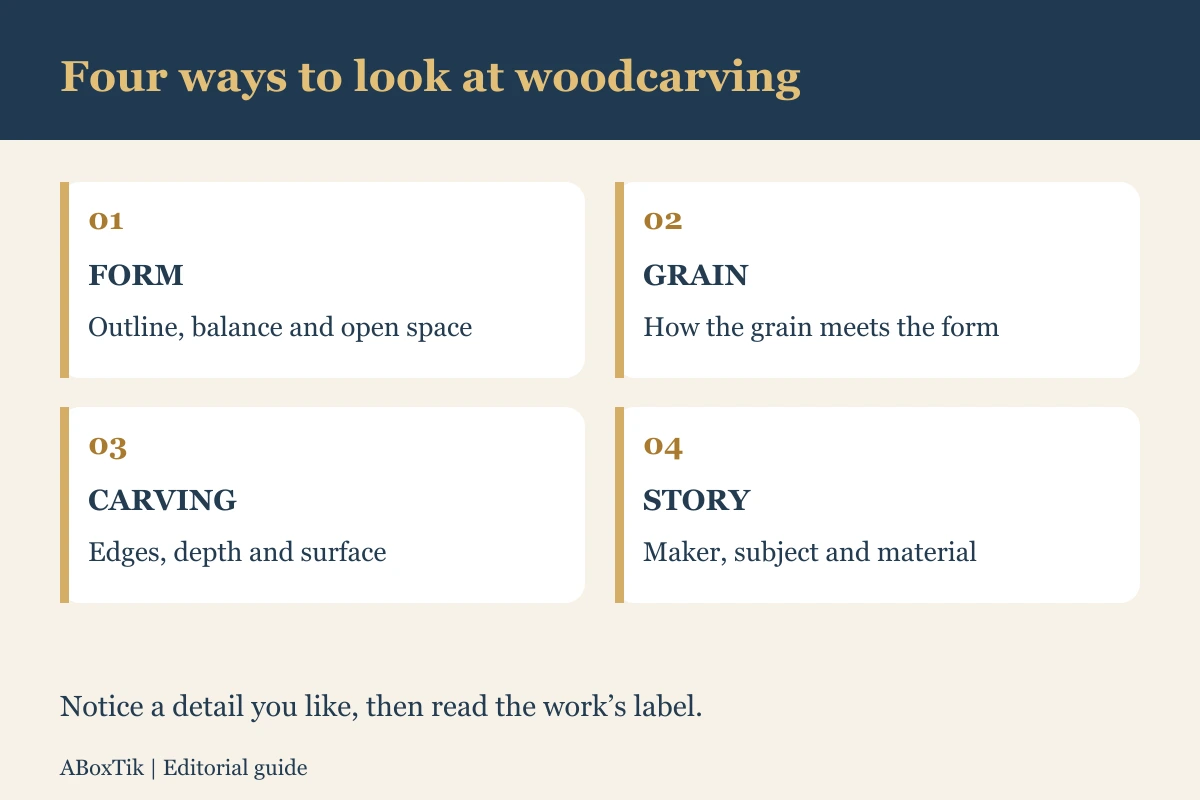
Sanyi woodcarving became an important Taiwanese craft tradition through more than a single origin story: timber work, skill, workshops, trade, and public culture gathered over generations. Its history moves from early wood-product businesses to postwar carving workshops and export production, then to a present where museums, makers, visitors, and new forms of practice meet. For a first look, there is no need to decide whether a work is “valuable.” Begin with four questions—form, grain, carving, and story—and your response will have room to become more precise.
Perhaps a carved tray, small sculpture, or display object caught your attention beside a tea table. That is a fine place to begin. As with our guide to Miaoli pottery, it helps to separate place, material, process, and intended use before giving a work one quick label.
Why does Sanyi woodcarving stand for Taiwanese craft?
A place becomes representative through long-lived relationships, not by one celebrated object alone. Taiwan Cultural Memory Bank records Dongda Products in Sanyi in 1918 and the founding of Xingye Products in 1946. From 1966 to 1973, export demand brought carving factories and related workers into closer concentration. Together, those developments made an identifiable local craft landscape.
That history is more useful than claiming that any one style is naturally “the most Taiwanese.” Materials, apprenticeship, orders, transport, and changing taste all shaped what happened in Sanyi. A wider view of local craft is available in our history of Taiwanese ceramic craft. The materials differ, but both histories show that craft is made slowly by people working with a place.
From woodware to contemporary practice: key turns in Sanyi
Sanyi’s story is not a straight line. The cultural record traces early woodware, postwar carving workshops, and the export-oriented clustering of the later 1960s and early 1970s. The Sanyi Wood Sculpture Museum opened in 1995, creating a public setting for collection, display, research, and promotion. Since 2010, the area has continued to consider how craft, culture, and tourism can develop together.
These dates are helpful as a map, not a shortcut for dating an individual work. A traditional subject is not automatically old, and a pared-back form is not automatically detached from Sanyi. The maker’s name, the date, a label, and the setting in which a work is shown carry more weight than a guess based on appearance. For a useful comparison in another material, read about Yingge ceramics: a craft district is often built through division of work and adaptation, not through one look.
Step one: look at form before looking for a verdict
Take one step back. Figures, animals, flowers, landscapes, and abstract forms each have their own balance, pauses, and preferred viewing direction. Does the work ask to be faced, walked around, or seen from above? You do not need to identify a school of carving to notice those choices. Miaoli County Government’s introduction to artist Kuan Hsiao-chin notes his preservation of natural grain and material form; it is a helpful reminder that wood’s irregular shape can participate in composition.
“Does it look realistic?” is only one question. A work that follows a branch-like contour may deliberately leave an edge uneven. A detailed figure may use lines and expression differently. Try asking: what did I notice first—gesture, open space, or a turn in the silhouette? That answer is enough to begin.
Can you appreciate it without understanding everything? Of course. Choose one detail you like—a curve, a patch of open space, or light falling on the grain—and stay with it for a moment. The work will not deduct points because you forgot a term; your own attention is already part of the encounter.
Step two: notice grain and material without trying to identify the wood
Grain is not simply a decorative backdrop. It can guide light, direction, and the breathing space of a surface. Notice whether lines run with a figure or are interrupted at a particular point; see whether a natural opening, color change, or irregular edge has been retained. These clues can show how a maker worked with material. They do not identify the wood species on their own.
For species, origin, or treatment, ask the maker, studio, or exhibition staff and keep the work’s written information. A photograph is not enough to determine species, age, or rarity. This modest approach resembles reading a teapot material guide: material is an entrance to understanding, not a universal conclusion.
Step three: look for carving and depth, not just fine detail
Move closer and see how a flat plane meets a recess, how a line turns, and how deep and shallow areas create foreground and distance. One maker may arrange attention through layered flowers; another may use an economical line to carry the movement of a figure. Both are openings for noticing line and depth, not fixed standards for every Sanyi work.
| What to notice | A useful question | What not to assume |
|---|---|---|
| Silhouette and balance | From where does the work feel most alive? | Status of subject or maker |
| Grain and open space | How does natural form join the composition? | Species, age, or rarity |
| Tool marks and depth | How do line, shadow, and relief carry the subject? | Hours, price, or technical name |
| Label and context | What memory, place, or feeling does the maker describe? | Authenticity from appearance alone |
More visible tool marks do not automatically mean “better.” Detail can build a story; broad, quiet planes can let the wood rest. Noticing how light pauses on a surface is already a useful observation.
Step four: read the story and ask four collecting questions
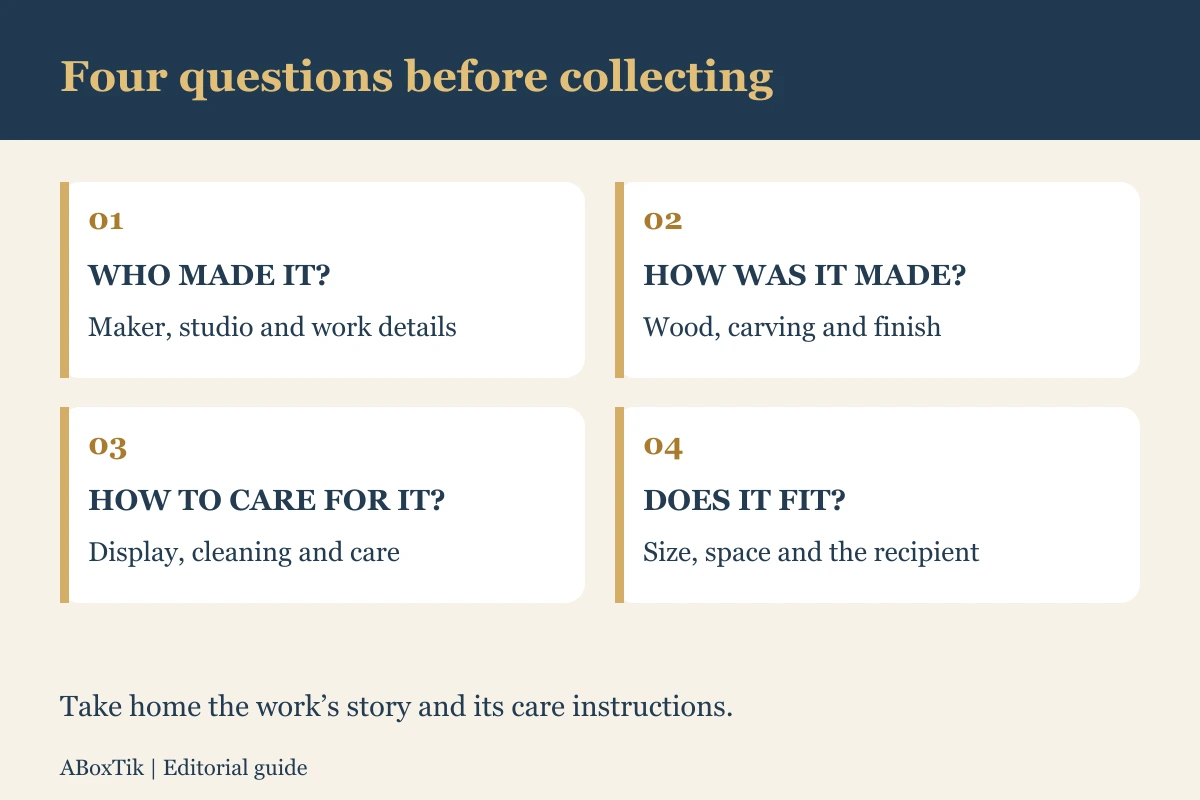
A work’s story is not a layer of mystery added afterward. It helps you understand where the work came from and how it can be cared for. Whether you are considering a collection, a gift, or simply a longer look, these four questions make a respectful conversation with the maker, studio, or exhibition team.
- Maker and subject: What are the title, date, and starting idea?
- Material and process: How was the material obtained and treated? Which decisions followed the original timber?
- Placement and care: What light, humidity, cleaning, and handling conditions suit this work?
- Scale and space: From its main viewing angle, does it have a suitable place in the intended room?
If a work may sit near tea, add a practical question about sun, moisture, and heat sources. Tea objects and sculpture have their own conditions; neither has to prove the other’s worth. Our guides to brewing in porcelain and gaiwan versus teapot can help keep the actual tea arrangement clear.
Follow ABoxTik

Putting craft back into daily life: visits, gifts, and tea time
Before a visit, check current opening and tour information. Historical material gives context, but does not describe today’s schedule. On site, read one label and stay with one work for an extra half minute; that often gives more than rushing through a full row of photographs. To see why ABoxTik cares about well-explained Taiwanese goods, you can also read About ABoxTik.
For a gift, let the recipient’s space, taste, and care habits lead. A sculpture made for display may not belong beside a damp window. If you would like familiar Taiwanese tea nearby, the roasted direction of Dong Ding Oolong tea bags or the range in the Classic Taiwanese Tea four-selection gift box can make the pause at the table feel more complete.
Sanyi woodcarving rewards time because local industry, individual choice, and a piece of wood’s character meet in one object. The next time a work catches your eye, try the four questions. You do not need every answer at once; understanding can grow each time you return to look.
Related recommendations
- What makes Miaoli pottery distinctive?: a place, material, and use framework for looking at craft.
- How Taiwanese ceramic craft developed: another material’s story of industry, daily life, and change.
- Classic Taiwanese Tea four-selection gift box: familiar tea for an unhurried looking moment.
Sources
- Taiwan Cultural Memory Bank: Sanyi woodcarving industry material (checked 2026-10-06)
- Miaoli County Government: Sanyi Wood Sculpture Museum material (checked 2026-10-06)
- Miaoli County Government: Kuan Hsiao-chin artist material (checked 2026-10-06)