
Tea Knowledge
Sunny or Shaded Tea Gardens: What to Compare
Ask about the hillside, then follow the actual tea back to its lot.
Before comparing sunny and shaded tea gardens on one mountain, ask for the actual plots, slope aspect, seasonal light and shade, cultivar, harvest and processing records, then connect each finished tea to its lot. Aspect can contribute to a local growing environment. It cannot independently tell you which retail packet must be more fragrant. Sunshine arrives without an award certificate for the finished tea.
It is tempting to assign personalities to a bright hillside and another in mountain shadow. Keep that curiosity, but separate the photograph, terrain, cultivation and tasting impression. This guide offers a data card for a conversation with a producer, rather than a way to grade gardens from a phone picture.
Distinguish aspect, gradient, elevation and mountain name
Aspect describes the direction a slope faces. Gradient describes its steepness, and elevation its height. A mountain name usually covers a much larger area. Two gardens sharing that name need not share any of the other three conditions. Nor does a compass direction establish the hours of light a plot actually receives. Matching the terms prevents the conversation from wandering onto another hillside immediately.
The Ministry of Agriculture’s tea-growing environment article identifies latitude, elevation, gradient and aspect as terrain factors, and explains connections between aspect, radiation and ground conditions. That supports recording aspect. It does not demonstrate that one direction necessarily produces a better-tasting finished tea. Growing conditions, manufactured quality and personal preference require different evidence.
Sunny and shaded need a local context
Actual exposure also involves season, time of day, neighbouring landforms, cloud and tree cover. A photograph may capture a temporary shadow. Tree shade is not equivalent to a compass-facing slope. Ask where the plot is, which season the description concerns and what creates the shade before asking whether “sunny tea” tastes sweeter. The earlier questions have a better chance of receiving usable answers.
General agronomic guidance is a starting context. Conditions in a particular garden still need their own description. Do not convert a broad passage into a flavour chart for every cultivar, region and harvest. If light has not been measured, retain that uncertainty. “Often shaded in the afternoon” is a producer observation; a precise number of sunlight hours would be a different kind of evidence.
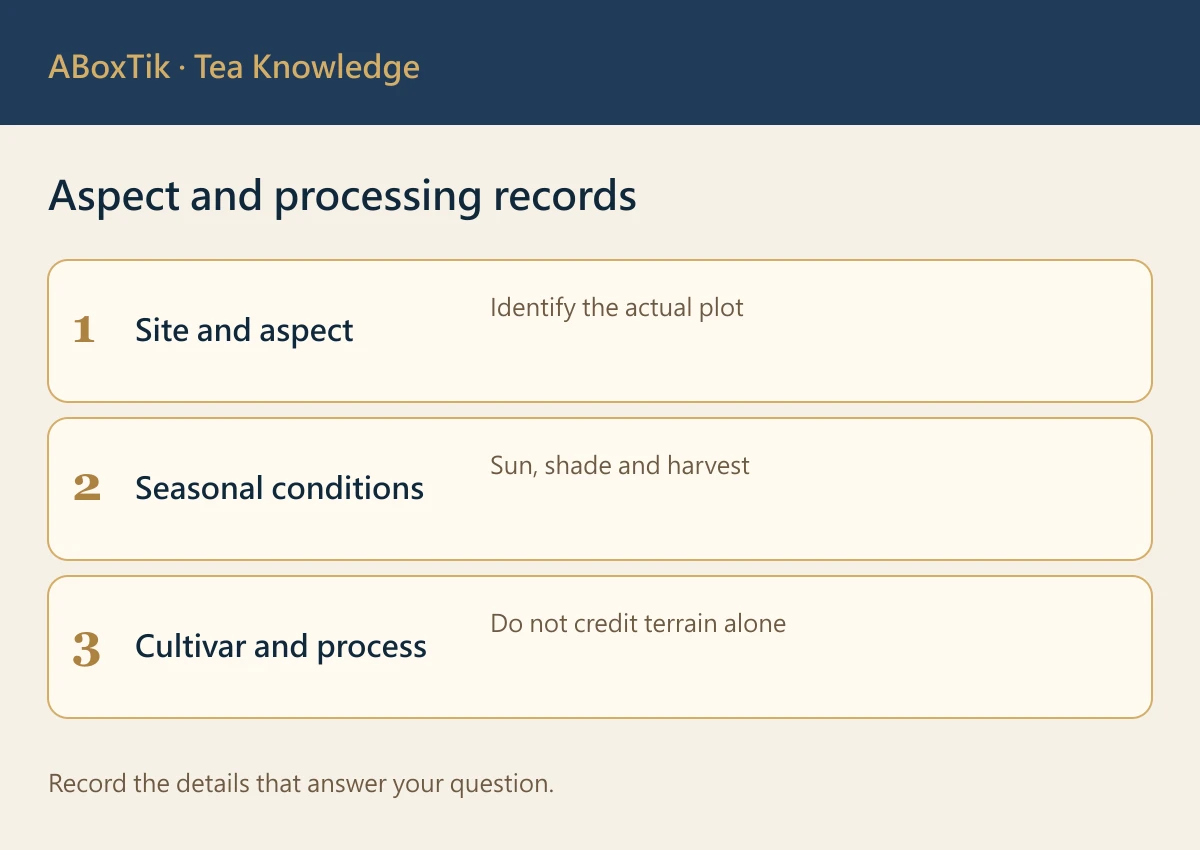
Connect the landscape with the actual batch
| Layer | Useful information | If unavailable |
|---|---|---|
| Plot | Location, aspect, gradient, elevation and source | Mark the plot as unconfirmed |
| Seasonal setting | Weather, light, shade and management observations | Distinguish descriptions from measurements |
| Leaves | Cultivar, harvest date, maturity and picking approach | Keep each unknown visible |
| Manufacture | Producer, processing and roasting direction | List uncontrolled differences |
| Finished product | Lot, packaging, opening and storage | Check its connection to the garden |
| Tasting | Dose, water, thermal conditions and impressions | Describe a session, not an origin test |
The card is not a demand for a small producer to install a mountain-wide monitoring network. Ask for information they are willing to share. A coarser location may be appropriate for privacy. The precision of the later conclusion must then remain equally modest: a township name cannot support an exact causal account of a particular slope.
One mountain and season can still hide many differences
Imagine one garden growing Qingxin Oolong and another Jinxuan, with different makers and roasting styles. Even if their exposure differs, the cups do not isolate aspect. Cultivar, harvest standard, transport and manufacture changed as well. Listing those differences preserves an interesting comparison while keeping the explanation within what the information can support.
If the purpose is to choose between two packets, preparing each appropriately and recording enjoyment may be enough. Investigating an aspect effect requires a more controlled design, comparable materials and processing, and repeated batches where appropriate. Household tasting can generate a good next question. It need not announce that it has completed causal research.
Ask questions that the producer can build on
Try: “I am interested in the garden’s exposure. Which plot supplied this tea? Does sunny or shaded refer to slope direction or actual shading? Which harvest season does the observation concern?” Once location and timing are clear, ask about cultivar, harvest and manufacture. One layer at a time usually works better than sending ten technical terms into the conversation together.
A useful follow-up is: “Which conditions are similar between these gardens, and which differ? Do you have lots with the same cultivar, similar harvest timing and comparable processing?” A reply that no such comparison exists is still informative. You can introduce two teas and their backgrounds without claiming that their difference has been explained by aspect.
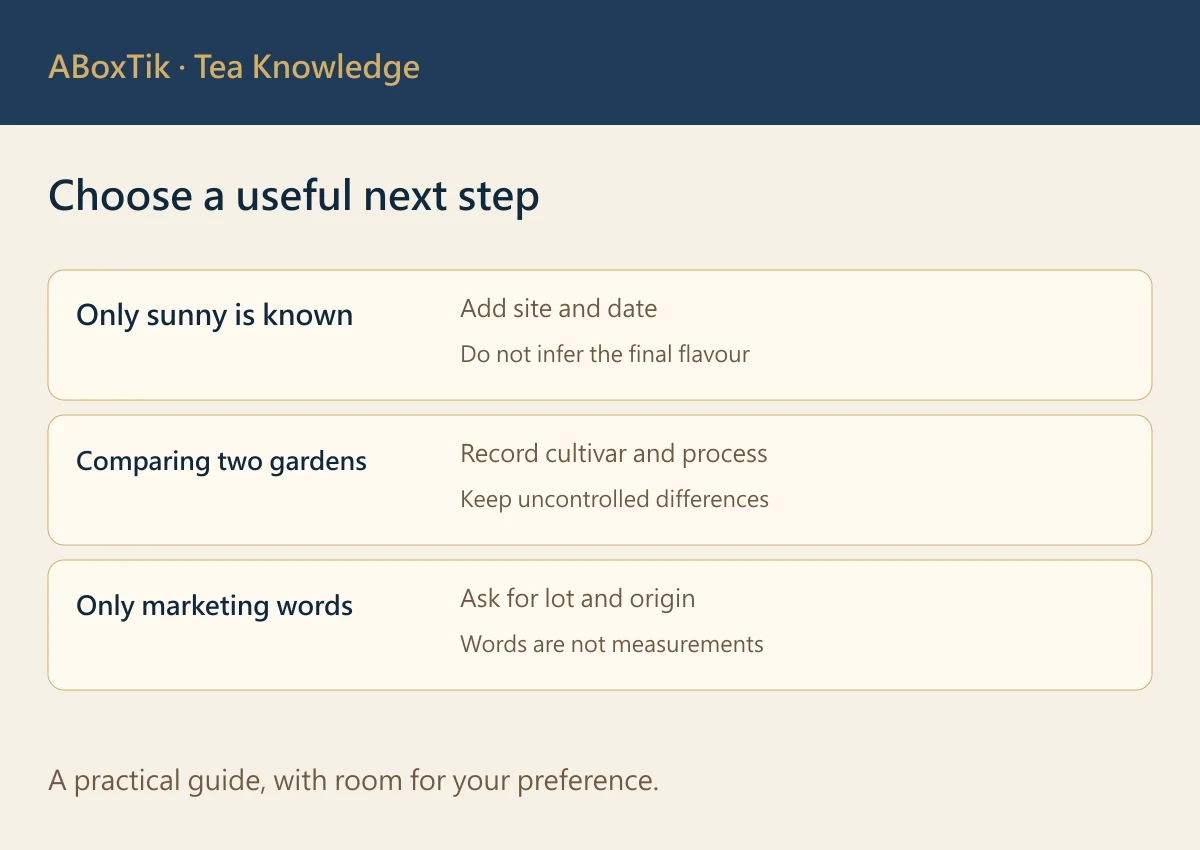
Put background on one side and impressions on the other
Record plot and lot information separately from aroma, flavour, mouthfeel and liking. Tasting coded cups before reading their stories can remind you not to write down the expected answer. Start with matching cups, water and recorded preparation. If the products recommend different methods, a separate round can compare those complete drinking arrangements instead.
“Cup A has a clearer floral impression; cup B’s roasted direction suits my after-dinner preference” describes cups and use. “Floral proves shade” does not. The aroma observation guide supports descriptions. The six-condition high-mountain quality guide considers the wider picture, allowing aspect to remain one clue among several.
Maps, photographs and visits answer different questions
A map helps locate a place. A photograph records a moment. Production records connect actual leaves with harvesting and manufacture. These are complementary rather than interchangeable. An illustrative landscape from elsewhere cannot become a batch’s garden photograph. During a visit, follow access rules, ask before recording precise locations, and avoid picking leaves, taking soil or stepping into planting rows without permission.
Trees, ground cover and insects can invite questions about management. They do not certify organic production, pesticide status or a particular aroma. The garden biodiversity guide offers another set of observations. Testing and certification return to their own documents, so each kind of evidence does the work it can actually support.
A producer’s explanation can also be recorded with its date and scope: an observation about one plot during a particular harvest is more precise than a permanent label for a mountain. If a retailer supplies a general regional story but cannot connect it to the packet, retain the story as background and mark the batch connection as unknown. That preserves useful cultural context without allowing a broad landscape description to stand in for a product record.
Keep the curiosity and narrow the conclusion
For today, distinguish aspect from shade, connect the product to a lot and separate tasting from background. Incomplete information does not prevent enjoying the tea; it simply limits the story you can responsibly tell about its cause. A specific question is often a better next step than another large adjective.
Next time someone says “same mountain, different side,” ask what else is alike and what else changed. To build flavour reference points, explore the current selection in the Classic Taiwanese Tea gift set and read each tea’s source information individually. The landscape can remain interesting while the cup leaves room for your own answer.

Related reading and tea choices
Sources
Sources checked: 25 October 2026.