
Tea Knowledge
Teapot Lid Fit Checklist: Safe Tests Before You Buy

A thoughtful question makes the next cup easier to choose.
A teapot lid does not need to create an airtight seal to be useful. It needs to sit safely, leave the vent clear, feel manageable in the hand, and let you pour in control. Check those things dry first, then with a small amount of cool water if the retailer permits. Do not turn the pot upside down, block its vent, force the lid, or “improve” a rim by grinding it. A tea pot is a vessel, not a household physics audition.
“Fits” also has two meanings. One is preference: perhaps you like a lid that feels light, a knob that is easy to pinch, or a handle that gives more knuckle room. The other is a condition worth asking about: a chip, crack, unstable seating, a lid that catches, a pour that cannot be controlled, or a leak that appears under ordinary upright use. Keeping those categories separate helps a shop answer properly and helps you avoid declaring a personal preference to be a manufacturing verdict.
This checklist concerns fit and handling. For broader vessel choice, see teapot materials, gaiwan versus teapot, and porcelain tea brewing. Those articles explain material and brewing context; this one asks a simpler question: can this actual pot be handled calmly at a tea table?
Look before you test
Put the empty pot on a stable, level surface. Check the lid, rim, knob, handle, spout, and body in good light. You are not trying to judge a handmade piece against a machine-made fantasy. You are looking for things that could affect ordinary use: visible damage, sharp edges, obvious rocking, a lid that will not seat without force, or a knob that cannot be held comfortably.
Handmade work may show variations in shape, glaze, or placement. Ask the maker or retailer how they describe normal variation for that particular piece. Do not supply your own tolerance number, and do not assume that a slight visual difference tells you how the pot will pour. Conversely, do not persuade yourself that a crack is “character.” Character should not require a bandage.
The dry-fit check
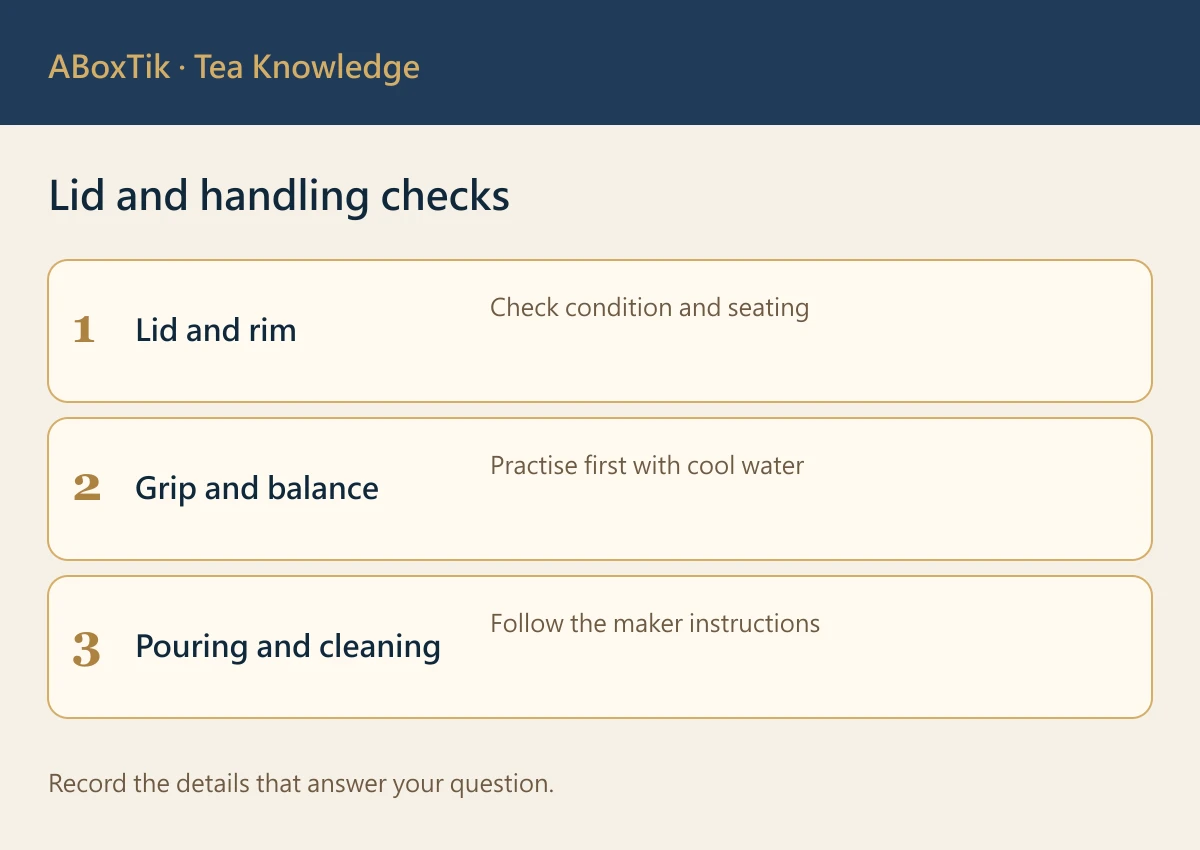
- Seat the lid gently. Place it in its intended orientation; do not press, twist, or force it. It should rest on the rim without an alarming wobble or catch.
- Check rim clearance. Look around the lid edge. A visible gap does not automatically mean failure; the question is whether the lid stays stable in normal upright handling.
- Find the vent. Identify where air enters while pouring. Keep it unobstructed. A blocked vent can make a pour unpredictable, which is a poor moment for experimental heroics.
- Hold the knob. Lift the lid as you would during rinsing or pouring. Notice whether your fingers have a secure, comfortable place and enough clearance from the hot body in future use.
- Hold the handle. With the pot empty, check whether the grip feels balanced and whether your knuckles have room. A comfortable handle is a preference; a sharp edge or insecure grip is a reason to pause and ask.
- Test the lid during an imaginary pour. Keep the empty pot dry and upright. Put one hand where it would naturally support the lid; do not cover the vent and do not tip the pot.
This is not a test for airtightness. A teapot normally needs airflow during pouring; holding a lid down and blocking the vent in pursuit of a dramatic seal tells you very little about safe daily use. It may tell you that water dislikes being trapped, which was already widely suspected.
The cool-water pour test
Only conduct this test where the seller allows it, using a stable surface and a small amount of cool water. Keep the pot base down and tilt normally to pour until you are ready to pour into a suitable vessel. Use the normal handle and, if needed, rest a finger lightly on the knob without obstructing the vent. Pour slowly. The purpose is to feel the path of water, not to prove bravery.
| Observe | What to note | Next step |
|---|---|---|
| Lid movement | Does it remain seated during a controlled, ordinary pour? | If it shifts unexpectedly, stop and ask the seller rather than gripping harder. |
| Pour path | Can you direct the stream comfortably into the receiving cup? | Some splash or a preferred speed can be subjective; report the exact behaviour. |
| Drips | Is there a small final drop, or repeated mess in normal pouring? | Ask how the maker expects the spout to pour; do not diagnose from one rushed attempt. |
| Balance | Does the handle feel manageable with a small amount of water? | If it strains the hand, it may be a mismatch even if not defective. |
| Vent response | Does the flow feel smooth while the vent remains clear? | Never cover the vent to “test” flow. |
Do not invert the pot, shake it, or fill it to the top for a shop test. Those stunts increase spill and breakage risk without representing how a careful person pours tea. A controlled, low-volume cool-water observation is enough to decide whether you need a more informed conversation.
Knob, handle, and balance: small details with large manners
Try the movements you will actually make: lift the lid, set it down, pick up the empty pot, and imagine bringing it to a cup. If you will use the pot with one hand, check the handle before it is full and hot. If a knob is small or smooth, that does not prove it is wrong; it may simply not suit your grip. Write “I prefer more purchase on the knob” rather than “the knob is defective” unless there is actual damage or unsafe instability.
Clearance matters because hot vessels are less forgiving than showroom tables. Notice where fingers would go and whether the grip encourages a steady wrist. A shop cannot choose your hand for you, but it can tell you the maker’s intended use, confirm dimensions if they are published, and explain whether the piece is designed for a particular style of brewing.
Cleaning and maker guidance belong in the decision
Ask how the maker recommends cleaning and drying the pot, especially around the rim, vent, and spout. Do not probe a vent with a sharp object or treat a stuck residue as a reason to alter the vessel. Use the maker’s guidance; if it is unavailable, ask the retailer before trying a household remedy that might scratch a glaze or damage a component.
After a cool-water test, empty the vessel carefully and dry it according to the supplied guidance. The point is not to create a perfect laboratory report. It is to discover whether you can use and maintain the pot comfortably.
Questions worth asking in the shop
- “How does the maker describe normal handmade variation in this lid and rim?”
- “May I do a small cool-water, controlled pouring test here?”
- “Where is the vent, and how should I keep it clear while pouring?”
- “What cleaning and drying method does the maker recommend?”
- “If I notice a chip, crack, unstable lid, or unexpected leak in ordinary use, what information do you need for review?”
A useful answer identifies the actual piece or product line, explains the intended handling, and gives a next contact if there is a problem. “Perfect seal” and “never drips” are not useful promises. Neither should be demanded. A teapot is judged by safe, comfortable, ordinary use, not by a magic trick.
Troubleshooting: preference, care question, or stop signal?
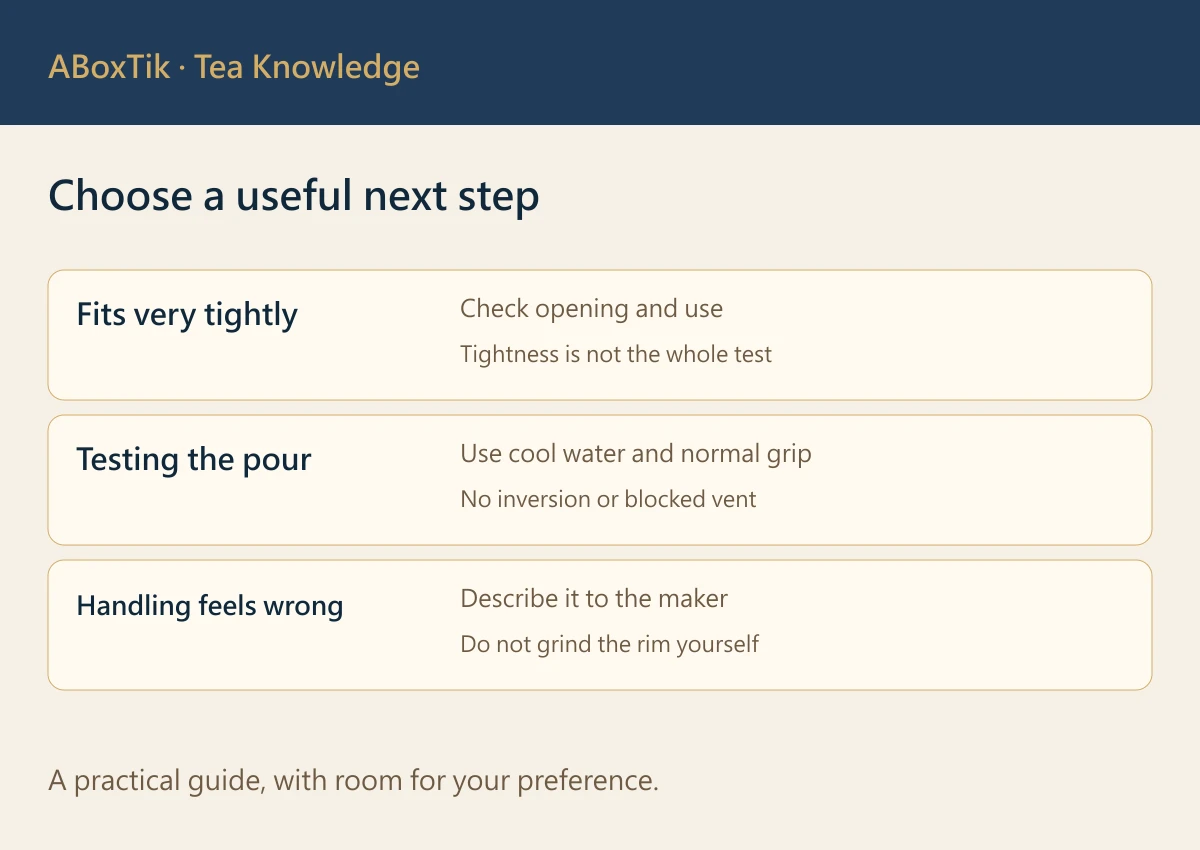
| You notice | Category | Response |
|---|---|---|
| You would prefer a larger knob or lighter pot. | Preference | Choose another piece or ask for alternatives; no defect need be alleged. |
| A final drop appears after a slow pour. | Observation | Describe the conditions to the retailer and ask about intended pouring technique. |
| The lid seems tight after residue builds up. | Care question | Stop forcing it; follow maker cleaning guidance or ask before attempting a remedy. |
| There is a chip, crack, sharp edge, unstable seating, or concerning leak. | Stop signal | Stop use, keep order details and photos, and contact maker or retailer. |
The best teapot is not the one that wins a dramatic lid test. It is the one you can lift, pour, clean, and put down with attention left over for the tea. Test calmly, leave the vent alone, and let a clear question do more work than a risky demonstration.

Related reading and tea choices
Sources
- Teapot material guide
- Gaiwan versus teapot
- Porcelain tea brewing
- KINTO: model-specific guidance on dripping and individual variation
Sources checked 25 October 2026.