
Tea Mixology
Tea Mocktail: Syrup or Honey? A Comparison Design Guide
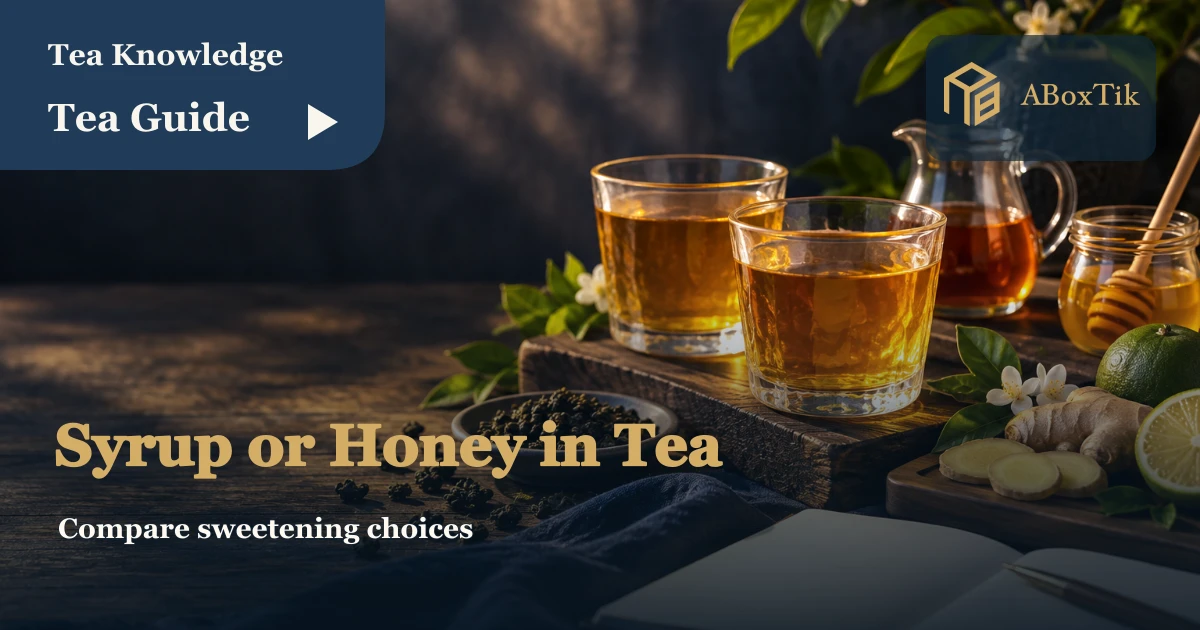
A thoughtful question makes the next cup easier to choose.
For a non-alcoholic tea drink, choose syrup when you want a labelled, often more neutral or deliberately flavoured sweetener that is easy to incorporate; choose honey when its own floral or darker notes are welcome in the design. Neither is automatically “better.” They create different variables, and a useful comparison keeps those variables visible instead of asking one teaspoon to settle an argument about tea, sweetness, ice, and temperature all at once.
Use this design guide to plan a small comparison, record the actual ingredients and choose a serving direction. A tea, a honey, a syrup, the water, the temperature, and the ice all change the finished drink. The practical goal is simpler: make a small comparison that you can describe honestly, then choose the version that suits the occasion and the people being served.
For broader alcohol-free tea-drink ideas, see non-alcoholic tea mixology, seasonal tea mocktails, and Qinyu tea. Those pages offer different contexts. Here the focus is how to compare syrup and honey in a practical home setting.
Read the actual label before you choose the story
“Syrup” is a format, not a single ingredient. A plain syrup, a flavoured syrup, and a product with several ingredients may perform differently in a drink. Honey also varies in colour, aroma, texture, and label information. Read the product you hold: ingredient list, nutrition information where provided, allergen or other required statements where applicable, and the maker’s storage guidance. The U.S. FDA food-labeling resources is a useful general reference for understanding why the specific label matters; it cannot replace the label on your own bottle or jar.
Label-reading is not a lecture that makes the drink less festive. It is how you avoid inviting a citrus-flavoured syrup into a tea comparison while believing it is only there to sweeten. If the point is to compare sweetener format, select a plain syrup. If the point is to design a fruit-forward drink, choose a flavoured syrup intentionally and record that flavour as part of the comparison.
Equal weight does not mean equal sweetness
Do not compare equal weights of syrup and honey and call the result a sweetness verdict. Products differ in concentration, water content, flavour intensity, and how they disperse. Rather than declaring a universal conversion, set a sensory aim: “I want the tea to remain identifiable,” “I want a rounder finish,” or “I want a sweetened iced drink that does not taste like melted dessert.” Add a small amount, taste, and record what changed. The word “small” is intentionally not a recipe measurement.
Keep tea strength and sweetness separate. If one cup tastes thin, do not solve that immediately by adding sweetener; first note that the tea base may be light, the final volume may be larger, or ice may have diluted it. If a cup tastes harsh, do not assume honey or syrup is a correction button. Change one condition for the next comparison, not five conditions while the glass watches in confusion.
Honey is an ingredient with its own aroma
Honey can bring floral, herbal, caramel-like, or deeper notes, depending on the actual honey. That may be exactly the point: a gentle floral honey can be chosen because you want its character beside the tea. It may also move the drink away from a tea-led profile. Record the honey as an ingredient, not a transparent sweetener. “Tea plus honey” is not the same design question as “tea with sweetness added.”
Temperature changes how easily honey mixes. For a warm tea drink, add and stir carefully once the tea is at a comfortable working temperature. For a cold drink, you may need to plan the mixing stage rather than expecting a viscous honey to disappear politely in a cold glass. This is not an instruction to heat or hold a product at a particular temperature; it is a reminder to observe whether the sweetener has dispersed before judging the drink.
Syrup can be plain or a flavour decision
A plain syrup may let the tea speak more clearly, while a flavoured syrup adds another aroma and should be named honestly in the final drink. Neither choice is a moral upgrade. If you are serving people with varied preferences, a plain option can make the tea comparison easier to explain; if the occasion calls for a clear fruit, spice, or botanical direction, a flavoured syrup may be the deliberate design choice.
Do not mistake smooth mixing for proof that a syrup is less sweet, cleaner, or more suitable. It may simply be easier to disperse under the conditions you chose. “Easy to mix” is a useful serving observation. “Better for everyone” is a claim no glass can support.
Final volume and ice belong on the record card
A drink changes after water, sparkling water, milk alternative, juice, or ice is added. Ice dilution especially makes the final beverage different from the tea base you tasted before serving. Record the final cup volume or at least the full set of components, including ice. Without that note, “too sweet” might mean “the base was too sweet,” “the cup was too small,” or “the ice had not yet melted.” These are not the same adjustment.
Start by tasting the unsweetened tea base. Then create a comparison with one sweetener at a time while holding as much else as practical constant: same tea preparation, same intended final volume, same serving vessel, similar ice condition, and the same time between mixing and tasting. Real homes are not sensory labs, and that is fine. The purpose is repeatable learning, not a white coat with a clipboard.
A small comparison design
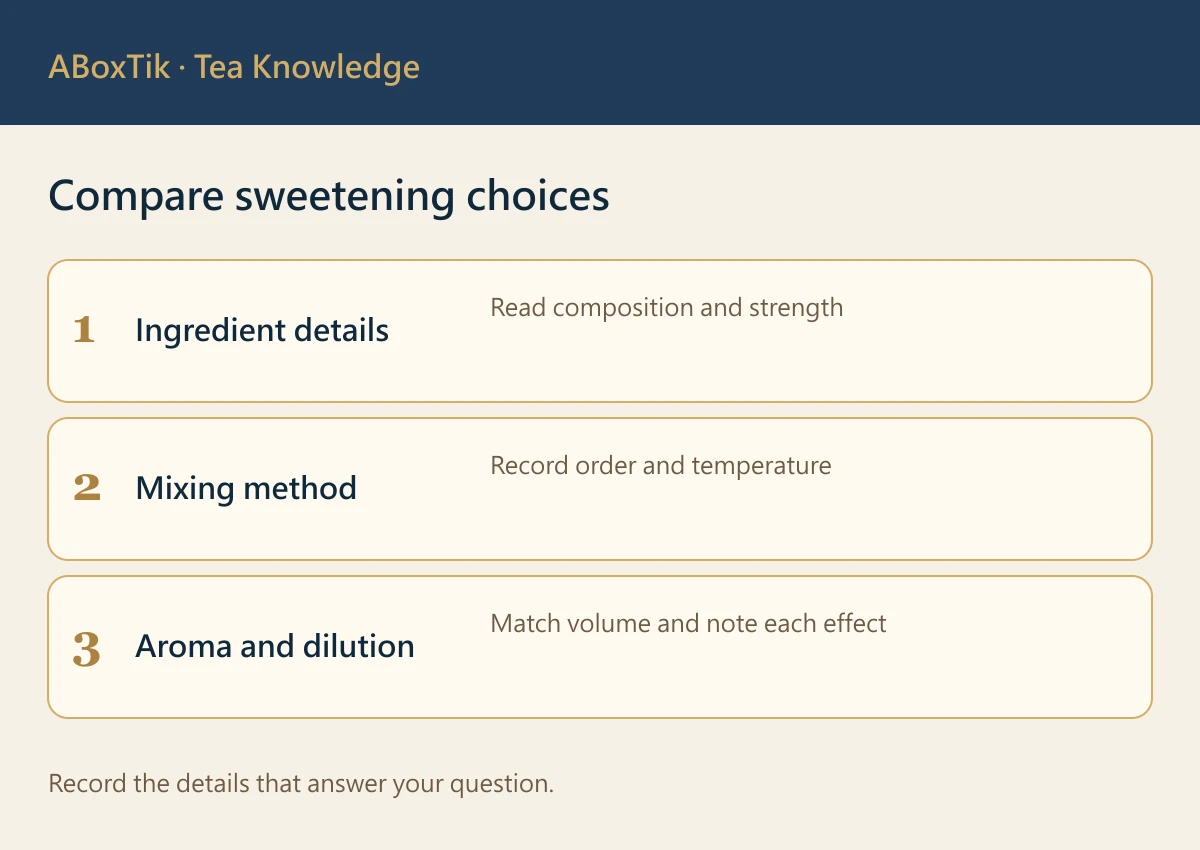
- State the question: for example, “Which option lets this tea remain noticeable in an iced afternoon drink?”
- Choose one tea base: use the same base for both cups and note how it was prepared.
- Choose the sweetener identities: record the exact honey or syrup and whether the syrup is plain or flavoured.
- Keep the intended final volume comparable: include any added liquid and ice in the note.
- Taste the plain base first: write one sentence before sweetness enters the room.
- Add one sweetener to each comparison cup: change no other design element in that round.
- Record, then decide: note aroma direction, tea visibility, sweetness impression, texture, and serving suitability.
| Record field | What to write | Why it matters |
|---|---|---|
| Tea base | Tea name, preparation note, and whether it was tasted plain. | Keeps tea strength separate from sweetener choice. |
| Sweetener | Exact product, label-relevant flavour/ingredient note, plain or flavoured. | Prevents “syrup” or “honey” becoming a vague category. |
| Final build | Added liquid, ice, and intended final volume. | Shows dilution rather than blaming the sweetener. |
| Observation | Tea visibility, aroma direction, sweetness, texture, and ease of mixing. | Records experience without declaring a universal result. |
| Next change | Only one adjustment for the next round. | Keeps the comparison interpretable. |
Choose for the situation, not a winner’s podium
For a tea-focused tasting, a plain syrup may be useful when the design calls for sweetness with less additional aroma. For a drink where honey’s own character is welcome, honey may be the point of the choice. For guests, offer information: which sweetener was used, whether a syrup has a named flavour, and what the product label says where that matters. Do not assume that “natural,” “floral,” “plain,” or “artisan” answers another person’s preference.
Serving temperature also matters. A warm drink may integrate ingredients differently from an iced drink; a cold drink may change as ice melts. Decide when to taste and serve, then write that down. Store each sweetener according to its own label and maker guidance; do not borrow an invented number of days from a recipe blog or apply one product’s instructions to another.
When a comparison goes nowhere
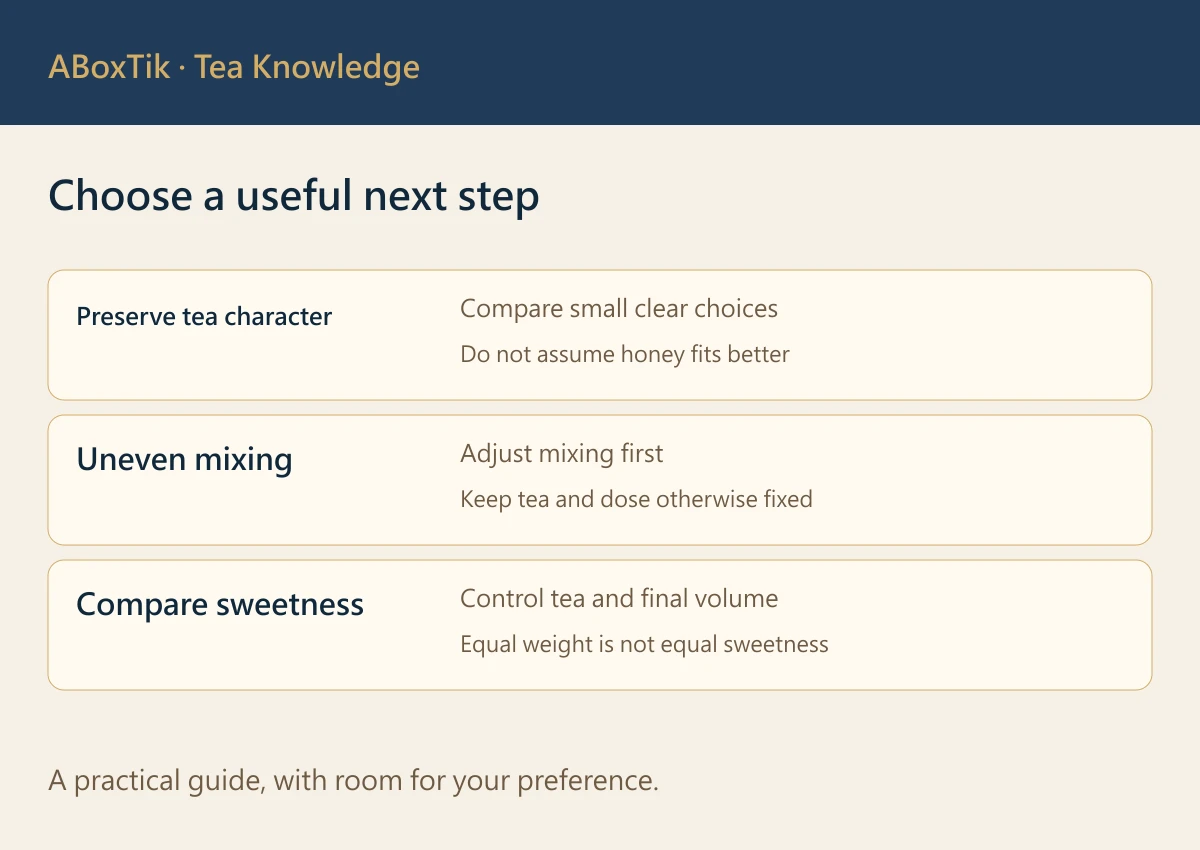
If both versions taste unclear, return to the plain tea. Check whether the tea base is strong enough for the planned final volume, whether added water or ice changed the cup, and whether a flavoured syrup has become the loudest ingredient. Do not keep adding sweetness in hopes that the original tea will speak more clearly. Tea is many things; a megaphone is not usually one of them.
A useful tea mocktail comparison ends with a preference, not a verdict: “For this iced serving, I preferred the tea-led version,” or “For this gathering, the honey’s aroma suits the intended mood.” The record lets you recreate the decision or change one condition next time. That is enough science for a drink you plan to share.

Related reading and tea choices
Sources
- U.S. FDA food-labeling resources
- Non-alcoholic tea mixology
- Seasonal tea mocktails
- Qinyu tea
- FAO: honey composition, physical properties and uses
Sources checked 25 October 2026.