
Tea Knowledge
Tea Gifts for Friends Who Live Alone
A little preparation leaves more room to enjoy the tea.
A tea gift for a friend who lives alone does not need to assume they drink little tea, or that solitude needs explaining. It only needs to be easy to open, easy to keep, and easy to return to on their own rhythm. One person may brew two cups every day, make a pot slowly at the weekend, or keep tea for a late-night writing break. Before choosing a gift, think about likely sessions, inner packaging, the mug or tools already at home, and flavour preference. A clear, manageable selection is often kinder than a large box that quietly becomes homework.
This is a guide to portion and opening rhythm in a one-person home, not a story about loneliness or low consumption. For other situations, see the practical tea-gift use guide, colleague tea-gift planning, and tea storage guidance. Here, the focus is what happens in the weeks after a gift is opened.
Ask “how many brewing moments?” rather than “is this enough for one person?”
There is no virtuous quantity. Picture a normal week instead: one morning cup on workdays, a cup while working from home, a weekend pot, or an occasional change from coffee. When you know someone’s habits, “What do you usually brew in?” is much more natural than “Can you finish all this alone?” The answer often reveals frequency, equipment, and preference at once.
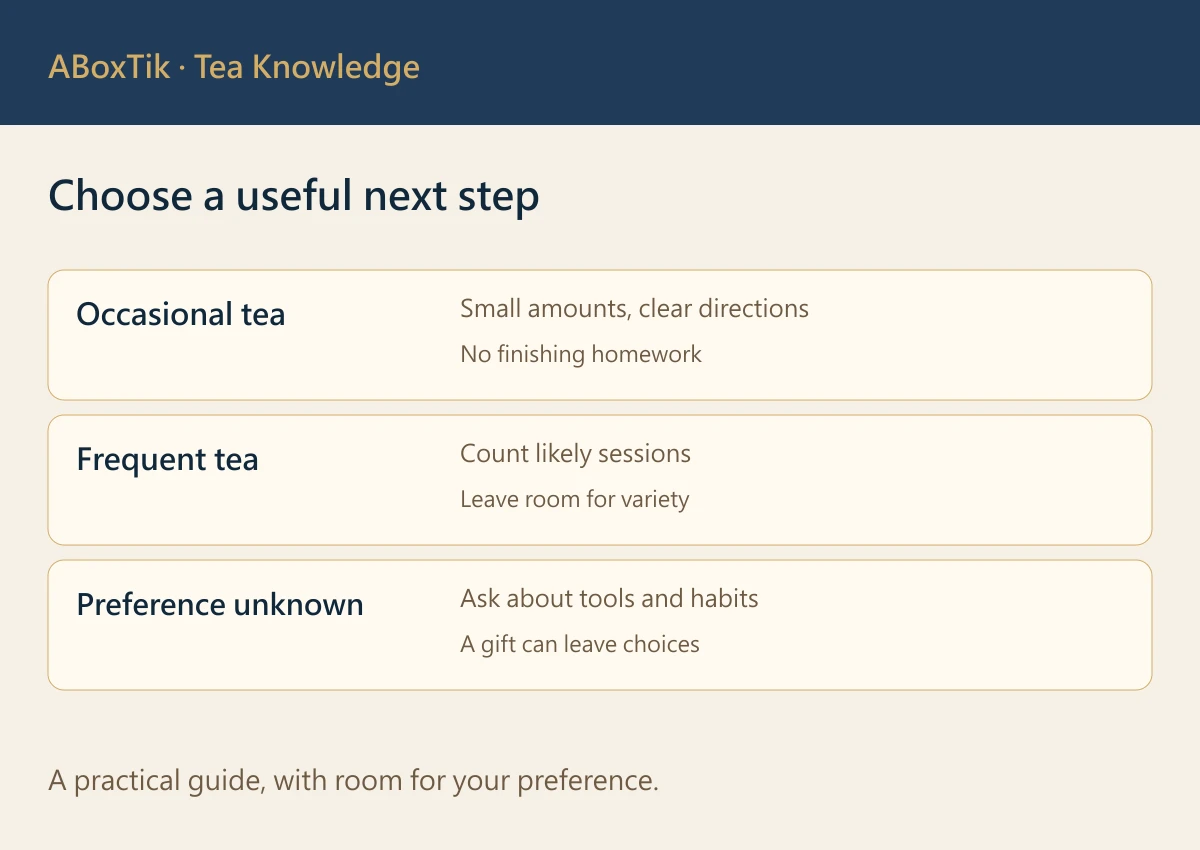
When habits are unclear, one or two clearly different flavours in portions that can be used gradually are easier to welcome than a crowded collection of similar names. Curious drinkers have a choice; people with a familiar favourite do not have to turn every packet into an exam. A gift should make room for a moment, not impose a tea-drinking timetable.
A reusable portion and opening-cycle table
This table is not a shelf-life promise or a product specification. It uses hypothetical arithmetic: if one portion makes one session, divide available portions by likely weekly sessions to imagine the rhythm. Actual contents, brewing instructions, and storage information must come from the current product label or supplier information.
| Rhythm | Useful question | Hypothetical arithmetic | Format to consider |
|---|---|---|---|
| Occasional cup | Would one portion at a time feel best? | 8 portions ÷ 1 weekly session = about 8 weeks of rhythm | Small, clearly marked portions |
| Regular weekdays | How many sessions usually happen? | 12 portions ÷ 4 weekly sessions = about 3 weeks | Easy-to-reach packaging with clear directions |
| Slow weekends | Mug or teapot? | 6 portions ÷ 2 weekly sessions = about 3 weeks | Tea bags or loose leaf suited to existing tools |
| Flavour explorer | How many teas should be open at once? | Keep 2 portions per tea and note favourites separately | Distinct names and flavour cues |
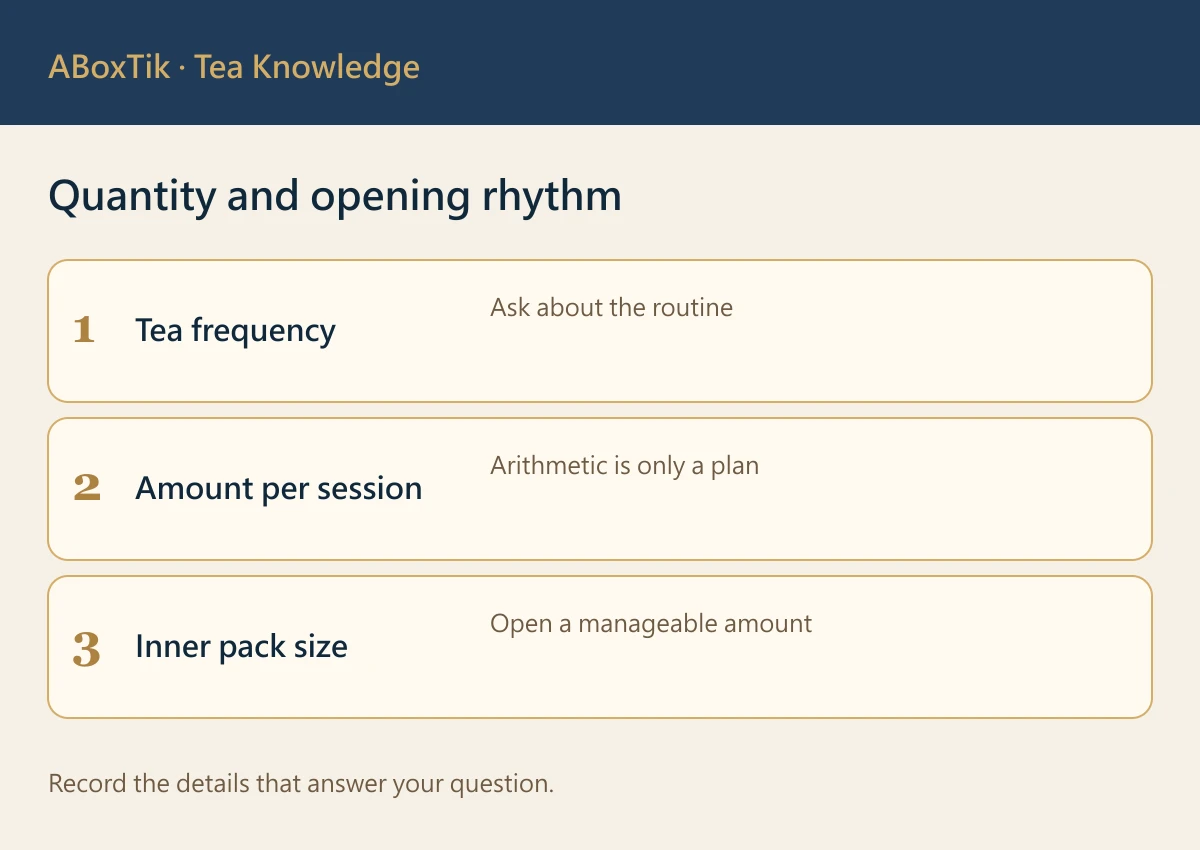
The point is not mathematical precision. It is seeing that “how much is opened at once” and “when it will be revisited” are different questions. With a large loose-leaf bag, do not force it into a pretty number of weeks; ask whether the recipient already has a comfortable way to scoop, reseal, and store it. With individually packed tea, see whether tea name and directions remain available after the presentation box is put away.
Look beyond the box: inner packaging does the daily work
The outer box can make a lovely entrance. Inner packaging is what someone meets on an ordinary Tuesday. Can the tea still be identified after opening? Are portions easy to reach? Can a loose-tea pouch be closed as intended? If scissors, clips, or another container are needed, are those already part of the person’s routine? These are not glamorous questions, but they matter more than how well the box photographs on a shelf.
Taiwan’s Tea and Beverage Crop Research Station notes that tea can be affected by moisture, light, oxygen, temperature, and odors. Storage advice should therefore return to the actual packaging and label. Do not claim that small packets always last longer, or promise a flavour will remain unchanged for a number of months when that information has not been verified. Keep the original package information available, store tea dry, away from light and strong odors, and check the current label or ask the supplier when a detail matters.
Begin with the mug already in the kitchen
A person living alone may have very little tea equipment, or a wonderfully serious tea shelf. Both are complete ways to live. The only useful question is what tools are already used: mug, insulated cup, infuser, teapot, or simply hot water. Where there is only a cup and hot water, a format with understandable directions and straightforward use is often more relaxing than one requiring extra tools. Where a teapot routine already exists, a gift can respect that familiar ritual instead of replacing it.
A card can point to the original product instructions rather than inventing a universal temperature or ratio. “For a lighter cup, begin with a shorter steep according to the package guidance” is kinder than issuing a command. The first cup only needs to begin; it does not need to earn a brewing certificate.
When preferences are uncertain, offer a small choice instead of a large guess
Do not pretend to read minds about floral, roasted, herbal, or fuller flavours. Two clearly different directions can be enough, with a note saying, “Choose the packet that fits today.” If someone already has a regular tea, let familiarity lead and make a new flavour optional. A gift does not need to pull anyone away from their habits; it can simply leave another door open.
Living alone does not require the smallest box. Someone who works from home, hosts friends, or brews daily may welcome more portions. Conversely, a frequent traveler or occasional tea drinker may prefer a smaller, clear selection. Write the expected brewing moments in your own choosing notes, then leave the timing to the recipient. That is a comfortable kind of consideration.
A card that invites without taking up space
A card does not need to explain somebody’s living arrangement. It only needs to offer an easy beginning and no obligation to reply. For example:
“I remembered that you sometimes keep a quiet pocket of time for yourself, so I chose these teas. Pick whichever one suits today, and use your own cup and rhythm. If one becomes a favourite, tell me whenever you feel like it.”
Change the wording for a shared memory, familiar nickname, or recent weather if that feels natural. Avoid turning care into homework: “Please drink this every day” or “Don’t be lonely” places weight on a small gift. Tea can keep company without diagnosing a life.
Six checks before sending
- Do I know a preference or tool, or am I only imagining one? Keep those separate.
- Have current product information confirmed contents and package format?
- After the outer box is removed, can tea name, brewing, and storage information still be found?
- Is my quantity estimate about possible sessions, not an instruction to finish tea by a date?
- Does the card invite rather than demand a reply or a lifestyle change?
- After delivery, can the recipient choose when to open and with whom to share?
A tea gift for a one-person home does not need to tiptoe. When portion, opening rhythm, tools, and preference are considered with care, it can join an already full life quietly. Before choosing, note the intended flavour direction and use situation, then use the ABoxTik contact page to confirm current contents and packaging information.

Related reading and tea choices
Sources
- Tea and Beverage Crop Research Station, Ministry of Agriculture: Tea packaging and storage (checked 2026-10-25)
- ABoxTik contact page (checked 2026-10-25)