
Tea Knowledge
How to Choose a Tea Tray for Your Space

A tray should leave room for the tools, your hands and the next comfortable cup.
Choose a tea tray by its working space, water route and cleanup routine rather than its size alone. A dry-brewing setup catches small drips and sends unwanted water to a separate vessel. A wet-brewing setup needs suitable collection or drainage for the water you actually use. Both need room for your hands. Arrange your present pot, pitcher, cups and waste-water vessel before guessing from a product photograph. The tray is joining the tea table to help, not entering a competition to occupy it.
A small dining table can still hold a comfortable tea session. Separate what you will use today from what merely looks lovely in the photograph, and seat the essentials first. For vessel questions, see the teapot material guide or using an aroma cup. Here, the subject is the layout connecting all those objects.
Dry and wet brewing: follow where the water goes
In everyday dry brewing, the main vessels sit on a relatively dry surface. A pot stand, small dish or cloth handles drips, while warming water and unwanted tea go into another vessel. Dry does not mean water-free, and an attractive wooden serving tray is not automatically designed for repeated hot-water pouring. Wet brewing often uses a water-collecting tray or table, whose intended use and drainage still require checking.
Neither arrangement proves greater tea knowledge. One daily cup and several rounds with friends produce different water and cleaning needs. Start with a routine you will maintain. Buying a wet-brewing tray does not oblige you to give the teapot a ceremonial shower every round.
| Arrangement | Check first | Often overlooked |
|---|---|---|
| Dry brewing | Pot stand, drip dish, cloth and separate waste vessel | Moving pots and pitchers still creates drips |
| Collection tray | Removing, emptying and cleaning the collection part | Seeing its water level and lifting it steadily |
| Draining tray | Hose route, connections and collection vessel | Compressed tubing, displaced containers and cleaning access |
| Temporary dining-table setup | Suitable surface protection and pack-away routine | Leaving the table dry afterwards |
Measure the tools in use, not just packed away
Put the empty pot, pitcher and cups on the table. Rehearse lifting, removing the lid, decanting, sharing and replacing. The spout, handle, wrist movement and resting lid require more room than a still photograph suggests. Fitting everything inside the tray and operating without collisions are different achievements.
Mark a candidate tray’s outline with paper or removable tape and arrange your existing vessels within it. Outside dimensions are not entirely usable space: raised edges, openings, decoration and uneven areas can restrict placement. Ask separately about external dimensions, usable surface and water-collection components.
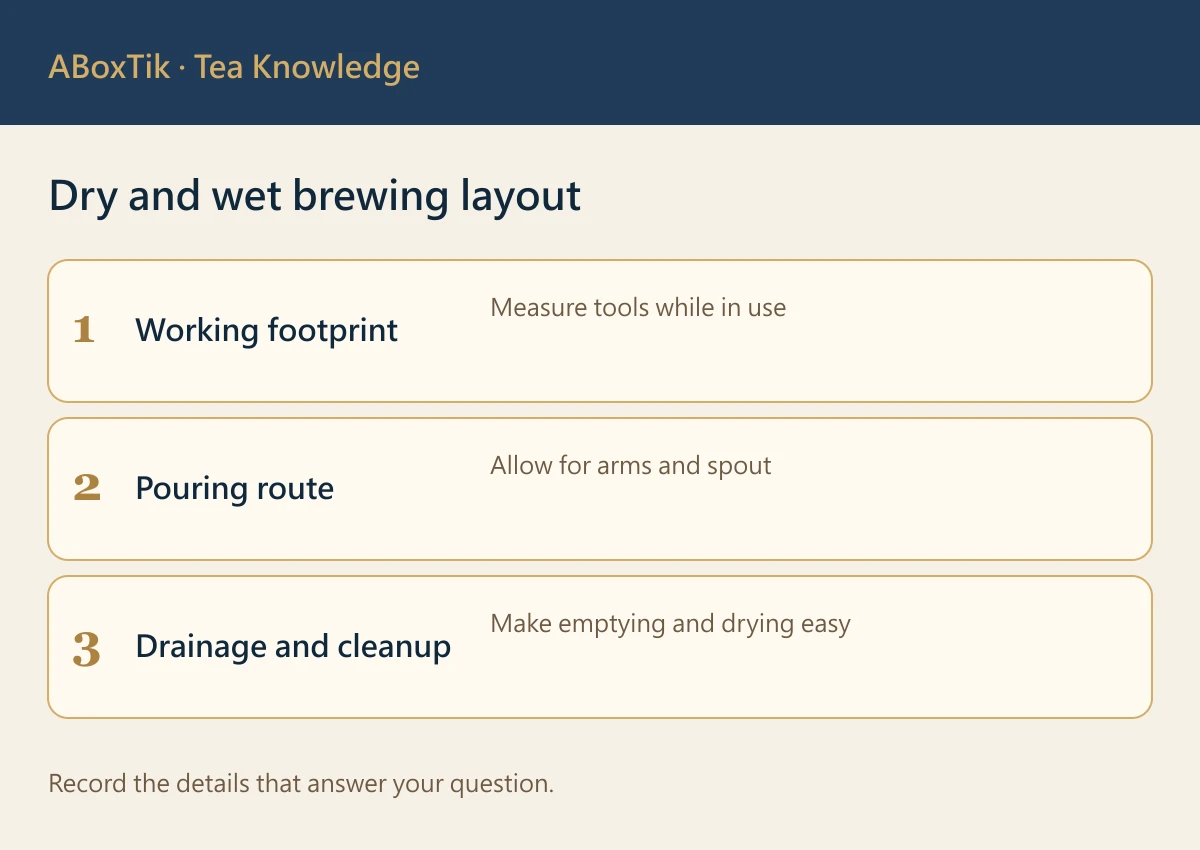
A paper example: remaining width is not a safety clearance
Suppose a usable tabletop is 60 centimetres wide and a candidate tray is 40 centimetres wide. The calculation 60 minus 40 equals 20 tells you only the total width outside the tray. It does not establish that ten centimetres on each side suits every person’s hands. The spout, handle, kettle, pouring route and chair position still need consideration. These hypothetical measurements illustrate the calculation; replace them with your own.
Check depth in the same way. A wall, nearby appliance or front edge brushing against clothing may limit usable space. If pouring requires crossing someone else’s cup, remove an unnecessary object or change the layout. Guests should not need to hold their breath for the whole tea session.
Draw three routes: filling, serving and waste water
Choose where your usual hand picks up the kettle, where the brewing vessel decants and where waste water goes. You should see the spout and receiving opening without carrying water across power leads, phones or another person’s hands. Place the kettle and base according to their instructions, keeping electrical connections separate from areas likely to receive splashes or standing water.
A left-handed brewer need not copy a right-handed photograph. Shared sessions also need a convenient route for the other person’s cup. Rehearse with empty vessels first, then use cool water in suitable vessels with normal handling to check collection and pouring. Do not invert a hot pot, block vents or perform risky tests on behalf of a tray.
Ask about water capacity and cleaning together
When a capacity is quoted, ask how it is measured, how the level is checked during use and how the water-filled part is moved. A stated capacity is not a target to fill every time. Follow the instructions and empty it during a session when appropriate. Record your own warming, dripping, trial-brewing and discarded-tea routine rather than estimating everything from a universal guest-count formula.
For drainage, examine more than the tray. Tubing needs a suitable route and the receiving container a stable place clear of feet and walkways. You need access for cleaning, removing leaves and drying afterwards. The drain is not an invitation for tea leaves to discover the ocean. Ask the supplier if dismantling or care is unclear.
Care belongs to the actual product
Wood, bamboo, ceramics and metal each include different finishes, structures and intended uses. Natural wood does not automatically tolerate soaking, and ceramic does not automatically tolerate any temperature change. Before buying, ask whether the piece is intended for wet brewing, whether it can receive hot water directly, how it is cleaned and which parts or accessories are required.
KINTO’s official guidance for its wooden products, for example, says to avoid soaking, dishwashers and open flames, and to wipe with a dry or lightly damp cloth before dry storage. That guidance concerns its products. It illustrates why a serving tray is not necessarily a draining tea tray, without imposing the same care instructions on every maker and material.
If you enjoy Taiwanese craft, learn about the work and ask how it fits daily use. The porcelain brewing guide separates contact surfaces, form and handling into useful questions. Appearance and manageable care can both take part in the choice.
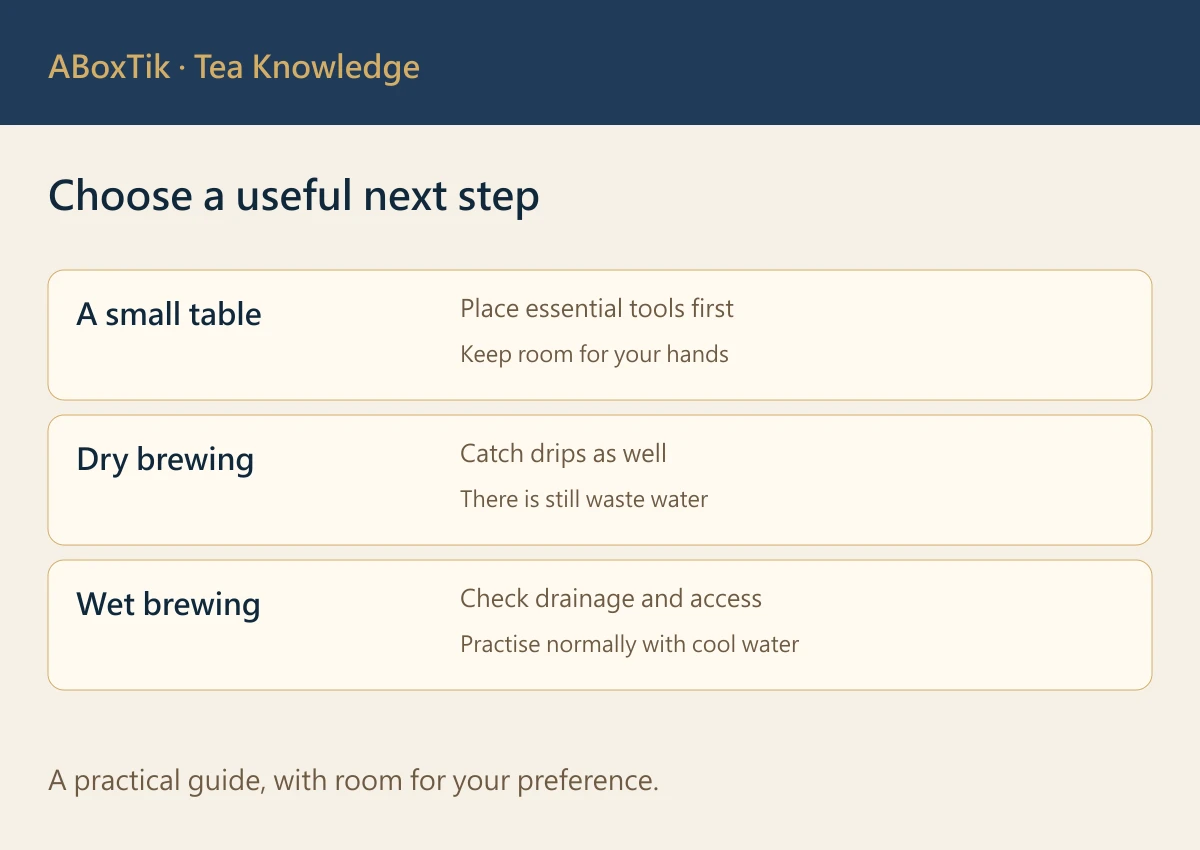
Rehearse packing away as carefully as brewing. After removing cups and pot, can the collector come out without awkward tilting or crossing other objects? Is the route to the sink clear? If family members share the dining table, decide where the cleaning cloth and dry components will go afterwards. A tray that looks compact while empty may be awkward once its water needs carrying.
Ask to see the underside and removable parts before choosing. Photographs of a finished tea setting may hide the collector, hose connection or supporting feet. Knowing those details helps you check your own table and storage cupboard. A useful layout works after the final cup too, when the table needs to return to ordinary daily life.
Six questions to bring to the shop
- Have I measured the usable table while brewing?
- Can my hands lift and replace pot, pitcher and cups comfortably?
- Do filling and waste-water routes avoid people, leads and devices?
- Are intended use, water handling and care clear?
- Can I clean the collector, tubing and leaves out easily?
- Will I willingly empty, dry and store this after tea?
Try a session before buying. Arrange your present tools, walk through the movements and photograph the point you would like to improve. If the lid lacks a resting place, a suitable small dish may answer the question. If the entire computer must move every time, reconsider the tabletop first. The right tray often announces itself quietly: your hands stop taking detours, and the next cup has somewhere comfortable to begin.

Related reading and tea choices
Sources
Sources checked: 25 October 2026.