
Tea Knowledge
Tea Tasting in Stages: Beginning, Middle and Finish

A little preparation leaves more room to enjoy the tea.
A cup does not have to reveal a perfect flower name to be worth noticing. One easy way to begin is to follow a single sip from its arrival to its finish: what reaches attention first, what changes while the sip is in the mouth, and what remains after swallowing. This is a record of sequence within one sip—not a score for the whole cup, not a cooling chart, and not a comparison between the first and fifth infusion.
That distinction is pleasantly freeing. You do not need to decide whether a tea is “good,” or force yourself to find sweetness after every sip. You only need to notice what happened in this cup today. If the answer is “warm, then a little dry, then I was distracted by the cat,” that is still a beginning, middle and finish. The cat has simply joined the panel.
The three moments belong to one sip
The beginning is the first impression as the tea arrives: perhaps warmth, a roast-like aroma, softness, or simply “stronger than expected.” The middle is what you notice while the sip is present: texture, spread, weight, or a flavour becoming clearer. The finish is what remains once the sip has gone: a lingering aroma, a dry feeling, a clean end, or nothing you can name. “Nothing clear” is a valid note, not a failed exam.
Do not use these three labels to predict a fixed scientific number of seconds. A sip is not a timed laboratory event; its pace changes with cup temperature, sip size, and the person drinking it. The labels only provide three friendly places to put attention.
Your one-sip time-order card
| Keep fixed for this card | Beginning | Middle | Finish |
|---|---|---|---|
| Tea, infusion number, vessel, approximate temperature | What arrived first? | What changed or spread? | What stayed after swallowing? |
| Small comfortable sip | Aroma / warmth / first taste | Texture / weight / developing taste | Lingering aroma / dryness / clean end / unclear |
| One sentence, not a verdict | “I noticed…” | “Then…” | “Afterward…” |
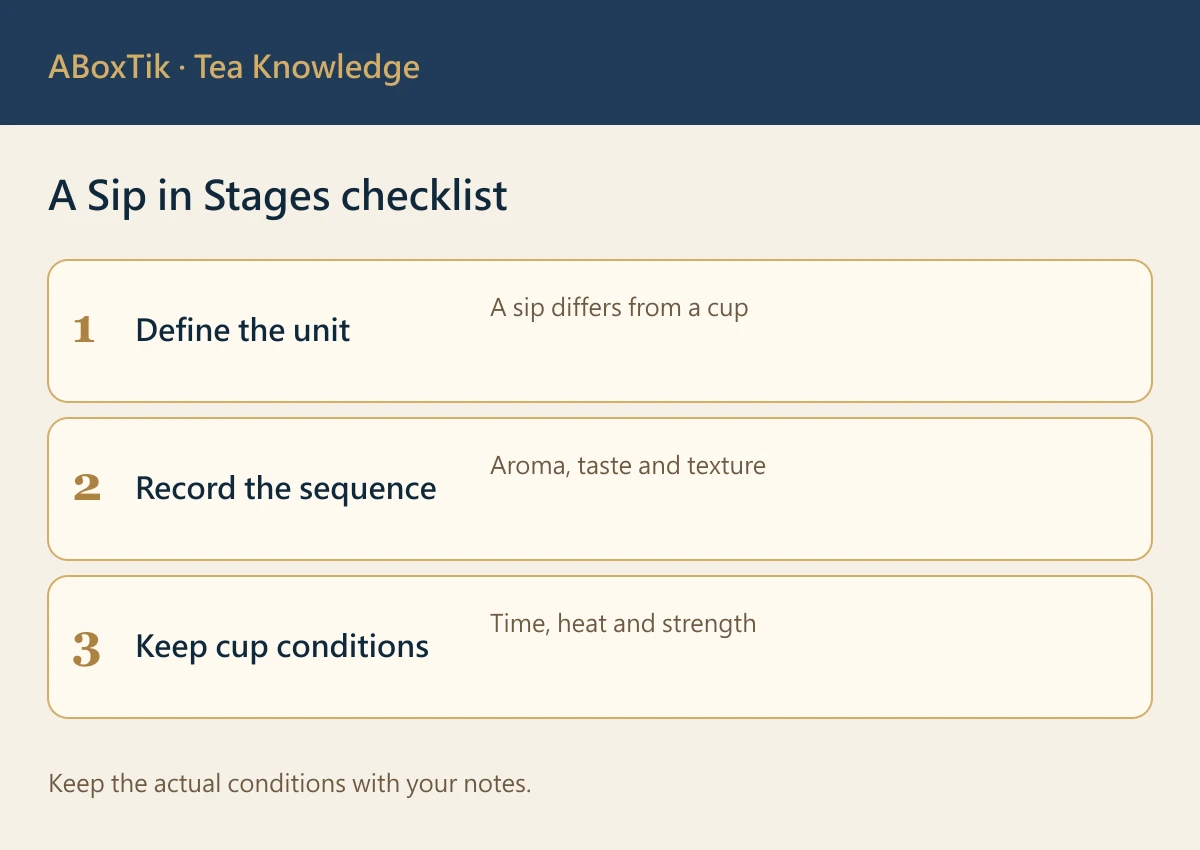
Before tasting, write the tea name or a simple label, the infusion number, and anything important that changed. Then take one small sip. Pause only long enough to notice comfortably; there is no prize for staring at a cup as if it owes you a confession. Write one short phrase in each column. On the next sip, you may either confirm the note or leave it alone. Avoid changing leaf amount, water temperature and steeping time simply because the first sentence was not poetic.
An explicitly fictional record
Fictional example only: “Cup A, first infusion. Beginning: warm and lightly toasted. Middle: the tea feels rounder than the first impression. Finish: a faint dry feeling remains; no clear sweetness noted.” This is not a predicted result for any tea. It shows how a record can be specific without pretending that a tasting note is universal.
Another person could write, “Beginning: I noticed warmth. Middle: I could not separate aroma from taste. Finish: I wanted another sip.” Both notes can be useful. The first is more descriptive; the second tells you where curiosity is still alive. Neither needs to borrow fancy language from a menu.
How this differs from other useful tea notes
A whole-cup cooling note follows the tea as the cup becomes cooler. An infusion note compares one brew with the next. A balance note may focus on intensity, texture, duration, or astringency before, during and after drinking. Those are useful practices, but this card stays narrower: it follows one sip in time. Keep the card small so you can learn what it is actually showing.
If a drying sensation is your main observation, write it where it appears in the sip. Do not turn it into a claim that the tea is defective, healthy, or guaranteed to become sweet later. If aroma is difficult to name, use everyday words such as fresh, warm, roasted, leafy, fruity, or “I cannot place it.” Taiwan’s sensory-training material treats tasting as a set of observations that can be recorded and practised; it does not require every drinker to perform identical perception.
A gentle three-sip practice
Use the same prepared cup. For the first sip, fill the card. For the second, see whether the same order appears. For the third, write only one difference, if there is one. Stop there if you like. The purpose is not to drink until every mystery is solved; tea is allowed to keep a little privacy.
If the cup has cooled noticeably by the third sip, record that fact and do not attribute every difference to the beginning-middle-finish pattern. You can return on another day with a fresh cup. Repetition is helpful when it is kind to your attention, not when it turns a quiet break into homework.
Questions people often ask
Must the finish be sweet?
No. A finish may be aromatic, dry, short, clean, busy, or difficult to notice. Write what remains rather than what you think ought to remain.
What if I notice only one thing?
Record it in the moment where it appeared and leave the other cells blank or write “unclear.” A blank is information: it gives your next cup a gentle question rather than a made-up answer.
Should I compare several teas at once?
For a first practice, one tea is enough. If you compare later, keep preparation and cupware as similar as practical and make separate cards. Do not treat a different tea style as proof that one person tasted correctly.
Make the next cup an invitation
At the end of your card, add one line: “Next time I am curious about ___.” It might be whether the first warmth returns, whether texture changes, or whether you still cannot name the aroma. Invite a friend to write their own card before discussing it. Asking “What arrived first for you?” is usually more generous than asking whether they found the approved answer.
A quiet tea practice can be this simple: one sip, three moments, and an honest note. The cup does not need to become a performance. It can just give you a small place to arrive.
When the stages overlap
The beginning, middle and finish are helpful headings, not three sealed rooms. An aroma may arrive first and remain after swallowing; a dry feeling may begin quietly and become clearer later. Rather than forcing it into one box, write “began in the middle, clearer in the finish,” or repeat the word in two columns. The card is meant to preserve a sequence, not to police it.
For the second sip, use the first note as a question, not an instruction. If you wrote “roast first,” ask whether it still arrives first; do not hunt it down until every other impression disappears. You might write “second sip: less clear,” and that is useful. Attention changes, and a good note leaves room for that ordinary fact.
Two examples: blank and specific
A blank card can be an honest record: “Beginning: unclear. Middle: warm. Finish: unclear.” It tells you that warmth was the only dependable observation. A more specific fictional record could read: “Beginning: leafy aroma. Middle: a light, smooth texture. Finish: the aroma stayed briefly; I did not notice sweetness.” Neither example is a result you should expect from your tea.
Do not conclude from a finish that a tea is healthier, superior, from a particular origin, or certain to develop in the same way next time. A long finish is not a medal, and a short finish is not a failure. It is one observation in one prepared cup.
Serving a friend
Pour small, comfortable sips and give everyone their own card. Ask “What came first?” “Did anything change?” or “What stayed with you?” Avoid offering an answer before they have written. If your friend says “I only noticed heat,” answer, “That is a complete first note.” The most welcoming tea table makes room for different attention, not identical conclusions.

Related reading and tea choices
- A practical tea-aroma smelling sequence
- Understand bitterness, astringency and balance
- Explore the current Taiwanese tea selection