
Tea Knowledge
Retirement Tea Gifts: A Keepsake for Everyday Life
A little preparation leaves more room to enjoy the tea.
A retirement tea gift can be a thoughtful choice when it is easy to receive, clearly labelled, and free to be enjoyed later. The useful question is not what a retired person “should” drink. Retirement marks a handover and a change of rhythm, not an age category. A specific thank-you, paired with tea that does not demand an immediate performance, is often the most gracious arrangement.
Start with the message the gift should carry
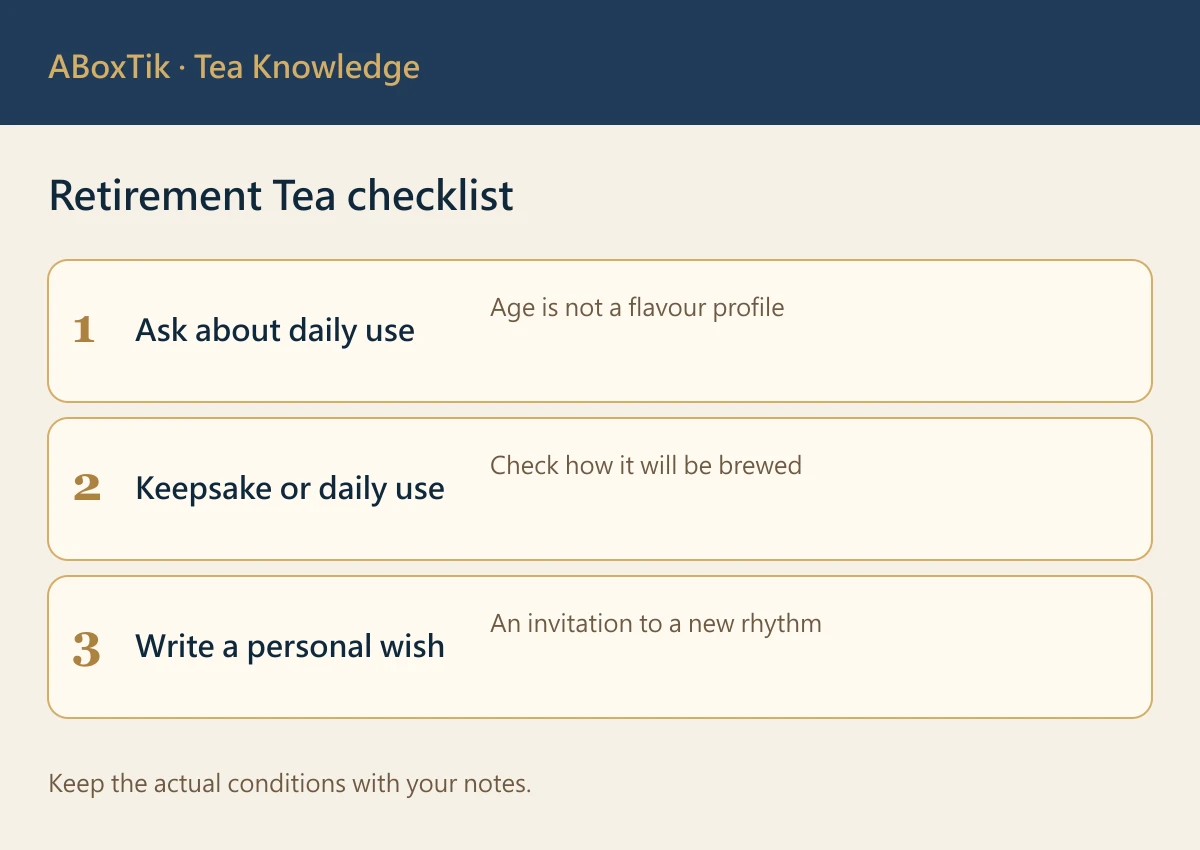
Tea can be both commemorative and practical. The commemorative part comes from a real shared moment: a patient handover, a project carried through, or an ordinary kindness that mattered. The practical part comes from whether the recipient can understand, store, and brew the tea without extra work. A dramatic box without a usable path can become storage; a purely functional purchase can feel like paperwork. Begin with one sentence such as, “Thank you for making every transition clearer,” and let that sentence guide the rest.
Do not infer flavour, strength, or needs from someone’s age, title, or appearance. Useful information is much simpler: do they usually make tea in a mug, enjoy a particular aroma direction, or already brew loose leaf tea? If the answer is unknown, choose a format with clear information and manageable portions, or ask a mutual contact whether a preference can be checked discreetly.
Retirement is not the same as other gift occasions
A first-visit gift is about a host’s immediate convenience. A teacher gift starts with institutional rules. A business gift may require company-policy and reciprocity checks. A retirement gift has its own centre: it marks the end of a role while leaving the recipient free to make the tea part of ordinary life. It does not need to be brewed at the farewell, photographed, or reviewed afterwards.
For a group gift, agree on budget, names, and card responsibilities in advance. People who do not join the physical gift can still contribute a line to the message. For an individual gift, keep it separate from any active evaluation, contract, recommendation, or request. If policy or a conflict-of-interest question exists, check the organisation’s process first; a well-written card still carries appreciation on its own.
A two-axis check before choosing tea
| What to protect | Question to ask | A useful choice | What to avoid |
|---|---|---|---|
| Memory | What exact contribution are we thanking? | Name one shared moment in the card | Replacing substance with price or praise |
| Everyday use | How does this person normally drink tea? | Match a known mug, bag, or loose-leaf habit | Guessing from age or job title |
| Quantity | Is it for one person or willing sharing? | Choose clear, storable portions | Treating a larger box as greater regard |
| Delivery | When will it not interrupt the farewell? | Give it quietly after the formal moment | Asking for an immediate opening or brew |
| Follow-up | What information is genuinely useful? | Leave tea name, storage, and brewing notes | Asking the next day whether it was tried |
This is not a shopping scorecard. It shifts attention from “Does it look important enough?” to “Will it feel comfortable once it reaches home?” Packaging, storage, dates, and instructions deserve a calm check. The Tea and Beverage Crop Research Station’s information on tea packaging and storage is a helpful reminder that these practical details matter. For any eventual purchase, confirm the current product page rather than relying on a gift-set name alone.
Let existing tools decide the format
If the recipient usually has a mug and hot water nearby, a format that is easy to remove and comes with clear brewing guidance can be a considerate start. If they already enjoy a teapot or gaiwan, loose leaf tea may make sense. This is not a ranking of tea bags against loose leaf tea; it is a way to avoid turning a first cup into a reason to buy more equipment.
When preferences are unknown, a modest amount with clearly different directions is often easier to use than a large collection of unfamiliar flavours. Aroma language can help a conversation—fresh floral notes, warmer roasted notes, or a familiar existing preference—but it is not a prediction. “Retirement calls for this tea” is less helpful than a choice that the recipient can accept or set aside comfortably. If they do not drink tea, listen to that answer and choose another form of thanks.
Write a card that gives the tea room to breathe
The card needs only three things: one remembered action, one wish for the next chapter, and permission to enjoy the tea whenever convenient. It does not need grand claims about the tea or promises about how it will make someone feel. For a group, invite each person to contribute one real detail and edit them into a short note. A handful of individual memories is warmer than a row of identical signatures.
Fictional example: Cheng and five colleagues want to thank a teammate who is retiring. They confirm that a group gift is allowed and know that the recipient usually makes tea in a mug. They choose tea with clear information and an easy-to-use format. Their card says, “Thank you for leaving every handover clearer than you found it. May a quiet morning cup belong entirely to your own schedule.” They give it after the farewell gathering, without asking for a tasting or linking it to unfinished work. It is not a universal script; it simply keeps both the relationship and the tea unpressured.Deliver it gently, then let it become theirs
“Please enjoy it whenever it suits you” is enough. If the recipient later asks for brewing information, share the actual instructions. If there is no response, do not turn silence into a verdict on the gift. The pace of life after retirement belongs to the person retiring; the giver’s role is to leave useful information and remove unnecessary expectations.
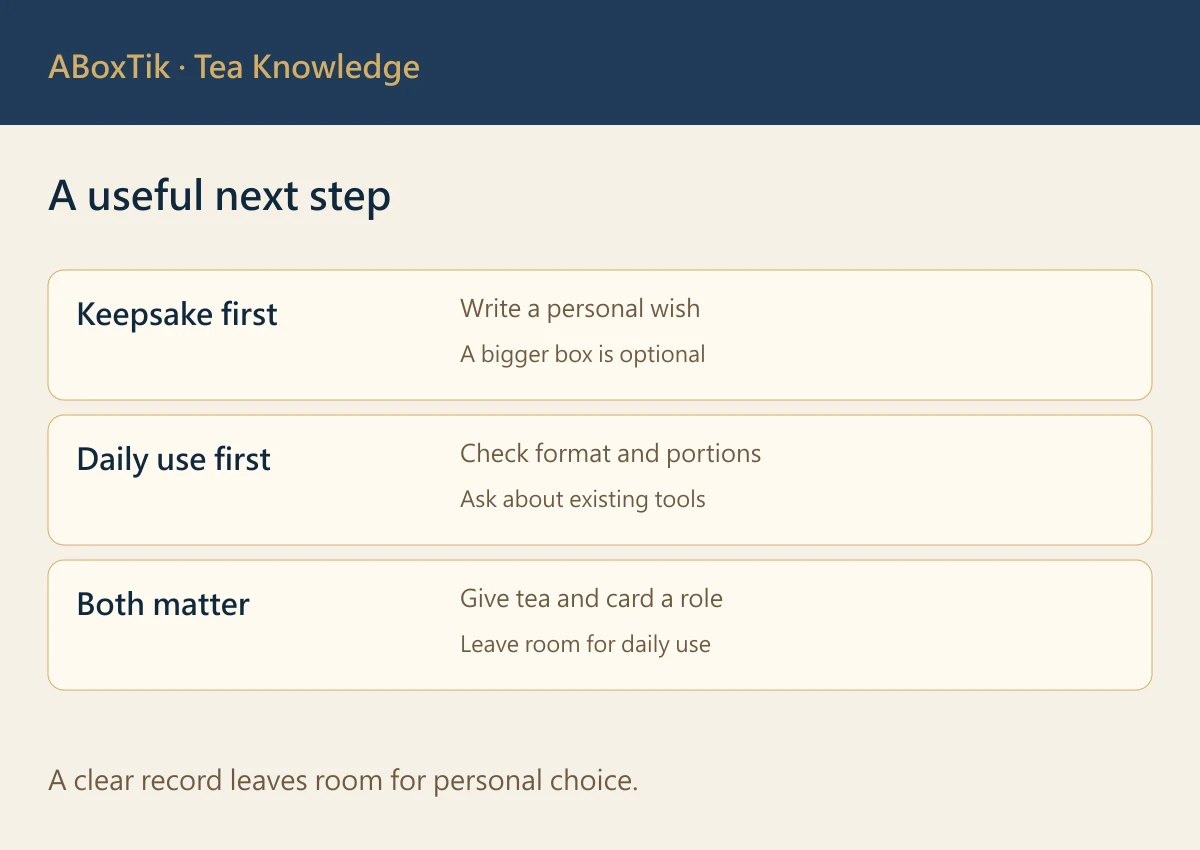
Before choosing a retirement tea gift, write the thank-you first. Then check the format, quantity, and current product information. A gift can complete its work quietly on the farewell day and still become a welcome cup on an entirely ordinary afternoon.
A five-minute check before giving it
Keep the last five minutes for the details that make a gift easier to receive. Read the card once: does it name a real contribution, rather than leaving “thank you for everything” to do all the work? Check the receiving method, particularly in a group, an institution, or a relationship that still has professional boundaries. Then read the package for tea name, contents, storage guidance, and dates, so the recipient does not have to guess later.
If you include brewing information, write it as an invitation. The recipient may begin with the package directions and adjust to a familiar cup, water, and pace. Exact instructions are useful when they help; they should not turn a private cup of tea into another task to complete correctly. A short note may be enough: “The brewing information is here whenever you want it.”
Ask two final questions. Would this gift still feel complete if it received no reply and appeared in no photograph? Would the appreciation remain comfortable if the person did not drink tea at all? If both answers are yes, the arrangement has likely left the right amount of room. A gift box does not need to file a closing report on a relationship. It only needs to carry a remembered piece of work safely into the next chapter.
If preference information is still missing at the last moment, it is also fine to let the card complete the farewell first. Giving suitable tea later is kinder than making a rushed guess.
The message will still arrive.

Related reading and tea choices
Sources
- Tea and Beverage Crop Research Station, Tea Packaging and Storage
- Tea and Beverage Crop Research Station, English information page