
Tea Knowledge
Why Did Tea Taste Different at Home? Record the Conditions Before You Buy
A few notes help a favourite cup find its way home.
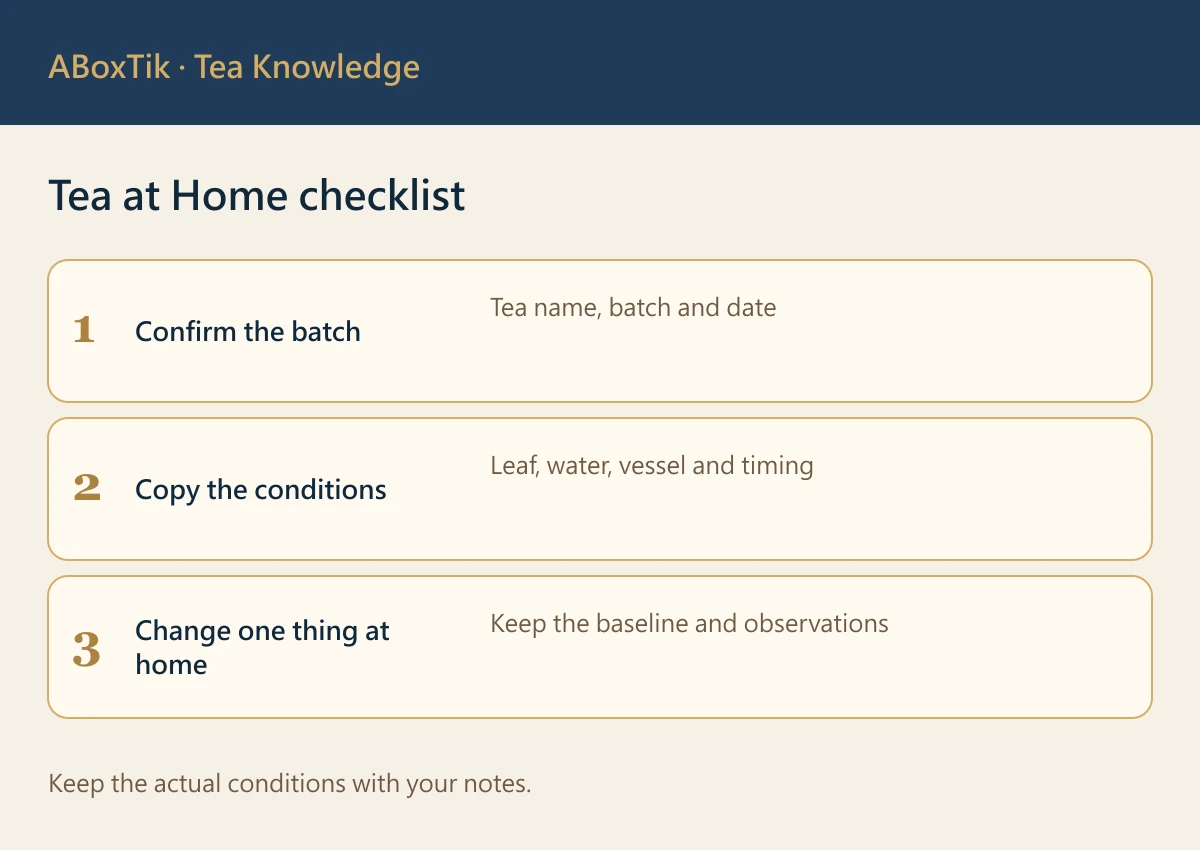
If a tea tasted wonderful in a shop but seems lighter, stronger or less aromatic at home, begin with the preparation rather than a verdict. The amount of leaf and water, temperature, steeping time, vessel and water source may differ. The tea you brought home may also be a different product or batch from the sample. A small tasting card gives you a useful place to start: record the conditions you can confirm, prepare a baseline cup at home, and change one thing at a time.
The goal is not to make every cup identical. A shop’s equipment and setting may be different from your kitchen, and your own impressions can change with the moment. A few notes make it easier to understand what you are adjusting; the rest can remain comfortably personal. The cup you enjoy at home may eventually be a little different from the one that first caught your attention.
Identify the tea before recording the brew
A tasting table may contain several teas with similar place names, cultivars or roast descriptions. Ask which product was in the cup you liked, and note the tea name, type or cultivar, region, harvest season and batch if available. If the sample and retail package are from different batches, ask what information the seller can share. Similar names alone do not establish that the two are identical. Leave an unknown field blank rather than filling it with a guess.
A photo of the label can help connect the product to the notes. If there are several samples, mark them A and B and record the corresponding package names. Write one or two observations as well: perhaps the aroma felt clear, the tea felt gentle, or you wanted another sip after it cooled. Those are personal impressions, not promises about every batch. “The fragrant one from yesterday” is a lovely memory, though it may leave the shop assistant with quite a mystery to solve.
You can also ask whether the package has its own preparation directions and whether those are close to the shop’s tasting method. If they differ, write both down. The shop method can help you revisit the sample, while the package directions may be a practical starting point for the equipment you have. Neither needs to become the only acceptable way to drink the tea.
A small card to take home
| Field | Ask or record |
|---|---|
| Tea and batch | Product name, cultivar or style, region, season or batch, and whether the sample matches the package |
| Leaf amount | Weight or the measuring method used |
| Water | Amount and, if known, source or type |
| Temperature and time | Starting water temperature, steeping time and when timing begins |
| Equipment and pouring | Vessel capacity, whether it was warmed and whether the tea was drained |
| Infusion number | Which infusion was tasted and what happened to the leaves before it |
| Your impression | Aroma, strength, mouthfeel and what you enjoyed while warm and as it cooled |
There is no need to turn someone’s hospitality into an interview while they are pouring. When convenient, you might ask: “I enjoyed this cup. If I want a similar strength at home, could you tell me the leaf amount, water amount, temperature and time?” If the shop uses a scoop rather than a scale, record the scoop or ask about the package guidance. A missing number does not make the tea impossible to buy; it simply means your home notes will contain one more field to explore.
Make one baseline cup at home
Read the directions for the actual tea and choose a clean vessel without a noticeable scent. Record how much tea and water you use, the starting temperature and the steeping time. When pouring, notice whether the leaves are fully separated from the water. If you do not own a scale or thermometer, you can still begin with the product’s everyday instructions and describe the cup and measure you used. A truthful household measure is more useful than a precise number you did not measure.
Before deciding whether the tea matches your memory, smell the warm cup and taste it when comfortable. Note the strength, aroma and mouthfeel, then return to it as it cools. The room, cup shape, drinking temperature and surrounding scents may differ from the shop. Even with matching quantities and times, the experience need not be identical. This baseline cup is a reference for a later adjustment, not a test you must pass.
If the tea is already enjoyable, keep the note. A home routine does not need to reproduce the shop to be worthwhile. You may discover that you prefer a shorter infusion in your own mug or a slightly different strength with breakfast. Recording that choice makes it easier to repeat the cup you actually like.
If the strength differs, review ratio and time
A lighter cup might prompt you to check whether you used more water, less tea or a shorter time than the tasting. A stronger or more astringent cup might invite a look at leaf amount, water amount, steeping time and whether the leaves remained in the water. Choose one adjustment for the next session, using fresh leaves, and record what changed. If the tea, water, vessel and time all change together, the result may be enjoyable but it will be hard to tell which change mattered.
| Observation | First look back at | One possible next step |
|---|---|---|
| Lighter than remembered | Ratio, time and infusion number | Keep the rest steady and adjust leaf amount or time within the product’s guidance |
| Stronger than remembered | Leaf, water and draining time | Keep the rest steady and adjust time or ratio |
| Aroma seems unclear | Tea identity, vessel scent and drinking temperature | Smell the empty cup and note the same observation point |
| Second infusion differs | First infusion time, draining and leaf opening | Record each infusion before adjusting the next |
The table is a home notebook, not a test of tea quality. Different teas do not respond identically to the same settings. If the result is still not to your taste, ask the seller about the particular tea, or choose a method that suits your equipment better. A mug is allowed to participate in a tea conversation without first earning a certificate.
Water, vessels and the place where you drink
Water and temperature influence a tea’s expression. If the shop can describe its water, record the information; at home, start with your usual safe drinking water and notice whether the result suits you. A different teapot can hold a different volume or give leaves a different amount of room. Copying a number of seconds into a different setup will not necessarily reproduce the same strength. Cup shape and the temperature at which you drink can also change perception.
Check that the vessel does not carry a strong cleaning-product or cupboard smell. If the tasting was served in a small cup and the home version is in a large mug consumed while working, the amount and timing have changed too. Pouring a small portion and observing it at a similar warmth can make the comparison clearer. You are not required to turn your kitchen into the shop; you are simply choosing a few conditions you can reasonably bring closer together.
Keep each infusion’s history visible
The second cup of the same leaves carries the history of the first. Record the first infusion’s time and whether the water was drained, then write down the next infusion’s water and time. Leaf form and opening also affect the sequence. Comparing a shop’s second infusion with your first may answer a different question from the one you intended.
For a fresh comparison of two preparation methods, use new portions from the same batch and label each method. If you want to follow how a single portion changes over successive infusions, keep the sequence together in one note. Both exercises can be useful; the important thing is not to let the two questions swap places halfway through the tasting.
Look after the package and ask when something seems wrong
Record the package condition and follow its storage directions. Taiwan’s Tea and Beverage Research Station discusses how moisture, light, heat, oxygen and surrounding odours can affect tea. A different smell on one occasion does not by itself establish why it changed. Smell the empty vessel and dry tea separately, check the package and storage location, and contact the seller if you need help. If the tea has an obvious mouldy smell or its condition seems questionable, there is no need to force yourself to drink it.
A short note can make the conversation with a seller more useful: the product and batch if known, purchase date, storage conditions, preparation and the specific difference you noticed. A photograph of the package may help identify the item. Keep an observation as an observation; there is no need to diagnose a cause before anyone has enough information.
Three questions before the next purchase
Is the package the same product or batch as the sample? How much tea and water did the shop use, and for how long? If your only equipment is your own cup, which package directions are a sensible starting point? Keep the answers with the label and leave unknowns open. Buying tea should not depend on remembering the precise second at which a floral note appeared.
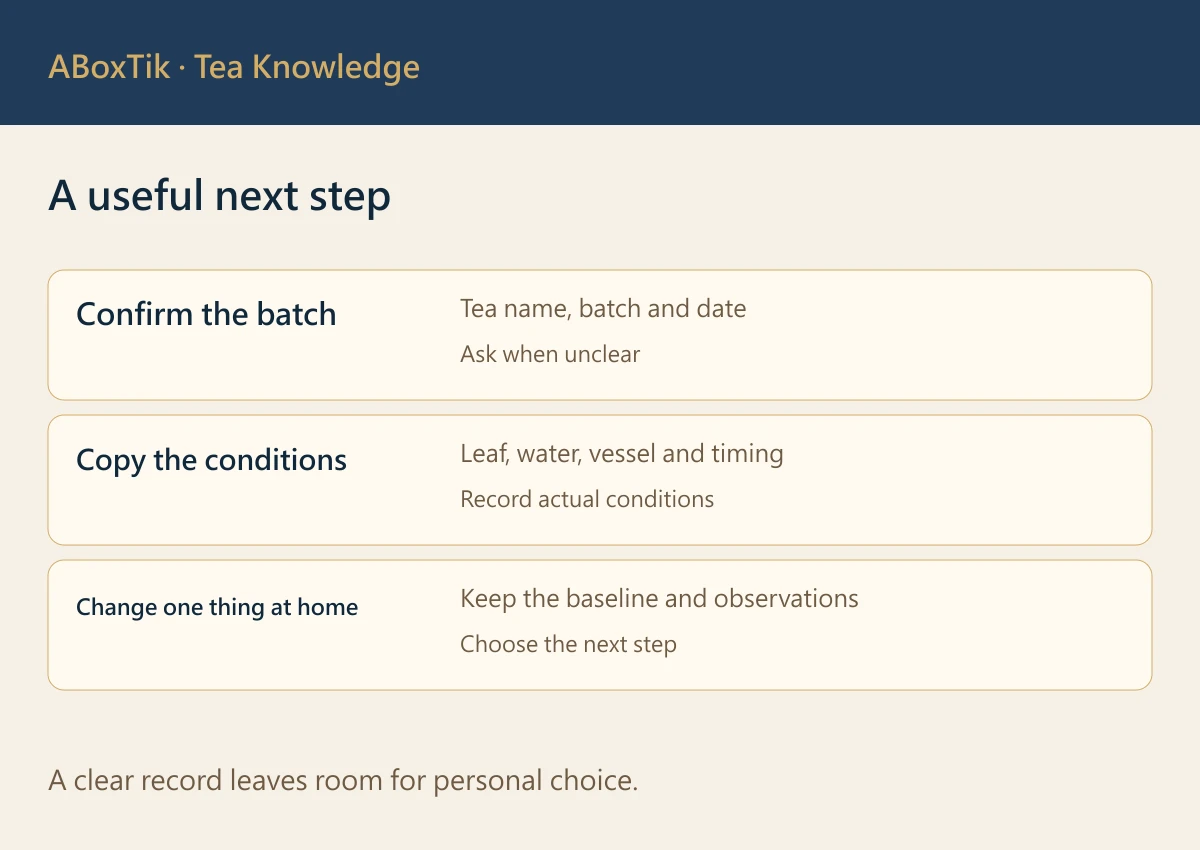
A tasting points toward something you like; a note helps that preference travel home. Start with the equipment you have, make one baseline cup and adjust gently. Current product descriptions and brewing directions can provide the next step, and a concrete question gives the ABoxTik team something useful to discuss. A cup that is a little different from the shop may become the one that fits your day best.

Related reading and tea choices
Sources
- Tea and Beverage Research Station: Tea packaging and storage
- Tea and Beverage Research Station: Introduction to tea sensory evaluation
Sources checked: 30 October 2026.