
Tea Knowledge
Tea Gifts for a Group: How to Count Portions and Make Sharing Easy
A little clarity makes room for everyone to enjoy tea in their own way.
To work out whether a tea gift will serve a group, count the usable units inside the box, not just the number of outer boxes. For individually wrapped tea bags, check the total bag count and how many of each tea are included. For loose leaf, divide the net weight by the amount used for one preparation, then decide how many people that preparation will serve. Write down those assumptions before calculating; a large-looking gift box is not a measuring cup.
There is a quieter question alongside the arithmetic: does the recipient want to share the tea, and when? A box that is easy to open, understand and put away is often more useful than one that obliges a host to serve everyone immediately. Some guests may prefer water, and some colleagues may want to take a bag home. Leave room for those choices.
Start with the unit on the label
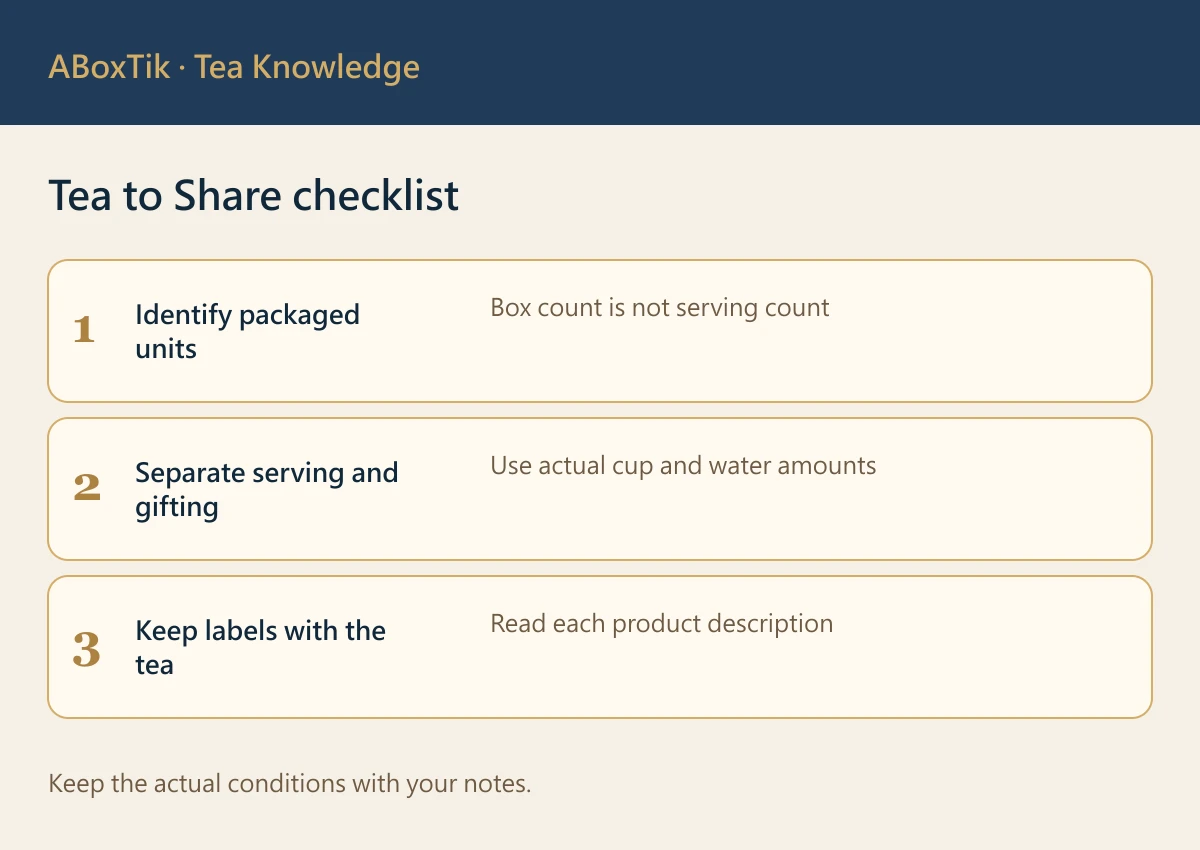
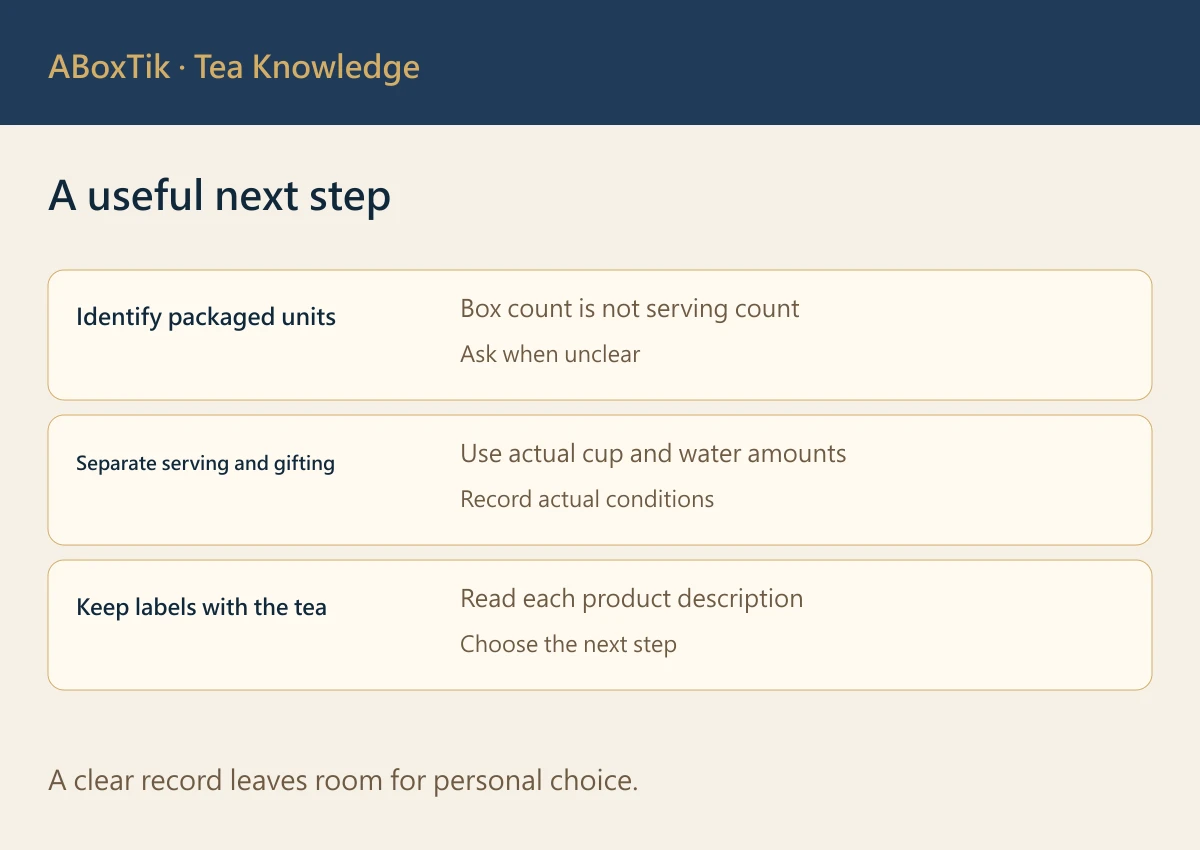
A description such as “four-piece gift set” may mean four inner tea boxes, not four individual tea bags. Each inner box might contain several bags, and different products can use the same word for different units. Look for the outer box, inner packages, total bag count, tea names, and amount in each bag. If the description is unclear, ask the seller: “How many individually packaged bags are there in total, and how many of each tea?” Use the current product listing or the supplier’s response for the particular order.
Here is an arithmetic example, not a statement about a specific product: four inner boxes containing ten bags each give forty bags. If eight people each take one bag per round, that provides five rounds. If two people each take two bags, someone chooses not to drink tea, or some are reserved for later arrivals, the result changes. For this calculation a portion means one bag; it does not say that a bag can only be steeped once or that every cup has the same volume.
Total quantity and choice are different questions. Forty bags across four flavours may look plentiful, but a group of eight cannot each choose two bags of the same flavour if there are only ten of that flavour. Check the distribution before promising a particular choice. When preferences are unknown, ask the host whether a mixed selection is useful rather than assuming everyone wants the same kind of tea.
Turn loose tea into a working estimate
For loose leaf, use the net weight and a clearly stated amount for each preparation. Imagine a 60-gram pouch and a planned 3 grams per brew: the simple division gives 20 preparations. If each preparation is shared into two small cups, the plan suggests 40 small cups. This is an illustration, not a universal recipe. Cup size, preferred strength, the actual tea, loss during handling and whether the leaves are steeped again all affect the experience. Begin with the product’s own directions and adjust to taste.
One preparation is not necessarily one person’s portion. A small teapot may serve several people with small cups, whereas an office mug may be one person’s drink. If the host is planning a sit-down tea session, ask about the teapot, cups, hot water and time available. If people are arriving at different hours and using their own mugs, a format they can prepare individually may be easier. The right answer belongs to the occasion, not to an abstract contest between loose leaf and tea bags.
Loose tea can be pleasant for people who already have a pot or infuser, and for a group that enjoys preparing tea together. Individual tea bags are often easier when each person chooses a time and a cup. Neither form establishes quality by itself. If the plan is to send portions home, consider whether the original packaging can be shared while keeping the tea name, ingredients, date, preparation and storage information with each portion. Do not assume an improvised container carries the same information or protection as the original pack.
Make a small sharing card
| Field | What to record |
|---|---|
| People and setting | How many are likely to participate, and whether the tea is for now or later |
| Definition of one portion | One tea bag, one pot preparation, or one small cup |
| Available amount | Actual bag count, or net weight divided by the planned amount per brew |
| Plan per person | One choice, several occasions, or different teas to compare |
| Flexible reserve | Any tea kept for later arrivals or another occasion, based on the actual situation |
| Information | Whether tea name, ingredients, dates, preparation and storage instructions stay with each portion |
Try a simple scenario. Ten friends are attending; two do not drink tea and the other eight would each like one bag to take home. The first round requires eight bags, not ten. If those eight also want a second flavour, add a second round and check the count of each flavour. If attendance is uncertain, choose a reserve after talking to the host. There is no universal spare percentage that fits every gathering, and a gift does not need to cover every imagined future afternoon.
This card is useful before buying as well as after receiving a gift. It separates the question of how many people will receive a box from how many drinks are in each box. A corporate team ordering a box for every recipient needs one calculation for recipient quantities and another for the contents of each gift. Keeping the two counts separate makes it easier to ask useful questions about the actual order.
Match the packaging to the moment
A shared table, a family kitchen and an office shelf each have different constraints. At a gathering, check whether the host has time and equipment to prepare a pot. At work, find out whether hot water, cups and a suitable storage place are available. A team may appreciate a box that stays in a common area, but only if that fits its workplace rules and the recipient agrees. A gift should not arrive with an invisible instruction to set up a tea station.
For a household, consider how many people regularly drink tea and whether they prefer to open a small amount at a time. An oversized outer box can be difficult to store even when the tea itself is modest. For people travelling home, individual packaging may be convenient if the label and instructions remain clear. When comparing products, check the current contents and dimensions rather than treating the number on the front as a promise about servings.
Packaging also helps the recipient understand what is inside. Keep the tea name, ingredients, date and brewing directions accessible. If someone has a particular ingredient preference, let them read the information and decide; do not answer for them with “everyone should be fine.” When a product contains several different teas or blends, make sure the person selecting a portion can tell which is which.
Share without assigning homework
Giving a host a box does not require it to be opened at the door. A gentle handover might be: “A little tea for whenever it suits you; please do not feel you need to serve it today.” The host can decide whether to prepare it during the visit, share it later or keep it for another day. If a guest declines tea, accept the choice and offer what is already available. No group needs to reach a unanimous verdict on its favourite cup.
For a workplace, check the relevant gift policy and the recipient’s preference before placing the box in a common space. Do not assume a gift to one person automatically belongs to a whole department. If the team wants to share, agree where it will be kept and how late arrivals can find the information. An invitation is enough; a sign-up sheet for mandatory enjoyment is probably one document too many.
If a box is to be divided, keep portions in their original packaging where possible and retain the product instructions. Set out a manageable amount and store the rest according to the package. The Tea and Beverage Research Station’s storage guidance describes why moisture, heat, light and surrounding odours matter to tea. Avoid pouring opened loose tea into an unidentified container and then asking someone to guess what it contains. A little label is a kinder memory than “the tea in the blue jar.”
Let the numbers serve the occasion
A shareable tea gift makes it easy to understand what is available, how to prepare it and when to enjoy it. Start with the number of people and the definition of a portion; then check the current product contents, equipment and storage. The count can be exact while the occasion stays relaxed.
If you are choosing a gift, bring the sharing card to the current product information or use it to discuss options with ABoxTik. One person may brew a cup now, another may save a bag for a quiet morning, and a third may prefer something else entirely. There is room for all three at the same table.

Related reading and tea choices
Sources
Sources checked: 30 October 2026.