
Tea Knowledge
Water Use in Tea Production: Rainfall, Irrigation and Processing
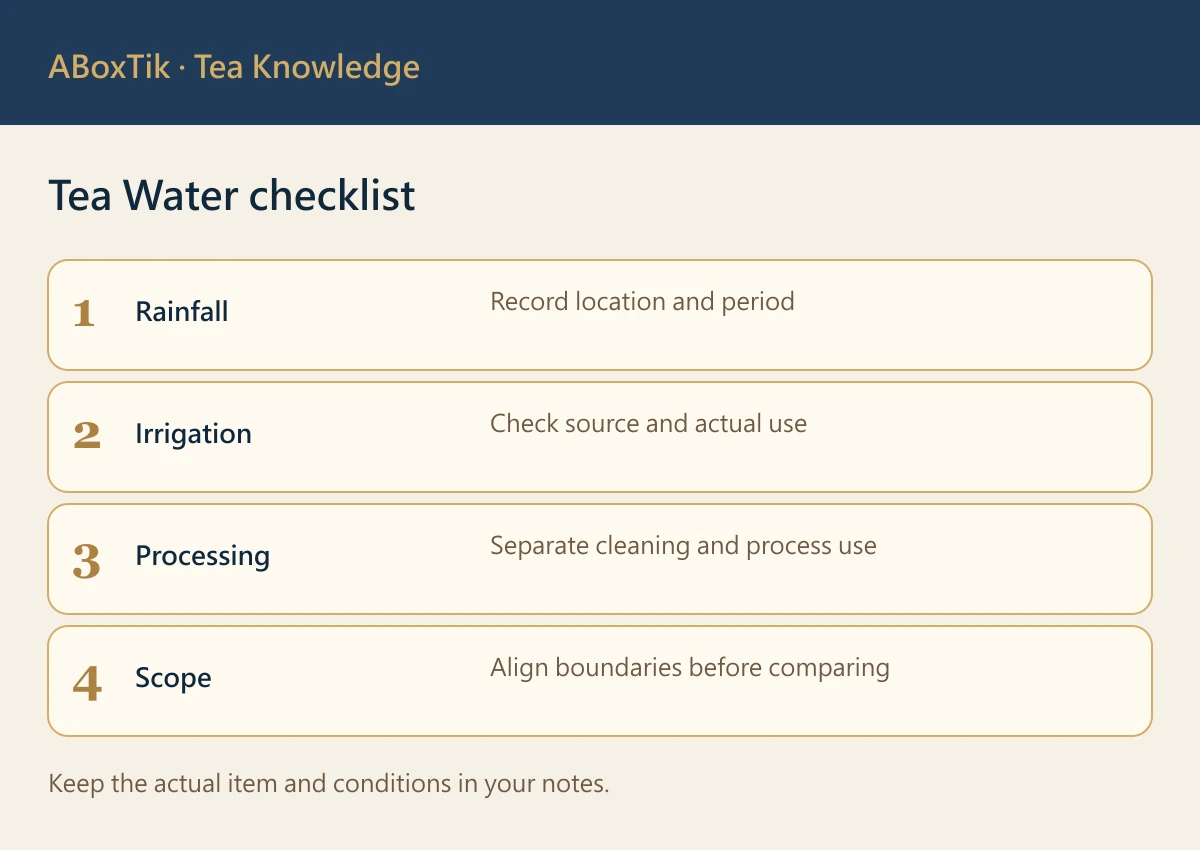
Start a conversation about water in tea production by separating rainfall, irrigation, water used at the processing facility and water used to brew a cup. Each describes a different stage. Rain falling on a garden is not the same measurement as irrigation withdrawals, and water used to clean equipment does not automatically tell us how much water was involved in growing a particular batch.
If a package mentions water use or water savings, there is no need to memorise a figure immediately. Ask what the information covers, where it came from and when it was collected. A tea travels from garden to table; keeping the stages in separate fields helps each piece of information do its own work.
Four stages to put on the water card
| Stage | What to ask or record | What it cannot establish on its own |
|---|---|---|
| Rainfall in the garden | Location, period and source of the observation | The amount withdrawn for irrigation |
| Garden irrigation | Water source, measurement point, period and purpose | All water associated with a tea garden |
| Processing and cleaning | Facility withdrawals, uses and reporting boundary | The complete life-cycle water use of a package |
| Brewing at home | Water prepared, cups and the actual serving context | Water used in cultivation or processing |
Not every garden irrigates in the same way, and not every factory runs the same process. Fill the card using the actual garden and factory records. If one field is unknown, leave it open rather than moving a number from the neighbouring field into it.
Rainfall and irrigation answer different questions
Rainfall forms part of a garden's environment. To read a rainfall record, note the observation location, dates and units. A nearby weather station may differ from a specific field in elevation or local conditions. It can provide useful context, but a station total should not be rewritten as the amount absorbed by every tea plant.
For irrigation, ask whether it actually occurred, where the water came from, which area it served and how it was measured. Even when two gardens report withdrawals for the same period, the planted area, harvest, equipment and weather may differ. Place those details alongside the figures before deciding whether a comparison makes sense.
The Food and Agriculture Organization describes water accounting in relation to supply, demand, access and use within a defined context. Its irrigation material distinguishes crop requirements from natural rainfall conditions. These frameworks help organise the questions; they cannot fill in the water use of an individual garden without the relevant data. If a value is estimated, record the method and assumptions too.
One useful question for a supplier is: “Are irrigation records available for the garden supplying this batch? What period and area do they cover?” A farm's annual record may describe the operation as a whole. It does not automatically equal the water associated with one harvest or one retail pack.
At the processing facility, ask where water is used
Facility information is easier to understand when the intake point, reporting period and uses are identified. Equipment cleaning, work-area cleaning or other activities may share a meter; the actual facility records are needed to understand that arrangement. A total labelled “water use” should not be assigned to one tea merely because that tea passed through the building.
Record the facility, dates, total and unit, then ask whether other products or operations share the system. If someone reports a figure per unit of product, ask how water was allocated, which output was used and whether packaging or other stages are included. Without that context, describe the available figure as a facility record for a stated period rather than as the water in a particular pack of tea.
Water-saving actions also benefit from a concrete description. If a cleaning procedure changes, ask when it changed, which equipment it covers and how the before-and-after comparison was measured. A confirmed action can be described as an action. A quantified reduction needs a suitable baseline and matching measurements; a method's name cannot supply the missing number.
Brewing at home: a useful record with a clear boundary
At home, prepare an amount of water that suits the number of cups and the way the tea will be served. A simple note can include water prepared, tea used, number of servings and any subsequent infusions. If the same kettle is used often, observe how much is normally heated and what remains. This helps organise a daily routine; it does not calculate garden or factory water use.
When comparing two brewing routines, state how many cups were served, whether leaves were infused again and what happened to any water left in the kettle. A person making one cup and a host serving several guests have different contexts. Neither needs to be forced into a single universal figure for a cup of tea.
It is reasonable to prepare a practical amount of water for the occasion. Quantifying an environmental outcome, however, requires a suitable method and the corresponding boundary. A kettle is excellent at pouring tea; the calculation needs its own clear assumptions.
Six fields to align before comparing data
- Subject: Is the statement about a garden, factory, product, production batch or served cup?
- Period: Which year, season or production dates are covered?
- Boundary: Does it include irrigation, processing, packaging, brewing or only selected stages?
- Unit: Is the number for an entire site, a kilogram of product or another basis?
- Data collection: Does it come from a meter, another measurement, an estimate or a model? Who compiled it?
- Comparison: Do the product, methods and conditions match the earlier result or the other claim?
Suppose one report covers only a factory while another includes a wider supply chain. Even if both use the same unit, their boundaries differ. Mark the mismatch and ask for clarification before ranking the figures. It is more useful to say that the reports cover different activities than to give a neat answer that the records cannot support.
If a supplier can provide only part of the information, keep that answer with its date and product name. Partial information can still be useful when its scope is clear. A site-level record may help explain an operation, while a batch-specific calculation requires additional allocation and evidence.
Make a water-information card
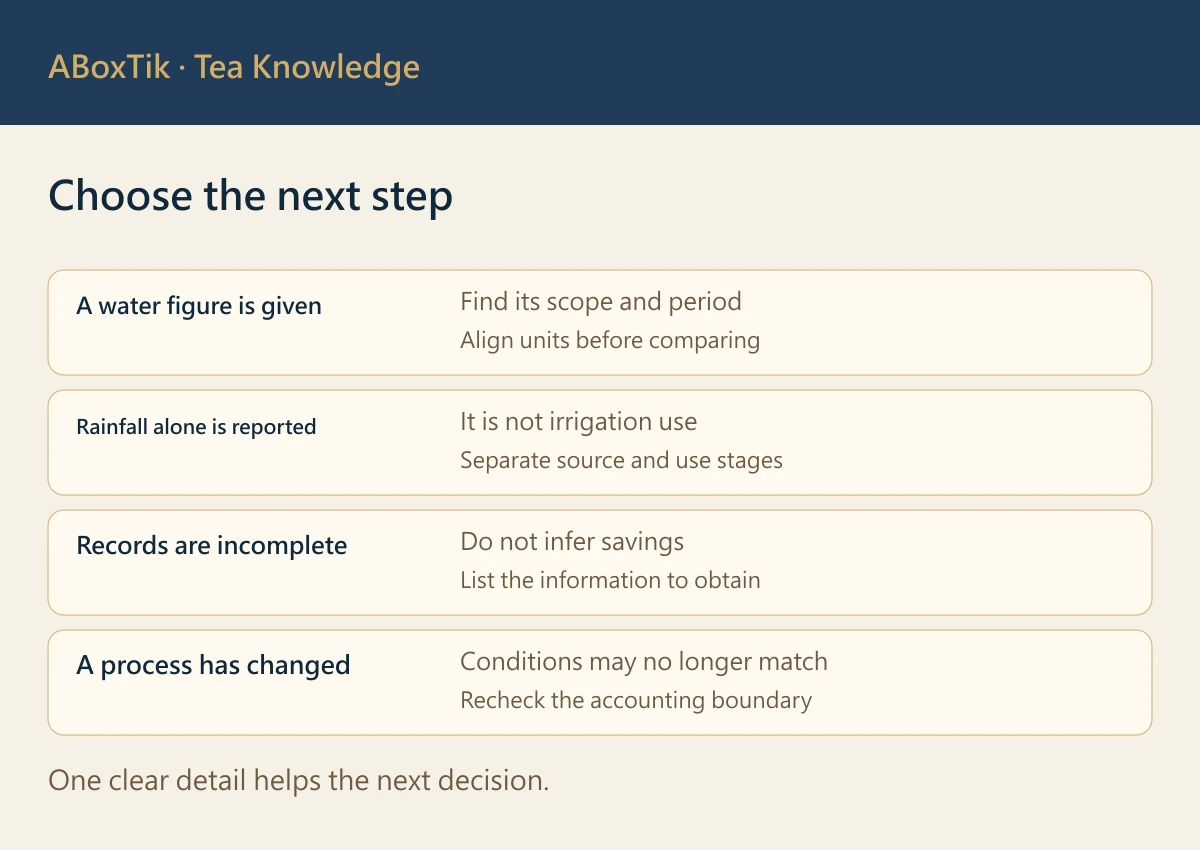
Choose one water-related statement on a package or in a supplier document. Fill in “subject ___; place ___; period ___; stage ___; unit ___; source ___.” Add one final field: “What I still want to confirm ___.” If the source describes an action at one farm, record it as an action at that farm. Do not add a savings percentage or a product-wide environmental result that the source does not provide.
Keep the full product name, batch or document version and the date of the response. When new information arrives, check whether it refers to the same product and period before replacing the earlier note. A card with one honest blank makes the next question easier than an attractive figure with no traceable origin.
Frequently asked questions
Does a rainy region mean a tea garden never needs irrigation?
Not necessarily. The timing and distribution of rainfall and the garden's management vary. Ask about the particular site and period rather than relying on a regional impression.
Does a factory water bill give the amount for each pack of tea?
A bill may provide a facility-level figure for a period. If several products or uses share the water, the measurement, output and allocation method need to be understood before relating it to an individual tea.
Is the water poured into a cup the tea's water footprint?
Brewing water describes one use-stage activity. A claim described as a water footprint needs its method, boundary, unit and subject to be checked before interpretation.
What is a good first question about a water-saving claim?
Ask: “Which site and period does this refer to, and what comparable information supports it?” Start with a question that can be answered, then request additional details as needed.
Leave the water story somewhere it can be checked
Rainfall, irrigation, the factory and the kettle each call for different information. Choose one statement to understand, write down its subject and boundary, and ask the person providing the data. Taking time over an empty field makes the story of the tea—and the decisions around it—clearer.
Related reading
