
Tea Knowledge
How Red Oolong Is Made: Processing Steps Explained
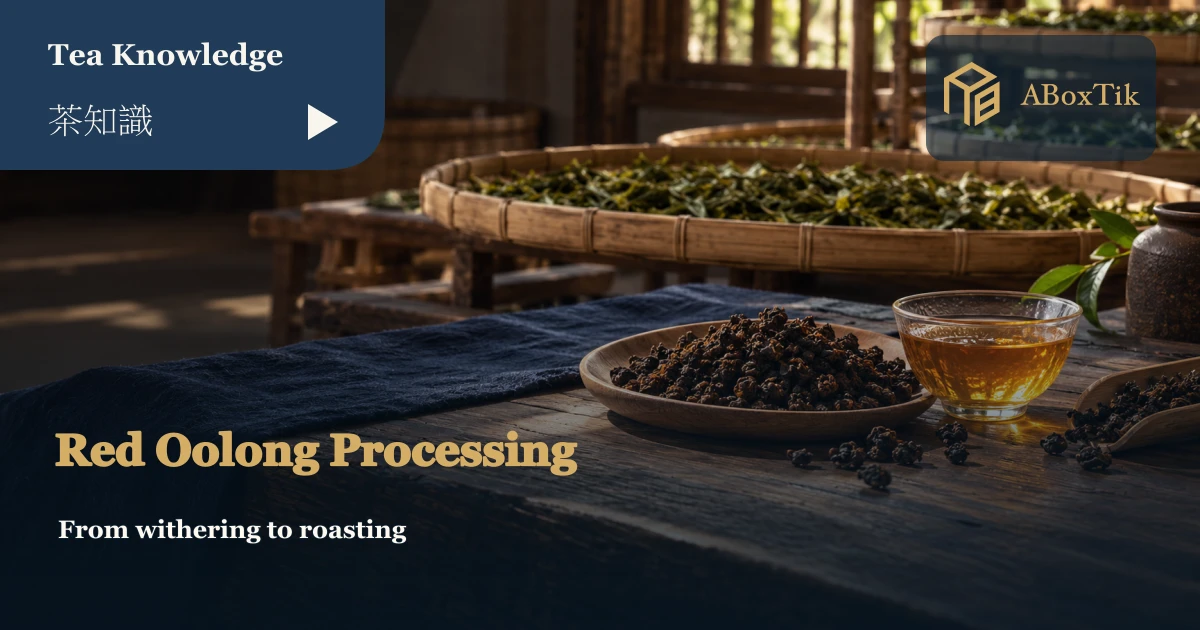
The red liquor and rounded leaves each have a sequence of work behind them.
Red oolong combines features associated with black tea and oolong processing. It is not a mixture of finished black tea and finished oolong. Follow withering and agitation first, then distinguish oxidation control, fixation, rolling, drying and roasting. These operations do different jobs; the colour in a cup cannot reconstruct the entire process.
The name can sound as though one tea has enrolled in two courses at once. There is no exam here. Separate the category, the maker’s process and the particular cup, and the route becomes easier to follow without memorising a universal oxidation percentage.
A processing direction, rather than a blend of finished teas
The Tea and Beverage Research Station describes red oolong as a specialty developed by combining processing characteristics and quality features of black tea and oolong. That concerns how fresh leaf material is worked. It does not mean a recipe in which two finished teas are poured into the same mixing bowl.
Tea classification places processing categories in context, while the black tea guide explains a different route. Not every tea with reddish liquor is red oolong. Keep the cultivar, growing origin and actual process information visible beside the product name.
For choosing a honey-aroma product, continue with the honey red oolong buying guide. Here the task is to understand the work. Honeyed, ripe-fruit or roasted impressions belong to the tea actually tasted, rather than a promise attached to every packet.
Harvest and withering: working with the leaves that arrived
Cultivar, harvest timing, leaf maturity and post-harvest condition affect later choices. A production timetable cannot make different leaf material identical. The maker starts with the physical material and its condition, before the eventual descriptive words appear on a label.
Withering involves water loss and changes in leaf condition. The station’s general processing explanation describes reduced weight, volume and hardness alongside reactions involved in aroma and taste development. The time required depends on the material and surroundings; a single number of hours would hide that work.
The withering guide supplies further background. Bamboo trays and spread leaves can show a stage, but a photograph alone cannot establish whether it is complete. The craft includes repeated judgement that a still image cannot conveniently fit inside its frame.
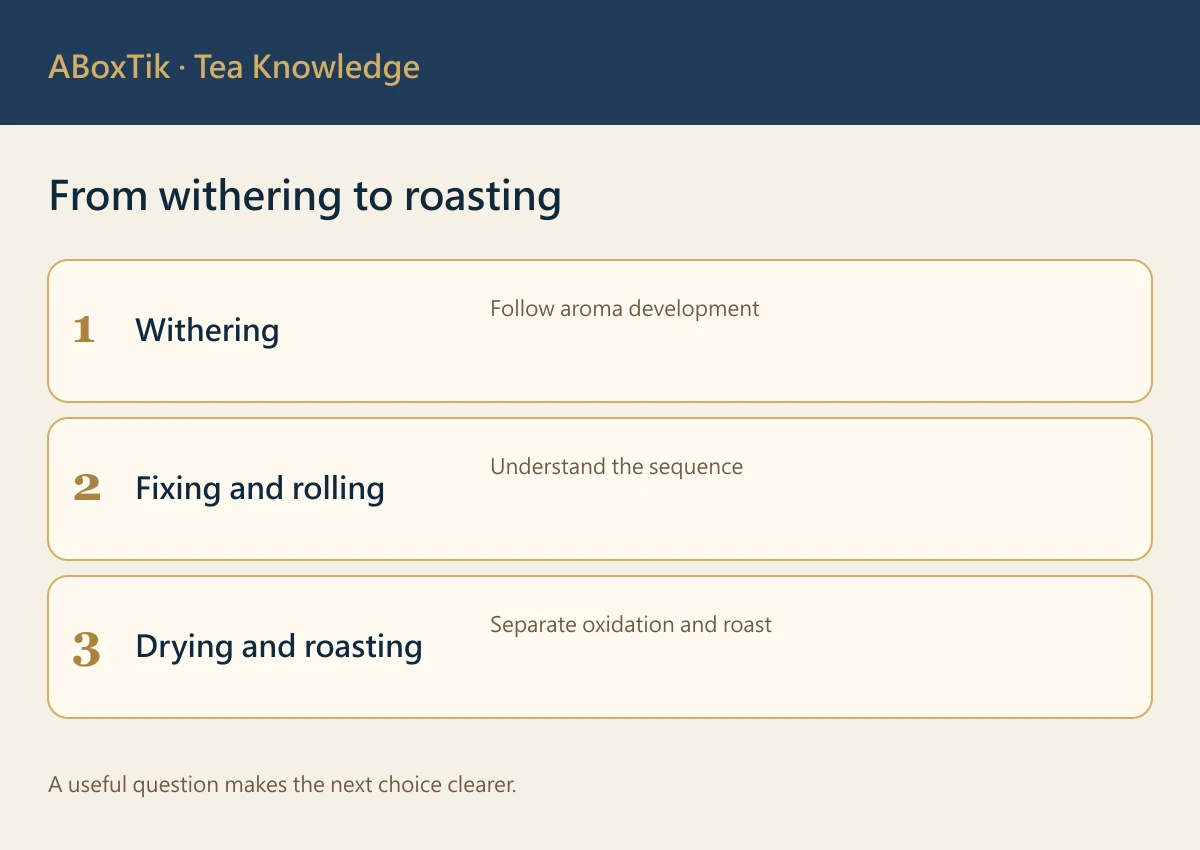
Agitation and oxidation require separate, useful language
Agitation and resting arrangements participate in moisture redistribution and changes to leaf tissue. The official processing explanation connects abrasion and tissue damage with enzymatic reactions in partially oxidised tea. The station’s account of red oolong particularly emphasises withering and agitation.
The word fermentation is often used in tea classification here to describe enzymatic oxidation. Do not automatically read it as the microbial process associated with a fermented drink. Likewise, an oxidation percentage needs its own definition and context if a producer supplies one; it is not a universal household quality test.
Oxidation and roasting describes two different processes. The former concerns reactions in the leaf; the latter belongs to a later heating context. They cannot substitute for one another, and a darkening cup is not a complete production log.
Fixation and rolling: a change of purpose in the process
Fixation uses heat to disrupt enzyme activity and prepare the material for subsequent handling. It and roasting both involve heat, but their purposes differ. Calling both simply “heating the tea” removes a useful distinction at the point where the sequence changes direction.
Rolling works leaf tissue and shape. Ball-shaped teas can also involve repeated wrapping, shaping and loosening operations. The rolling guide helps explain how form develops. Observe tightness, size and opening during brewing without assuming that appearance alone grades the finished batch.
A process diagram is a reading map, not a home manufacturing instruction. Making tea requires appropriate material, equipment and practical judgement. From the drinking side, the useful action is to record what the maker says alongside how that tea was prepared.
Drying and roasting: stable tea, different aromatic directions
Drying removes moisture and helps stabilise the finished material. Roasting can further alter moisture and aromatic direction. The official classification places red oolong within a roasted ball-shaped oolong context; that does not mean every batch should display the same roast intensity.
Light and roasted tea styles offers a way to arrange a comparison. If warm grain, developed fruit or other impressions emerge, record them as sensory observations. One aroma does not establish which machine was used, how often a tea was roasted or the exact conditions applied.
Storage remains part of the story after production. Opening date and storage conditions help explain differences between packets. Without those notes, it is easy to assign every change to manufacture, even when the two teas have had very different lives in the cupboard.
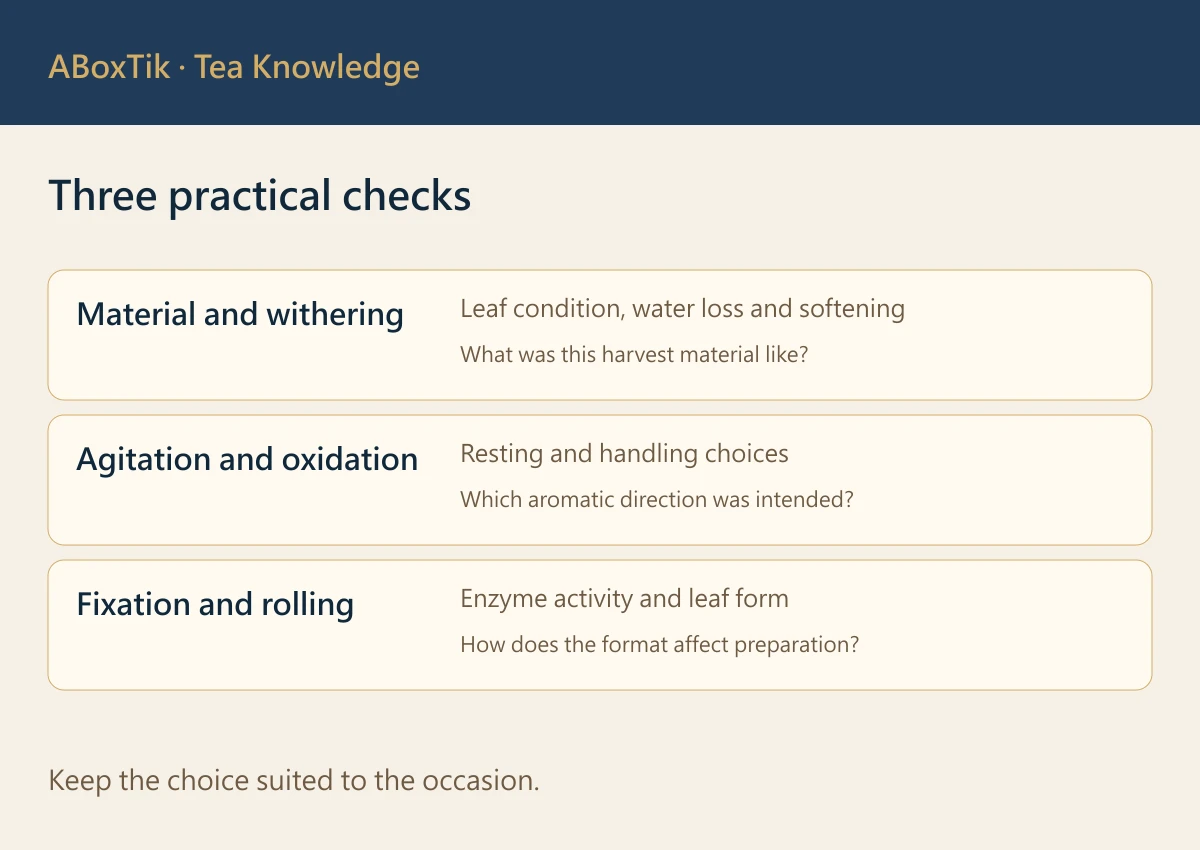
A process-reading card for the next conversation
| Stage | Read for | Ask the maker |
|---|---|---|
| Material and withering | Leaf condition, water loss and softening | What was this harvest material like? |
| Agitation and oxidation | Resting and handling choices | Which aromatic direction was intended? |
| Fixation and rolling | Enzyme activity and leaf form | How does the format affect preparation? |
| Drying and roasting | Stability and developed character | How should the opened tea be kept? |
To compare red oolong, light oolong and black tea, prepare small servings using each tea’s guidance. Keep aroma, texture and finish in separate columns. The aroma sequence and steeping-time notes help organise this without expecting one sip to reveal an entire factory.
Choose the stage you are most curious about and ask one concrete question. Record an answer in the context of that producer and batch. Different practices can be informative without requiring a winning method; a clearer question is a worthwhile outcome in its own right.

Tea, one box at a time
Bring the craft back to an understandable cup
At ABoxTik, process knowledge has a practical destination: the next time a packet of red oolong arrives, its name, origin and making direction are easier to separate. Begin with a plain small cup and leave room for a personal preference.
View the actual teas in the Classic Taiwanese Tea Four-Box Set, then choose a suitable loose-leaf or whole-leaf tea bag routine. Learning the craft is useful when it supports the next choice, rather than becoming a vocabulary test.
Related reading
- Read the honey red oolong buying guide
- Explore rolling and leaf shape
- View the Classic Taiwanese Tea Four-Box Set
Sources
- Tea and Beverage Research Station: origins of red oolong
- Tea and Beverage Research Station: Taiwanese tea classification and processing
Sources checked 20 October 2026.