
Tea Knowledge
How to Read Craft Artist Statements: Details and Interpretation
Look at the work, then read its words. Give the two a little time to meet.
To read a craft artist’s statement, identify the theme, materials, techniques and intended setting described, then return to the object and look for visible details. Keep three kinds of notes apart: what the text says, what you can observe and what the work brings to your own mind. There is no need to guess a single correct response, or to treat every poetic phrase as a verified product specification.
A small label can mention landscape, time, touch and everyday life in only a few lines. It is perfectly natural to like the shape and still wonder what the text means. Choose one word and ask where it might connect with the object. Let the statement guide your attention without asking it to announce what your eyes must see.
Look before reading: keep a first impression
Spend a moment with the whole work and its details: shape, proportion, surface, joins, colour and the places where it might be held or placed. Write two observations you can point to, such as “the rim opens outward” or “the surface has lighter and darker lines.” You do not need to decide immediately that those lines represent a river or a mountain. That can be a later association; the observation gets its own column first.
At an exhibition or shop, follow the instructions for viewing, photography and handling. Online, remember that a photograph may show only one angle. Dimensions, weight, interior construction and the feel of the material may not be evident. If intended use matters, consult the work’s information or ask its provider. One photograph is not a complete specification sheet.
A first impression need not sound like a formal review. “The outline feels quiet” or “I wonder what this part does” is enough. When you read the text, these small questions can reveal what drew your attention without letting the artist’s explanation replace your own looking.
Read the statement along four lines
| Clue | What to underline | Question for the object |
|---|---|---|
| Theme or feeling | A place, time, memory or question | Which visible details bring that theme to mind? |
| Material | Materials explicitly identified in the source | Which surface details can I see, and what remains to ask? |
| Technique | A stated way of making or decorating | Does the text identify where that technique appears? |
| Everyday setting | Display, drinking, light or another described context | Is this an idea, or a confirmed instruction for the product? |
The 2025 Taiwan Craft Awards materials ask entrants to describe aspects such as their original concept, subject, craftsmanship and particular approach. The Taiwan Craft Catalogue presents information for individual works. These fields offer useful starting points; they do not mean every maker must write in the same way, and they cannot supply facts absent from a particular entry.
Some statements begin with technique, others with a memory. If all four columns cannot be filled, leave space and record the source. Keep dimensions, materials, care and intended-use instructions alongside the statement when available. A statement may explain why a work was made; practical information helps place it in daily life. Each can illuminate the other.
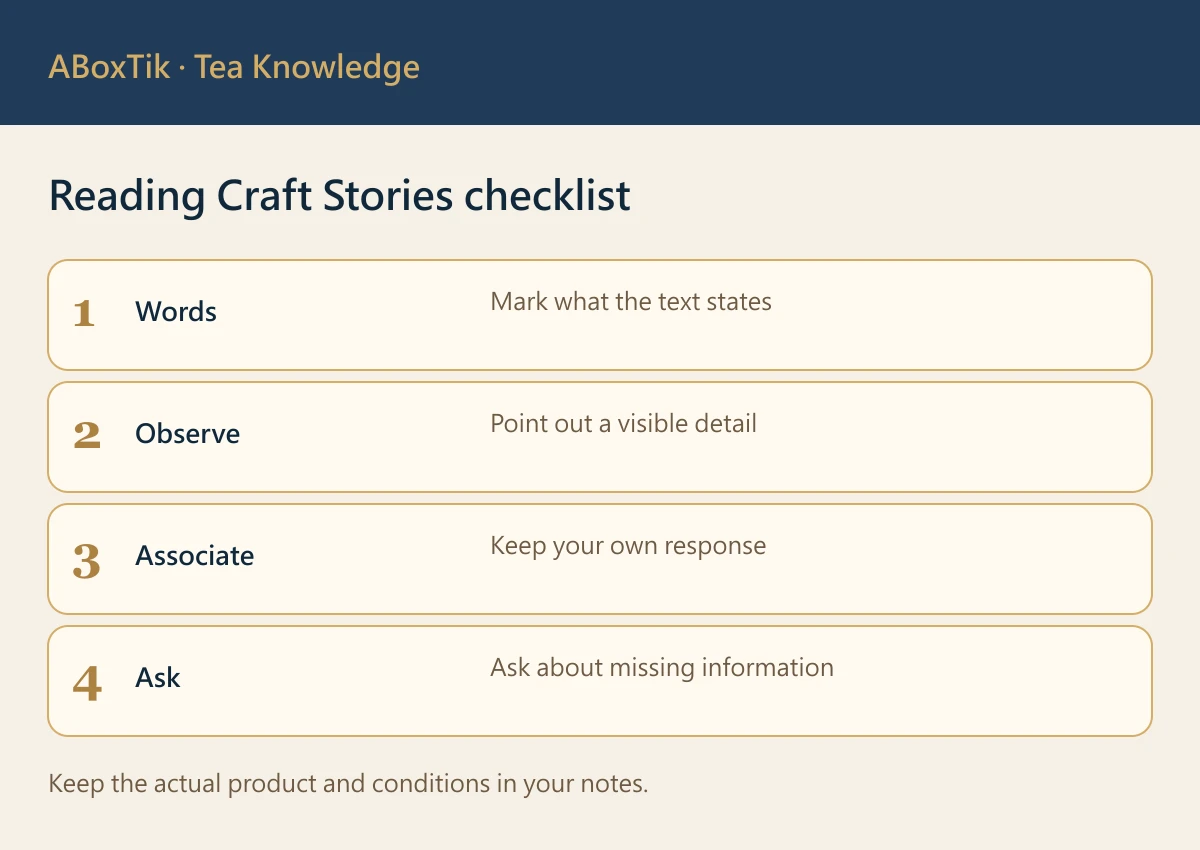
Practise separating text, detail and association
Here is a fictional exercise rather than an account of a particular object. Suppose a ceramic cup’s statement says it was inspired by a road after rain, and the image shows variations in the surface colour. Three notes might read: The text says: the inspiration is a road after rain. I see: lighter and darker areas on the cup. I imagine: they remind me of traces of water. The last sentence is the viewer’s association; it does not establish the maker’s intention for each mark.
To learn how the surface was made, return to the stated material and process or ask the artist. A resemblance to water is not evidence of a particular firing method. Equally, a phrase such as “inspired by nature” does not establish the origin of materials, an environmental benefit or a certification. A personal association can remain lovely while factual claims keep their own sources.
Different people may connect one object with very different memories. When looking together, each person can first name a visible detail and then share an association. If the answers vary, there is no need to ask the artist to award a prize for the correct interpretation. One line can open several worthwhile conversations.
A reading card for a craft statement
| Field | What to note |
|---|---|
| Work and source | Name, maker, source page and date consulted: _____ |
| Explicitly stated | Theme, material, technique or purpose: _____ |
| What I can see | A shape, texture or colour and its position: _____ |
| My association | A personal feeling or memory: _____ |
| To confirm | Material, use or permission to quote: _____ |
A source beside a note is more useful than “I think I read it somewhere.” If a label and a website differ, keep both versions and their dates and ask the provider. Do not simply choose the more appealing account. When passing on a maker’s statement, preserve its context and obtain any permission needed for the intended use.
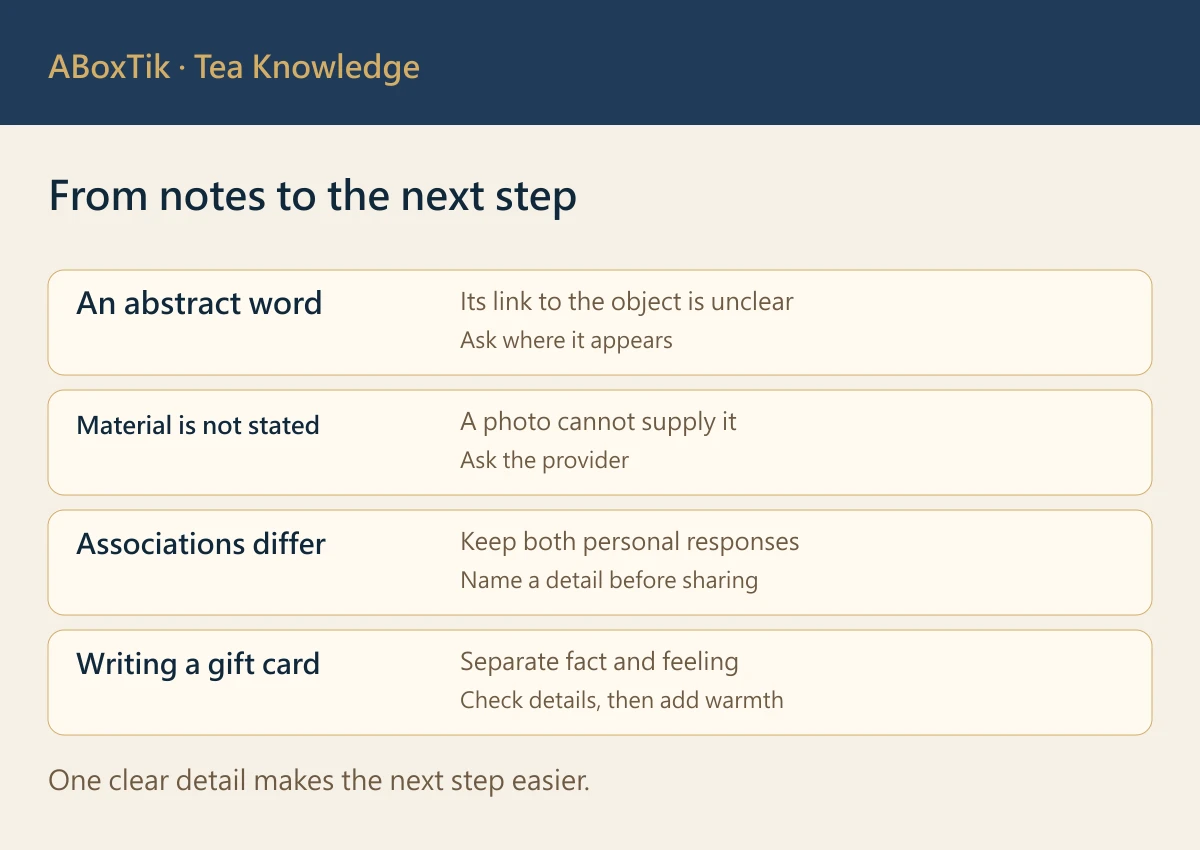
Turn an abstract word into a useful question
For “time,” ask which shape or part of the process the artist connects with time. For “land,” ask whether the word concerns inspiration, material origin or a local story. If the text does not say, write “to confirm” rather than adding a place name. Translations may also carry a different tone; for an important phrase, return to the original or ask the provider.
For “everyday life,” ask what setting the maker imagined and whether the provider has actual use instructions. A display concept and suitability for hot drinks or food are separate questions. Check the individual item’s information for use and care. Our teapot materials and use guide can help frame a question, but the specific piece still needs its own answer.
To understand technique, ask, “Is this surface or join connected with the method mentioned in the statement?” The maker can indicate the relevant area. Not every process has to be disclosed in full, and a photograph does not identify the cause of every surface variation. Being willing to leave “I do not know yet” in the notebook is part of careful reading.
Bring the statement to a gift or tea table
When giving a craft object, confirm its dimensions, use, care and packaging first. A brief, checked introduction can accompany it: “The work’s description mentions ____. I especially like ____.” The first part has a source; the second is the giver’s personal response. Include an artist, material, location, date or award only when the information actually applies to the work and can be checked.
At a tea table, place the object according to its confirmed use or display instructions. Invite a companion to describe one thing they see before reading the text. Different impressions need not be corrected into one version. If an object’s use is uncertain, ask the provider instead of deciding that it can hold tea simply because it resembles a cup.
Our introduction to Taiwanese ceramic craft offers historical and material background. For a particular work, put the maker’s information and the object in front of you first. A history article is a map; the individual work’s label is an address. Together they make it easier to find your own route.
Keep one observation and one question
Next time you pick up a work’s label, underline one word, point to one visible detail and write a sentence about your own association. If material or use remains unclear, take that question to the provider. A statement does not have to deliver every answer at once. It can be an invitation for the object, its words and daily life to meet at a tea table.
Related recommendations
- Taiwanese ceramic craft for historical and material context.
- Teapot materials and use for practical questions about an object.
- Tea as a gift for considering the recipient’s habits.
