Tea Knowledge
Tea Tree Age and Flavour: A Practical Evidence Guide
A garden’s history can begin a conversation, while the cup in front of us offers something to notice today. Keep the source, the making and the brewing notes alongside a personal impression. Each field helps the next question find its place, without asking one number to tell the whole story.
Can tea tree age determine flavour?
Tea tree age can help describe a garden, but age alone cannot guarantee aroma, taste or quality. Cultivar, growing conditions, cultivation, picking, processing and brewing all belong in the conversation. Ask how an age was established, then taste the actual batch. A tree’s birthday is not a flavour report card.
Tree age, leaf age and finished-tea age
Tree age refers to years from a stated starting point such as planting. Leaf age describes the growth stage of the picked leaf. Finished-tea age refers to time after processing. They answer different questions. Ask whether an age is measured or estimated, which plot it describes and what records support it.
Where does the age count begin?
A useful first question is the starting point. One producer may count from sowing or planting; another may give a range based on a transfer record or a family account. These are different types of evidence and can support different levels of precision. If the answer is “roughly several decades,” preserve that range instead of turning it into an exact year. Ask whether the description concerns a whole garden, selected plants or the leaves used in a particular batch. Even plants in the same plot need not have been planted on the same day.
What can records and photographs tell us?
An old photograph or map can offer a clue that a garden existed at a certain time. Purchase and processing records may help connect a garden to a particular batch of finished tea. One photograph usually cannot establish the exact age of every plant, and a thick trunk is not a stand-alone dating method for a box of tea. The point of asking for evidence is to understand the limits of a claim, not to demand that every producer use the same filing system. Some records may also contain private or commercially sensitive information; ask what can appropriately be shared.
Read the study with its setting
One study compares Wuyi Rougui stands of different ages and examines leaf components and soil. Its findings belong to that cultivar, location and sampling design. Gardens of different ages can also differ in soil, management and history. The comparison cannot establish that every old tree produces better tea, or that age alone explains each difference.
Cultivar and cultivation are part of the story
Taiwan’s tea research station describes cultivar development through growth observations, tea-making trials and sensory assessment. Cultivar, pruning, picking practice and garden conditions are useful context alongside age. If a claim gives only a striking number, ask how it was established and leave the answer open until a source is available.
Ask about care without filling in the gaps
Pruning, picking and other management choices can vary with the garden, the season and the producer’s goals. Ask which practices are documented, who carried them out, and whether the information applies to the tea in hand. Do not convert “one grower uses this approach” into “every old tea plant is managed this way.” A producer’s long experience can be valuable context: identify it as their account rather than presenting it as a controlled comparison. If the answer is not known, a blank field is perfectly usable.
Processing has a role too
Withering, oxidation, fixation, rolling, drying and sometimes roasting can produce different styles; the sequence and choices depend on the tea. Research about processing describes specific samples and conditions, not a universal recipe. Storage and brewing add further variables. A flavour note cannot identify a tree’s age on its own.
Build a fair comparison card
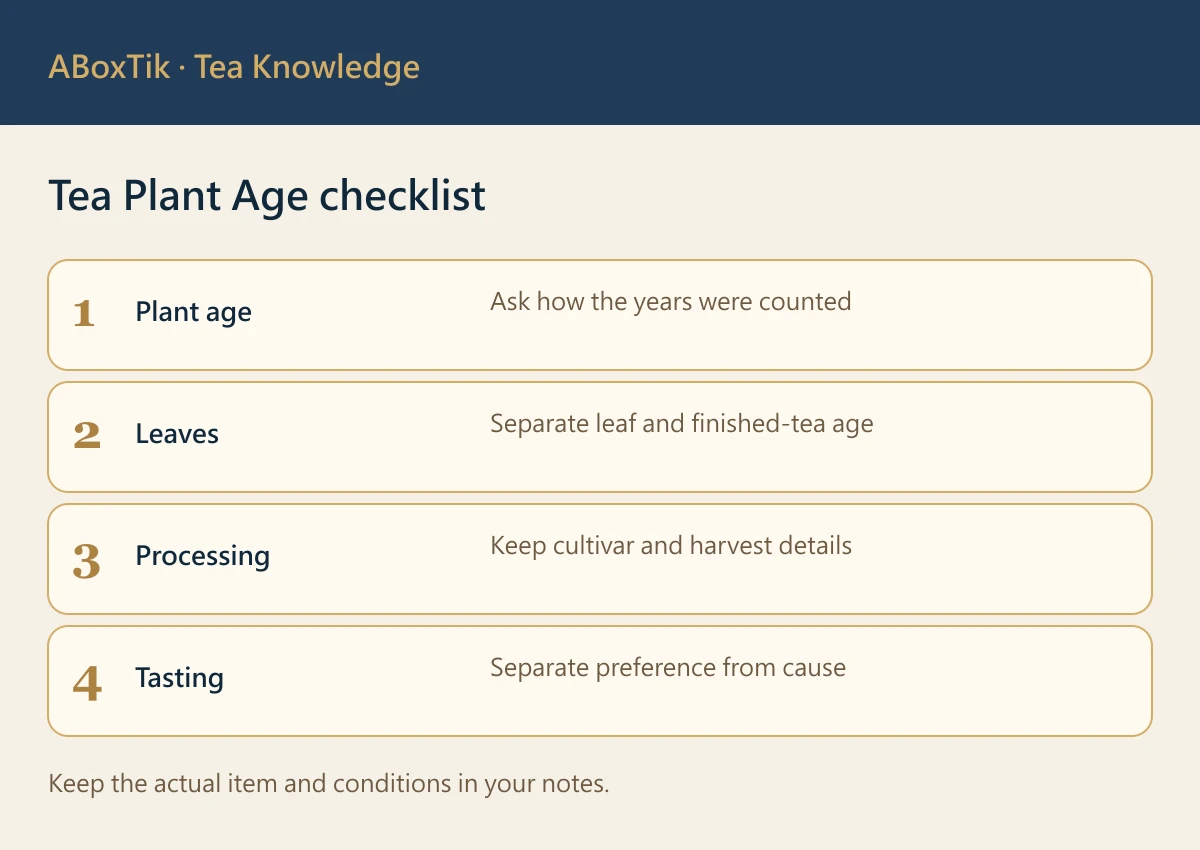
A tea tree age claim is most useful when its starting point and scope are clear. Record the tea name, stated origin, cultivar, age and source of the claim, harvest, processing and opening date. Make a small first cup according to each package and record leaf, water, temperature and time. To investigate one brewing change, keep other conditions as consistent as practical. If the teas differ in origin and processing too, a tasting can reveal preference but cannot isolate tree age as the cause.
| Field | Check first |
|---|---|
| Tea tree age | Starting point, plot and evidence |
| Other conditions | Cultivar, harvest, care and processing |
| Tasting | Brewing, aroma and preference |
Set up a comparison that answers a modest question
Suppose two teas carry a similar name but have different stated tree ages. First compare what is known about cultivar, plot, harvest, processing and storage. Mark unknown fields instead of silently assuming they match. Prepare a small serving of each using the producer’s starting instructions, clean equipment and drinking water. Record the leaf amount, water, temperature and steeping time. Note aroma, taste, texture and finish separately before deciding which cup you prefer. The result can answer “which cup did I enjoy under these conditions?” It cannot by itself establish that age caused the difference.
What if the first cups do not suit you?
If one tea tastes stronger than you like, record that observation before changing the method. For the next round, use fresh leaf and adjust one variable, such as contact time, while keeping the others as close as practical. A later infusion of leaves already brewed is useful for enjoying the day’s tea, but it has a different history from a fresh-leaf comparison. Do not force two very different products into an identical method if the producer’s instructions call for different starting conditions. The aim is a useful note, not an artificial competition.
Use four fields on a tasting card
The first field is verifiable information: name, batch, source of the age statement and the date checked. The second is sensory observation: dry-leaf aroma, cup aroma, taste, texture and finish. The third is a question: perhaps the starting point for age or how the leaves were processed. The fourth is the next step: keep this brewing method, or change one thing next time. This small distinction helps a personal impression remain personal and keeps a source claim available for later checking. A blank field is an invitation to continue the conversation, not a failed test.
Questions worth asking
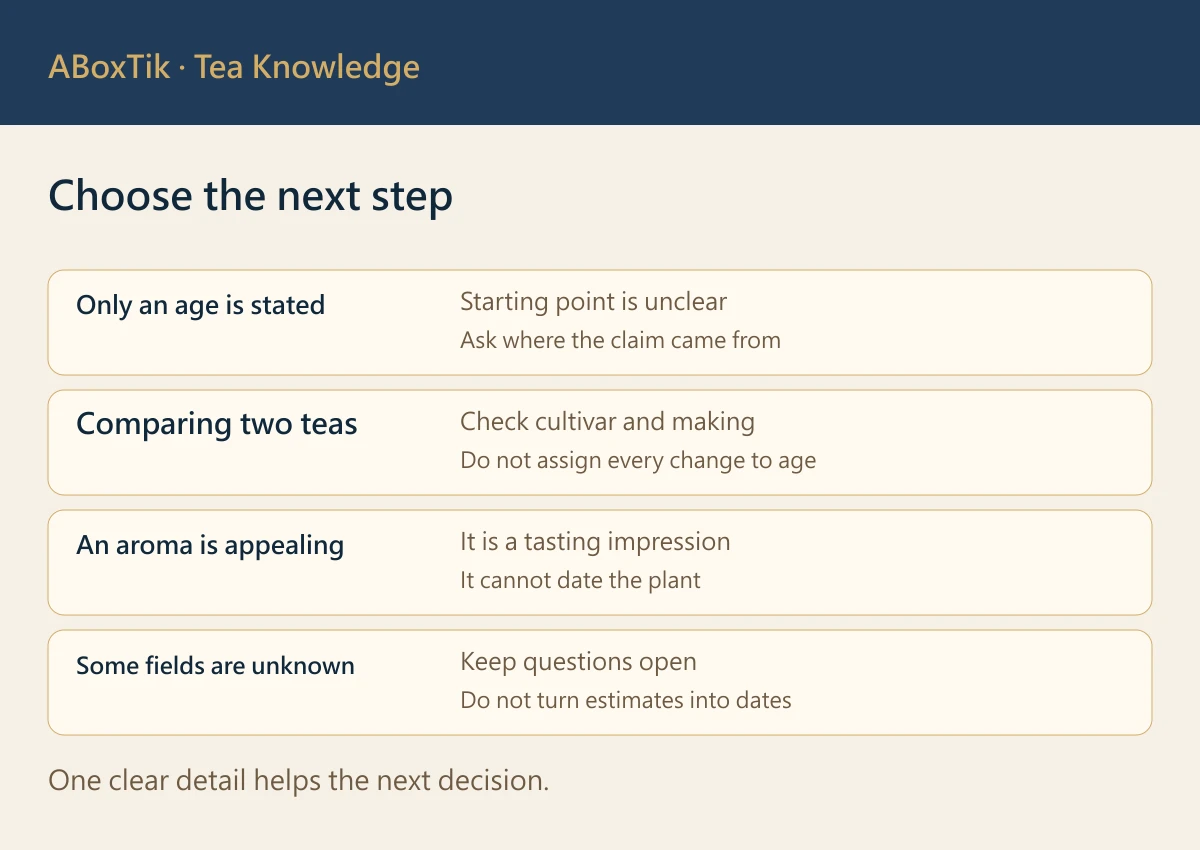
Try: “Does the age describe this batch or an estimate for the garden?” “What is known about cultivar and processing?” “Where should I start with brewing?” Records vary across producers. An unanswered question may simply remain unanswered; do not turn a guess into an exact planting year.
Compare price and information together
When comparing prices, use the same net weight and check whether packaging, harvest, processing, origin, delivery and batch are comparable. Tree age may be background worth checking, but it cannot explain every cost. For a gift, consider the recipient’s brewing equipment and a convenient portion too. Keep the product description and batch identifier so a future purchase can be checked afresh. Price, evidence and personal preference each deserve their own field.
Three easy misunderstandings
A woody note does not prove that a plant is old: an aroma impression is not an age measurement. A garden containing old plants does not establish that every leaf in every box came from those plants; that requires batch-specific information. Finally, tea stored for years after manufacture is not automatically tea made from old plants. Plant age and the storage age of finished tea are separate. Keep the questions separate, ask for the relevant evidence, and let your own preference retain a place alongside the information.
Keep the cup and the evidence together
Write down what is known, what you want to check and what you enjoyed. Floral notes, body and finish describe this tasting; they are not instruments for dating a plant. Choosing a tea can remain intuitive while the story told about its source stays precise.
Share a cup with ABoxTik. Begin with a familiar tea and leave one line for what you noticed today. Follow a related guide below when another question arises, and choose a next step that fits the way you enjoy tea.