
Tea Knowledge
Reading Historic Tea Shop Packaging: Text, Size and Local Memory
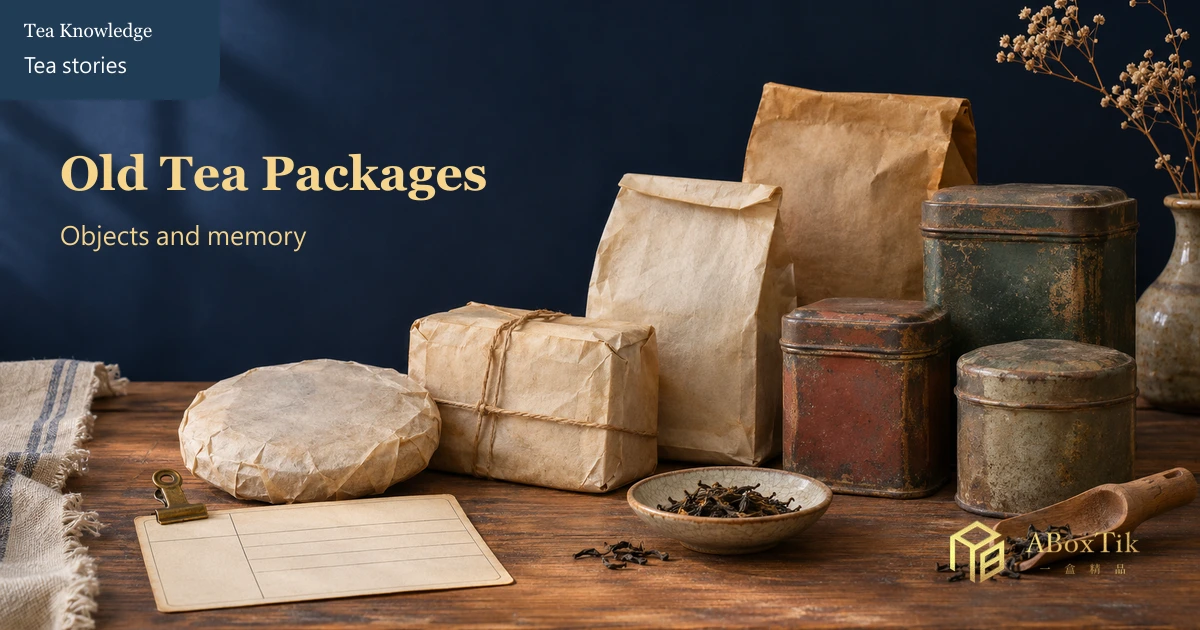
An old tea tin or paper wrapper may preserve a shop name and clues to use. Begin with the object and traceable sources, then ask where it came from and how it was used. An old label does not need an invented legend.
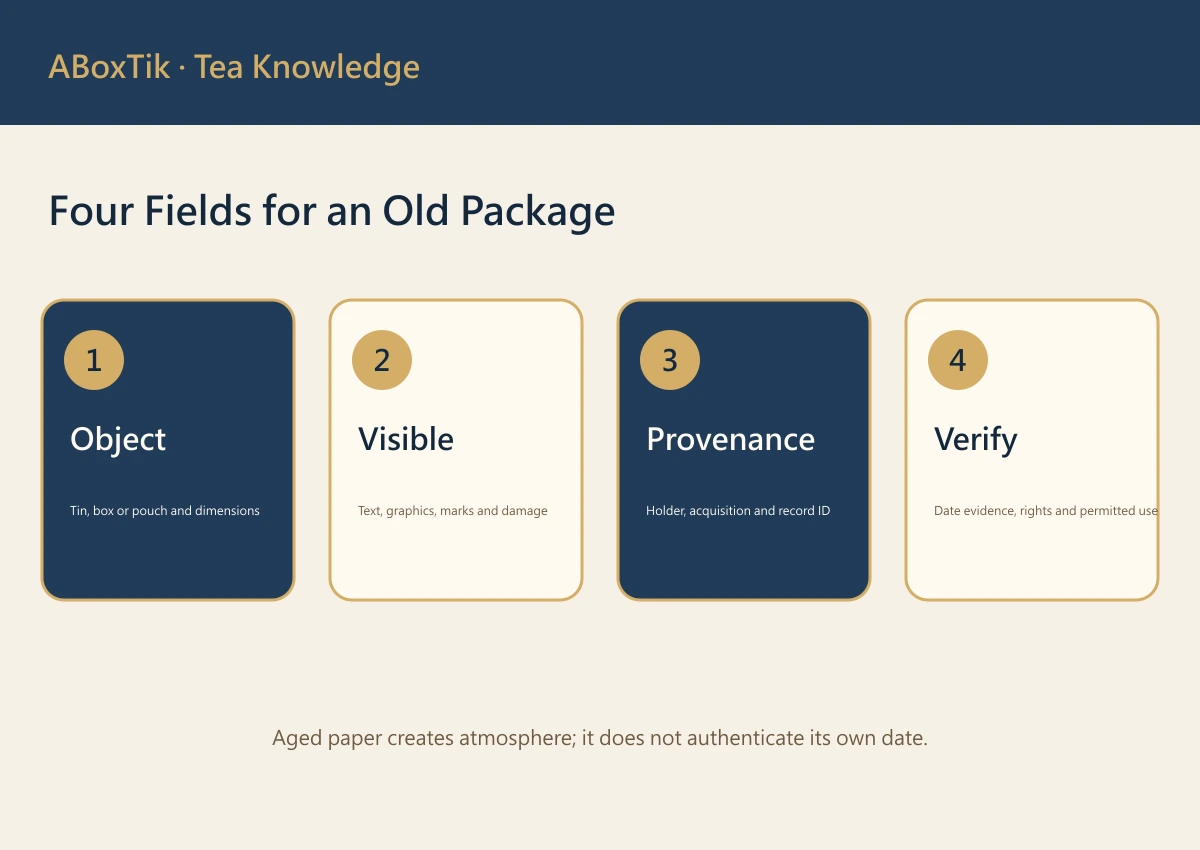
Record what can be observed
Note the object, dimensions, material, text, graphics, condition and observation date. Mark an uncertain date as unresolved. A printed date, trademark or address needs context from original records.
Ask how it was used
Openings, closures, weight and portability may suggest a use, but keep inference separate from documented facts. When asking a holder, museum or shop, record who provided the information, when and what may be shared.
Preserve local memory carefully
Compare museum holdings, local archives, publicly available shop information and oral accounts. Sources may describe different times or perspectives; one family’s experience should not be presented as the history of every tea shop.
An observation card
Object and source: ____; text and graphics: ____; dimensions and material: ____; confirmed date: ____; evidence of use: ____; open questions: ____; image permission: ____. Confirm rights before reproducing a photograph.
Common questions
Does an old package make its tea valuable? The age of an object and the contents and storage condition are separate questions. Can one online photograph establish authenticity? Usually not; more documentation is needed.
Inventory the existing identity before changing it
When a long-standing tea shop reviews packaging, photograph actual examples by version and record dimensions, material, text, graphics, closure and provenance. Give each item an internal reference and observation date, and note its holder, storage location and what may be shared. If a date is unknown, mark it unresolved rather than arranging a history from paper colour, type style or a single old photograph.
A shop name, sign lettering, familiar colours or a particular motif may be meaningful to existing customers. Ask the shop which elements remain important and which versions are in use, then place original items beside verifiable design records. Confirm rights and permission before redrawing or reusing an image. A family holding an object and the right to publish every related image are questions to discuss, not assumptions.
Use size and hierarchy to make information findable
Group the information needed to identify the product, use and store it, and contact the responsible business, as well as batch details. Confirm actual content against the product and applicable requirements. On a proof at intended size, check whether the name is easy to find, text contrasts with its background, a seal or fold obscures information, and the intended reading distance remains practical. Reserve space for the actual date and batch printing instead of squeezing essential information into an ornamental corner.
Retaining a familiar shop mark does not require every instruction to use the same treatment. Present the name according to the approved identity and make use and storage information legible; have local-language text checked by someone familiar with the market. Confirm food-labelling and origin wording against the applicable rules and actual product. A phrase on historic packaging does not by itself establish that the same wording is appropriate today.
Check materials, batch details and proofs separately
List the outer box, inner pouch, coatings, closure and label. Ask the supplier which parts contact tea, what barrier and sealing information is available, which printing is compatible and what storage conditions apply. A kraft-paper appearance does not prove that the entire package is paper. If supporting information is missing, leave the function as a question. Similar-looking old and new packages do not automatically have identical storage performance.
Proof at the planned size and on the materials actually proposed. Check colour, contrast, trimming, folds and the location of date printing; assemble a sample and check again for covered information. A team can place a sample in the intended shelf setting, observe it from a typical reading distance and record lighting, distance and specific feedback. This is a possible check, not a claim that consumer research has already taken place or a guarantee that every person will read it easily.
Give old and new packaging distinct identities during a changeover
Inventory the remaining old-version materials, quantities, condition and intended products. Confirm each version’s material, label and conditions with the supplier, then assign an owner, a changeover point and a plan for the remaining stock. If versions coexist, record version, batch and actual use date so that artwork or information from one is not inadvertently applied to the other.
Retain the approved artwork, supplier confirmations, proof and issue records. If date printing is unclear, a seal is abnormal or information does not match the product, pause use of the affected batch and ask the responsible owner to investigate. Keeping an old sample with its provenance gives a familiar visual a place in the record without requiring anyone to invent its story.
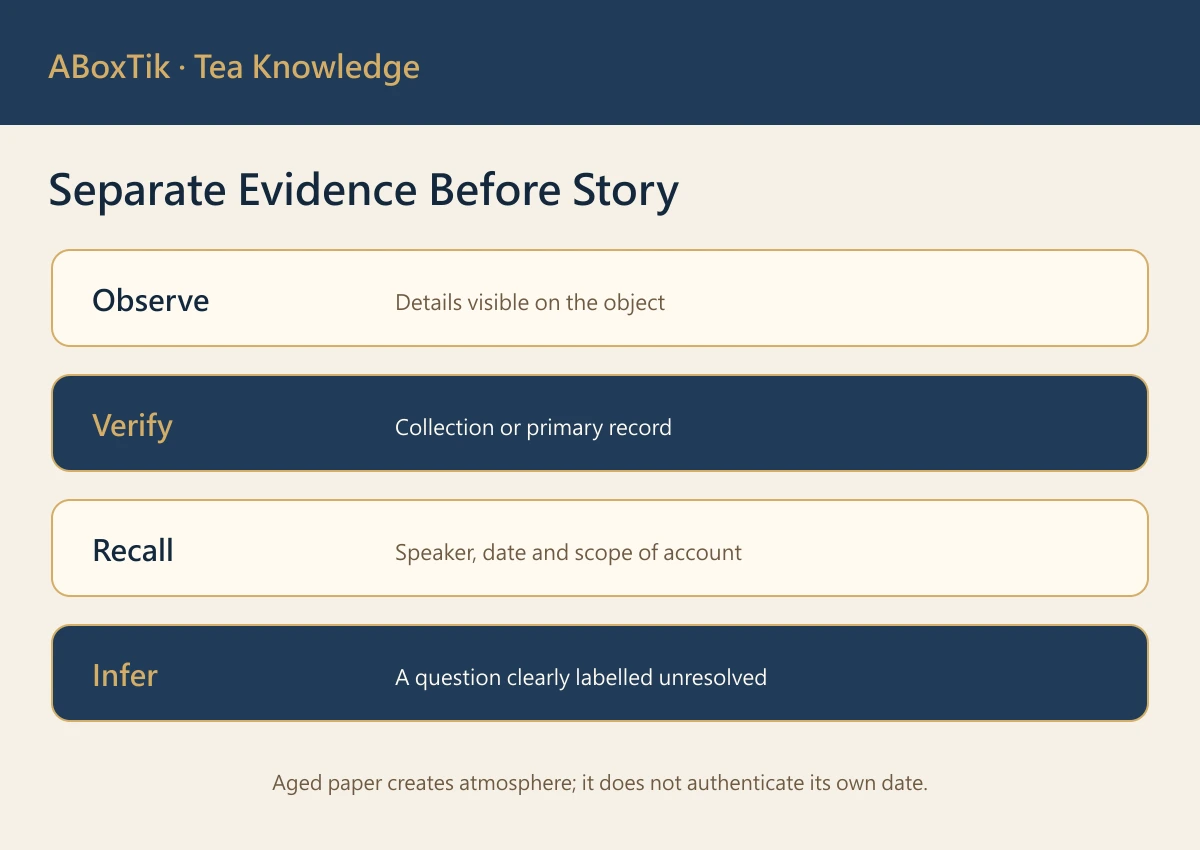
Begin with a collection number, not the colour of the paper
The National Museum of Taiwan History record for a Chien Mao tea shop scented-tea box provides a collection number, dimensions, material, date and object description. It also records the labels, trademark and physical condition. This demonstrates a sound starting point: find an identifier that returns to a primary record before building a commercial or local-history interpretation. Yellowed paper, old-looking type and worn corners are observable condition details. None authenticates a production date by itself.
Photograph the front, back, sides, base, closure and any liner with a scale, then record dimensions. Transcribe the shop name, address, weight, telephone number, trademark, printer or batch details exactly, marking uncertain characters rather than silently repairing them. For a family, shop or private collection, note the current holder, acquisition method, known custody and interview date. An old box can look remarkably confident; it should still be asked for identification.
Separate observation, collection records and memory
The museum describes acquisition as a sequence that includes assessment, registration, cataloguing, conservation, digitisation and authorised use. Cataloguing involves researched and checked fields such as title, period, provenance, technique, appearance and content. A shop’s observation card is not a museum authentication, but it can borrow this discipline. Put visible details in one field, verifiable records in another, the speaker’s recollection in a third, and unresolved inference on a question list.
During an interview, ask when and where the person saw or used the object, then how they know the proposed date. Record the speaker or agreed anonymity, interview date, publication scope and context. One shop name may span addresses, operators and packaging versions; one family’s experience is not the history of an entire district. When sources differ, preserve the disagreement and next check instead of forcing a smooth timeline.
Visibility is not permission to reuse a design
The museum’s licensing guide explains that individual digital objects may carry PDM, CC0, Open Government Data or Creative Commons statements, or be marked view-only. The item-level statement controls use. Even an open copyright licence may not clear trademarks, personal data, portraits or other third-party rights. For commercial reuse of a photograph, motif or shop mark, record the object URL, collection number, rights statement, access date and attribution, and ask the museum or relevant rightsholder when necessary.
The two diagrams in this article are newly drawn research tools and do not reproduce a collection image. If a collection object is later quoted or illustrated, follow its current item-level notice. That keeps local memory welcome at the table without inviting a rights puzzle to sit in the best chair.
Explore next
Old tea packaging keeps stories in paper, type and size; the story can continue below through premium tea gifts, more articles, and the latest boutique selections—with considerably less dust on the shelf.
Sources
National Museum of Taiwan History—Chien Mao tea shop scented-tea box · National Museum of Taiwan History—A collection object’s journey · National Museum of Taiwan History—Data licensing guide