
Tea Knowledge
How to Ask About Tea Aroma Before You Buy
A thoughtful question makes the next cup easier to choose.
The quickest way to ask about tea aroma is to say three things: what you enjoy, what you would rather avoid, and when you plan to drink it. “I like a clear floral or fruit-like aroma, dislike a heavy smoky impression, and want something for an afternoon cup” gives a retailer somewhere useful to begin. “What is your most fragrant tea?” is charmingly direct, but it asks one word to carry a piano, a mountain, and possibly a family disagreement.
You do not need a ceremonial vocabulary test before buying tea. Aroma is perceived differently by different people, and it changes with tea type, processing, storage, water, and preparation. A good conversation does not try to make a seller promise the exact flower that will appear in your cup. It helps you choose a tea whose documented style and likely experience fit your own preference.
This worksheet is for the moment before checkout. For a home tasting sequence after the tea arrives, see our tea aroma smelling guide. Here, the task is smaller and more practical: ask a question the retailer can answer, understand what kind of answer is useful, and keep your preference separate from evidence.
First, replace “fragrant” with a direction
“Fragrant” can mean lifted, sweet, floral, roasted, woody, ripe-fruity, fresh, or simply “I noticed it before I drank it.” None is wrong. They are just poor roommates in one tiny word. Give the word a direction by choosing one or two broad families.
| If this is close to your preference | Say this to a retailer |
|---|---|
| Fresh flowers, garden-like lift | “I enjoy a clean floral direction rather than a heavy roast.” |
| Ripe fruit or honeyed sweetness | “I am looking for a round, sweet-fruited impression; is there a tea with that style?” |
| Toast, grain, caramel-like warmth | “I like a warm roasted character, but not smoke or a burnt note.” |
| Leafy, green, brisk freshness | “I prefer a fresh vegetal style and would like to avoid perfume-like sweetness.” |
| Quiet aroma, more texture in the cup | “I do not need a dramatic nose; I care more about a calm, balanced cup.” |
“Like” and “avoid” are equally helpful. A retailer who knows that you enjoy roasted grain but dislike smoke has far more to work with than one handed a request for “something premium.” Price may matter, certainly, but it does not do a particularly good job of smelling the tea for you.
The preference interview worksheet
Copy this as a message, or answer it privately before you browse. Leave a blank when you do not know. An honest blank is better than a borrowed adjective that makes you sound like a teapot with a résumé.
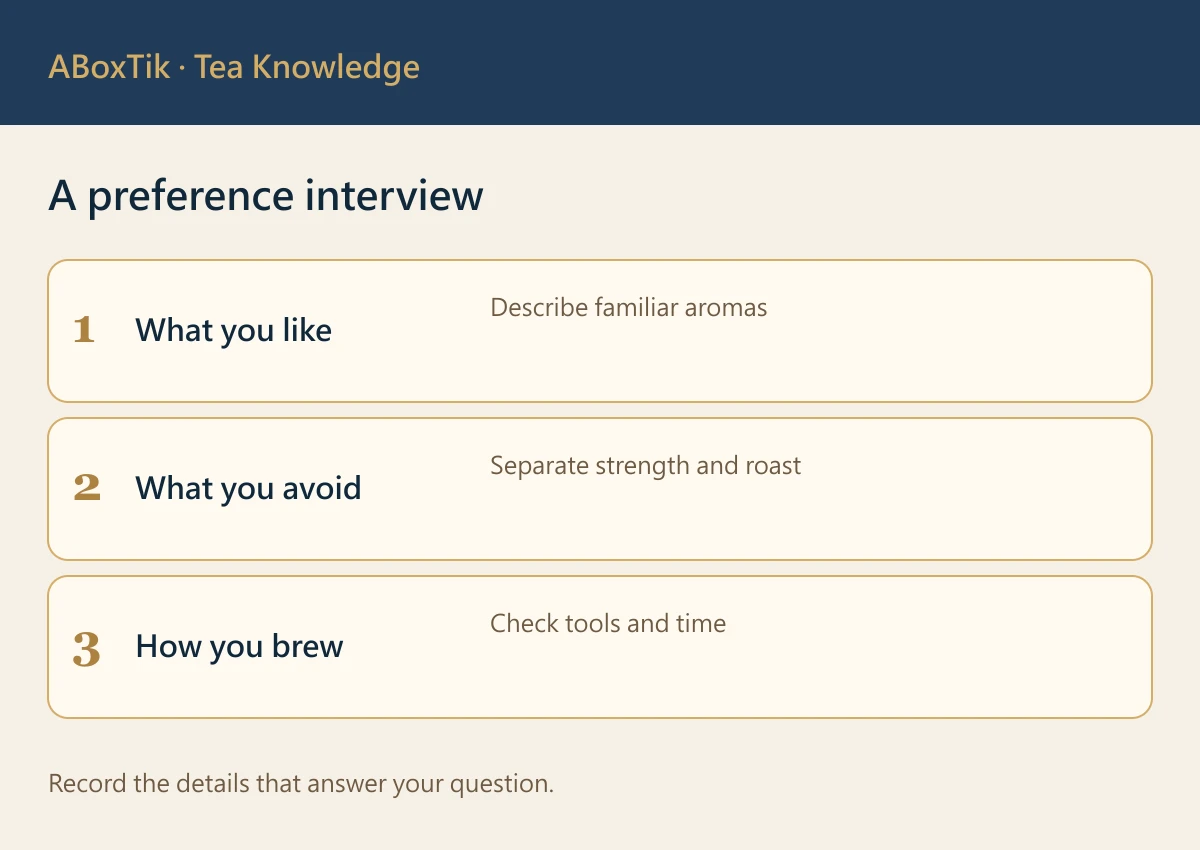
| Prompt | Your note | Why it helps |
|---|---|---|
| What aromas have I liked in tea, food, coffee, or flowers? | For example: orchid-like flowers, toasted bread, dried fruit, citrus peel. | Everyday comparisons are easier to answer than an attempt at technical brilliance. |
| What would I rather not smell? | For example: smoke, strong perfume, very green notes, heavy roast. | A clear “no” narrows the field quickly. |
| When will I drink it? | Morning, after lunch, alongside a meal, sharing, or a slow weekend cup. | It gives the seller a use context without pretending it determines quality. |
| How much preparation suits me? | Tea bag, mug, small pot, repeated infusions, or undecided. | The retailer can explain how preparation may reveal a tea differently. |
| What information matters besides aroma? | Tea type, harvest/lot information if offered, origin, roast direction, brewing guidance, price range. | It keeps the decision from resting on a perfume description alone. |
A ready-to-send version might read: “I usually enjoy fresh floral and ripe-fruit aromas. I would rather avoid smoke and a very heavy roast. This is for an afternoon mug, and I will begin with the package brewing guidance. Could you suggest one or two teas and tell me the tea type, aroma direction you use to describe this current offering, and any preparation note that matters?” That is specific without demanding clairvoyance.
Ask for a description that belongs to the tea in front of you
Useful answers connect an aroma description to the actual offering and name the limits of the description. They do not need to be long. In fact, a short answer with concrete information often travels farther than a paragraph that has been hiking around a misty mountain since breakfast.
| Question | A useful retailer reply | Why it is useful |
|---|---|---|
| “What aroma direction does this tea have?” | “We describe this current tea as floral and sweet rather than heavily roasted. Please use the package guidance first; aroma can shift with preparation.” | It names a direction, identifies the offering, and avoids a promise. |
| “Is the roast obvious?” | “The listed style is lightly roasted. If you want a stronger roast impression, this may feel quieter than your preference.” | It addresses the buyer’s criterion instead of declaring a winner. |
| “Will it smell like jasmine?” | “It is not jasmine-scented. We can describe a floral impression, but we would not promise a specific flower in every cup.” | It distinguishes an aroma association from an added ingredient or guarantee. |
| “Which one should I choose?” | “Between these two, one is described as fresher and floral, the other warmer and roasted. Tell us which direction you prefer and how you will brew it.” | It gives a meaningful comparison and invites one needed follow-up. |
An unhelpful reply is not necessarily dishonest. “Very fragrant, top quality, everyone loves it” simply leaves the buyer with no decision detail. A calm follow-up works: “Could you describe the aroma direction and whether it is fresh, floral, fruity, roasted, or something else? Which fact on the current package or product page supports the description?”
Keep preference and evidence in two columns
Tea buying becomes less foggy when these two kinds of statements do not borrow each other’s coats. Your preference is real because you experience it. Evidence is checkable because it belongs to the product information. Neither has to defeat the other.
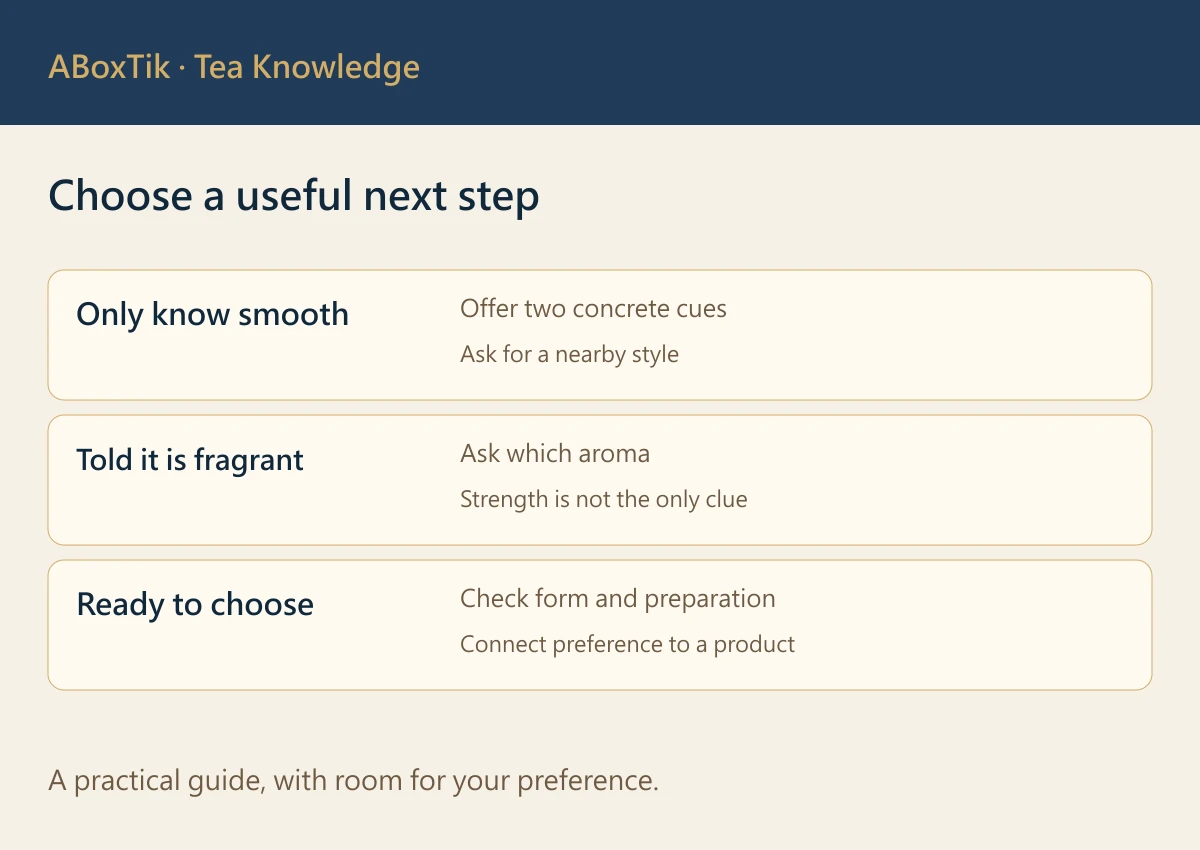
| Preference: personal and revisable | Evidence: checkable for this offering |
|---|---|
| “I find the floral direction relaxing.” | Product name, tea type, listed producer or source, pack size, lot/season if provided. |
| “I do not enjoy a strong roast.” | The retailer’s stated roast or style description; package preparation guidance. |
| “This felt too perfumed for my afternoon.” | Whether the tea is scented or contains added ingredients, where that is stated. |
| “I would buy this again for sharing.” | Price, availability at the time checked, shipping or packaging details where offered. |
Do not turn the left column into proof of origin, cultivar, quality grade, or authenticity. A floral impression cannot authenticate a mountain, and a quiet cup cannot prove that a tea is poor. For origin questions, ask for the producer, source, batch, and supporting information directly. Our Fushoushan tea guide shows why aroma and source information should stay separate.
Compare fairly after the tea arrives
If you buy two candidates, start with each package’s guidance. Use the same cup style, similar water amount, and comparable timing when you compare. The Agriculture Academy describes a consistent preparation framework for sensory evaluation; a kitchen does not need to become a laboratory, but changing leaf amount, water, vessel, and timing all at once makes the result hard to interpret.
Write one sentence per tea: “warmer roast, shorter finish, best for a rainy desk,” or “clear floral lift, preferred after lunch.” Then write one adjustment for next time. That note is more useful to a retailer on your next visit than an anxious search for the one official answer.
Three questions that prevent avoidable disappointment
- “Is this aroma description about the current offering, and what preparation do you suggest first?” It anchors the words to a product and a starting point.
- “Is the tea scented or are these tasting descriptors?” It separates added aroma from an impression used to describe tea.
- “What can I check on the product or package?” It invites information such as tea type, source, lot or season where offered, and preparation guidance.
There is no prize for asking the most complicated question. The best one produces a reply you can use: choose, brew, taste, and remember. Begin with one tea, keep the note small, and let the next purchase be a little more informed than the last.

Related reading and tea choices
Sources
- Agriculture Academy: tea sensory-evaluation competency framework
- TBRS: Taiwan specialty tea flavor wheel
- ISO 3103:2019, preparation of tea liquor for sensory tests
Sources checked 25 October 2026.