
Tea Knowledge
Light vs Roasted Taiwanese Tea: Aroma, Mouthfeel and Food Pairing
Some days call for a clear floral lift; others for the warmth of a little fire. Neither has to be the better choice.
Light vs roasted Taiwanese tea is not a quality test. Begin with the feeling you want: a light-style tea is a helpful starting point when you want floral lift and a brighter, fresher cup; a roast-forward tea may suit a craving for toasted grain, nuts, ripe sweetness and a warmer finish. Then let your meal, brewing strength and own palate decide.
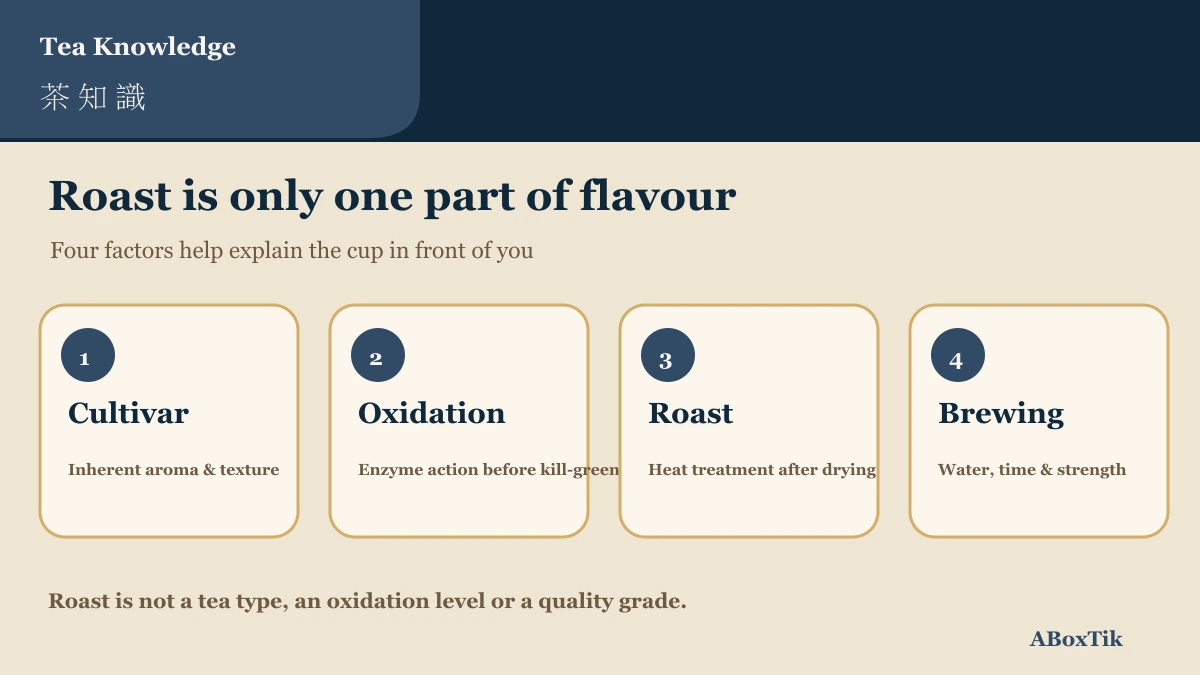
One useful distinction first: roasting is not tea type, oxidation level or a quality score. Cultivar, origin, season, processing, roasting, storage and brewing all shape a cup. This is a sensory guide for choosing a starting point, not a promise about every tea.
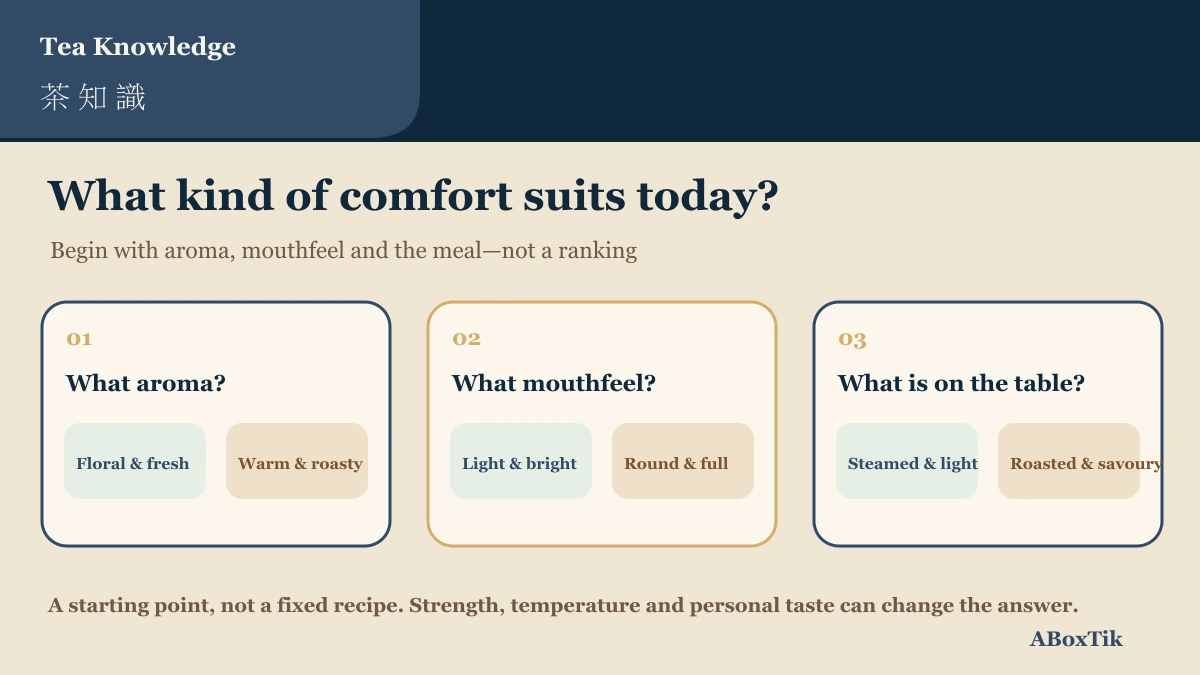
Choose the feeling you want today
| If you want | Start here | Notice in the cup |
|---|---|---|
| Floral lift, fresh green notes and room for food to stay distinct | Light-style or lightly roasted oolong; pouchong | Whether aroma stays clear and the finish feels lively |
| Toasted, nutty, caramel-like or ripe sweet notes; a warmer contour | A roast-forward oolong | Whether roast feels clean and integrated, rather than simply bitter |
| You are unsure | Brew two small cups lightly and side by side | Which one makes you want another sip—not which is “finer” |
The Ministry of Agriculture Tea and Beverage Research Station’s Taiwanese tea flavour wheel gives us words such as floral, fruity, sweet, green, woody and roasted. Think of them as a map for describing a cup, never as a scorecard.
If two people at the table want different things, there is no need to force one “correct” pot. Brew a smaller amount of each style, keep both infusions gentle, and let everyone return to the cup that feels most comfortable. One person may enjoy the floral tea before the meal and the roasted tea with dessert; another may choose the reverse. That flexibility is part of the pleasure. A label can open the conversation, but your second sip is allowed to change the answer. Let the first comparison stay curious, generous and pleasantly unfinished.
Light, roasted, oxidised and tea type are four different things
Light-style and roast-forward describe a sensory direction. Oxidation is a processing change before fixation; roasting is a later heat treatment; tea type describes the overall production method. They can meet in the same cup, but they are not interchangeable.
Two oolongs may taste very different because of cultivar, making and roast. A deeper roast does not automatically mean heavier oxidation. For the process in more detail, see ABoxTik’s oolong oxidation guide.
Pair by sensation, not by a rulebook
| On the table | A gentle first try | A question to ask |
|---|---|---|
| Steamed fish, seafood, tofu, salad or delicate vegetables | A light-style tea, brewed gently | Can you still recognise the food’s own aroma? |
| Roasted vegetables, mushrooms, nuts or baked treats | An oolong with a measured roast | Do the toasted notes sit alongside the food, rather than overwhelm it? |
| Savoury grilled or sauce-rich dishes | A more roast-forward tea with a clear body | Can you still find sweetness after a bite? If not, brew shorter. |
| Fruit or light desserts | Try a light tea and a gentle roast in small cups | Which pairing feels more harmonious to you? |
These are sensory suggestions, not health claims or fixed pairings. Seasoning, heat, tea strength and personal perception all matter. For a barbecue setting, see our tea-and-barbecue planning guide.
Let brewing reveal the style, rather than overwrite it
A light-style tea does not need to be pushed hard to prove it has flavour. Start with enough space for its florals and sweetness to arrive. A roast-forward tea does not need an ever-longer steep to feel substantial either: too much extraction can make its toasted character feel dry, bitter or separate from the tea’s own sweetness. Follow the maker’s brewing guidance first. When you want to experiment, change only one thing—leaf amount, time or water temperature—so your next cup can tell you what actually changed.
It can also help to compare at two temperatures. Take one sip when the tea is comfortably warm, then return when it has cooled slightly. Floral notes may become easier to name later; a roast may settle into sweetness or become more assertive. Neither change is a verdict. It is simply another chance to notice which expression you enjoy with this food, in this moment.
Buying cues that are more useful than a single label
Before choosing, look for the information a producer is willing to share: cultivar, growing area, harvest or lot where available, flavour notes, roast information and storage guidance. A complete description gives you more to work with than “light” or “roasted” alone. If a tasting note says floral, fruity or toasted, take it as an invitation to observe—not a guarantee that your cup will match every word.
For a gift, variety can be kinder than pretending to know another person’s only preference. A small set with distinct directions lets the recipient begin with the cup that feels right, then return to the other one on a different day. That is often a more welcoming introduction to Taiwanese tea than a ranking.
Storage matters after the choice, too. Keep the tea sealed, dry and away from heat and strong odours, then follow the maker’s guidance once opened. If a once-clear floral tea seems flat or a roast tastes harsher than you remember, check storage and brewing before deciding that the whole style is not for you. A fresh packet and a slightly lighter infusion can make the comparison fairer—and kinder to your own palate.
A simple first comparison at home
- Choose two clearly described teas with different directions.
- Use the same cups, water and timing; make the first round light.
- Note “floral/roasted,” “lively/round,” and “would I like another sip?”
- When a cup is too bitter, astringent or hidden by food, change one thing next time—time, leaf amount or temperature.
ABoxTik currently describes its Green Jade Oolong with a delicate jasmine-like fragrance; its Dong Ding Oolong is another place to explore roast-led character. They are discovery prompts, not controlled comparisons; check live product details before purchasing.
Questions about light and roasted Taiwanese tea
Does roast-forward mean heavily oxidised?
No. Oxidation occurs before fixation; roasting is later heat treatment. Both affect flavour, but one cannot be inferred from the other.
Is light tea always delicate and roasted tea always strong?
No. Cultivar, harvest, storage and brewing change the result. Treat those words as a direction to try, not a guarantee.
Is there one correct food pairing?
No. Use these ideas for the first sip, then adjust strength, order or tea style around your actual meal.
Let your preference become a personal tea map
Floral brightness and roasted warmth do not need to compete. Keep a light cup for a quiet lunch, and a warming roast for the end of dinner. When you separate cultivar, oxidation, roast and brewing, choosing tea becomes less about getting the answer right and more about finding what fits this moment.
Related recommendations
Sources
- Tea and Beverage Research Station: Taiwanese tea flavour wheel (accessed 2026-09-23)
- Agricultural Knowledge Portal: Taiwanese tea flavour wheel (accessed 2026-09-23)