
Tea Knowledge
Tea Package Crushed on Delivery? An Arrival Inspection Checklist
A few clear arrival photos and a separate look at the carton and pouch make the next question easier to ask, and the first cup easier to approach.
A dent in the shipping box does not automatically mean the tea inside is damaged. Photograph the carton first, open it carefully, and check the actual tea pouch, original seal and label before opening the tea. If a pouch is torn, wet, open at the seal or otherwise suspect, pause use, keep the packaging and contact the supplier with clear photos. There is no need to squeeze the bag or brew a test cup.
It is natural to want to see the tea as soon as a parcel arrives, especially when it is a gift. Take a quiet moment first: the outer carton and the inner pouch have different jobs, so give each its own look. This practical checklist helps turn an uncertain first impression into observations that are easy to share.
Start with the delivery carton
Place the parcel on a clean, dry surface. Look at each side, the corners, the bottom and the taped opening. Note whether there is a small indentation, a deep crush, a hole, a wet area or staining, and where it appears. A single close-up can be useful, but a wider photograph shows which part of the parcel was affected and how large the area is.
Photograph the whole box and the shipping label, then take close-ups of any damage. Keep the photo date and record the delivery date if it differs. Before sharing an image, cover personal details that the recipient does not need, while keeping enough information to identify the order. If the carton is very wet or open, prevent the contents from touching dirty surfaces and ask the supplier how to proceed.
The outer carton protects the contents during handling. A dent is a reason to look inside, not proof that a tea pouch has failed. Equally, an attractive carton cannot tell you what happened to each pouch. Think of the carton as the travel coat: the tea still deserves its own inspection.
Open the shipping box, not the tea pouch
Cut the shipping tape carefully, keeping scissors or a blade away from the contents. Remove the inner boxes and pouches gently. Keep the carton and cushioning for now, and leave the original tea packaging unopened while you look at it. Check the pouch faces and corners for holes, tears, wet marks or escaped tea. Look at the original heat seal or other factory closure for visible separation or a split.
Turn the pouch to see its reverse and edges without pressing it. Do not squeeze it to listen for air or pull at the seal to test its strength. A fold in packaging is different from a visible tear or an opening with tea coming out; if the area is difficult to read, photograph it and ask. A visual check is useful for noticing a concern, but it cannot establish that every part of a seal is sound.
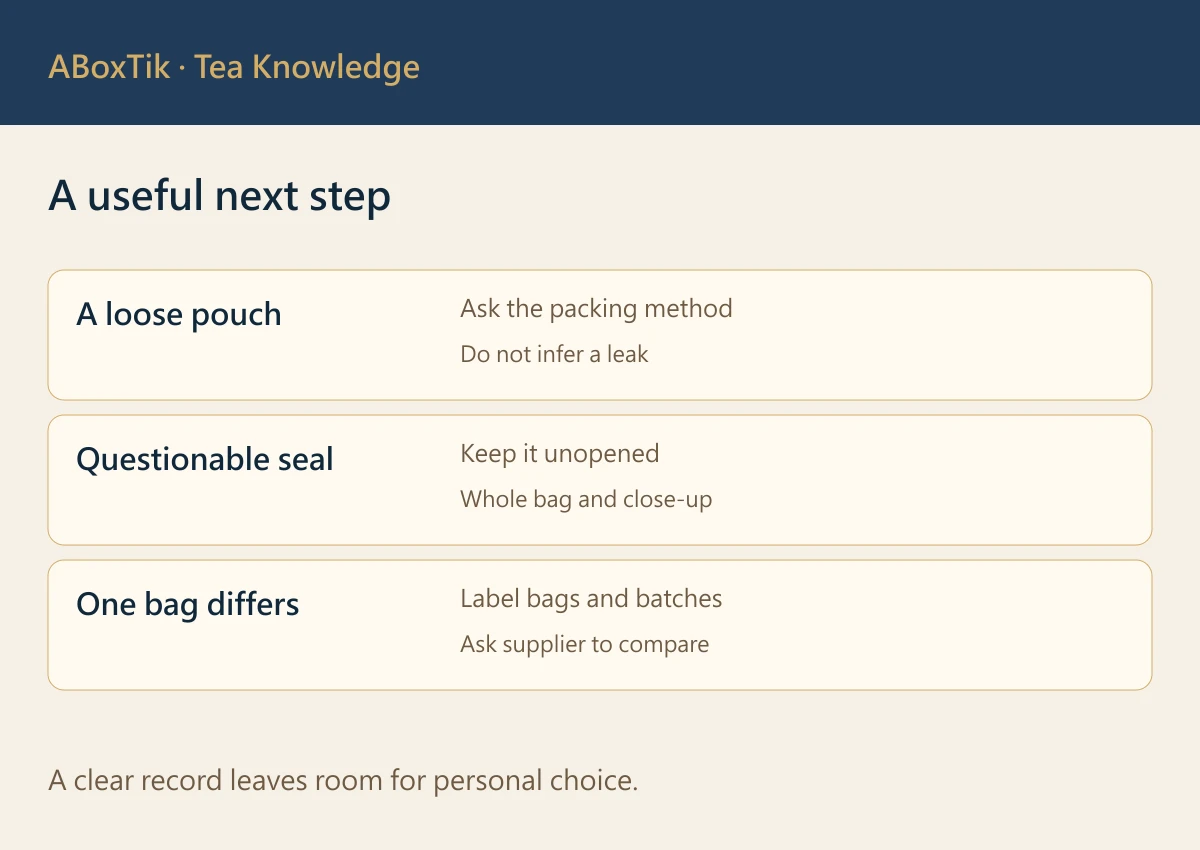
Not every legitimate tea pouch is vacuum packed. A pouch with some space inside, or one that does not cling tightly to the tea, is not by itself evidence of a leak. A tight-looking bag is not proof of an intact seal either. If the expected format is unclear, check the product information and ask the supplier with a photo rather than judging by shape alone.
A simple arrival inspection card
| Where to look | What to record | Next step |
|---|---|---|
| Shipping carton | Location and extent of dents, holes or moisture | Photograph the whole box and details; inspect the layers inside |
| Inner box and cushioning | Movement, damage or wet areas | Keep the materials and note their position beside the tea |
| Tea pouch | Holes, tears, dampness or loose tea | Pause use if concerned; photograph and contact the supplier |
| Original closure | Visible splitting or separation at the seal | Leave it as found; do not press or pull it |
| Label and order | Product name, quantity, date and available lot information | Compare with the order and keep legible photos |
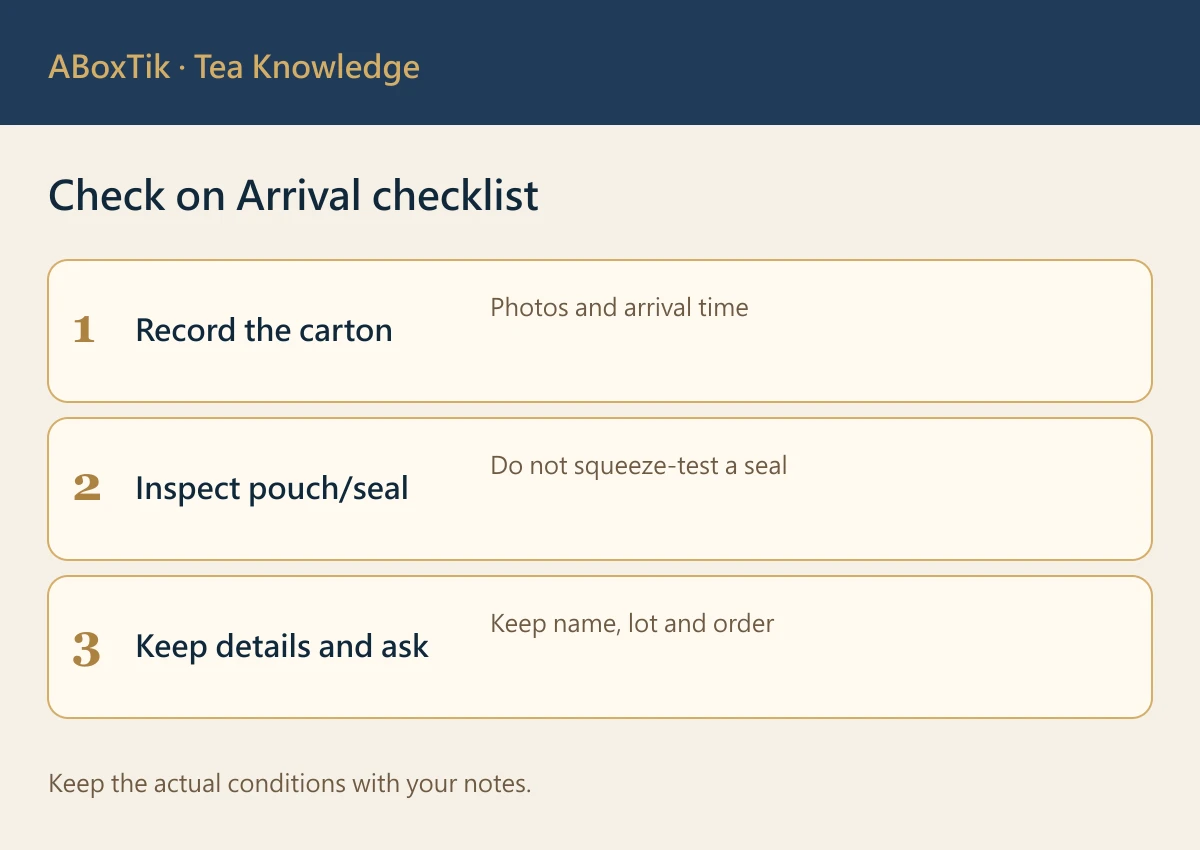
The card is a way to organize observations and a conversation, not a package-integrity test. “Not sure” is a useful entry. When several pouches are in the same box, give each one a simple identifier in your notes so that both parties know which photo shows which item. A small piece of paper beside a pouch can help, provided it does not cover the area being photographed.
When to pause and what to keep
If the tea pouch has a hole, an obviously open seal, exposed contents, moisture damage or another sign that makes its condition uncertain, do not use or brew it while seeking guidance. Set the questionable package apart from other dry items to avoid spreading contamination. If you see what may be mold, do not smell it again or brew and taste it to investigate. Preserve the situation and ask the supplier how to handle it.
The U.S. Food and Drug Administration advises consumers against buying sealed food packages that are torn, punctured, separating at the seams or leaking. When a delivered package has a similar visible problem, pausing use and asking for assistance is a practical next step. A photograph can show what was observed; it cannot, on its own, establish the quality or safety of the tea.
Keep the product name, order number, delivery date, quantity and any lot or batch information printed on the package. If part of a number is obscured, photograph what is legible rather than filling in the missing characters. Retain the carton, padding, inner box and pouch in a dry place while you ask whether they are needed for review. Do not repair a tear before photographing it or transfer questionable tea to another container: either step can make the original condition harder to explain.
A hypothetical example: one dented corner, two pouches
Imagine a parcel arrives with its lower right corner visibly crushed. The recipient photographs the whole box, the label and the corner, then opens the top carefully. An inner box has a compressed corner. Both tea pouches appear dry, but one has a fold near its seal that is difficult to interpret. The exercise is to connect the carton location with the condition of the pouch inside.
Instead of pressing the fold or making a trial brew, the recipient photographs the pouches in place, takes a closer picture of the fold and records the lot information. They identify the pouch with the question and contact the supplier. The other pouch looks normal, but the recipient keeps the set and its packaging together while awaiting instructions. The dent is an observation; whether that fold affects the seal is a separate question.
If the carton has only a minor dent and the pouches, closures and labels show no obvious issue, follow the product’s storage directions. If a question remains, ask before opening. For a gift, the appearance of the presentation box may also matter to the giver; discuss that separately from the condition of the food pouch so each concern can be understood clearly.
Make the supplier message easy to answer
Try one concise message: “Hello, order number __ arrived on __. The outer carton has __ at __, and I noticed __ on the tea pouch. The lot number is __. I have attached an overview of the box, detail photos and the label. Could you advise the next step and whether you need anything else retained?” Describe what you can see and leave the cause open if it is unknown.
For an order containing several items, list their names and quantities and identify the pouch in question. Arrange pictures in order: carton, inner box, pouch and label. This gives the supplier context without making anyone play a guessing game with a camera roll. Ask the seller and, where appropriate, the carrier about the particular order’s handling arrangements; keep the record without assuming who is responsible or what the outcome will be.
Keep the response alongside the original photos and note the agreed next action. If the supplier asks to examine or receive the items, follow their instructions for retaining and handing over the packaging. A useful follow-up question is simply, “Which materials should I keep?” The answer can save an unnecessary second search through the recycling bin.
Once the pouch is ready to store
When no further handling is needed, follow the product’s storage instructions and choose a dry place away from light, heat and strong odors. For the background to dry tea and its packaging, see our guide to tea drying and packaging background; for the wider storage setting, explore how to store tea. Our tea price and specification guide helps with the earlier task of comparing a product page and its specifications.
At the next delivery, ask three questions: What should I record on the carton? What can I see on the tea pouch and original closure? Can I match the label to the order? Keep those answers in a note or a few photographs, then choose the next step at an unhurried pace. If you are choosing flavors for everyday tea or sharing, explore the four-tea Taiwanese gift set and find a comfortable place to begin.
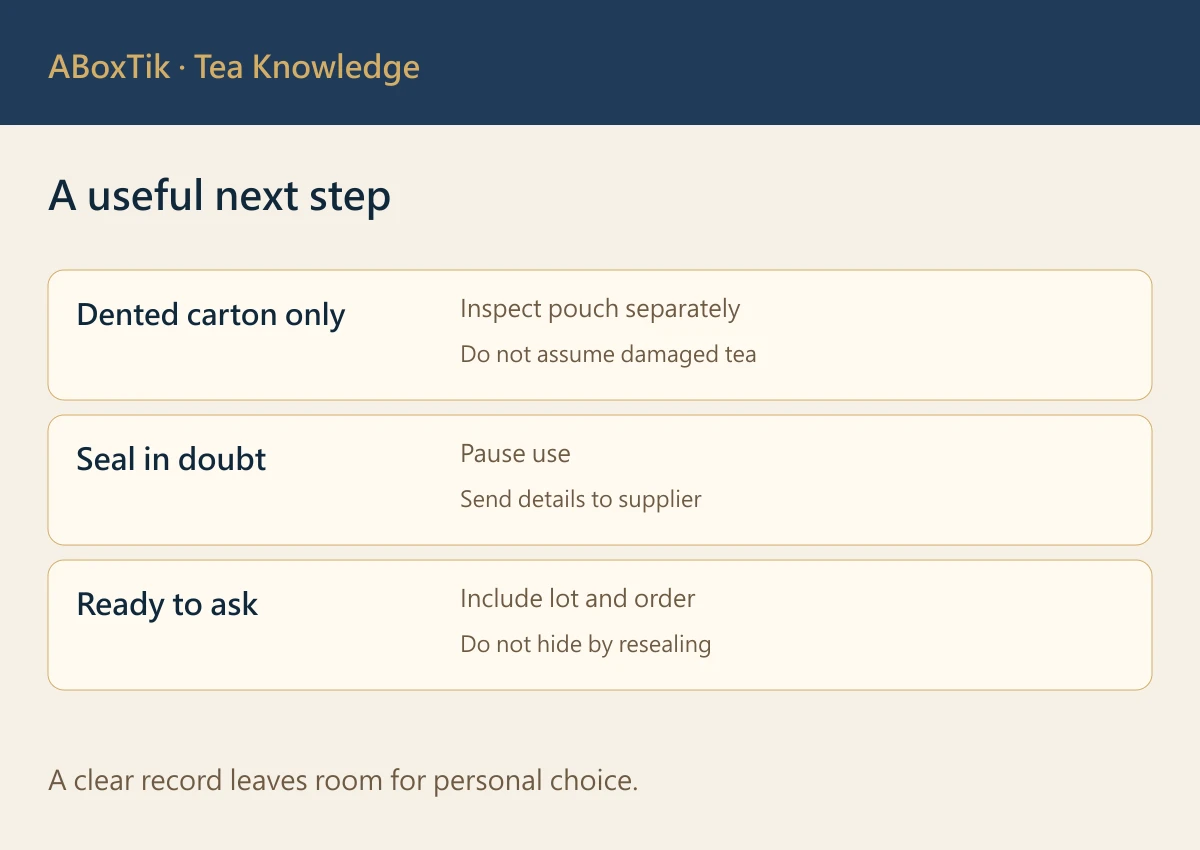
Two bags look different? Compare them on one sheet
If two bags in the same box look different, label them A and B. Put their visible appearance and package information side by side, then ask the supplier about the packing method and expected appearance. There is no prize for the tightest-looking bag; the comparison simply makes the question easier to answer.
| Question | Bag A | Bag B |
|---|---|---|
| Product and batch | ____ | ____ |
| Appearance and labelled packing method | ____ | ____ |
| Supplier reply and next step | ____ | ____ |
Attach a matching photo of each and ask: “Were these packed the same way, and what should I do about the difference I can see?” Keep the response date with the bag labels so everyone can follow the same conversation.

Related reading and tea choices
Sources
- U.S. Food and Drug Administration: Surplus, Salvaged, and Donated Foods, accessed October 27, 2026.