
Boutiques, Tea Knowledge
When to Order Corporate Mid-Autumn Gift Boxes: A 6–8 Week Plan

A seasonal gift begins with its arrival date: each name, proof and parcel deserves enough room to be handled well.
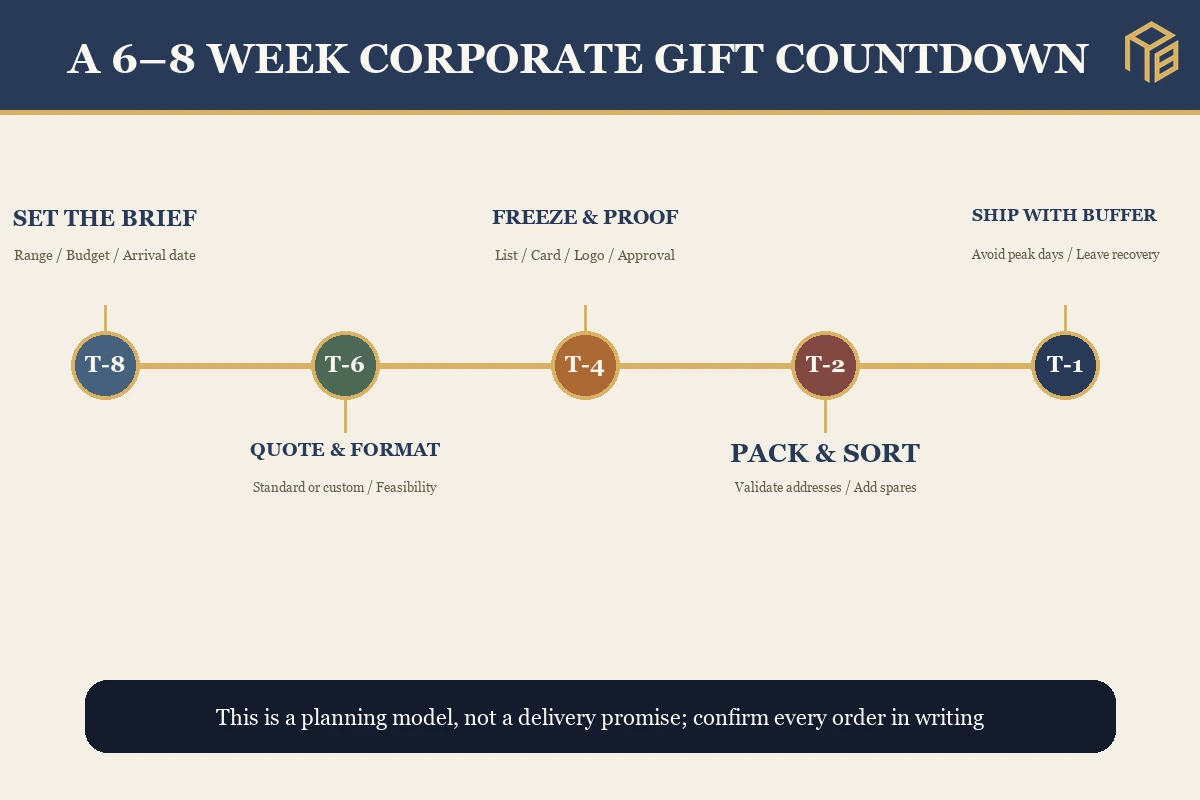
Corporate Mid-Autumn gift boxes are best planned backwards from the requested arrival date, with a 6–8 week working window. First stabilise recipients and destinations; then confirm a standard or customised route, artwork approval, packing and delivery groups. Six weeks can be a useful planning starting point for a standard, single-destination project once availability and handover have been confirmed. Use eight weeks or more for custom work, many addresses, remote/offshore destinations or cross-border questions. This is a planning model—not a promise of ABoxTik stock, MOQ, price, production lead time or delivery coverage.
In Taiwan, Mid-Autumn Festival falls on 25 September in 2026. The late-stage problem is often not selecting tea; it is discovering that a recipient list is still moving, a card is unapproved, or different destinations cannot follow one dispatch rhythm. For tea selection and seasonal hosting, read the Mid-Autumn tea gift-box guide. For per-gift budget and quotation inputs, see corporate tea gift budgets. This article is about a controlled arrival plan.
Corporate Mid-Autumn gift boxes: work backwards 6–8 weeks
| Countdown | Decision | Output |
|---|---|---|
| Weeks 8–7 | Arrival date, recipient tiers, destination types | One versioned list, flagged single-point/multi-address/remote/cross-border |
| Week 6 | Standard or customised route; tea direction and availability | Written feasibility or quotation—not an old screen shot |
| Weeks 5–4 | Freeze count, card copy, logo file and address format | Proof-ready file and one final approver |
| Week 3 | Approve proof, pack and group deliveries | Dispatch list, contingency rule and owner |
| Weeks 2–1 | Meet carrier cut-offs and handle exceptions | Tracking and exception list |
Chunghwa Post’s public domestic-parcel table is a useful risk signal, not a carrier SLA for this project: it lists local delivery normally on day two, other areas on day two or three, and remote/offshore areas normally in 3–5 working days. It also notes that holidays, weather and transport can delay delivery, and asks customers to post time-sensitive parcels early before Mid-Autumn Festival or consider express service. Reconfirm every carrier, address and seasonal cut-off before making a date commitment.
Build a quote brief that exposes assumptions
A useful quotation request describes the decision that still has to be made, rather than implying that every variable is settled. State the desired arrival date, estimated and committed recipient counts, destination split, intended gift format, standard or branded presentation, and a contact who can answer questions promptly.
Also record the assumptions beside the quote: product configuration, personalised names, proof-required card or sleeve, expected delivery groups, and responsibility for taxes, documents or receiving arrangements. If an assumption changes, reopen the affected date. The premium gift-box collection can help discover formats, but a product page is not a stock reservation or logistics commitment.
When should quantity and the recipient list freeze?
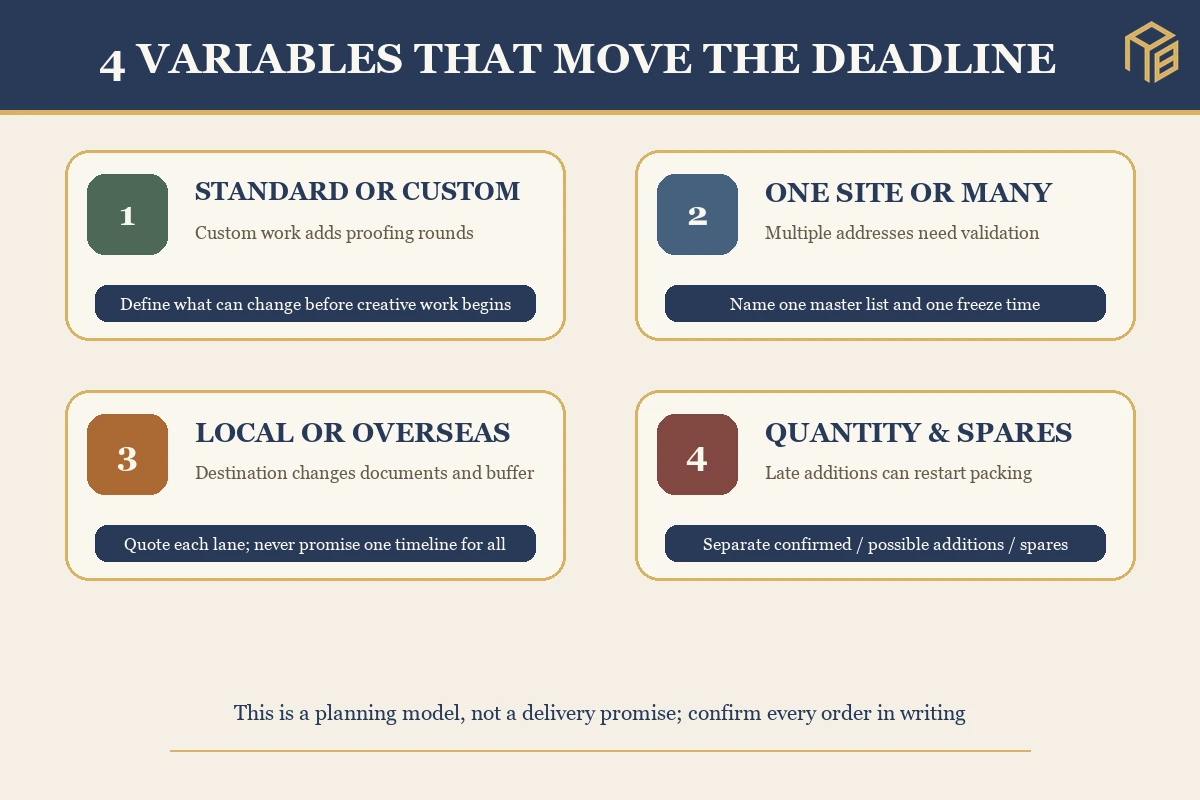
Quantity is not one number. Separate fixed recipients, destinations and salutations from variable approved alternates, internal reserves and re-send cases. Before a proof is made, a multi-address project needs postcode, recipient, phone, delivery window and company/residential fields. Do not let address collection begin after design approval.
- Name one list owner and one final approver.
- Group addresses as standard, remote/offshore, or cross-border pending confirmation.
- Approve any spare allocation openly; it is a risk provision, not a hidden add-on.
Set an address-freeze date that precedes the carrier handoff—not merely the requested arrival date. After that point, collect corrections in a small exception log rather than overwriting the approved list. The log can record the recipient, the field that changed, when it changed, the owner, whether the label is already produced, and the agreed next action. This creates a visible choice between correcting a parcel before dispatch, re-routing through the carrier where available, or treating it as a possible re-send. It does not assume any particular carrier feature is available.
For format context, explore the two-tea-bag gift set, four-tea classic Taiwan tea set and four-tea gift box. Product content, availability and delivery conditions must always be checked live.
Standard or customised: decide by the last safe change date
A standard route concentrates decisions on an existing combination and packaging; it is useful when time is short or variability must be reduced. A customised route may add a card, sleeve, sticker, bag or tailored contents. It also adds asset collection, proofreading, proof approval and possible rework. Ask not only “Can this be customised?” but also when assets are due, when the proof must be approved, and what becomes unchangeable afterwards.
For the storytelling side of a gift, see the limited-edition tea-box perspective; for a festival project, protect the time needed to arrive well.
Proof approval should have a clear owner. The person who supplies a logo or writes a message may not be the person authorised to approve it for the organisation. Before a proof is circulated, identify one decision-maker, a backup contact, the response deadline and the exact version to approve. Ask reviewers to check spelling, language, recipient-facing names, product description and brand asset usage in the same pass. Comments from several people are useful input; a single recorded approval is the gate that prevents contradictory last-minute instructions.
Proof, packing and dispatch are three separate gates
- Proof: verify copy, language, names, logo, colour and product names from one versioned file.
- Packing: verify gift box, bag, outer carton, protection and label format; presentation packaging and transit packaging do different jobs.
- Dispatch: group destinations first, then confirm acceptance date, cut-off, receiving restrictions and escalation contact.
A single-site handoff is usually simpler because one receiving contact, venue window and carton count can be confirmed together. It still needs a plan for where cartons are received, checked and distributed after arrival. A multi-address handoff is a different project: each label becomes a recipient-data dependency, and the dispatch file should be reconciled against the frozen list before labels are produced. Keep the two streams separate in the plan even when the gifts are identical; combining them only because the contents match can hide different delivery risks.
For office-friendly sharing, read about pyramid tea bags. Add useful discovery links such as what makes Taiwanese tea distinctive, the Taiwan tea regions guide and tea as a gift; they do not replace operational confirmation.
Multi-address, offshore and cross-border destinations need different queues
Test the data and labels for multi-address delivery. Check service days, weather and trans-shipment separately for remote or offshore areas. For another country, first confirm destination eligibility, product/ingredient documentation, required paperwork, tax responsibility, carrier options and local holidays. An unconfirmed address stays in a “pending” group; it must not be described as deliverable or same-day. Share the target arrival date, count, geographic split and custom needs through Contact ABoxTik to request project-specific feasibility.
For cross-border gifting, the destination itself is part of the brief. Requirements can vary by country or territory, product composition, service selected and rules in force at dispatch. Verify destination-specific eligibility and documents before including an address in the committed count; a prior shipment does not prove the same route is currently available. Keep overseas recipients on a separate confirmation track and communicate only confirmed status.
Corporate Mid-Autumn gift-box FAQ
What is the latest I should order?
Work backwards 6–8 weeks. Six weeks is a planning starting point for a confirmed standard single-destination order; start at eight weeks or more for custom, multi-address, offshore or cross-border work. Written project confirmation governs the actual timeline.
Can we start before the recipient list is final?
You can prepare tiers, product direction and an address template, but do not treat a moving count as a committed delivery count. Set a change deadline and alternate-recipient rule first.
Can overseas addresses use the Taiwan schedule?
No. They require their own destination, documentation, carrier and timing checks. Until those are confirmed, neither availability nor an arrival date should be promised.

Follow ABoxTik
Turn seasonal pressure into a confirmed arrival plan
A corporate gift is thoughtful not only because of the tea inside, but because each recipient receives a properly checked name, package and timing. Fix the arrival date, freeze the list, separate custom work from delivery risk and keep unknowns visible until they are confirmed. Discover the brand perspective at About ABoxTik.
Sources
- DGPA: 2026 government work calendar (checked 2026-08-31)
- Chunghwa Post: domestic parcel delivery-time table (checked 2026-08-31)