
Tea Knowledge
How to Read Taiwan Tea Traceability: TAP, QR Codes and Origin Marks
A mark is not a blanket promise. Read the package, the record and the source together.
Taiwan tea traceability is easier to understand when three different systems are kept separate. TAP is a third-party verification system. A domestic tea traceability QR code is a registration and labelling route. An origin certification mark or collective mark follows its own trademark rules for geographic origin. Each can be useful; none automatically proves every quality or safety conclusion a shopper may hope to draw.
For the flavour context behind a place name, begin with our Taiwan tea regions guide. This article is a practical companion: how to identify the system on a pack, enter the correct official site, and read what a record does—and does not—say.
Three labels, three questions
| Label | What it is for | What it does not establish on its own |
|---|---|---|
| TAP traceability | A product verified against the current traceability system and standards. | A blanket pesticide or safety claim, permanent equivalence across lots, or superior taste. |
| Domestic tea traceability QR | A regulated route to trace the applicant or labelling responsible party and product information. | TAP third-party verification or testing of each individual lot. |
| Origin certification / collective mark | Geographic origin and characteristics defined by that mark’s rules. | A substitute for TAP, organic verification, or domestic-tea traceability labelling. |
For Taiwan-origin tea produced from 1 January 2023 onward, the legal traceability route is one of three: TAP, organic verification, or the traceability QR route. That does not mean every pack must carry a general QR code, nor that every producer must apply for TAP.
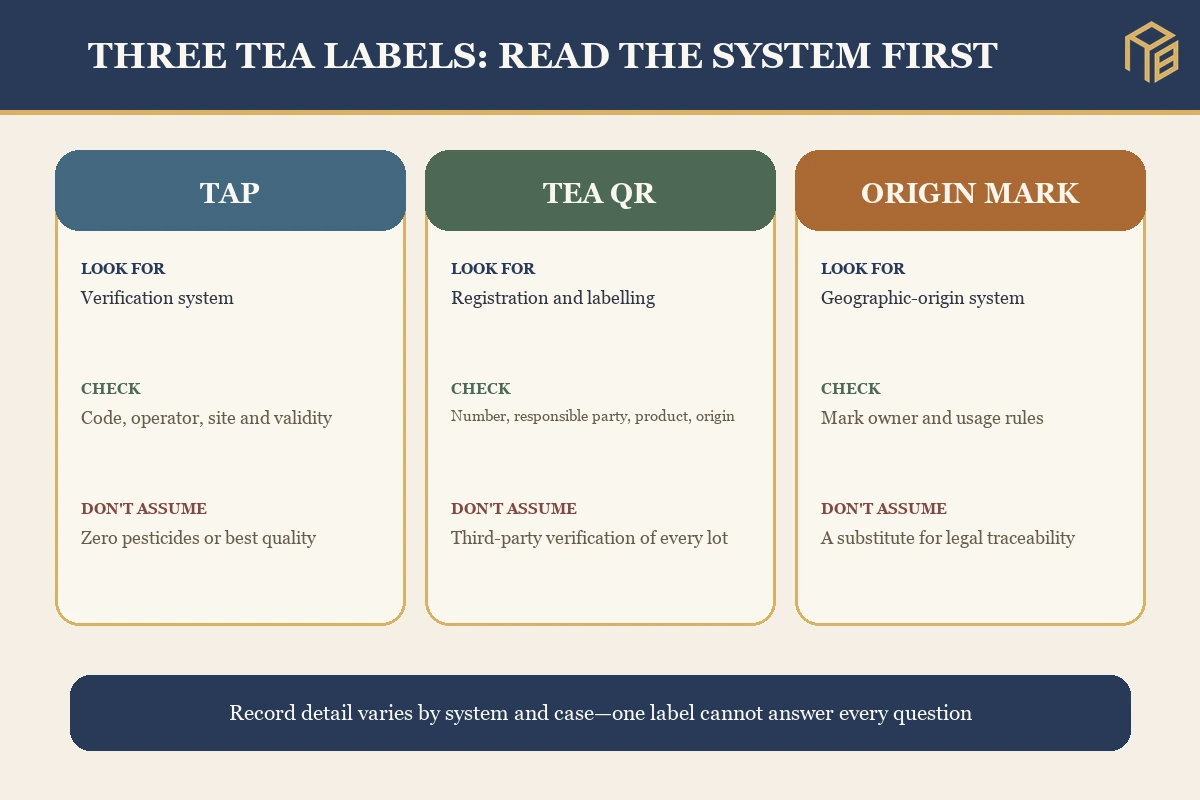
For TAP, verify the record—not just the mark
TAP is a product verification system. Start at the official TAP information site, then match the code on the page to the package. Check the product name, agricultural operator, production site, main operations and dates, verification body, and verification validity period. Some records show more fields, such as packing date or detailed process information; page detail can vary by case.
The system offers a traceable, checkable framework. It should not be expanded into a blanket pesticide, safety or fixed-flavour claim. Tea processing and sensory character deserve their own evidence—our guide to oolong oxidation is a useful place to begin.
For a domestic tea QR, identify the responsible party first
A domestic tea QR code is not another name for TAP. On the official traceability system, first match the tracking number and product. Then read the applicant or labelling responsible party, contact details and origin information. A company or tea shop shown on a page is not automatically the grower; treat it as the responsible party unless the record separately identifies a producer.
Lot details, packing dates and test information may appear depending on the record. If testing is listed, ask who supplied it—government sampling, rapid mass-spectrometry screening, or business-uploaded material—and compare the sample, date and test items with the tea in hand. One report is evidence for its stated sample, not every future or brand-wide lot.
Origin marks: useful provenance, different legal role
Origin certification marks and collective marks operate under trademark rules. They may establish a defined geographic origin and the characteristics set out in their own rules. They cannot replace the three legal traceability routes for domestic tea. A mountain name, a regional claim or a brand-made map should not be promoted to an official mark without evidence.
For shoppers outside Taiwan, the most reliable approach is to preserve the official field names while translating their meaning. A result labelled as the agricultural operator, applicant or responsible labelling party should stay in that role; it should not be casually translated as “tea farmer.” Likewise, a verification validity period belongs to the listed TAP record, while a packing date belongs to a particular product entry. If automatic translation makes a field unclear, compare the tracking number and product name first, keep a screenshot of the package and result, and ask the seller a specific question. This is especially useful when a gift box contains several teas, when a retailer packs leaves produced elsewhere, or when an older package design points to a record that has since changed. Traceability works best as a careful match between a physical package and an official record, not as a shortcut from one logo to a broad claim about origin, safety or taste.
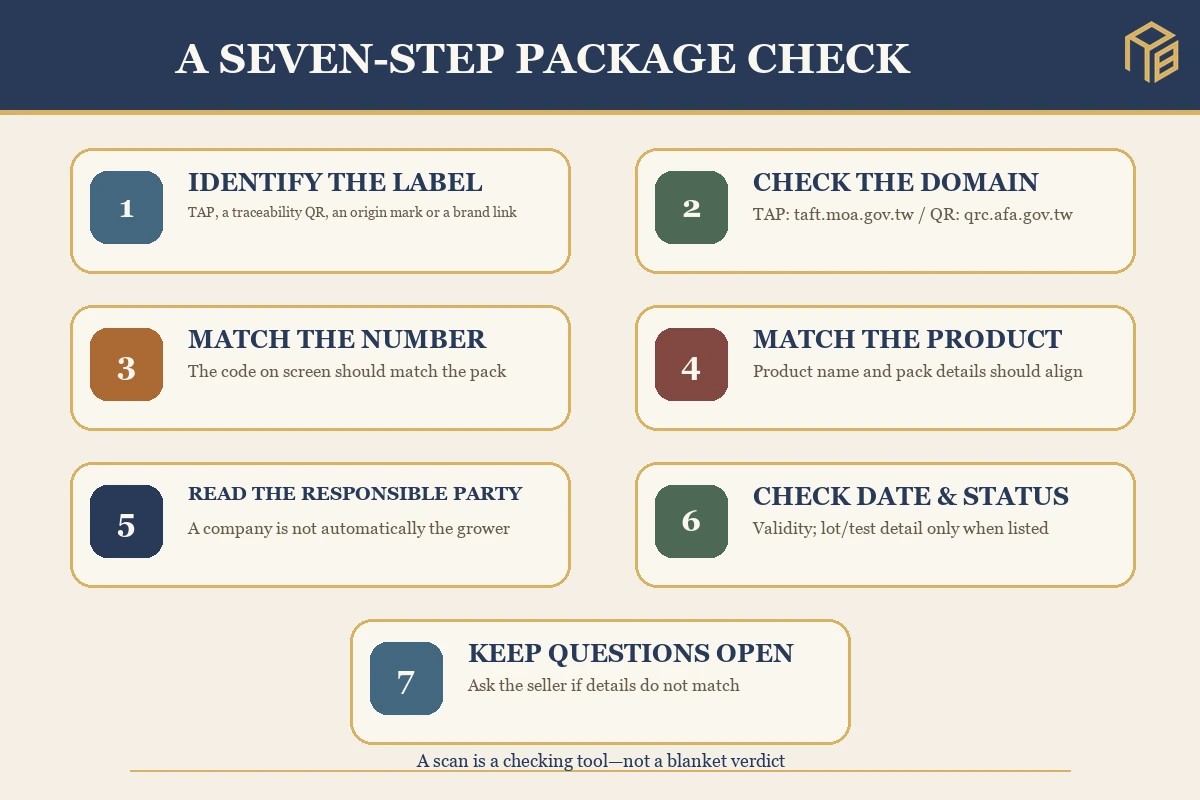
A seven-step package check
- Identify the label: TAP, traceability QR, origin mark, or a brand link.
- Check the domain: TAP uses
taft.moa.gov.tw; general traceability usesqrc.afa.gov.tw. - Match the tracking number.
- Match the product name and pack details.
- Read the operator or responsible party without assuming it is the grower.
- For TAP, check validity and process fields; for a QR record, see whether lot or test information is actually listed.
- If a page will not load or details do not match, ask the seller before reaching a conclusion.
Use the record as a match, not a shortcut
Before scanning, photograph or note the product name, weight, tracking number, pack date and the name printed on the package. This makes it much easier to spot whether a result belongs to the tea in hand rather than to a similarly named item, another format or an earlier package version. A tea company may be responsible for packing, labelling or the finished retail product; that role is meaningful, but it is not automatically a statement about who grew the leaf.
When a page includes a test document, read its scope before treating it as purchasing advice. Ask whether it came from government sampling, rapid screening or a business upload; then compare the sample name, date and items with your package. If lot or testing fields are absent, the precise conclusion is simply that the current record does not display them. It is better to ask the seller a concrete question than to supply a reassuring or alarming story on the record’s behalf.
Tea traceability and tea appreciation answer different questions. Records help you describe the product responsibly; brewing, aroma and texture help you decide whether you enjoy it. For sensory context, explore our tea aroma guide, oolong oxidation guide, Taiwan tea regions guide and Alishan regions comparison.
A clear introduction to Taiwan tea
When sharing tea with a friend overseas, a modest explanation travels well: name the tea, explain its region at the level you can support, offer a brewing suggestion, and point to any traceability information without overstating it. That approach leaves room for curiosity. It also distinguishes a legal or administrative record from a taste promise, a rarity claim or a claim about one grower.
For practical formats, compare the Classic Taiwan Tea Set, the two-piece tea-bag gift set, the four-tea selection, and our tea collection. Their product pages are useful for choosing a format; official systems remain the source for the status of a traceability or verification record.

Tea, one box at a time
Clear information makes a better introduction
At ABoxTik, premium tea is best introduced with proportion: where it comes from, who is responsible for it, which details can be checked, and which claims should remain unmade. If you are sharing Taiwan tea with someone new to it, explore the Classic Taiwan Tea Set or our brand story.
Sources
- Ministry of Agriculture: Agricultural Production and Certification Act (checked 2026-09-01)
- Ministry of Agriculture: Traceability Verification Standards (checked 2026-09-01)
- TAP Information Platform (checked 2026-09-01)
- Requirements for Taiwan-origin tea traceability (checked 2026-09-01)
- Agriculture and Food Agency traceability FAQ (checked 2026-09-01)