
Tea Knowledge
Sustainable Corporate Gifts: A Local Sourcing and Packaging Checklist
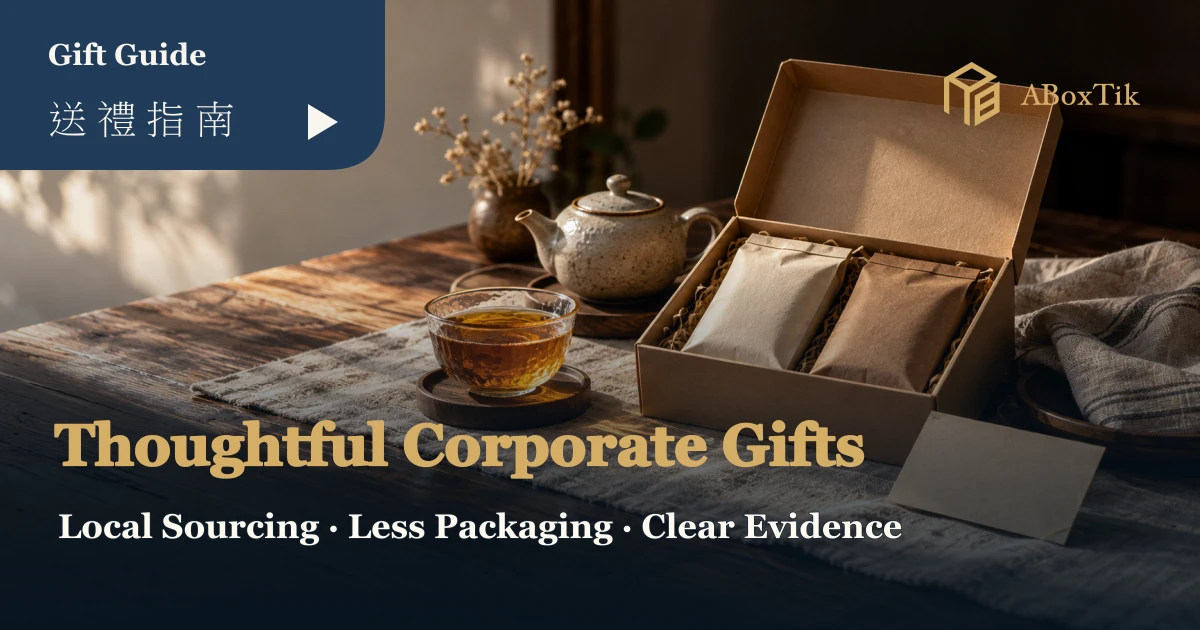
A responsible gift does not hurry to pin a green badge on itself. It begins by explaining where it came from, what surrounds it and how it will arrive.
Sustainable corporate gifts are easier to choose in three steps: define what “local” and “reduced packaging” mean for this project, request evidence for each claim, and compare every option within the same boundary. Taiwanese tea, paper packaging and recyclable materials can all be relevant. The useful procurement record, however, is specific: origin, supplier location, packaging components, materials, label scope, quantity and delivery method.
This approach does not make a gift less warm. It gives the gesture a story that colleagues and recipients can understand without asking a leaf icon to do all the talking. For the wider questions of usefulness, quality, personalisation and brand fit, begin with ABoxTik’s corporate gift selection guide. This article takes a narrower path through environmental sourcing claims and the evidence behind them.
What should a sustainable corporate gift brief check first?
“We would like a more sustainable gift box” is a reasonable opening, but it is not yet a comparable specification. Turn it into four questions. Does local refer to the tea origin, the packaging supplier, final assembly or all three? Does reduction mean one fewer layer, a smaller box, less printing or no unnecessary add-on? Which component carries a certification claim? How will the recipient open, brew, share and sort the packaging?
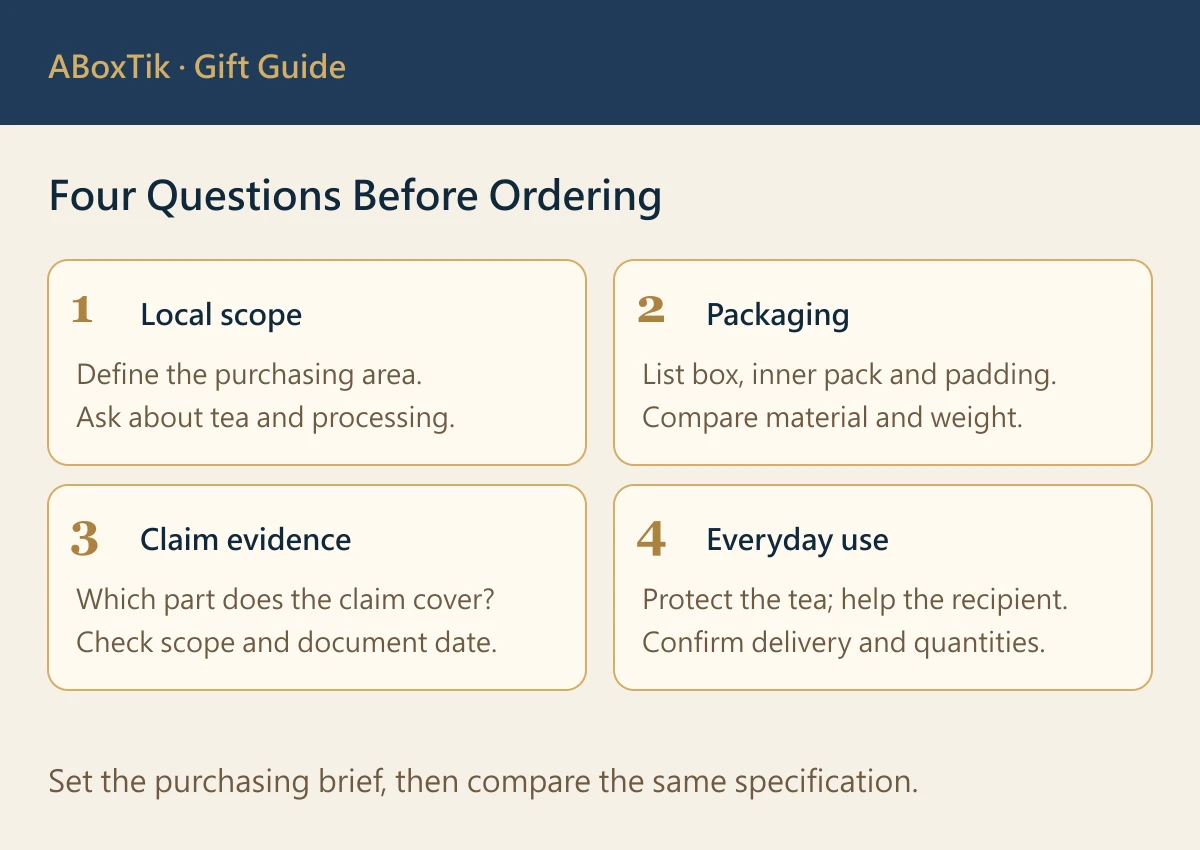
| Area | Question for the supplier | Evidence to retain |
|---|---|---|
| Local boundary and origin | Which geography applies? Where are the tea, box, printing and assembly sourced? | Product labels, supplier address, purchase documents and source records |
| Packaging parts and materials | What are the box, insert, sleeve, card, bag, cushioning and shipping carton made from? | Component list, specifications, sample and version date |
| Claim scope and evidence | Which component does an FSC, recycled-content or recyclability statement cover? | Label type, licence code, supplier documentation or test information |
| Delivery and use | Is delivery to one site or many? Which extra materials are genuinely needed? | Address count, carton plan, arrival requirements and spare-gift policy |
Each part can connect to an existing task. Keep costs in the corporate tea gift budget, quantities in the master-list and spare-quantity plan, and artwork approvals in the custom gift-box timeline. One question per sheet is often calmer than adding “FINAL-final-please-use-this-one” to another filename.
How should “local sourcing” be defined? Use the boundary logic in GRI 204-1
GRI Disclosure 204-1 asks a reporting organisation to disclose the proportion of procurement spending at significant locations of operation that is spent on suppliers local to those locations. It also asks the organisation to state its geographical definition of “local” and its definition of significant locations of operation. That detail matters: a company using the whole of Taiwan as its boundary is reporting something different from one using the county around a particular office.
A gift project can borrow this discipline. Write the geographic boundary in the brief, then record the tea origin, packaging or print supplier, assembly location and delivery destination separately. If the requirement is Taiwanese-grown tea, say exactly that. It should not quietly become “every part of this gift is locally sourced.” If the organisation needs a spending measure, apply its established reporting boundary and a consistent financial basis, such as the invoices or commitments identified in the GRI guidance.
A single gift order can contribute project data; it does not establish an organisation-wide GRI 204-1 result. Procurement, Finance and Sustainability teams should agree on the period, operating locations, supplier tier and treatment of design, freight and printing before calculating a percentage. Boundaries are less glamorous than ribbons, but they are considerably better at surviving a review meeting.
How can the origin of Taiwanese tea be checked?
Begin with the selected tea, not a general brand story. Check the product name, ingredients, origin statement, responsible business, quantity, storage information and brewing directions. If the procurement file needs more detail, ask for records that correspond to the actual product or batch. ABoxTik’s guide to Taiwan tea traceability, QR codes and origin marks explains the different systems and why a lookup result should be matched to the pack in hand.
“Tea grown in Taiwan,” “packed in Taiwan” and “purchased from a Taiwanese company” answer three different questions. A card can use the part that has been verified and is useful to the recipient, such as the origin and flavour of the teas in the box. For broader context, link to the terroir, cultivars and craft behind Taiwanese tea rather than squeezing several mountain ranges into a card that also needs brewing instructions.
For format planning, the two-selection tea-bag gift box and four-selection classic Taiwanese tea box offer useful starting points for discussing group size and flavour variety. Confirm the chosen tea, origin, contents, packaging, availability and project terms at the time of enquiry.
What does packaging reduction look like in practice?
The US Environmental Protection Agency’s waste-management hierarchy places source reduction and reuse ahead of recycling. For a gift project, that means removing a layer with no protective, information or delivery purpose before debating its recyclability. It can also mean right-sizing the box around the contents, considering reuse only where a recipient is likely to have a real second use, and then checking how the remaining materials are handled where the gift will be received.
- Ask what can be omitted: Is there a duplicate card, plastic sleeve, decorative filler or add-on that serves no clear purpose?
- Ask what can be smaller: Can the box and shipping carton reduce empty space while still protecting sealed tea?
- Ask whether reuse is plausible: Does the box have a practical storage role, or only a poetic “second life” in the copy?
- Then check sorting: Identify film, magnets, foam, coatings and adhesives instead of calling a mixed package simply “paper”.
Taiwan’s Ministry of Environment also offers a compact gift-box principle: more product, less packaging material, fewer material types and less printing. It is a useful design conversation, while product-specific obligations remain a matter for the supplier and the organisation’s compliance team. If a logo, sleeve or card is required, the guide to company branding on tea gifts helps assign each item a job rather than making every surface report for duty.
What does an FSC label cover on a gift box?
FSC chain of custody tracks forest-based material through the supply chain. FSC on-product labels include FSC 100%, FSC Mix and FSC Recycled, and each communicates a different material claim. A buyer should read the complete label and licence code, verify the status of the final-product supplier, and ask whether the label applies to the outer box, card, sleeve or another paper component.
| Information available | What it can support | What it does not establish |
|---|---|---|
| FSC 100%, Mix or Recycled label | The specific FSC claim for the labelled forest-based material or product | FSC certification of the tea or every part of the gift |
| Supplier certificate and licence code | Verification of the supplier and authorised trademark use within its scope | Automatic coverage for unlisted components |
| Paper-box recycling instruction | Material, coating and disassembly conditions for that component | Collection in every recipient location or a measured carbon reduction |
If a supplier replies, “We can use FSC paper,” three gentle follow-ups usually clarify the matter: Which label type? On which finished component? Which certified supplier will produce and approve the label? Clear questions protect both parties from an awkward reprint, and the FSC logo can remain a controlled mark rather than being invited to decorate the artwork.
How do you compare two corporate tea gift proposals fairly?
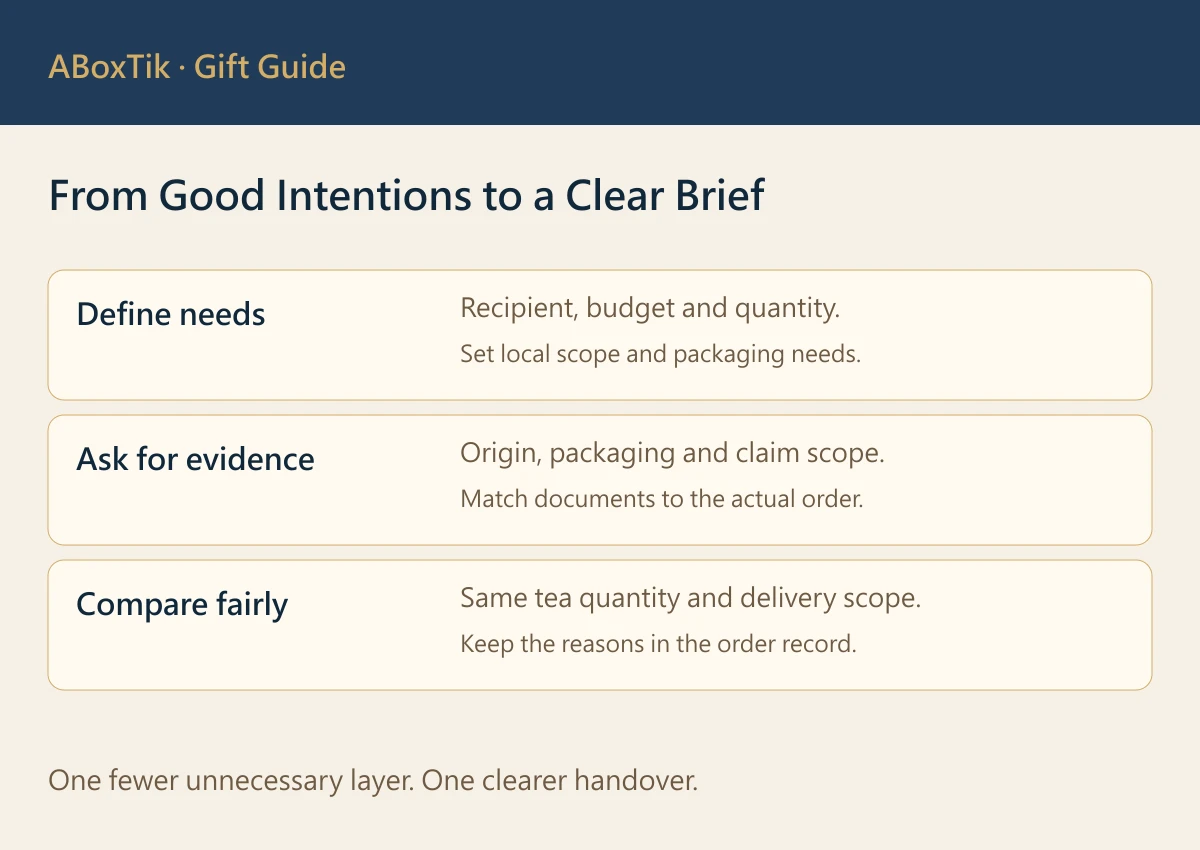
First, define the need. Record the purpose, recipient group, quantity, budget and desired arrival date. Select one or two improvements that matter for this project, such as removing an unnecessary presentation layer, using paper with a documented claim, or improving the traceability of the Taiwanese tea. A gift box does not need to carry the entire sustainability report on its shoulders.
Second, request evidence. Ask for the tea origin, direct-supplier location, packaging bill of materials, confirmed and spare quantities, label scope, shipping carton and address count. For any weight, recycled-content or environmental figure, record the method, period, responsible party and products covered.
Third, compare like with like. If proposal A reports only presentation-packaging weight while proposal B includes the transport carton and cushioning, the figures are not yet comparable. Mark the missing field as pending instead of filling it with an assumption. Delivery dependencies can be mapped through the customisation confirmation chain; multi-address or international deliveries need their own checks.
What should an enquiry include to produce comparable answers?
- Purpose and recipients: employees, clients, event guests, visiting partners or overseas teams.
- Quantity and list status: confirmed, pending, documented spares and number of addresses.
- Per-gift and total budget: state whether tax, custom work, freight and shipping cartons are included.
- Desired arrival date: separate one-site, multi-address, offshore and international delivery.
- Local boundary: specify whether the question concerns tea origin, direct supplier, box making, printing or assembly.
- Packaging objective: name the parts to remove, reduce or simplify and the protective functions to retain.
- Claims and documents: identify the label, component, certificate, specification or data format required.
- Approval owner: name the person reviewing brand copy, environmental wording, versions and final changes.
Unknown fields can remain open; they do not need to be covered by a larger promise. To discuss tea profiles, sharing format and feasible packaging, send these eight items through the ABoxTik contact page. Products, stock, pricing, packaging composition, customisation and lead time should be confirmed for the project.
Follow ABoxTik|Let every thoughtful statement arrive with a question that can be answered.
Let a sustainable corporate gift begin with a clear box of tea
A mature sustainable corporate gift does not compress every value into one slogan. It identifies where the tea comes from, which components make up the packaging, what each label covers and how the gift will be delivered and used. Confirmed details can be stated plainly; open questions can remain visible. That quiet clarity tends to carry further than a box crowded with green vocabulary.
ABoxTik helps organisations consider Taiwanese tea through flavour, brewing and sharing occasions. Begin with the tea gift selection guide to understand the recipient’s routine, then visit About ABoxTik for the brand’s approach to Taiwanese tea and gifting. When purpose, evidence and real use sit together, the tea can do its own modest piece of work: be opened, brewed and remembered.
Related reading and selections
- Taiwan tea traceability and origin marks: understand what each source record can support.
- Corporate gift quantity planning: reduce duplicate names and unexplained spare stock.
- ABoxTik premium tea gift boxes: compare the actual format before preparing a project brief.
Sources
- Global Reporting Initiative: GRI 204 Procurement Practices 2016 (checked 12 October 2026)
- US Environmental Protection Agency: Recycling Basics and Benefits (checked 12 October 2026)
- US EPA: Sustainable Materials Management Basics (checked 12 October 2026)
- Forest Stewardship Council: Chain of Custody Certification (checked 12 October 2026)
- FSC: On-Product Labels (checked 12 October 2026)
- Taiwan Resource Circulation Administration: gift-box packaging principles (checked 13 October 2026)