
Tea Knowledge
2027 Lunar New Year Tea Gifts: Origin, Packaging and Variety
Think about a New Year tea gift early; make the final decision with information close to the recipient’s everyday life.
2027 Lunar New Year tea gifts can be planned around three practical comparisons: clear origin information, packaging suited to its job, and a selection of teas that is easy to begin using. Turning these directions into questions is more useful than moving repeatedly between attractive photographs of boxes.
Starting early does not mean deciding everything immediately. List recipients, budgets and drinking habits, then confirm the products, supply and receiving arrangements in stages. A clear list of unanswered questions prevents every new message from overturning the whole plan. The tools here are intended to support a real comparison and a manageable conversation with the supplier.
2027 Lunar New Year tea gifts: make local origin specific
Begin with the actual product description: where the tea comes from, how its cultivar or style is identified, who prepares it and what the box contains. Keep leaf origin, processing location and packing location in separate fields before connecting them. Clear information gives a short story card something precise to say, rather than asking “a taste of Taiwan” to answer every question.
If several teas are included, record their details separately. For herbal ingredients or other blends, read the individual ingredient information instead of applying one tea-origin story to the whole box. The Taiwan tea-regions guide and places and craft overview provide context; return afterwards to the information for the actual item.
A recipient need not receive an entire industry timeline. Choose one useful detail connected to the included tea, such as a style or a clearly stated origin, and make brewing information easy to find. The practical tea-gift questions help keep that introduction useful. A gift can offer a place to begin without turning opening the box into a geography test.
Ask what each packaging layer does
Separate three jobs: the inner pack protects the tea, the gift box organises the contents, and a bag or delivery carton supports carrying and transport. Ask what problem each layer solves before discussing what could be omitted. Appearance, delivery protection and storage closure serve different purposes; a count of layers alone cannot settle the comparison.
Official tea-storage guidance discusses moisture, light and surrounding odours. When considering reduced packaging, keep suitable storage functions in view, then ask about duplicate decoration or bags that will not be used. The corporate tea-gift information checklist offers a broader way to organise questions about local purchasing and packaging.
Give the supplier a concrete situation: “These will arrive together at an office and be collected individually; is a carry bag optional?” or “This one will be mailed; how is transport protection arranged?” Confirm the options and conditions actually available. Packaging does not need to prove affection one layer at a time; keep the parts that do useful work.
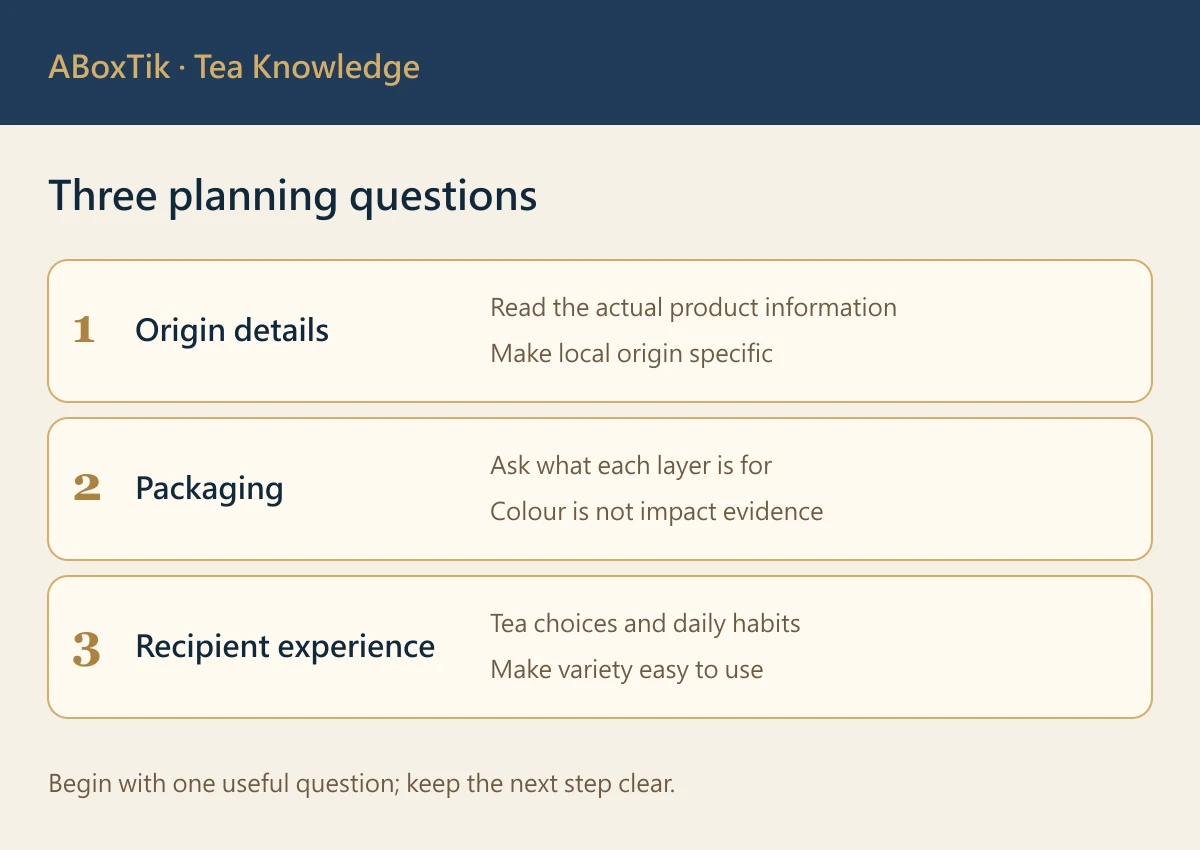
Make variety easy to understand
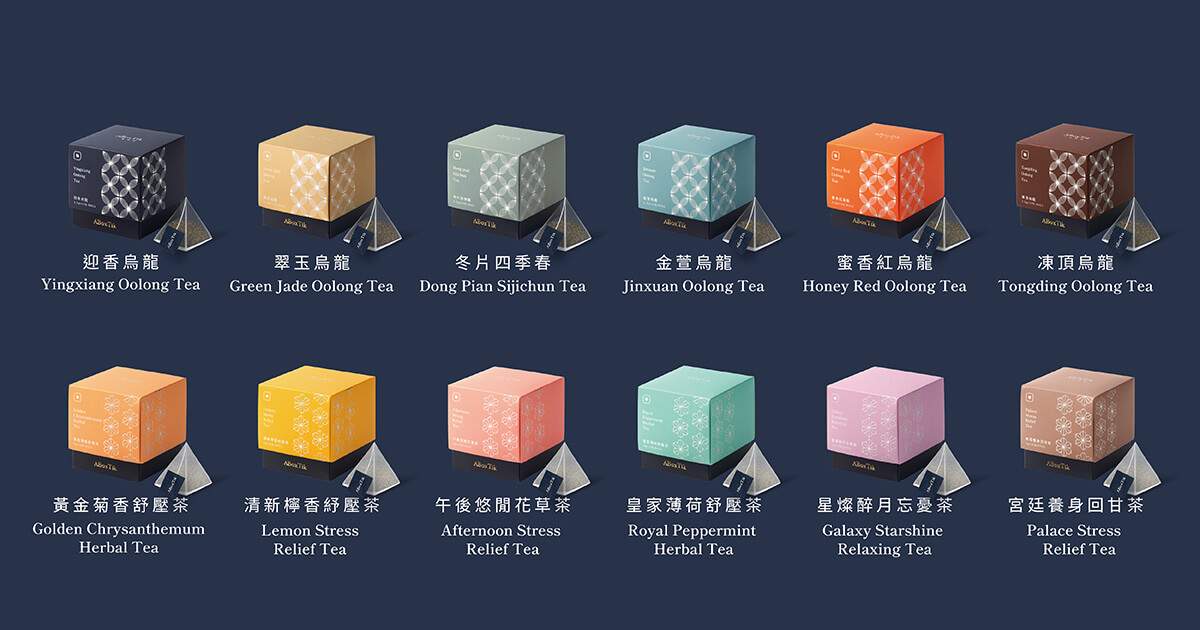
For a recipient who enjoys exploring, choose a difference that can be described, such as a fresher direction and a roasted direction. Several similar names may be less approachable than two clearly introduced choices. The fresh and roasted tea comparison helps with vocabulary, while actual product information and the person’s habits decide what belongs in the box.
The mixed tea-bag guide compares formats and selections. A household using mugs may benefit from tea bags that are easy to remove; an established teapot routine may welcome loose leaf. Legible names and directions for each tea matter more than fitting ten aroma descriptions onto a card. The first cup should not require searching for an explanation of the entire gift.
For format comparisons, examine the current two-box tea-bag gift, mixed tea-bag selection and classic tea assortment. Confirm contents, amounts and supply, then return to the recipient’s needs. In a household with different preferences, clear individual labels and convenient separate servings can be important selection criteria.
Let three receiving situations shape the questions
For one person, ask how often tea is made, which cup is used and what style is familiar. The largest quantity need not be the most suitable. For a sharing household, check whether teas are easy to identify, use in separate sessions and choose by ingredient. Sharing can be as simple as everyone knowing what is in the packet they have picked up.
For an office or team, confirm who receives the delivery, how the gifts are distributed and whether each person needs an individual allocation. These questions are more useful than guessing a spare-stock percentage. The quantity-planning guide supports the list. Keep household sharing and one-per-person orders in different counting units so they cannot become the same ambiguous “set.”
| Comparison | Information to confirm | This recipient’s need |
|---|---|---|
| Origin details | Actual teas, ingredients and source information: ____ | ____ |
| Packaging jobs | Inner pack, box, bag and transport: ____ | ____ |
| Variety and format | Amounts, labels and starting directions: ____ | ____ |
| Handover | Supply, confirmation date and receiving method: ____ | ____ |
Plan backwards from a workable receiving date
Write down when the recipient can actually receive the gift, then ask the supplier about stock, design, samples, packing and delivery steps. Separate content confirmation from design sign-off and fill the dates from real replies. The customisation timeline guide helps identify the stages; a general workflow should not be mistaken for the lead time of a particular item.
The Directorate-General of Personnel Administration provides the 2027 government-office calendar as a reference for holiday dates. Confirm the operating arrangements of the supplier, delivery service and receiving location separately. A recipient may travel early or an office may have limited receiving staff, making the person who can accept a parcel more important than a date chosen only because it falls close to the festival.
Group outstanding decisions into tea selection, packaging and arrival. If the first two cannot be completed in time, discuss an available existing format. For the third, settle a feasible receiving arrangement before returning to small visual changes. Card colours can be considered gradually; the delivery address is less suited to a surprise appearance in the final message.
Keep one confirmed version and close the comparison
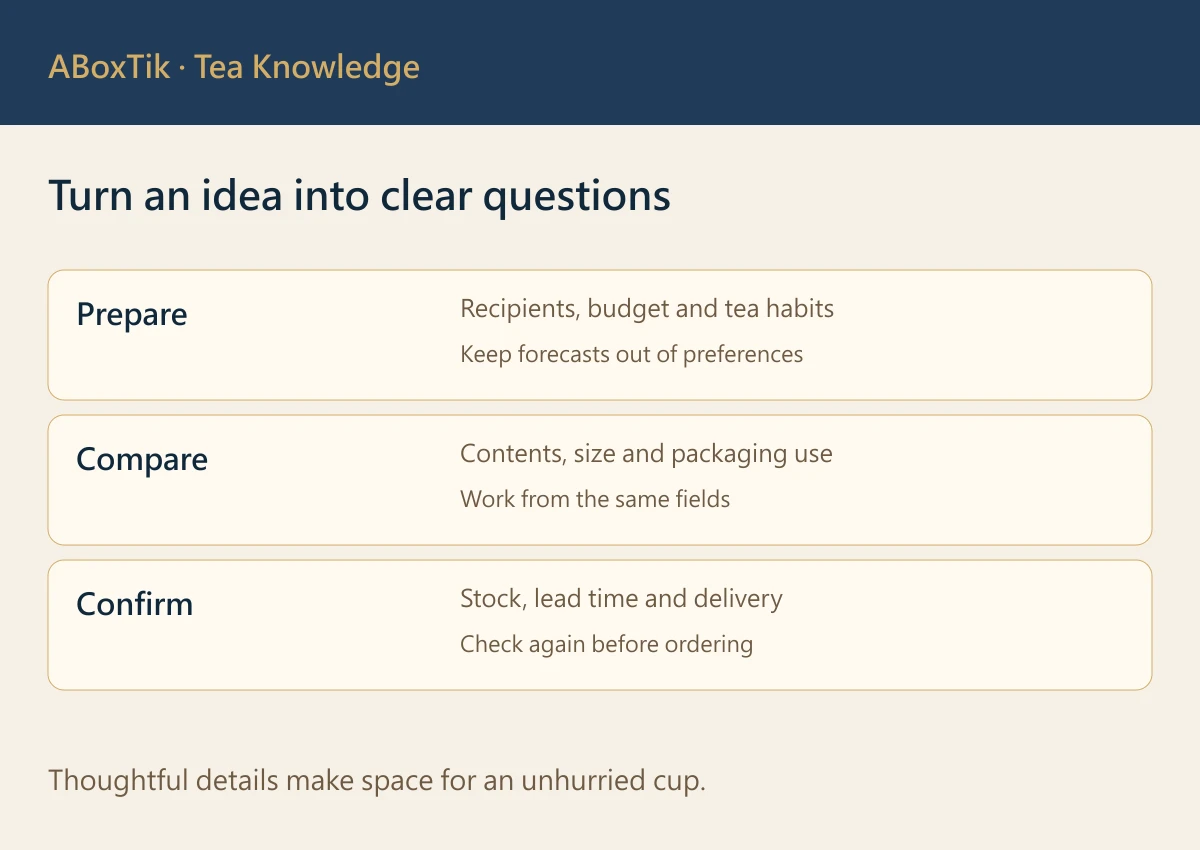
Save the approved item, contents, count, units, packaging options, price conditions, delivery arrangement and contact person together. Let purchasing, design and receiving staff use that reference, updating it in one place when something changes. The handover checklist provides fields for several destinations; destination-specific special requirements need their own review.
When the gifts arrive, check condition and version, keep the original packets and storage directions, and add a short note connected to the chosen tea. The specific thank-you card guide offers adaptable wording. For family gifts, the guide to familiar and new flavours helps balance comfort and exploration without making every card identical.
Decide what will let the comparison end: clear information, practical use and workable delivery. Once those are confirmed, allow the gift to do its job. Another ten photographs of boxes may not bring the answer closer; sometimes they only keep the browser company during an extra evening of year-end overtime.
ABoxTik brings the details of a seasonal tea gift closer to everyday use.
Begin the New Year tea-gift plan with three clear questions
Check how origin information relates to the included teas, what each packaging layer does, and whether the selection is easy to use. These questions turn a broad direction into a choice that can be discussed and confirmed.
Fill the worksheet as far as the information allows, then ask the supplier and recipient about the remaining fields. Planning early gives consideration time to become practical, leaving the final handover a little lighter.
Related reading
Sources
Sources checked 17 October 2026.