
Tea Knowledge
How to Label Tea Opening Dates Without Losing the Original Details
Leave dates on the packet, and keep a little more memory for the tea.
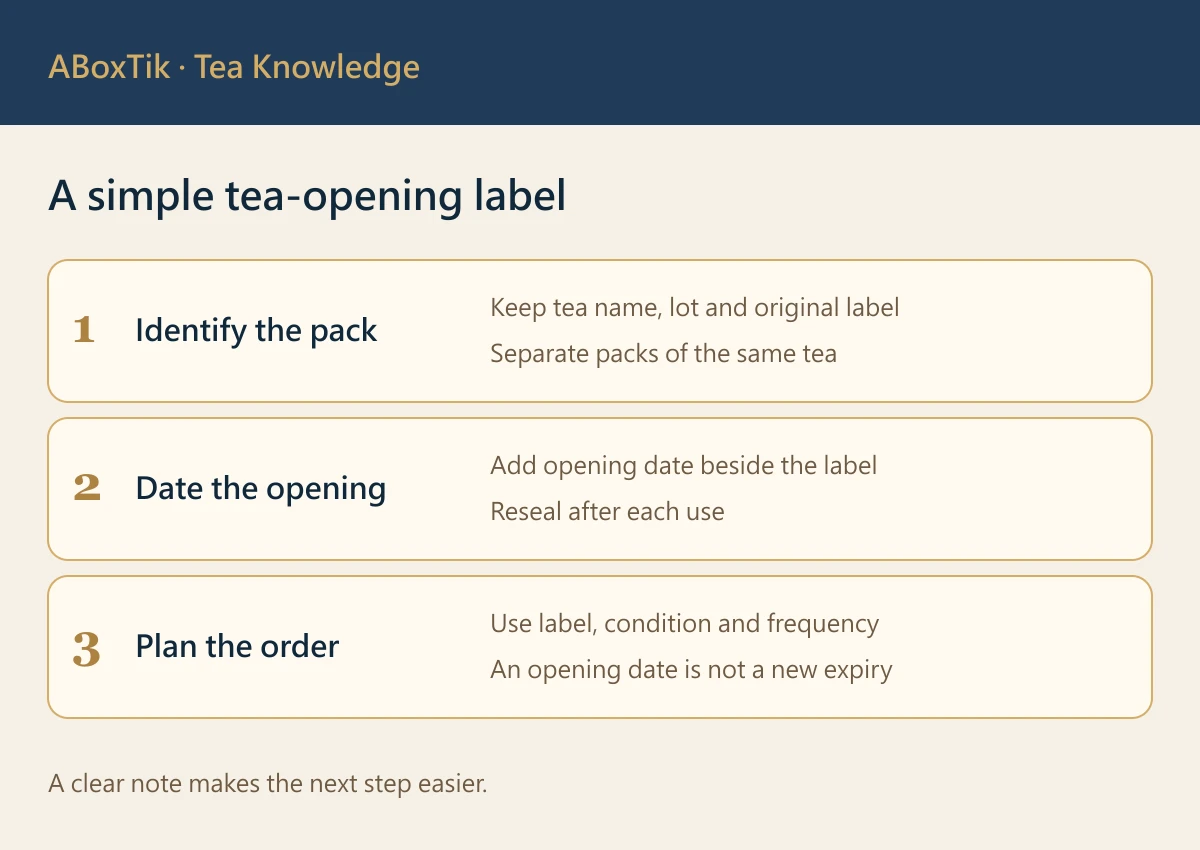
Record a tea opening date where it is visible on the outer package without covering the original label. Keep the tea name, a pack identifier, the date opened and the original date information. If you decant into smaller containers, add identifiers that lead back to the original pack. An opening date helps organize use; it does not create a new expiry date or establish the condition of the tea by itself.
When three packets all answer to “that nice oolong,” memory may leak faster than the zipper seal. A short note now saves a household archaeology meeting later. The aim is to make tomorrow’s tea easier to find, not to build a warehouse management department in the cupboard.
Opening, purchase and package dates have different jobs
A purchase date helps locate an order. Original package dates and lot information identify the product. The opening date marks when repeated access began. They are useful together but cannot replace one another. Two packs of the same tea should have separate records, even if they came home in one shopping bag.
| Date | Useful for | Do not assume |
|---|---|---|
| Purchased | Finding the order and supplier | Later purchase means later production |
| Original label | Keeping the maker’s date information | A new container restarts the clock |
| Opened | Planning everyday use | Every tea has the same open-pack period |
| Decanted | Linking a smaller jar to the pack | Decanting restores an unopened state |
The Tea and Beverage Research Station identifies moisture, oxygen, light, temperature, time and odors among factors affecting storage. Dates matter, but so do conditions. A beautifully labelled packet beside a steaming kettle has a clear record, not a personal weather shield.
Begin with four fields on the outer pack
Write the tea name, an identifier such as “Jinxuan pack A,” the full opening date and either the original date information or where it can be found. Use an unambiguous year-month-day format. Keep any lot code and photograph the original label so a later product question can refer to the right item.
Place the added label outside the package, away from direct contact with leaves. Leave the original name, ingredients, lot and dates readable. Do not convert today’s opening into a new expiry date or invent one standard countdown for every tea. The storage overview provides background; the specific product’s instructions remain part of the decision.
When decanting, preserve a route back to the original
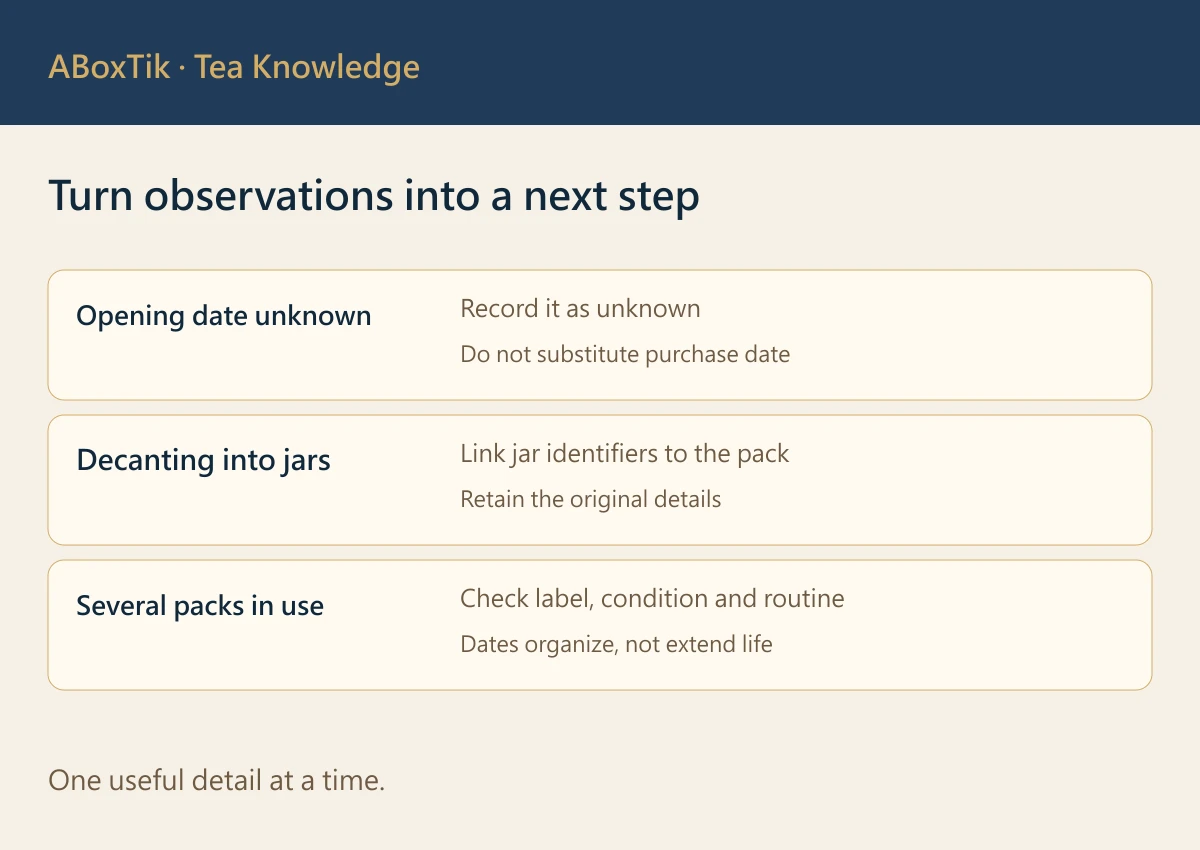
Call the original pack A and smaller containers A-1 and A-2. Add the tea name and decanting date, while retaining the original pack or a clear label photo. Keep different packs and lots distinct where possible instead of combining every “little bit left” into a mystery house blend. If material has already been mixed, record that rather than describing it as a single identifiable lot.
Containers and scoops should be clean and dry, suitable for the purpose, and able to close properly. Do not repeatedly open the packet for everyone to verify its name. Take the photo and add the identifier once. If the household shares tea, put a simple key inside the cupboard door; readability is more helpful than an impressive code.
Which of three open teas should come first?
Check the original label and storage instructions, consider actual condition and drinking frequency, and then use opening dates to help organize attention. Earlier opening is a useful clue, not an order to ignore everything else. A recently opened pack affected by moisture does not become reassuring merely because its date is later.
A practical arrangement is three spaces: regular tea for this week, occasional comparison tea, and unopened packs. Reseal after each use and return the pack to its place. Review the cupboard briefly at the weekend. Personal choice still belongs in the routine; enjoying a different tea need not feel like breaking stock-control rules. If usage is slow, smaller purchases may help more than a complicated system.
For tea bags, distinguish an opened outer box from individually sealed inner packs. Opening the box may leave every inner bag sealed. Record the packaging as it actually works instead of treating one cardboard opening date as the unsealing date of all its contents. See whole-leaf tea-bag formats and mixed tea selections when planning convenient portions.
A small record for several teas
| Tea and identifier | Original information | Opened or decanted | Location and next step |
|---|---|---|---|
| Tea ___ / pack A | Copy label dates and lot | Opened: year-month-day | Upper shelf; regular use |
| Tea ___ / pack B | Original photo location | B-1, decanted on ___ | Locate jar and original pack |
| Individually sealed bags | Box and inner-pack details | Box open; inner seal status | Follow the actual packaging |
A phone note is enough; no additional app is needed. Photograph the name, code and date clearly and use the same identifier in the filename. A useful record can be found next time. It does not need to resemble a professional tea archive on the day it is created.
What if the opening date is unknown or aroma changes?
Write “opening date unknown.” Do not invent a tidy date. An order or photo may add context, but a purchase date is not automatically an opening date. Check the original label, packaging and signs of moisture or other concerning changes before use. If the condition raises concern, stop using the tea and ask the seller how to proceed.
Faint aroma alone cannot establish why a change occurred or determine safety. Use aroma notes to describe the difference and provide the name, lot and storage history. Longer steeping or extra leaf should not be used to justify an uncertain condition. The research station’s expiry-date guidance also emphasizes product and storage conditions; one storage experiment cannot set a rule for every packet at home.
Follow ABoxTik: let a label share the remembering
Recording tea opening dates removes a repeated guess from daily life. Take the pack out, use it, close it and return it; glance at the record later. When choosing a Taiwan tea selection, consider how quickly it will be used rather than opening everything at once. There is plenty of time to explore the origins and styles of Taiwanese tea. A calmer cupboard leaves more attention for the cup.

Related reading and tea choices
- Whole-leaf tea bags and packaging formats
- Choose a tea selection that fits daily use
- Describe aroma changes clearly
Sources
- Tea and Beverage Research Station: packaging and storage
- Tea and Beverage Research Station: tea expiry-date questions
Sources checked: 24 October 2026.