
Tea Knowledge
Fresh Tea Leaf Handling: From Harvest to First Processing
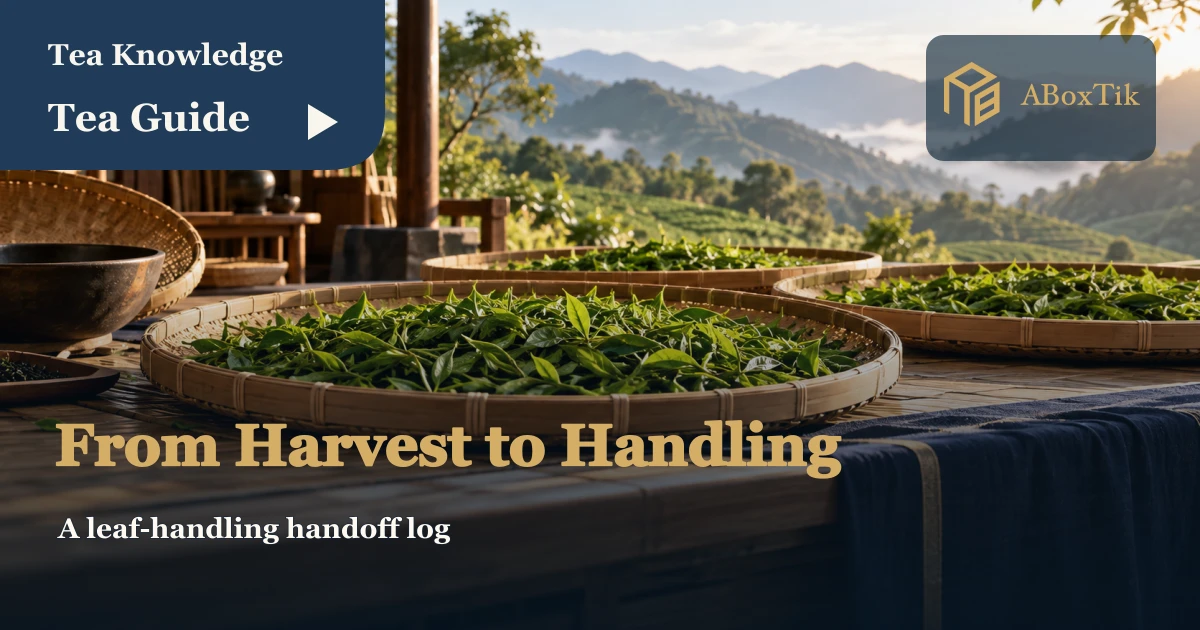
The care of a leaf continues in the next pair of hands.
Fresh tea leaves need prompt, appropriate handling because they continue changing after harvest. Heat buildup, compression and mixed batches can complicate the work that follows. Prompt handling does not mean every tea must immediately undergo fixation. It means harvesting, loading, transport, receiving and initial processing form an organized handoff, with both timing and leaf condition recorded.
Finished tea may rest quietly in a cupboard. Fresh leaves are less suited to an unplanned holiday. Understanding their short journey gives a tea buyer a useful question: how was this particular batch cared for before the familiar processing steps began?
Why transport time is more than driving distance
Fresh tea material consists of harvested shoots and leaves, not the dry product in a retail packet. Moisture condition, temperature and physical damage matter to subsequent processing. Two journeys of similar duration can deliver different material when loading, airflow or waiting conditions differ. Asking only how many minutes the vehicle travelled leaves much of the handling story unexplained.
The Tea and Beverage Research Station’s factory guidance includes checking the cleanliness of containers and vehicles, and recording incoming batches, cultivar, weight and leaf condition. These records provide a starting point for decisions. They are neither decorative paperwork nor a guarantee that every finished cup will taste a certain way.
For the harvesting stage, read hand and machine harvesting. Either method still needs an appropriate journey afterward. An impressive harvesting label does not automatically ventilate a forgotten load of leaves.
Separate unmanaged waiting from controlled withering
Green tea, black tea and oolong follow different processing paths. “Handle promptly” therefore cannot mean sending all leaves into the same next operation. Partially oxidized teas commonly involve outdoor and indoor withering, followed by managed resting and agitation before later steps. Green tea has a different fixation sequence. Controlled withering responds to material, environment and intended style; an unattended pile in a vehicle is not the equivalent operation.
When discussing a harvest-to-processing interval, define the clock. Picking start, picking finish, loading, departure, arrival and spreading are distinct events. Two people may both report two hours while measuring different intervals. A record becomes much more useful when its event names travel alongside its numbers.
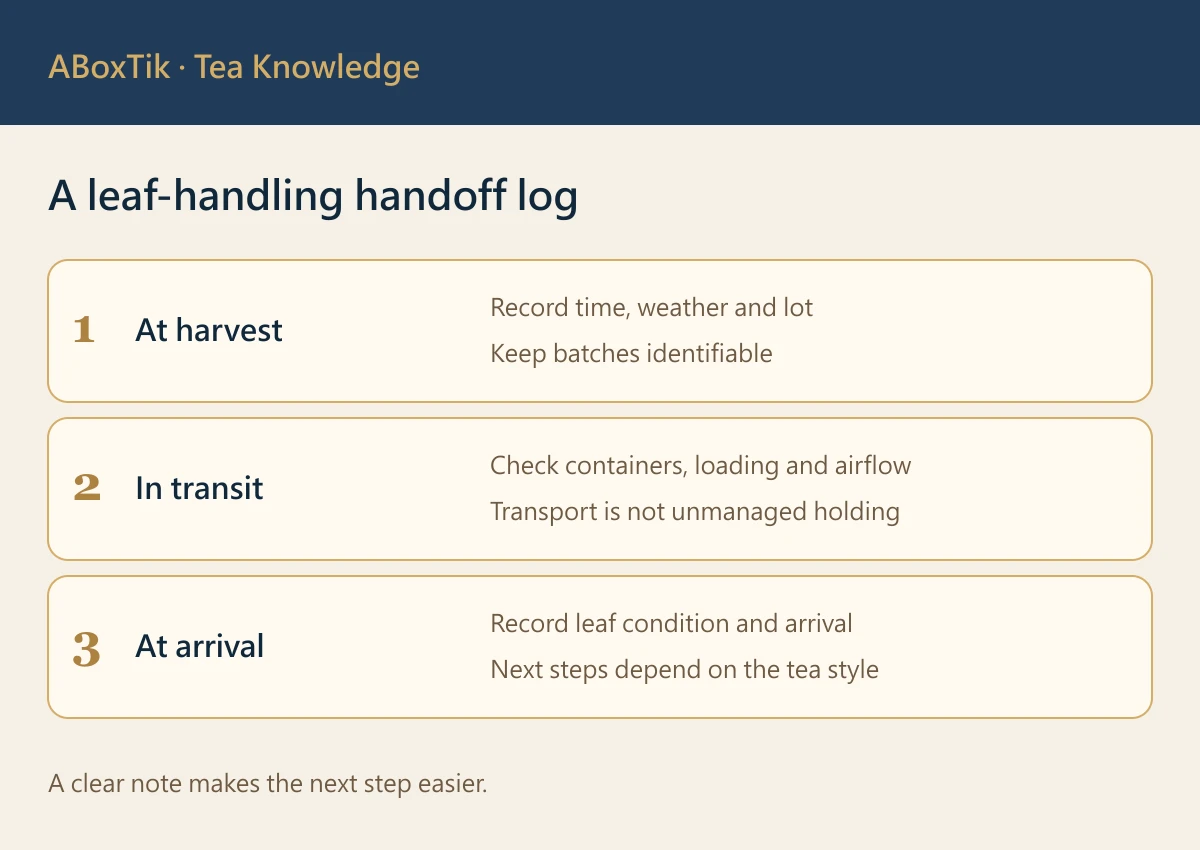
At harvest, connect the batch to its containers
A simple handoff log can begin with a garden or supplier identifier, cultivar, harvest date, picking interval and harvesting method. If gardens, cultivars or picking periods require separate handling, identify their containers before arrival. Later discussion of a cultivar or season then has something concrete to refer to, rather than relying on a basket acquiring two identities during the journey.
Official factory guidance also calls attention to contamination and foreign objects, including soil, oil and equipment parts. A consumer does not need to replace the receiving team. A procurement conversation can instead ask how incoming material is separated and checked. That is a more practical question than assuming an altitude label explains every management step.
During transport, record loading as well as time
Plan who will receive the vehicle, whether the unloading area is ready and how delays will be communicated. Avoid unnecessary holding while following the processor’s requirements for loading, airflow and placement. Saving a few minutes does not justify compressing the load excessively, exposing it carelessly or mixing it with unrelated goods.
There is no universal time limit offered here for every cultivar, weather condition and facility. Record actual departure, stops and arrival, together with container and leaf condition. If temperatures are measured, identify the place and method of measurement. A number without its conditions is rather like “steep for three minutes” without knowing the water volume.
Continue into oolong processing and tossing and agitation to understand what the receiving team is preparing for. A good handoff gives the next operation usable information, rather than requiring someone to reconstruct the morning from memory.
A harvest-to-factory handoff sheet
| Stage | Time and identity | Condition or responsibility |
|---|---|---|
| Harvest | Date, lot, cultivar, start and finish | Weather and leaf state |
| Loading | Container identifier and loading time | Cleanliness and separation |
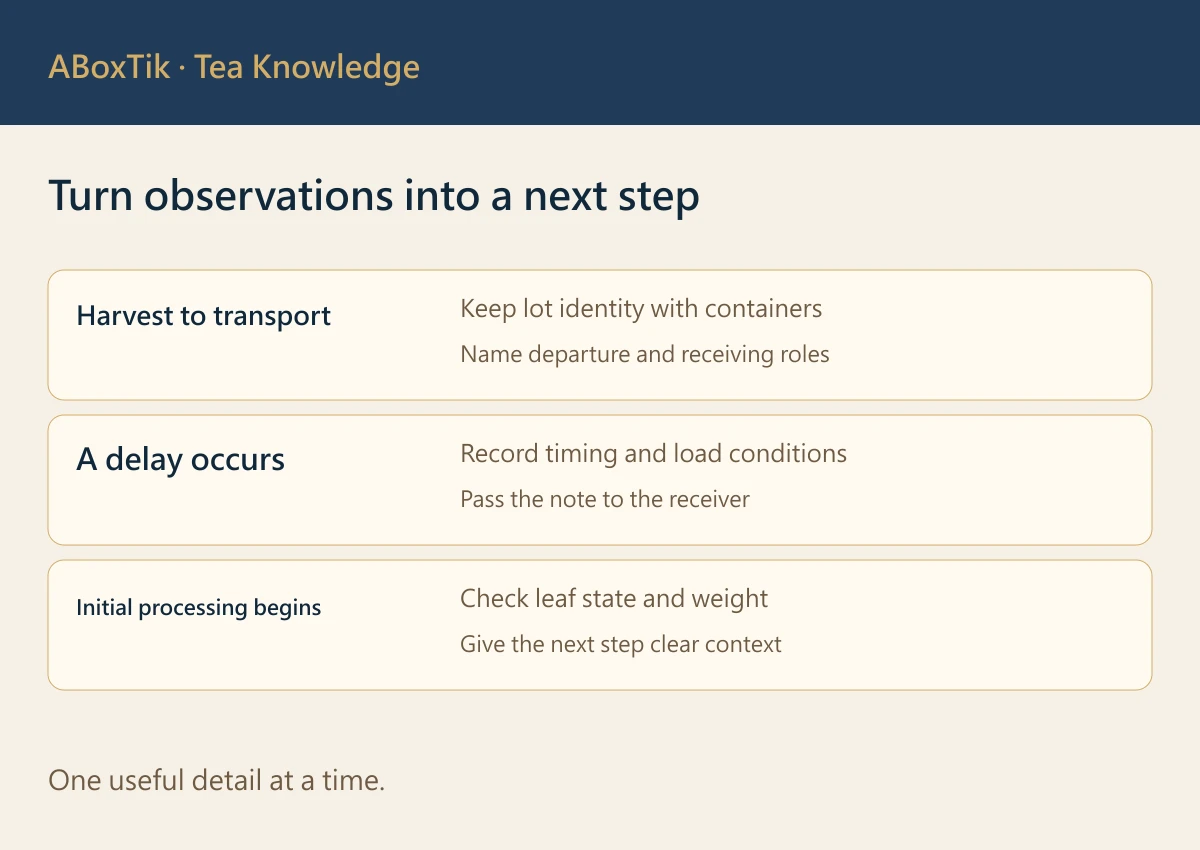
| Journey | Departure, stops and arrival | Delay and load changes |
| Receiving | Weight, receiver and handoff time | Uniformity, leaf state, foreign objects |
| Initial processing | Named operation and start time | Method, equipment and responsible person |
These are editorial communication fields, which can be integrated with a processor’s existing system. Wet leaves and uneven maturity deserve their own notes rather than disappearing into an average journey time. The research station’s leaf-grading material similarly considers maturity and weather-related leaf conditions when discussing incoming raw material.
For example, a hypothetical delayed load might have a clear arrival record but no receiving name. The immediate improvement is to name the person who accepts it and records its state, not to invent a reassuring average. Another load may arrive quickly but contain material from several picking periods without identification. Shorter travel has not solved that information gap.
What a buyer can ask, and what a cup cannot prove
Ask whether batch records are retained, how fresh leaves are received and who plans the first operation. Not every supplier will release every internal measurement, and missing detail is not itself proof of poor tea. Specific information helps explain the conditions behind tea quality, while aroma, mouthfeel and storage still need consideration.
Conversely, a drying cup cannot establish that transport took too long. Material, processing, water and brewing can all affect perception. Use the bitterness and astringency guide and steeping records to describe the cup before asking the seller. Questions about geographical origin belong with tea origin and traceability records, rather than with taste-based guesses about delivery.
Follow ABoxTik: notice the care between the familiar steps
Learning about fresh-leaf transport is not a requirement to turn afternoon tea into a logistics audit. It simply reveals a part of production that packaging often leaves out. Harvesters, drivers and makers pass along material together with a small body of essential information. When reading about Taiwanese tea and craftsmanship, leave room for that handoff too. A modest, specific question about one batch often teaches more than a grand claim about every tea.

Related reading and tea choices
Sources
- Tea and Beverage Research Station: hygienic factory guidance
- Tea and Beverage Research Station: fresh-leaf grading and receiving conditions
Sources checked: 24 October 2026.