
Tea, Tea Knowledge
4 Essential Tips for Storing High-Value Tea

If you appreciate tea and consume tea on a regular basis, you will certainly want to preserve your collection as best as possible. Whether you keep your collection hidden in the office or at home, you absolutely need to read – how to store your high-value tea leaves.
Start with dry, odour-free, sealed packaging that protects tea from light, then choose a suitable storage location. Proper storage methods matter to the quality and flavour of your tea. These simple tea storage tips can help you care for your expensive teas.
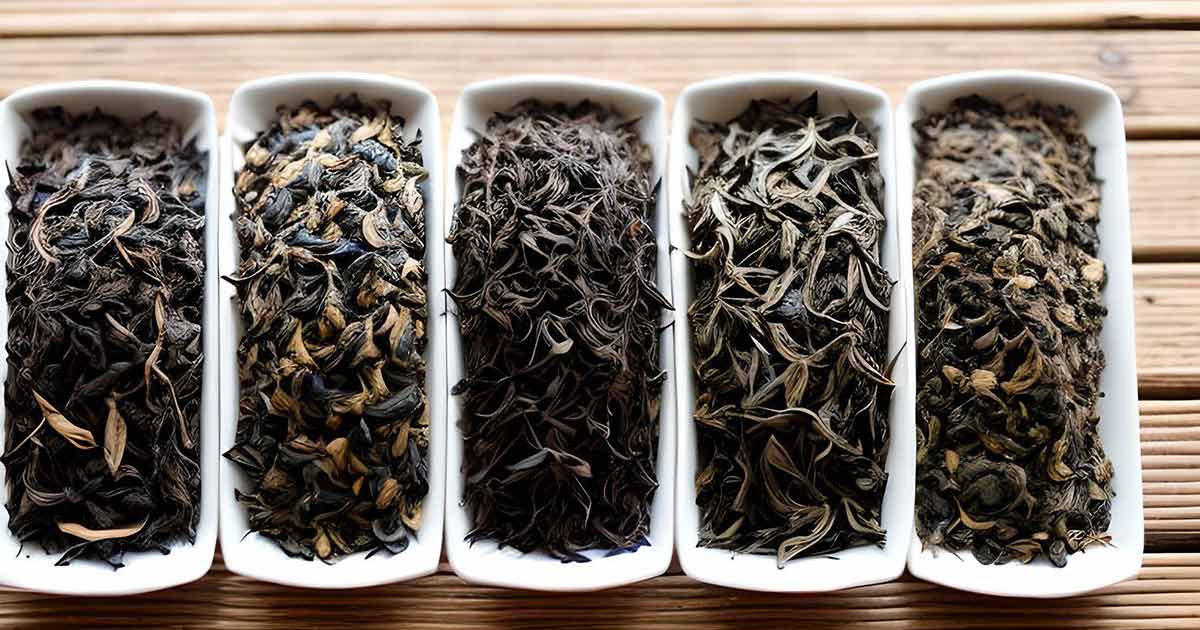
How do you Presere Premium Tea?
The Importance of Properly Storing High-Value Tea Leaves
The Tea and Beverage Research Station describes controlling finished tea moisture at 3% to 5%, together with thorough drying, moisture-barrier packaging and handling in low relative humidity, as important conditions for storage. However, because the tea leaves are well dried, they have a strong hygroscopicity, meaning they easily absorb moisture from the air when stored in a humid environment. This is why storing high-quality tea leaves in clean, dry, and sealed containers is the most important aspect of preserving tea leaves, to prevent them from absorbing too much moisture.
How to Properly Store and Purchase Tea Leaves?
When storing tea leaves with other items in storage, keep the tea leaves away from any strongly scented or flavored items. Due to their dryness, tea leaves easily absorb other odors. The most common mistake is storing tea with medicinal items, which can unintentionally impart medicinal flavors to the brewed tea!
If you want to enjoy the best flavor of tea leaves, choose locally produced or seasonal tea leaves as much as possible. The fresher the tea, the better. Regardless of how well tea leaves are stored, their quality will still be affected by freshness. That’s why we always find the tea served in tea shops to be of the best flavor, while the flavor of tea leaves stored at home diminishes over time.
If you’re not someone who regularly consumes large quantities of tea leaves, it’s recommended to purchase smaller quantities of individually packaged tea leaves, such as a box of premium single-serving tea bags. Only restock your supply when it’s running low, ensuring that you always enjoy the freshest tea.
⚑ Read More ⚑
[6 Major Tea Categories] Chinese Tea Culture – Origin of World Tea
In the sanctuary of preservation, Premium Tea finds solace, where air is soft and whispers of time stand still, a sacred space where flavor blossoms and essence endures, preserving the legacy of leaves kissed by the sun and dew.
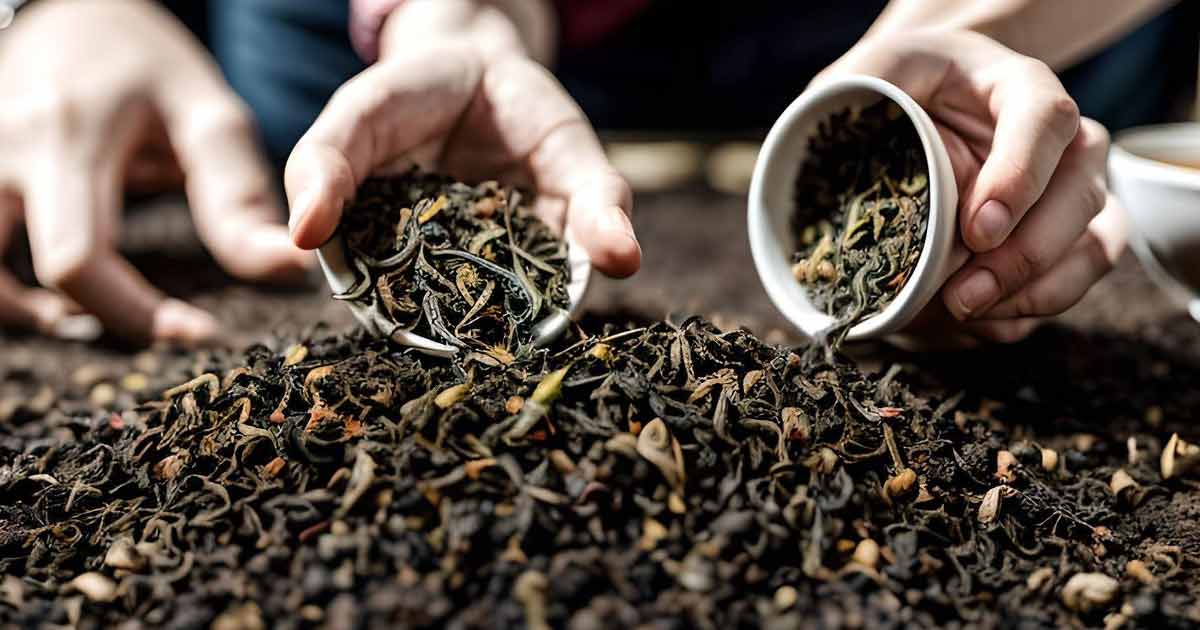
What is Tea Knowedge?
Methods for Preserving High-Value Tea Leaves
If we were to delve into the factors affecting tea leaves, we must mention light, heat, humidity, odors, and air, as these five conditions greatly impact the shelf life of tea leaves. Below are a few simple steps to properly store your premium tea leaves, helping reduce quality deterioration during storage so you can better appreciate the flavours the tea artisans have created.
⚑ Read More ⚑
2025 High-Value Tea Brands, Worthwhile Investment Rankings
[Taiwan Tea Ranking 2025] Top 10 Taiwanese Teas
1. Keep Dry – Tea Leaf Storage Method
Most tea leaves are dried or roasted during processing, leaving them with low moisture content that helps preservation, while suitable packaging and storage conditions remain important. To prolong this good quality, store tea leaves in sealed containers to prevent moisture from entering and damaging the tea leaves.
Sealed tea canisters are also a good way to store unused tea leaves. Check that the canister is clean, dry and free of odours.
Moisture is an important factor in tea storage quality. Dried tea still needs protection from moisture. Many people choose to gift premium tea gift boxes, but tea leaves are prone to absorbing moisture from the air in daily life. Keeping tea leaves away from humid areas will benefit you. Unless you intend to brew the tea leaves immediately, you should not put them in any liquid water.
2. Keep Dark – Tea Leaf Storage Method
Exposure to sunlight or indoor light can affect the storage quality of premium tea. Alongside sealing against moisture, choose an opaque container or keep the sealed package in a dark cupboard to reduce light exposure. Protection from light still needs suitable temperature, moisture protection and an odour-free environment.
⚑ Read More ⚑
Top 10 Exquisite Tea Recommendations – Top 10 World Tea Premiums
3. Keep Away from Air – Tea Leaf Storage Method
In addition to heat and moisture, you also need to keep premium tea leaves as far away from air as possible, as oxygen in the air will oxidize various active ingredients in the tea leaves, causing changes in flavor. This is why many tea suppliers store tea leaves in vacuum-sealed tea bags to minimize the chances of tea leaves coming into contact with air.
After opening a sealed bag of tea, close it securely after use according to the package design, without squeezing the leaves.
Tea easily absorbs odors, a characteristic that allows tea leaves to emit a natural tea aroma when placed in a certain area. However, this also means that storing tea in the vicinity of spice cabinets, trash cans, or other heavily scented areas is likely to absorb odors from those areas, increasing the chances of tea absorbing moisture and odors when exposed to air.
4. Keep Cool – Tea Leaf Storage Method
High temperatures contribute to deterioration in stored tea, so keep it away from heat sources. The Tea and Beverage Research Station identifies refrigeration at 0–5°C as a low-temperature storage approach for maintaining tea quality. Cold storage still needs moisture-barrier, light-blocking, low-permeability and odour-free packaging; follow the product instructions for storage and use.
⚑ Read More ⚑
Degree of Tea Fermentation and Process – How Are the Six Major Tea Categories Classified?
With delicate care, Preserving Premium Tea becomes an art, where each leaf is cradled in whispers of silk, sealed in jars of memories, safeguarding the essence of nature’s bounty for moments yet to unfold.

Follow ABoxTik
Taiwanese excellence recommended to tea collectors
Taiwan is famous for its tea, and many people often choose high-grade tea from Taiwan as souvenirs that represent Taiwan. ABoxTik carefully selects local tea farmers and rigorously professional tea makers from Taiwan to achieve tea perfection. A variety of teas can be mix-matched, and presented in beautiful minimalistic packaging. We welcome you to ABoxTik’s official website to discover our range of Taiwanese tea.
⚑ Read More ⚑
How to Brew Tea? ABoxTik of Tea Series
[2025] 6 Best Herbal Tea of 2025 – Premium Herbal Series
Keep or remove the little packet in the tea container?
Remove and discard a food desiccant after opening; Hong Kong’s Centre for Food Safety recommends this to reduce accidental ingestion. It is not a permanent canister accessory. An oxygen absorber has a different role: it acts on oxygen rather than moisture. Check the original product’s after-opening directions for that packet. Do not transfer either kind of used packet to another tea container, open it, brew it or heat it for reuse.
| Check | What to do |
|---|---|
| Name and purpose | Distinguish a desiccant from an oxygen absorber; appearance is not enough |
| Original directions | Check the after-opening instructions for this tea; ask the supplier if unclear |
| Packet condition | Do not consume tea from the same package if the packet is damaged or leaks |
| Tea packaging | Reseal after serving; keep the container dry and free of odours |
If the purpose is unreadable, separate the packet from the tea and photograph its label before asking. Do not replace it with one from another container. Taiwan’s Chemicals Administration notes that these packets gradually lose their protective function after opening. Suitable sealed packaging, moisture protection and storage still matter.
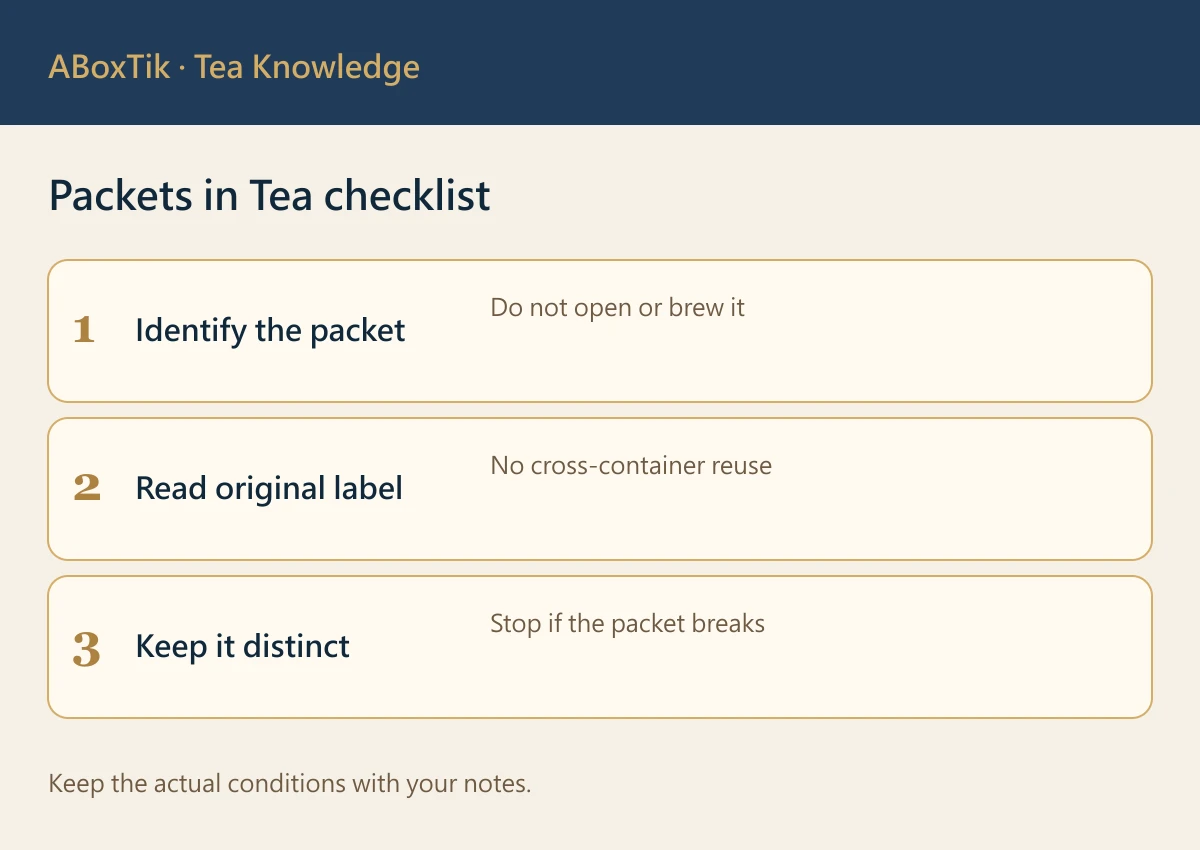
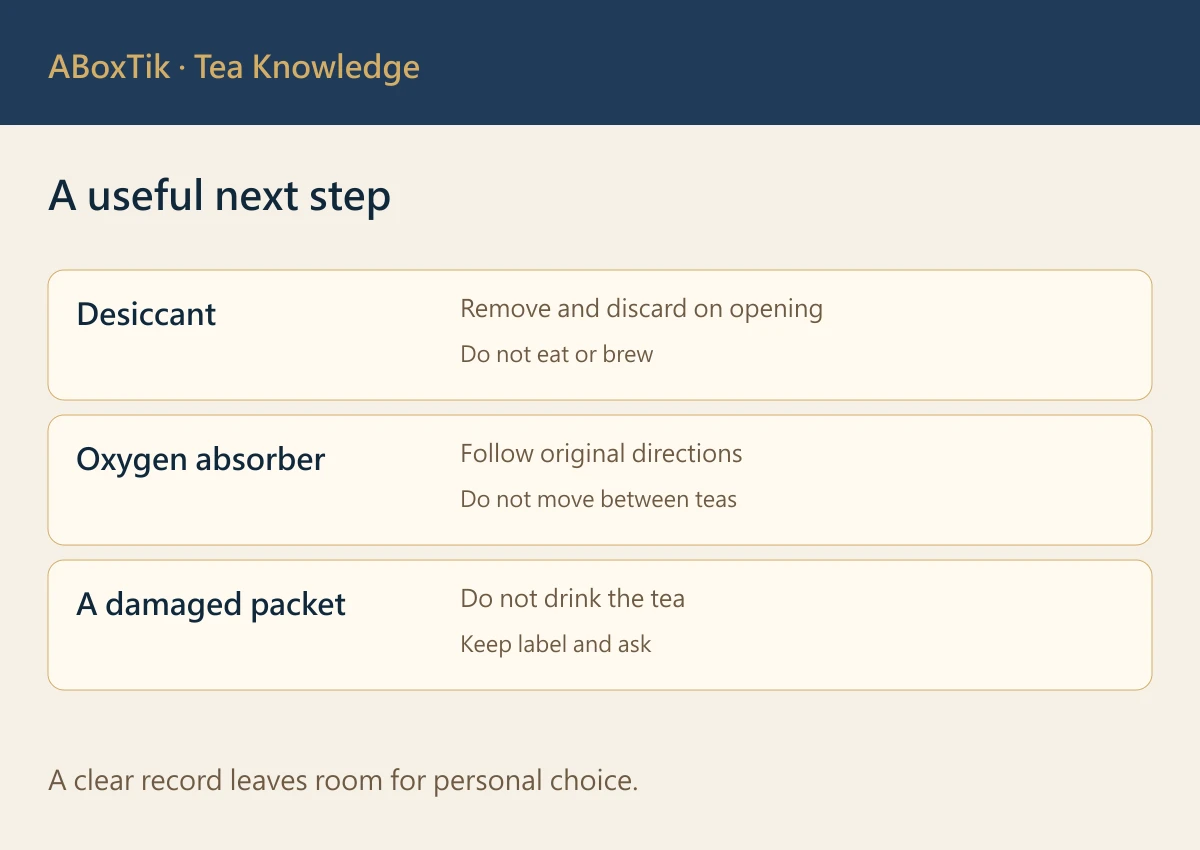
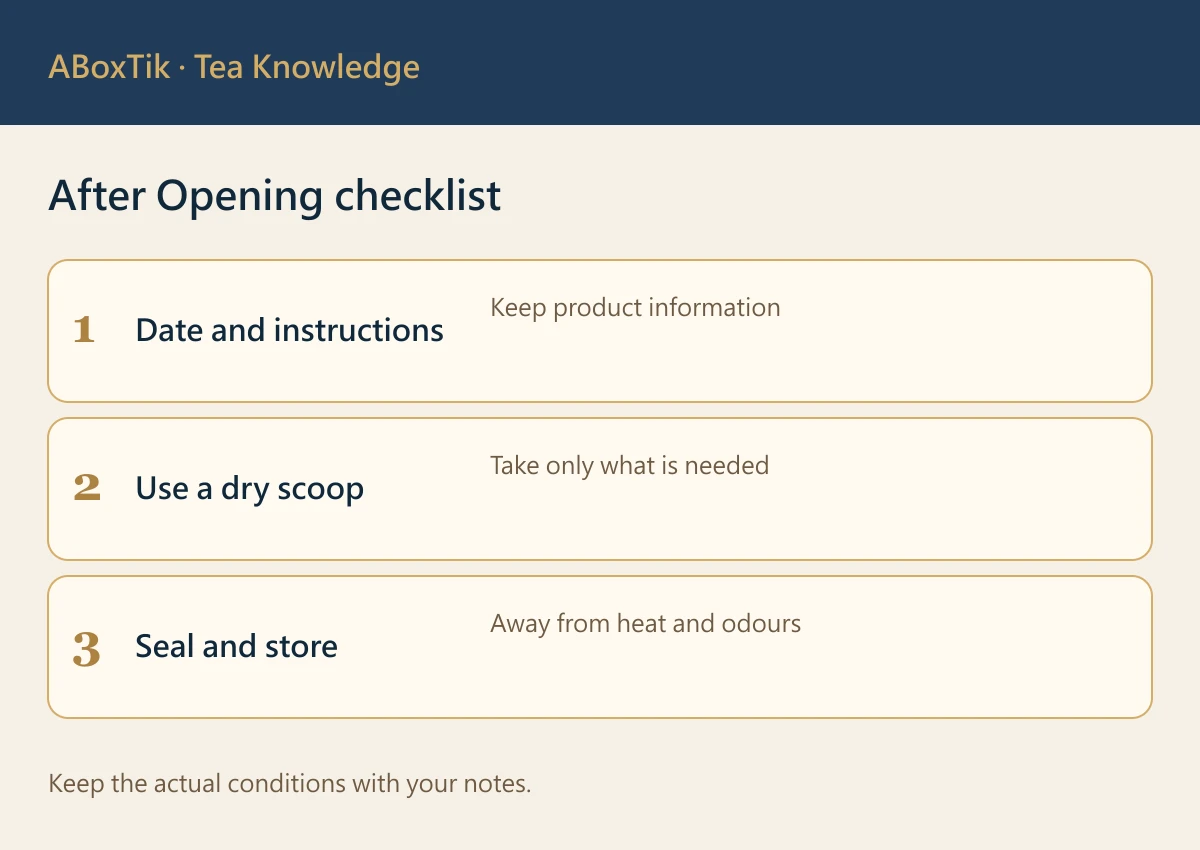
A practical checklist for tea after opening
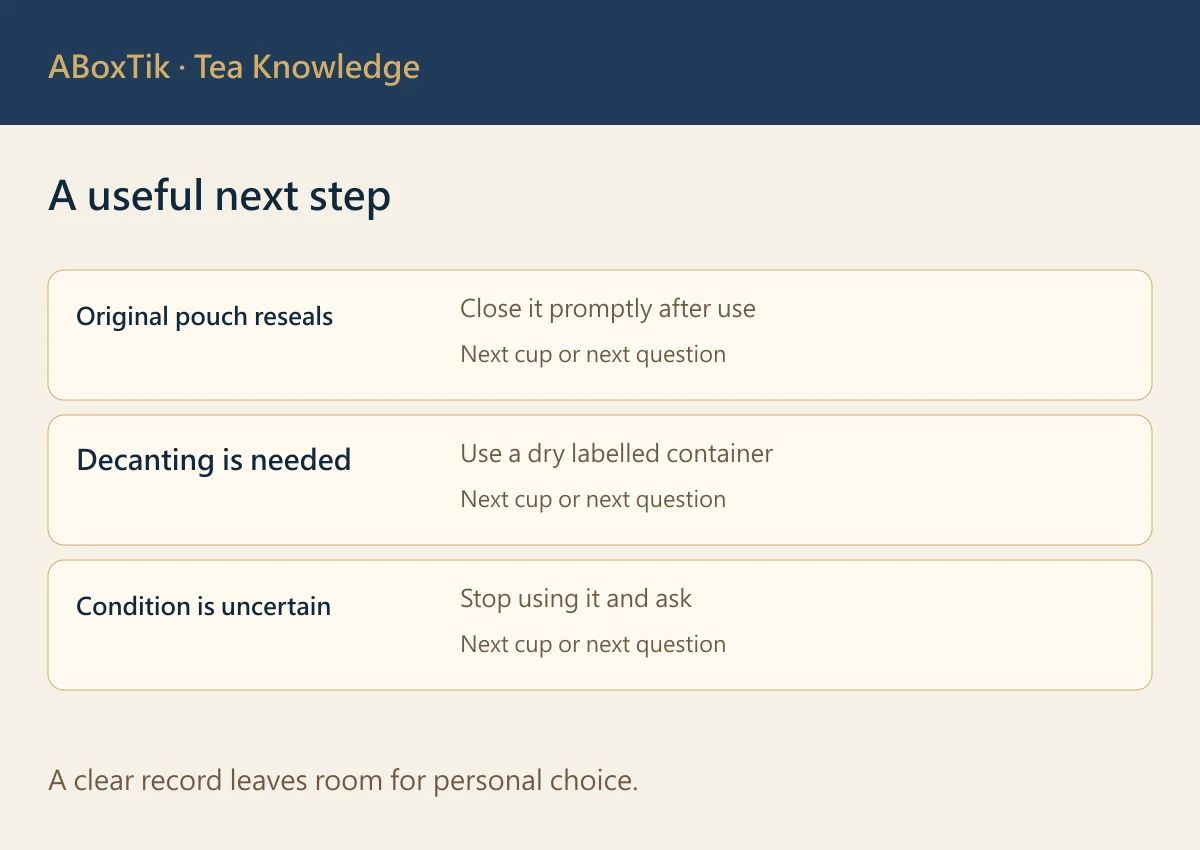
Check whether the original package reseals. If it does not, close the inner bag securely and place it in a clean, dry, odour-free container with a close-fitting lid. Choose a cool, dark place away from moisture, heat and spices, and keep the scoop dry.
| When | Check | Action |
|---|---|---|
| First opening | Date, storage instructions and seal | Record the opening date and keep product details |
| Each use | Dry hands and utensils | Take what is needed and reseal promptly |
| Return to storage | Cool, dry, dark and free of strong smells | Keep away from heat and spices |
| Before reuse | Moisture, mould or unusual odour | Stop using suspect tea and contact the supplier |
For a frequently used tea, consider dividing a suitable amount into a smaller container so the main package is opened less often. Dry the container completely and label the tea and date. For repacking, start with dry, odour-free packaging that closes securely.
The Tea and Beverage Research Station identifies refrigeration at 0–5°C as a low-temperature storage approach for maintaining tea quality. It still needs moisture-barrier, light-blocking, low-permeability and odour-free packaging. Follow the product instructions for storage and use. If mould or a distinctly unusual smell appears, stop using the tea and ask the supplier.
The Tea and Beverage Research Station notes that tea readily absorbs moisture and odours, while light, temperature and oxygen also affect storage quality. A simple routine is to prepare a dry scoop, open the bag, take the amount needed, reseal it and return it to its place. Avoid leaving the package open beside a sink, steam or spices.
Before transferring tea, check that the container has no lingering coffee, spice or cleaning-product smell and is completely dry after washing. Use an opaque container or keep the sealed package in a dark cupboard. Do not crush the leaves simply to fill the container. Label different teas separately so the next person does not have to guess what is inside.
A small label can carry the tea name, opening date and product storage instructions. Periodically check the closure and the area around the container for moisture or strong odours. If the storage location changes, record the new place too. A routine that is easy to repeat is more useful than a beautiful checklist that nobody opens.
Return loose tea to the packet? Give the extra portion its own place
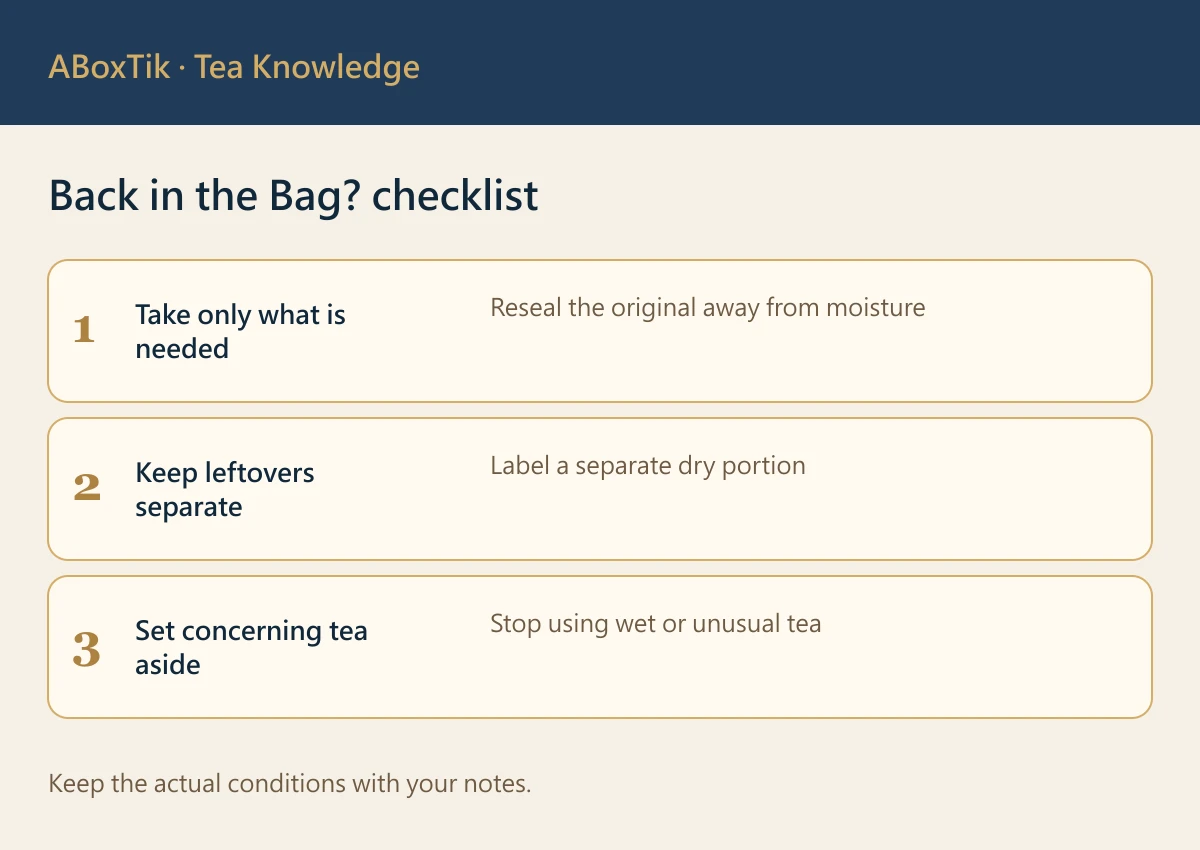
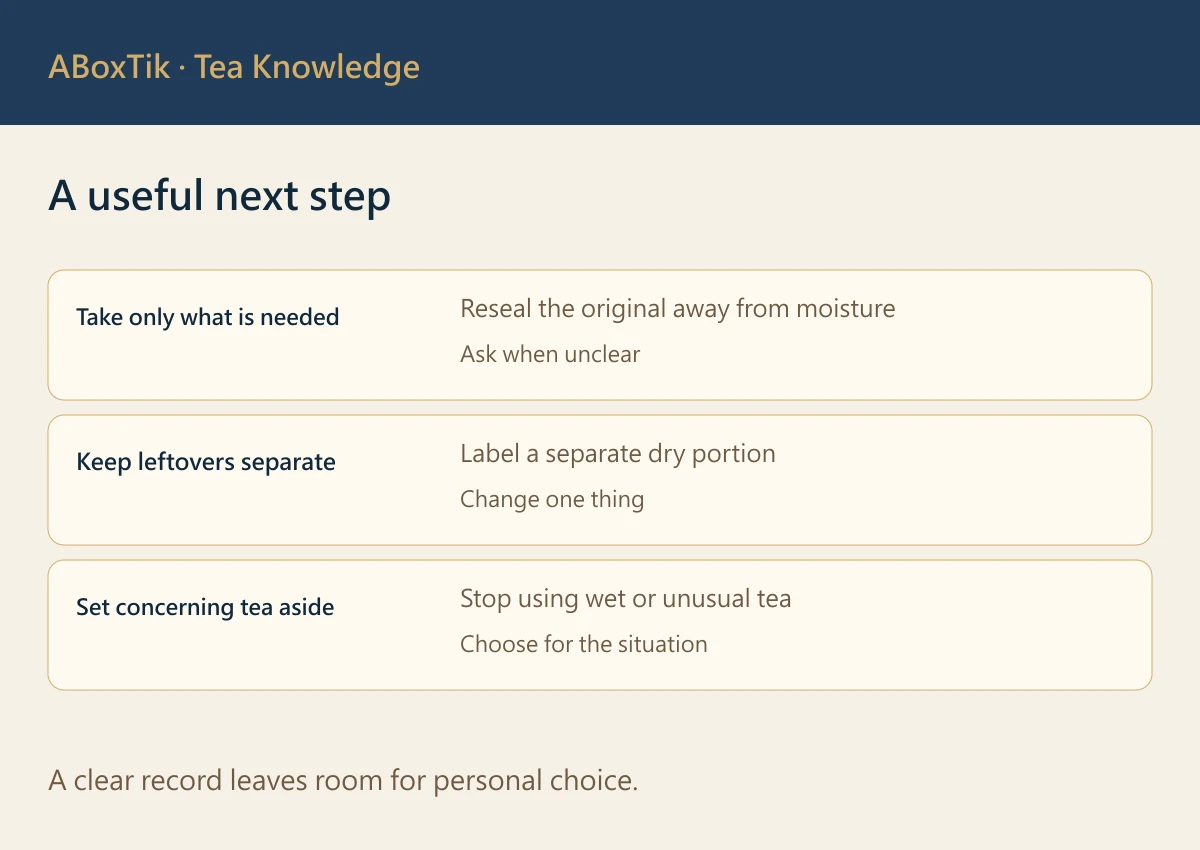
Estimate the amount needed before opening the main packet, then reseal it after taking tea. If some dry, unbrewed tea has already been placed on a dish or in another vessel, a suitable separate dry packet can keep that portion identifiable. Retain its name, original batch and dates. The main packet then avoids welcoming a traveller whose recent itinerary has become unclear.
| Portion | First step |
|---|---|
| Same batch, dry and unbrewed | Check the utensils and surroundings; if suitable to retain, package and label separately rather than mixing back. |
| Another tea or batch | Keep separate with its own information, not only the newer date. |
| Brewed, wet or concerning | Keep out of stored dry tea; stop using concerning tea and ask the supplier. |
A dry appearance does not establish an identical handling history. Note exposure near a sink, steam, spices or a scented container. If uncertain, ask the supplier rather than treating repacking or home heating as a solution. Separate storage does not restart a shelf life; follow the original instructions. Next time, take a little less, use dry tools and note your usual amount. That small adjustment removes one decision from the tea table.
Tea and Beverage Research Station: tea packaging and storage (checked29October2026).