
Tea Knowledge
Loose Leaf Tea vs Tea Bags: Cost, Time and Useful Brews
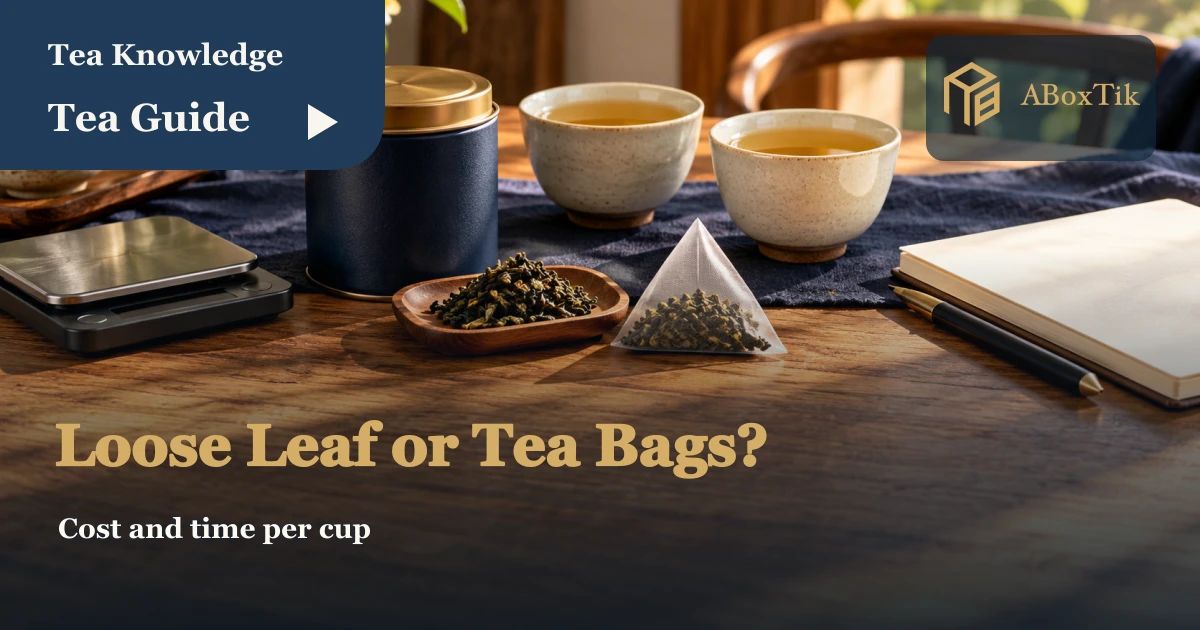
Count the cups you enjoy, and leave room for the routine that makes them possible.
Compare loose leaf tea and tea bags by the volume you actually enjoy, then add preparation, rebrewing and cleanup. Loose leaf allows flexible dosing; tea bags make portioning convenient. Either format may contain whole leaves, and format alone does not establish quality. A rebrew you never drink should not appear in the savings column.
A large packet beside a box of small bags can make the mental calculator announce a winner immediately. Unfortunately, that calculator does not know about the five minutes before work or the teapot used only at weekends. Invite the actual routine into the calculation before choosing.
Choose one comparison unit: cup, session or week
Define cup capacity or the total amount you want from one session. Three small-pot infusions and one large mug cannot be compared simply as three versus one. Total volume, acceptable strength and whether the tea was finished all matter. The steeping-time guide and leaf-form comparison provide context without promising a fixed number of infusions.
Start with a familiar cup. For a weekly record, separate weekdays from weekends. A convenient mug on working days and a teapot on a quiet afternoon can both be sensible choices. There is no need to make every tea in the cupboard enter the same elimination contest.
Calculate the tea used before dividing by the tea enjoyed
For loose leaf, estimate the session cost as the amount paid divided by usable net weight, multiplied by the leaf dose. For tea bags, divide the amount paid by usable bag count and multiply by the number of bags used. Apply the same treatment to freight and other costs. Comparing a discounted packet with a full-price box plus delivery creates an uneven starting point.
Next divide that session input by the number of equal-volume cups actually enjoyed at a pleasant strength. The result describes personal use, not a universal market price. Cost per gram misses a packet that takes too long to finish; cost per bag misses differences in net weight and directions.
| Field | Loose leaf | Tea bags |
|---|---|---|
| Price basis | Paid ___; freight included? ___ | Paid ___; freight included? ___ |
| Usable amount | Net weight ___ grams | ___ bags; ___ grams each |
| Session input | ___ grams; estimated cost ___ | ___ bags; estimated cost ___ |
| Tea actually enjoyed | ___ milliliters; ___ standard cups | ___ milliliters; ___ standard cups |
| Active time | Setup ___; cleanup ___ minutes | Setup ___; cleanup ___ minutes |
| Practical preference | Keep ___; change ___ | Keep ___; change ___ |
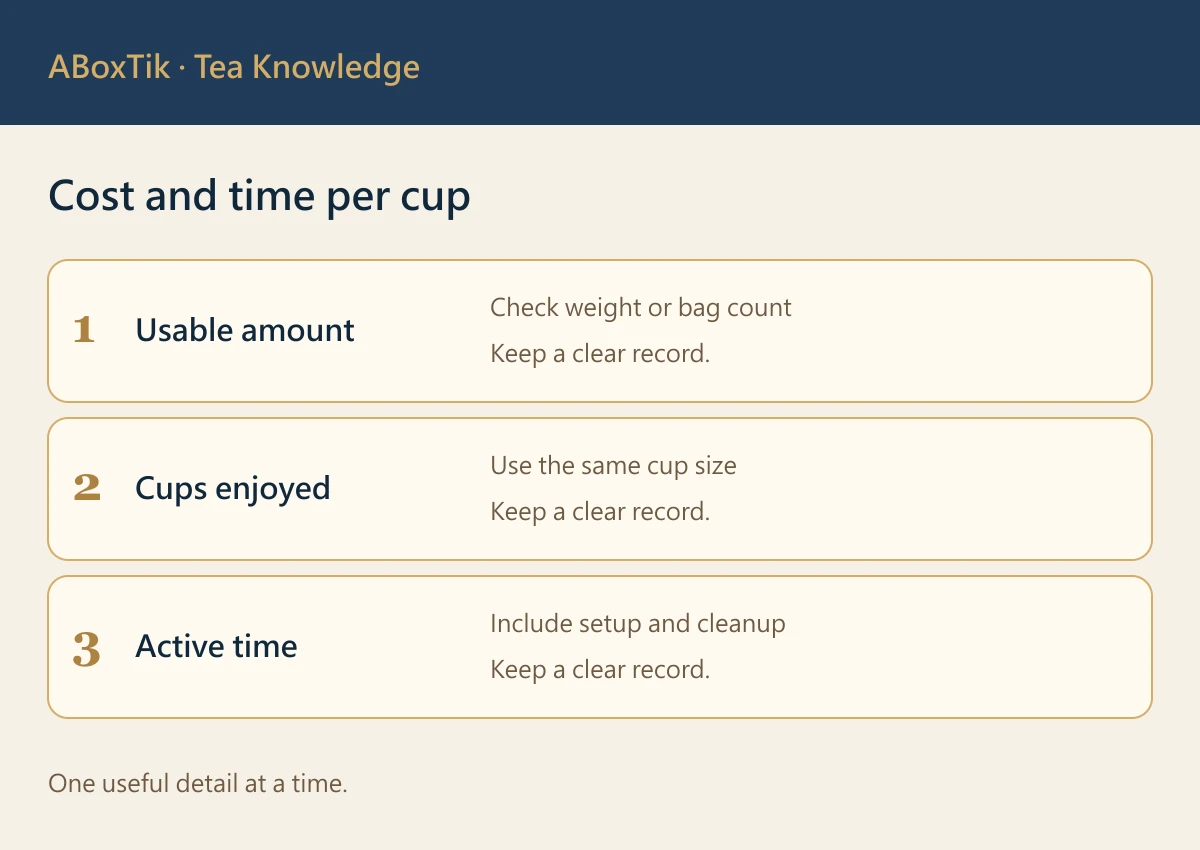
A worksheet example: count the second cup only after drinking it
Suppose an imaginary loose-leaf packet costs six hundred dollars for one hundred and fifty grams, with five grams used per session. The tea input is twenty dollars. An imaginary box costing three hundred dollars for fifteen bags also costs twenty dollars when one bag is used. These figures illustrate arithmetic; they are not product prices and do not establish equivalent quality.
If both methods produce only one equal-size cup that you actually drink and enjoy that day, record twenty dollars for each. If one produces another cup of the same size and a strength you still like, allocate the session cost across those cups in that record. Do not enter ideal rebrews when there was no time, the flavor was no longer welcome, or the tea remained unfinished.
A tea’s capacity for another infusion and the amount consumed today are different quantities. The gift assortment guide clarifies box positions, while the pyramid bag guide and whole-leaf bag guide explain structural questions. Clear units prevent the numbers from talking past one another.
Record time without issuing an invoice for washing the pot
Separate active work from waiting. Measuring leaves, arranging an infuser, pouring and cleaning require attention. Waiting during an infusion may allow another task, so it can have a separate field. A few real records are more useful than guessing how long somebody else takes to wash teaware.
For someone who enjoys setting the tea table, that time may itself be a break. Before a meeting, the same sequence may feel inconvenient. Neither reaction needs an hourly wage calculation. Convenience is a legitimate preference, just as adjustable dosing and a leisurely session are legitimate preferences.
The office tea guide and mug-brewing guide help plan busy days. The home tea-bar guide considers equipment flow. Use them to reduce a particular inconvenience rather than assuming one format saves the same amount of time for everyone.
Storage and finishing speed belong in the calculation
A large packet may have a lower price per gram but become less satisfying if it stays open longer than the household wants. Estimate real use frequency before choosing quantity. Follow packaging directions for sealing and storage, with attention to light, moisture, odors and the surrounding conditions. The storage guide supplies more detail.
Do not assume every tea bag has an individual protective envelope. Count the bags and inspect the actual packaging. Loose tea can also arrive in small sealed portions. The format name does not answer the protection question. Official packaging guidance explains why storage conditions matter; it does not guarantee a fixed extension of shelf life from a particular container.
When recording waste, be concrete and gentle. Note how much remained unused and why: too much open at once, an awkward package, or a flavor that no longer suited the routine. The purpose is to choose a more manageable amount next time, not to make the tea cupboard feel like a financial audit.
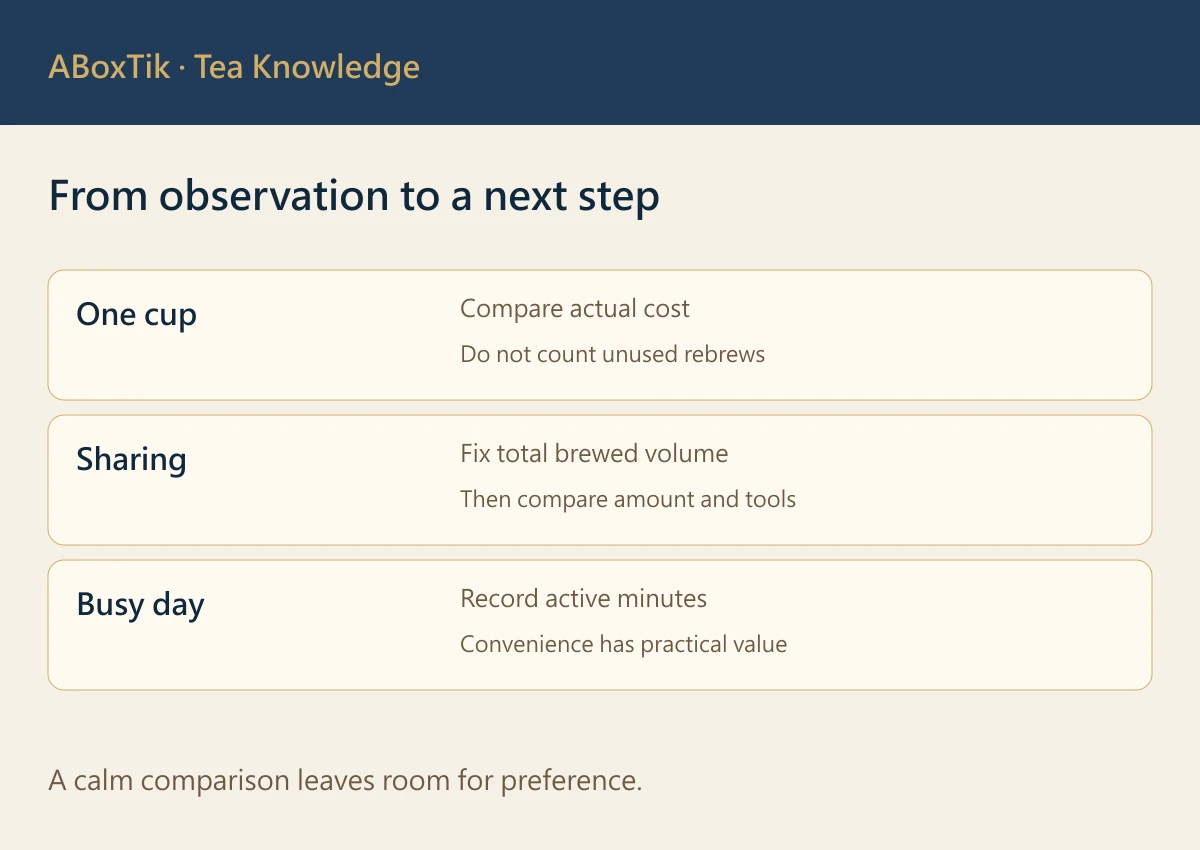
Read the same sheet in two everyday situations
In the first situation, you prepare one cup before leaving home. Record its actual volume and active work, then ask whether a second infusion genuinely fits the morning. If it does not, retain the single-cup figure. Potential rebrews should not improve a calculation merely because the packet says the leaves can be used again.
In the second situation, two people share tea at the weekend. Record the total liquor produced, the leaves used and the amount actually finished, then convert to one common cup size. A larger number of pours does not automatically mean a lower cost for the same amount of enjoyed tea. The worksheet should describe the session that happened.
Gifting needs another line. Does the recipient use a mug, own an infuser or want to measure loose leaves? Convenience may matter because it makes the gift easy to begin. Your household’s cheapest cup is not necessarily the best format for someone else. Choose a usable form before comparing quantities within it.
After a week, remove fields that added no useful information. If cleanup times are much the same, daily precision may be unnecessary. If tea is often left over, move portion size to the top. The sheet is there to support a decision, not create another recurring household assignment.
Follow ABoxTik: let both formats have suitable days
Try one busy mug day and one unhurried pot session. Fill in cost and practical impressions, then circle the part worth keeping: convenience, adjustment, flavor or the rhythm of sharing. If each offers something useful, both can remain in the household. A permanent winner is optional.
Review the current formats in ABoxTik’s Classic Taiwan tea selection and two-box tea gift, then return to the Taiwan tea introduction for the craft behind the contents. The best value is tea that gets brewed, enjoyed and comfortably finished. That is a calculation with room for the person drinking it.

Related reading and tea choices
Sources
Sources checked: 24 October 2026.