
Tea Knowledge
Mindful Tea Drinking: A Gentle Guide to Paying Attention
If your thoughts wander off, the cup is still here. Meet it again with the next sip.
Begin mindful tea drinking by placing the cup securely, noticing one sensory detail and taking a small sip at a comfortable temperature. There is no need to empty your mind or turn tea into another task to complete. Thoughts about dinner, work or an unanswered message may appear. Notice that, then return to the cup if you wish. A wandering thought does not mean you have somehow drunk the tea incorrectly.
This guide starts with an ordinary drink that is already prepared. It gives attention a concrete place to return, without setting a required level of quiet. You might look at the colour, notice an aroma or simply take one sip. Choose a version you would be willing to try again before considering any elaborate tea setup.
Understand attention before arranging a ritual
Plum Village presents tea meditation within its Buddhist community practice, describing being present with tea and companions, with room for quiet or sharing. That is a cultural starting point. An everyday sensory exercise at home need not reproduce a religious ceremony or ask companions to share particular beliefs.
Attention can be very specific: the cup is on the table, an aroma is noticeable, or this sip is cooler than the previous one. Those are observations. “Why am I distracted again?” is another thought that has appeared, rather than a score you must accept. The cup has not issued a report card. You can leave the marking pen in the drawer.
Use familiar tea to make starting easier
Choose tea you enjoy preparing and follow its instructions. Bags and loose leaves can both fit. Finish brewing, remove the leaves or bag and place the hot-water equipment securely before sitting down. If the purpose is to notice the drink, you need not simultaneously investigate a new kettle, unfamiliar leaves and a new temperature setting.
A stable place for the cup and a comfortable seat are enough. Keep your eyes open if that suits you. There is no special posture to perform. Make sure the tea is comfortable to drink; holding an uncomfortably hot cup or enduring a hot sip is unnecessary. If you do not want tea now, you can notice the cup or another object on the table instead.
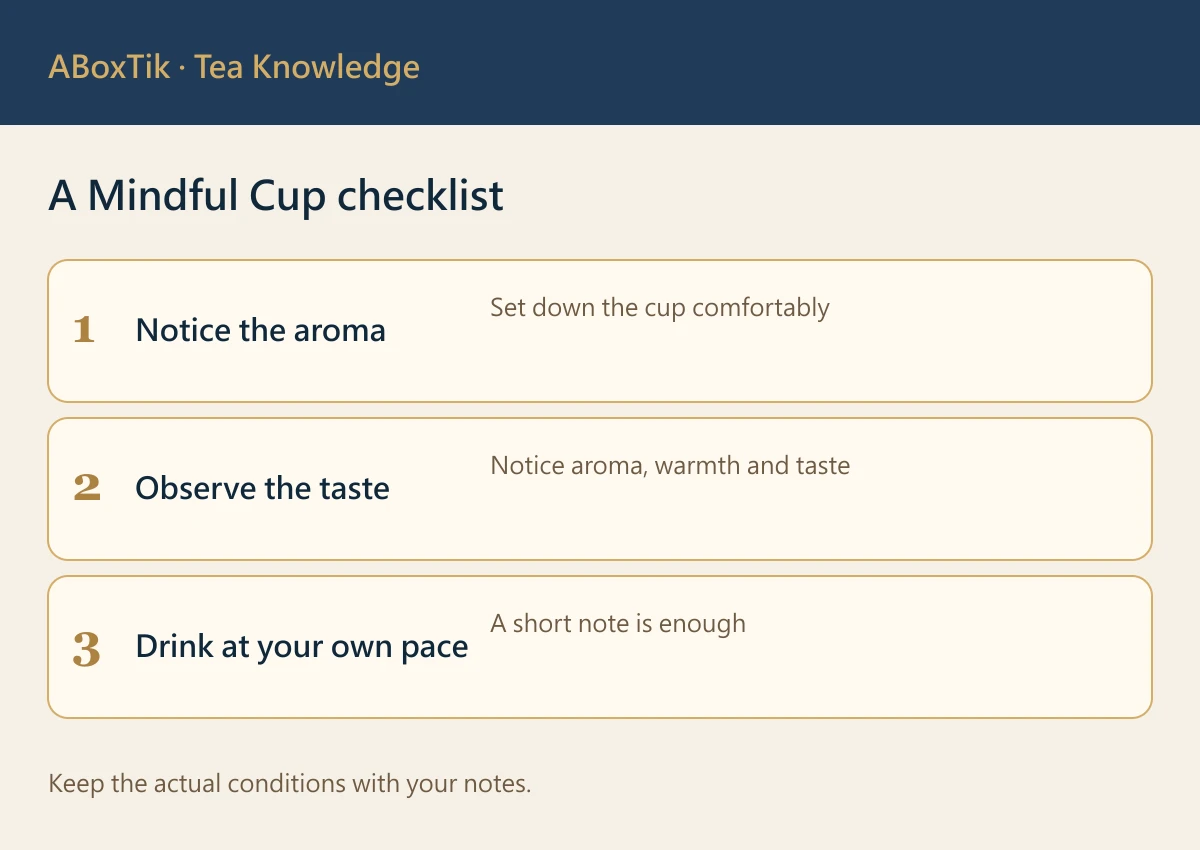
Try three small steps without filling every sense
First, look. Choose one detail: the colour of the liquid, a reflection on its surface or the shape of the rim. You do not have to produce a complete sensory inventory. Light and the vessel affect what you see, so describe the detail rather than immediately deciding what it proves about quality or origin.
Next, notice aroma from a comfortable distance. It might seem clear, gentle or difficult to name. Not noticing an aroma is also something you can record honestly. Do not lean into hot liquid to force a result. A specialist vocabulary is not an entry requirement. “The scent seems faint today” can be a more useful observation than an impressive borrowed description.
Finally, take a small sip and return the cup to the table. Notice temperature, the feeling in the mouth or an impression after swallowing. Give that sip room before explaining it. Continue if you would like another, or stop if you do not. Completing a sequence is less useful than noticing what you actually want at the table.
Separate the detail from the comment about it
| Detail noticed | Possible comment | A place to return |
|---|---|---|
| Light on the tea | This seems too ordinary | Look where the reflection falls |
| An unnamed aroma | Other people know more | Note clear, gentle or uncertain |
| A thought about work | I am doing this badly | Set the cup down; choose one detail |
| No wish for another sip | I must finish the exercise | Notice your preference and stop |
Replace these situations with your own experience; they are possibilities rather than events that must happen. You do not need to remove the comment. Recognising it as a comment may be enough before deciding whether to return to the tea. Liking and disliking remain available too. Paying attention does not require praising every cup.
If you are choosing tea to buy, keep observations for a later comparison. This particular pause need not produce a ranking. Wanting a lighter style today and a roasted one tomorrow is a perfectly useful preference. Your buying question and the immediate sensory detail can each have their own space without fighting for the same small table.
When attention wanders, choose one return
Place the cup securely. You might briefly recognise “thinking about work” or “planning dinner,” then choose an easy external detail: the cup’s outline, an aroma or the temperature of the next sip. There is no need to rewind and recover the sips you did not notice. The next one provides another opportunity.
If a message requires a reply, attend to it. Afterwards decide whether to continue, prepare something fresh or finish. The exercise does not require keeping daily responsibilities outside a locked door. If attending to internal sensations is uncomfortable, look at an object nearby or stop and do something that suits the moment better. You remain free to change the arrangement.
A brief pause can have a complete shape
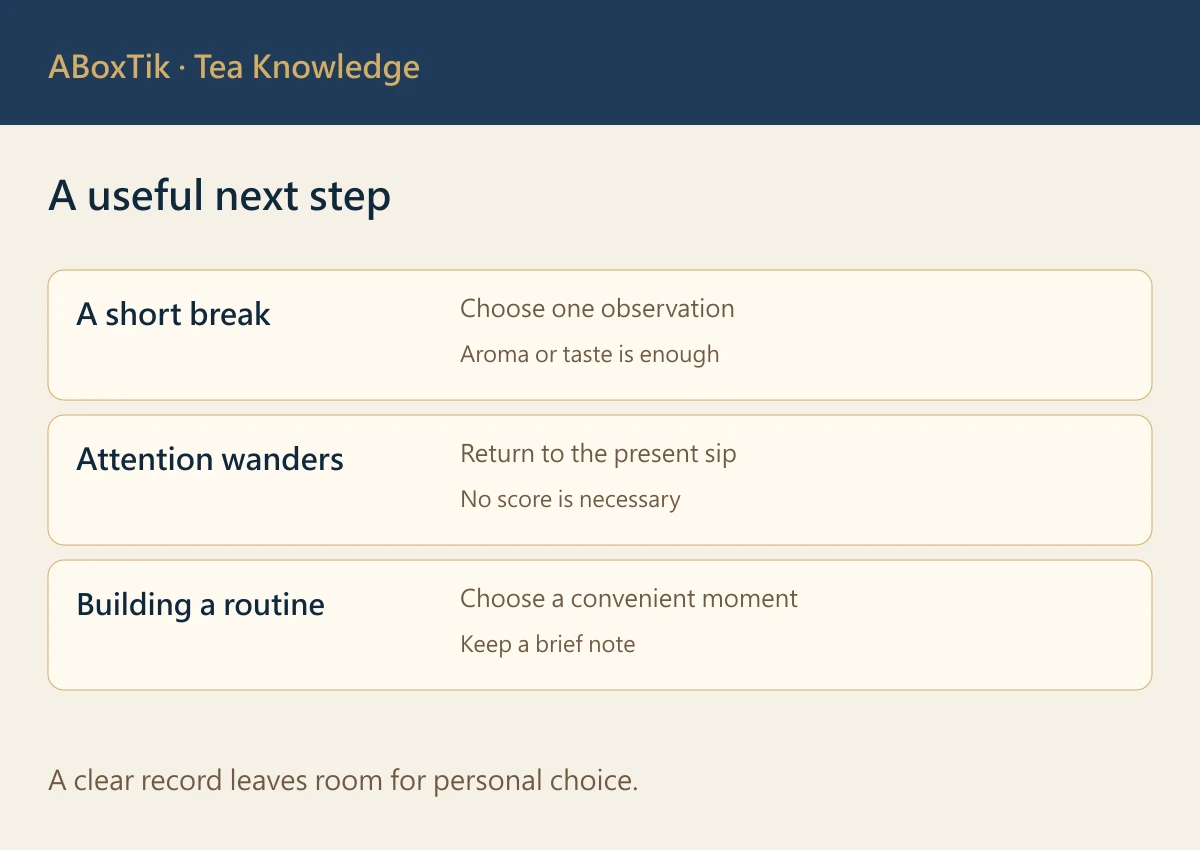
On a busy day, choose just one action: look at the tea before the first sip. There is no required number of minutes, and a longer session is not automatically a promotion. If recording helps, write one observation afterwards. If a notebook adds work, leave it closed. The tea can be noticed without a completed page to prove it.
When you have more room, set the cup down between a few sips and notice what changes. Record the experience without turning a preference at a cooler temperature into a rule for every tea. Preparation, surroundings and temperature vary. The note exists to help your future self recognise this particular occasion.
A useful short record has three spaces: the detail you noticed, something that interrupted attention and a choice for next time. A blank space is allowed. For example, you may remember the reflection clearly but have nothing to say about aroma. Selective notes are often easier to revisit than a page completed because every box looked lonely.
Invite a companion before inviting silence
Ask, “Would you like to take one quiet sip, then share something you noticed?” If the other person would rather talk, let conversation shape the occasion. Do not require closed eyes or interpret someone else’s feelings. Silence works best when it is an agreed option, rather than an expectation the other person has to discover by guessing.
Speak from your own experience: “I noticed a softer feeling in this sip,” or “I kept thinking about dinner.” Listen when the other person notices something different. The tea-table etiquette guide offers useful ways to ask about refills and accept “not now.” Those choices help a shared pause remain comfortable for each participant.
Keep one beginning for next time
At the end, ask which detail was easiest to notice, which preparation felt unnecessary and what small action you would retain. The answer can be modest: put the phone aside, use an easier cup or stop trying to fill a page. A workable beginning means the next cup does not need another planning meeting.
For a wider cultural perspective, explore Taiwan tea spaces and their histories. When choosing familiar leaves, check the current ABoxTik Taiwan tea collection and its preparation information. Everyday attention need not make the occasion grand. It simply gives this cup a chance to be encountered.

Related reading and tea choices
- Comfortable tea-table etiquette
- People and spaces in Taiwan tea culture
- Explore the Taiwan tea collection
Sources
Sources checked: 29 October 2026.